857 résultats
1502726483.Gpaperback. Good. Access codes and supplements are not guaranteed with used items. May be an ex-library book. paperback
22141513like new. unknown
1502726599.Gpaperback. Good. Access codes and supplements are not guaranteed with used items. May be an ex-library book. paperback
B9781502726599Paperback / softback. New. paperback
BOOKS313766Houston TX: NASA. VG/NO DUSTJACKET. 1972. Flexibound. Apollo 16 was the tenth crewed mission in the United States Apollo space program the fifth and second-to-last to land on the Moon and the second to land in the lunar highlands.2 The second of Apollo's "J missions" it was crewed by Commander John Young Lunar Module Pilot Charles Duke and Command Module Pilot Ken Mattingly. Launched from the Kennedy Space Center in Florida at 12:54 PM EST on April 16 1972 the mission lasted 11 days 1 hour and 51 minutes and concluded at 2:45 p.m. EST on April 27. . Sm 4to. Bound with clasps. Massive 5" thick printed on both sides. . NASA unknown
22141517like new. unknown
150272667X.Gpaperback. Good. Access codes and supplements are not guaranteed with used items. May be an ex-library book. paperback
B9781502726674Paperback / softback. New. paperback
22124705like new. unknown
1502728877.Gpaperback. Good. Access codes and supplements are not guaranteed with used items. May be an ex-library book. paperback
I7-SBAJ-B0EGPaperback. Good. Two volume set large and heavy paperbacks. Externally worn internally clean light yellowing some minor creases bindings firm. paperback
1396134484.Gpaperback. Good. Access codes and supplements are not guaranteed with used items. May be an ex-library book. paperback
1396133682.Gpaperback. Good. Access codes and supplements are not guaranteed with used items. May be an ex-library book. paperback
1396148922.Ghardcover. Good. Access codes and supplements are not guaranteed with used items. May be an ex-library book. hardcover
1396714154.Ghardcover. Good. Access codes and supplements are not guaranteed with used items. May be an ex-library book. hardcover
ET-JF2S-O63SHardcover. Very Good. Minimal shelf wear to book and jacket. hardcover
200888971Washington DC: National Aeronautics and Space Administration c2008. Presumed First Edition First printing this. Single sticker sheet printed on both sides peal line is about at the diameter line. Very good. The format is a circle with a 4 inch diameter. Sticker seam at the back is at the mid-point. Rare surviving copy. One side is a version of the ARES logo originally designed by Star Trek artist Michael Okuda with 10 stars and a rocket ascending but no image of Earth in the background. The other side has the following text: NASA's Ares I-X Flight Test Vehicle NASA's first flight test of the full rocket for the agency's next-generation spacecraft and launch vehicle systems is launching in 2009. The flight test called Ares I-X will bring NASA one step closer to its exploration goals--to return to the moon for more ambitious exploration of the lunar surface ad to travel to Mars and destinations beyond." Then two links to on-line resources. Ares I-X was the first-stage prototype and design concept demonstrator of Ares I a launch system for human spaceflight developed by the National Aeronautics and Space Administration NASA. Ares I-X was successfully launched on October 28 2009. The Ares I-X vehicle used in the test flight was similar in shape mass and size to the planned configuration of later Ares I vehicles but had largely dissimilar internal hardware consisting of only one powered stage. By flying the vehicle through first-stage separation the test flight also verified the performance and dynamics of the Ares I solid rocket booster in a "single stick" arrangement which is different from the solid rocket booster's then-current “double-booster†configuration alongside the external tank on the space shuttle. Ares I was the crew launch vehicle that was being developed by NASA as part of the Constellation program. The name "Ares" refers to the Greek deity Ares who is identified with the Roman god Mars. Ares I was originally known as the "Crew Launch Vehicle" CLV. NASA planned to use Ares I to launch Orion the spacecraft intended for NASA human spaceflight missions after the Space Shuttle was retired in 2011. Ares I was to complement the larger uncrewed Ares V which was the cargo launch vehicle for Constellation. NASA selected the Ares designs for their anticipated overall safety reliability and cost-effectiveness. However the Constellation program including Ares I was canceled by U.S. president Barack Obama in October 2010 with the passage of his 2010 NASA authorization bill. In September 2011 NASA detailed the Space Launch System as its new vehicle for human exploration beyond Earth's orbit. Unlike the Space Shuttle where both crew and cargo were launched simultaneously on the same rocket the plans for Project Constellation outlined having two separate launch vehicles the Ares I and the Ares V for crew and cargo respectively. Having two separate launch vehicles allows for more specialized designs for the crew and heavy cargo launch rockets. The Ares I rocket was specifically being designed to launch the Orion Multi-Purpose Crew Vehicle. Orion was intended as a crew capsule similar in design to the Apollo program capsule to transport astronauts to the International Space Station the Moon and eventually Mars. Ares I might have also delivered some limited resources to orbit including supplies for the International Space Station or subsequent delivery to the planned lunar base. NASA selected Alliant Techsystems the builder of the Space Shuttle Solid Rocket Boosters as the prime contractor for the Ares I first stage. NASA announced that Rocketdyne would be the main subcontractor for the J-2X rocket engine on July 16 2007. NASA selected Boeing to provide and install the avionics for the Ares I rocket on December 12 2007. On August 28 2007 NASA awarded the Ares I Upper Stage manufacturing contract to Boeing. The upper stage of Ares I was to have been built at Michoud Aerospace Factory which was used for the Space Shuttle's External Tank and the Saturn V's S-IC first stage. The Ares V formerly known as the Cargo Launch Vehicle or CaLV was the planned cargo launch component of the canceled NASA Constellation program which was to have replaced the Space Shuttle after its retirement in 2011. Ares V was also planned to carry supplies for a human presence on Mars. The Ares V was to launch the Earth Departure Stage and Altair lunar lander for NASA's return to the Moon which was planned for 2019. It would also have served as the principal launcher for missions beyond the Earth-Moon system including the program's ultimate goal a crewed mission to Mars. The uncrewed Ares V would complement the smaller and human-rated Ares I rocket for the launching of the 4–6 person Orion spacecraft. Both rockets deemed safer than the then-current Space Shuttle would have employed technologies developed for the Apollo program the Shuttle program and the Delta IV EELV program. National Aeronautics and Space Administration unknown
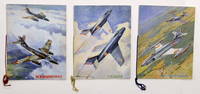
92498Lotto 3 fascicoli - Insignes de l'Aviations - Bombardement / Chasse / Reconnaissance - Pag. 11; 9; 8. Con numerose illustrazioni. - Copertina semirigida - Testo in francese. - Condizioni molto buone. unknown
1979759996PN. New. 1979. Soft Cover. Date is original print. This is a reprint edition. . PN paperback
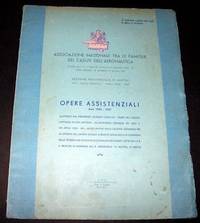
7029Aeronautica - OPERE ASSISTENZIALI - anni 1932-1937 - Associazione Nazionale tra le Famiglie dei Caduti dell'Aeronautica - NAPOLI - ed. 1938 - pp. 48 con fotoCondizioni buone come da foto d'inserzione !!! - - - FAI IMMEDIATAMENTE un'offerta per l'oggetto . NON ASPETTARE la scadenza. NON TE NE PENTIRAI!!!. - ….COMPRA SUBITO!!!. COMPRA PER PRIMO!!!!! unknown
186531117London: Chapman & Hall 1865. First Edition. THE DEDICATION COPY. A Copy with Fine Provenance being the copy given by the author to his mother the true dedicatee of the book as noted in the printed Dedication itself which reads "To The Lady Caroline Turnor and Christopher Turnor in Grateful Rembrance of Their Parental Care.This Volume is Dedicated by Their Son. The volume is further inscribed by hand as follows: <br><br>"My dear Mother<br> from her son Hatton<br>Knowledge is not Wisdom.<br>Knowledge puffeth up but Charity edifieth<br><br>This work was begun October 1863 &<br>finishes October 1864 from October till June<br>it was going thro' the prep<br> 21 June 1865" Profusely illustrated throughout including a chromolithographic frontispiece a photographic print tipped to the dedication page and 40 other full-page photozincographic plates on heavy paper and textual illustrations throughout in great number. Folio 326 x 252 mm. publisher's original royal-blue cloth the spine lettered in gilt the upper and lower covers decorated in gilt and blind original coated endleaves top edge gilt. xxiii 530 pp. A very handsome copy and very well preserved a little evidence of shelving and a little evidence of age but a very pleasing copy especially desirable in its present condition. THE DEDICATION COPY OF THE FIRST EDITION A COPY WITH WONDERFUL PROVENANCE. THE COPY GIVEN BY THE AUTHOR TO HIS MOTHER THE DEDICATEE OF THE BOOK WITH HIS PERSONAL THOUGHTS ABOUT WISDOM KNOWLEDGE PUFFERY AND CHARITY NOTED IN THE PRESENTATION INSCRIPTION AS WELL AS A DESCRIPTION OF THE PROCESS OF THE CREATION AND PRODUCTION OF THE BOOK.<br> Hatton Turnor's work covers and offers a vast survey of aeronautics and the literature available up until the time of the publication of his own work. The author gives a fine preface to the work in which he notes that his is the first great English publication devoted to the panorama of aeronautics. Chapters included are devoted to a study of the development of aeronautics from ancient times to the present to the ascents made from 1800 until 1864 to the subject of balloons used during war time to aerostats to the physical experience of ballooning in calm and storm to a caricature of the science itself and to a survey and consideration of the future of aeronautics.<br> The work is superbly illustrated throughout including the chromolithograph and original photograph at the front and the 40 additional full-page plates produced on heavy stock. Chapman & Hall hardcover
197490734Johnson Space Center Texas: U. S. Government Printing Office 1974. Presumed to have been uniquely signed in person. Photograph. Very good. The format is approximately 8 inches by 10 inches. There is a quarter inch white border around the color image. At the bottom edge in the white space there is the following text: JSCL-119 ASTRONAUT DONALD K. SLAYTON U. S. Government Printing Office 1974-779 888/2. The color image is of the full face of Deke Slayton in has astronaut space suit showing him from the waist up. Near his ungloved hands is a spacecraft mode. Across his chest he has inscribed the photograph as follows "Best wishes to Randy Sarbocher -- Deke Slayton." The back of the photograph is blank. Donald Kent "Deke" Slayton March 1 1924 – June 13 1993 was an American Air Force pilot aeronautical engineer test pilot and one of the original NASA Mercury Seven astronauts. He went on to become NASA's first Chief of the Astronaut Office and Director of Flight Crew Operations responsible for NASA crew assignments. Slayton joined the U.S. Army Air Forces during World War II and flew in Europe and the Pacific. He left the Army after World War II went on to receive a Bachelor of Science degree in aeronautical engineering from University of Minnesota in 1949 and later joined the Minnesota Air National Guard after working for Boeing as an aeronautical engineer. He joined the United States Air Force and attended the U.S. Air Force Test Pilot School in 1955. In 1959 he applied to and was selected as one of the Mercury Seven NASA's first class of astronauts. Slayton was scheduled to pilot the second U.S. crewed orbital spaceflight but was grounded in 1962 by atrial fibrillation. In March 1972 he was medically cleared to fly and was the docking module pilot of the 1975 Apollo–Soyuz Test Project ASTP. Slayton continued to work at NASA until 1982. He also helped develop the Space Shuttle. In January 1959 Slayton was selected as one of the candidates for NASA's Project Mercury the first U.S. crewed space flight program. Slayton was psychologically and physically tested at the Lovelace Clinic in Albuquerque New Mexico along with fellow future astronauts Scott Carpenter and Jim Lovell. On April 2 1959 Slayton was notified of his selection as an astronaut. After a decade of seeing doctors around the world in 1971 Slayton was examined at the Mayo Clinic after a long period without heart fibrillation and was determined to not have a coronary condition. On March 13 1972 NASA announced that Slayton had returned to flight status. The Apollo and Soyuz spacecraft both launched on July 15 1975. He was 51 years old making him the oldest astronaut to fly in space at the time. U. S. Government Printing Office unknown
197190735Johnson Space Center Texas Presumed: U. S. Government Printing Office 1971. Presumed to have been uniquely signed in person. Photograph. Very good. The format is approximately 8 inches by 10 inches. There is a quarter inch white border around the color image. At the bottom edge in the white space there is the following text: ASTRONAUT VANCE D. BRAND. The color image is of the full face of Astronaut Brand in has astronaut space suit showing him from the waist up. Near his ungloved hands is a globe of the earth. Internet research dated this picture as from 1971. Across his chest he has inscribed the photograph as follows "To Randy with Best wishes! Vance Brand." The back of the photograph is blank. Vance DeVoe Brand born May 9 1931 is a retired American naval officer aviator aeronautical engineer test pilot and NASA astronaut. He served as command module pilot during the first U.S.-Soviet joint spaceflight in 1975 and as commander of three Space Shuttle missions. Brand's flight experience includes 9669 flying hours which includes 8089 hours in jets 391 hours in helicopters 746 hours in spacecraft and checkout in more than 30 types of military aircraft. One of the 19 pilot astronauts selected by NASA in April 1966 Brand initially was a crew member in the thermal vacuum chamber testing of the prototype command module alongside astronauts Joe Engle and Dr. Joseph Kerwin and support crewman on Apollos 8 and 13. During the Apollo 13 crisis Brand was CAPCOM during the PC2 burn. Later he was backup Command Module Pilot for Apollo 15 and was likely to be named to the prime crew of Apollo 18 before that mission was canceled. Brand was backup commander for Skylabs 3 and 4. When Skylab 3's CSM had problems with its Reaction Control System Brand was put on standby to command a rescue mission with backup Pilot Don Lind; however the crew stood down when it was decided that the problem did not require the rescue mission to be launched. As an astronaut he held management positions relating to spacecraft development acquisition flight safety and mission operations. Brand flew on four space missions; Apollo–Soyuz STS-5 STS-41-B and STS-35. He commanded three missions. Brand was the last member of his astronaut class to remain active with NASA and was the only Apollo-era astronaut to pilot the Space Shuttle in the post-Challenger era. Brand departed the Astronaut Office in 1992 to become Chief of Plans at the National Aerospace Plane NASP Joint Program Office at Wright-Patterson Air Force Base. In September 1994 he moved to California to become Assistant Chief of Flight Operations at the Dryden Flight Research Center then Acting Chief Engineer Deputy Director for Aerospace Projects and Acting Associate Center Director for Programs. He retired from NASA in January 2008. U. S. Government Printing Office unknown
196238405Washington DC: GPO 1962. good. 10.25" x 7.5" 10 wraps profusely illus. some soiling to rear cover top corner rear cover bent. Illustrations of Glenn's flight aboard Friendship 7 and a condensation of his remarks at the press conference three days after the flight. GPO paperback
196263828United States National Aeronautics and Space Administration 1962. Wraps. Good. No dust jacket. Cover has some wear and soiling. Includes illustrations. Unpaginated 40 pages plus covers United States, National Aeronautics and Space Administration paperback