4 résultats
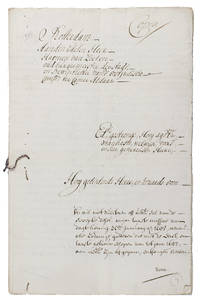
1699ABC_47411Jaffanapatnam Ceylon 1699. Folded and kept together by an orange white and blue piece of string in the left margin 1.5 cm from the edge of the leaves in the middle. Folio 33 x 21 cm. The Dutch letter is written in a neat late 17th-century cursive hand in brown ink. Contemporary copy Copia perhaps by Schenkenberg himself or by his secretary including the address on the first leaf: Rotterdam./ Aenden Edelen Heer./ Harmen van Zoelen/ oud burgermeester der stadt/ en Bewinthebber vande Oostindische/ Comp. ter Camer Aldaar.Very interesting letter by the Director commandeur of the fort and Dutch East India Company VOC station Jaffanapatnam on the northern-most coast of Ceylon now: Sri Lanka facing the Coromandel coast of India. The fort was captured from the Portuguese by Rycklof van Goens in the 1630s and was an important stronghold for the VOC presence on Ceylon during the late 17th and 18th centuries. The letter offers clear insight in the VOC policy regarding appointments nominations and commissions as well as for the required qualifications and salaries for the various functions. The letter also shows how important family ties recommendations and even favouritism and nepotism were in these matters.Matthaeus Schenkenberg was born in Batavia in 1667 as son of Hendrik Schenkenberg and Henrietta Chasteleyn. He writes that after having been chief-merchant opperkoopman for eight years he had been appointed by the high command at Batavia the hooge regeering director commandeur of the fort Jaffanapatnam Jaffna in June 1698 as the successor of Hendrik Swaardecroon with a monthly salary of 120 guilders for five years. Hardly a year after this appointment he is already dissatisfied - one of his predecessors Floris Blom who was director from 1669-1693 earned 150 guilders - and he is seeking for a following step in his career. Thats why he is writing this letter to his uncle Harmen van Zoelen or Soelen; ca. 1635-1702 hoping to be helped into a better job: a good move because Van Zoelen was one of the directors of the VOC chamber in Rotterdam and burgomaster of that city.Which is why he asks his uncle to put in a good word for him in order to obtain an appointment as for instance Governor of places like Macassar Celebes Ambon or Banda island between Sumatra and Malacca. Indeed Mattheus Schenkenberg was appointed Governor of Banda where he ultimately died on 14 June 1709 his tomb is still in existence.With faint folding lines and some pencil annotations on the first and last pages small wormholes in the left inner margins of the leaves very slightly affecting the text but not its legibility the edges are very slightly frayed and the last page is slightly browned. Overall in very good condition.l Bons Kinderen van de Verenigde Oost-Indische Compagnie Master scriptie Univ. Leiden 2015 esp. pp. 82-83; Van den Belt Het VOC bedrijf op Ceylon in de 18e eeuw Zutphen 2008; Valentijn V 1726 p. 564. unknown
1672910579CGAmsterdam:, Janssonius und Waesberge, 1672. Kupferstich 27,5 x 36 cm, Blattgröße 31 x 38 cm.
1697F7UEAGCAXE78Copy imprint: The Hague: widow and heirs of Hillebrandt Jacobsz. van Wouw 1697. Modern plain-paper wrapper attached with 3 copper staples. 4to. With the woodcut arms of the States General lion with sword and 7 arrows in an elaborately decorated cartouche with military attributes on title-page and 1 woodcut decorated initial. A late edition copying the original 1645 imprint of a provisional agreement made between the Dutch States General and the Portuguese ambassador Francisco de Zousa Continho on the jurisdiction and territory of Fort Galle one of the most important outposts in Ceylon Sri Lanka one of the most important outposts both strategically and as a trading centre. The Dutch had captured it from the Portuguese in 1640 and they had been fighting in the region since that time. As the Eighty Years' War was nearing its conclusion the present treaty was written in an attempt to settle the dispute. The dispute in fact continued beyond the peace of 1648 until the Dutch managed to drive the rest of the Portuguese out of Ceylon by 1658. The treaty notes the losses and battles caused by the dispute between the two powers and the demands made by the Dutch government to secure their position in the East Indies. This includes their demand for a yearly supply of cinnamon through which the Portuguese are to pay off their debt and restitution by both parties for the losses they caused one another. The parties agree to honor the treaty and not trespass on each other's rights and territories. Copies were to be sent to the Viceroy in Goa and to various governors in the East Indies.With library stamps. In very good condition.l STCN 2 copies; cf. Knuttel 5202 & 5202b other eds.; Landwehr 242 other ed. widow and heirs of Hillebrandt Jacobsz. van Wouw, unknown
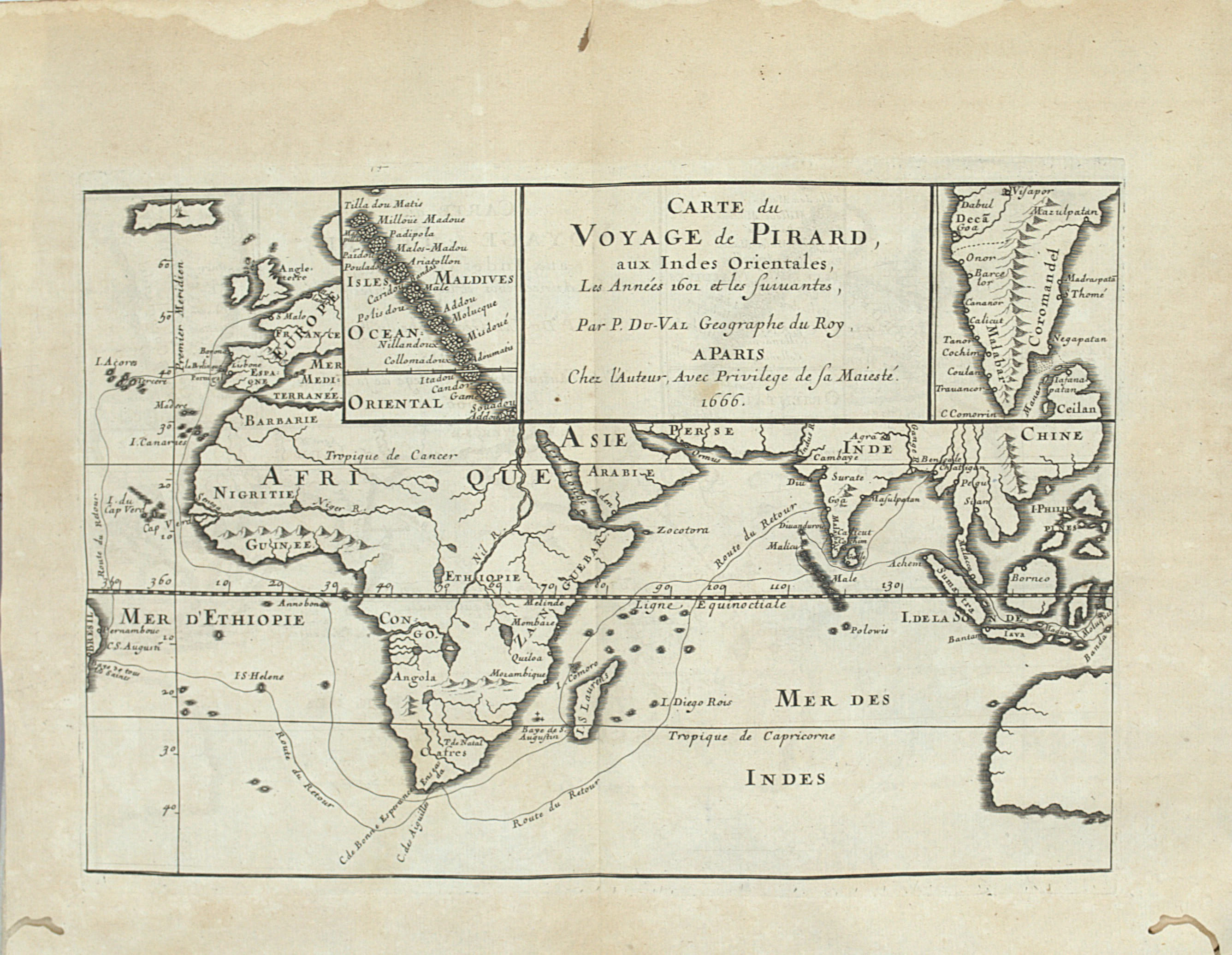
1679PHO-2525A Paris, Chez Louis Billaine, 1679. In-4° ; 5ff.-1 carte h.-t.-repl.-327 pp.-218 pp.-144 pp.-12ff., veau époque, dos à nerfs orné avec titre. Manque au dos et charnières, coins usé, travail de ver sur les 17 premiers et 30 derniers feuillets, petite mouillure angulaire, titre bruni, feuillet « Au lecteur » déchiré sans manque, brunissures. L’une des meilleures descriptions des Maldives et une importante description de Goa.