3 141 résultats
2026x-1032982551Taylor & Francis Ltd 2026. Paperback. New. 308 pages. 6.14x0.66x9.21 inches. Taylor & Francis Ltd paperback
ria9781848721609_inpPaperback. New. New Book; Fast Shipping from UK; Not signed; Not First Edition; This book offers a critical post-colonial reading of the newly emerging arena of global mental health; with particular focus on psychology's and psychiatry's encounters with distress or 'mental illness' in low-income countries. paperback
ria9781848721593_inpHardcover. New. New Book; Fast Shipping from UK; Not signed; Not First Edition; This book offers a critical post-colonial reading of the newly emerging arena of global mental health; with particular focus on psychology’s and psychiatry’s encounters with distress or ‘mental illness’ in low-income countries. hardcover
A9781848721609Paperback / softback. New. paperback
697000008Taylor & Francis Group pp. 192 . Papeback. New. Taylor & Francis Group unknown
697193168Taylor & Francis Group pp. 192 . Hardback. New. Taylor & Francis Group hardcover
19780763-nnew. unknown
19780763like new. unknown
2013x-1848721609Routledge 2013. Paperback. New. 1st edition. 192 pages. 8.43x5.43x0.51 inches. Routledge paperback
2013x-1848721595Routledge 2013. Hardcover. New. 1st edition. 192 pages. 9.00x6.00x0.75 inches. Routledge hardcover
2013DADAX1848721595Routledge 2013-11-14. 1. hardcover. New. 5.50x0.63x8.50. Buy with confidence. Excellent Customer Service & Return policy. Routledge hardcover
2013DADAX1848721609Routledge 2013-11-11. 1. paperback. New. 5.43x0.44x8.50. Buy with confidence. Excellent Customer Service & Return policy. Routledge paperback
2013SONG1848721595Routledge 2013-11-14. 1. hardcover. Used: Good. 5.50x0.63x8.50. Buy with confidence. Excellent Customer Service & Return policy. Routledge hardcover
1848721609.Gpaperback. Good. Access codes and supplements are not guaranteed with used items. May be an ex-library book. paperback
2026x-9819824176World Scientific Publishing Co Pte Ltd 2026. Hardcover. New. 396 pages. 6.00x0.64x9.00 inches. World Scientific Publishing Co Pte Ltd hardcover
ria9780443439506_inpPaperback / softback. New. New Book; Fast Shipping from UK; Not signed; Not First Edition; N/A paperback
2013DADAX1844641872Brand: Paths International Ltd 2013-02-01. paperback. New. 5.50x0.50x8.50. Buy with confidence. Excellent Customer Service & Return policy. Brand: Paths International Ltd paperback
2013SONG1844641872Brand: Paths International Ltd 2013-02-01. paperback. Used: Good. 5.50x0.50x8.50. Buy with confidence. Excellent Customer Service & Return policy. Brand: Paths International Ltd paperback
46130909like new. unknown
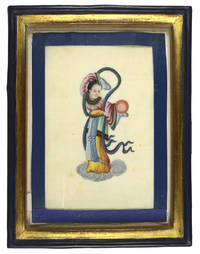
86239Canton c.1860. . A set of 6 watercolour and gouache studies on pith paper each surrounded by blue fabric borders.<br /> Pith seems not to have been adopted for painting until about 1820. Some European museums claim that their paintings on pith often erroneously called "rice paper" or "mulberry pith" come from the end of the eighteenth century but there do not seem to be any dateable examples that are so early. There is a record of the Kaiser Franz of Austria buying some albums from an English Consul-General Watts in 1826. We know of an Italian Count who visited Canton in 1828 and had over 350 paintings on pith in his baggage when he died in Ambon two years later. In the British Library there is a scrap-book containing six pith paintings and a journal entry by a serving British officer who sent them home from India in 1829. These examples and contemporary accounts by visitors to Canton suggest that there was a flourishing trade in pith paintings by the early 1830s.<br /><br />Pith presumably came into use for painting to satisfy the increasing demand for small inexpensive and easily transported souvenirs following the massive growth in the China Trade in the first quarter of the nineteenth century. Paintings in oils on board and canvas were costly and difficult to carry home. Earlier and more prestigious export water-colours had often been on a larger scale and painted on fine Chinese paper or on paper imported from Europe. The albums of pith paintings and later the little glass-fronted boxes were inexpensive light easy to pack and gave the pictures some protection on the long voyage home. Because many were sold in albums and hence protected from the light they retain their bright colours to this day.<br /><br />Pith comes from the central column of spongy cellular tissue in the stem of a small tree called Tetrapanax Papyrifera native to south-west China. It has had a variety of uses some going back many centuries. At the imperial court both men and women wore coloured flowers made from pith in their hair. For use in painting it is cut by hand with a knife into thin sheets from short lengths of the spongy tissue. Cutting is highly skilled and the constraints of the process mean that the finished sheets for painting seldom if ever measure more than about 30cms by 20cms. The sheets are dried trimmed and used for painting without any further processing.<br /><br />Because of the nature of pith and its cellular structure the gouache used by the Chinese sat on the surface and produced a bright and even sparkling effect. Very fine detail could be achieved but pith did not lend itself to the flat wash of colour favoured for European watercolours. <br /><br />Carl Crossman in his book The Decorative Arts of the China Trade originally published under the title The China Trade gives an excellent list of export painters with a note of those known to have painted on pith. These include Tingqua Sunqua and Youqua. From 1757 until 1842 Canton was the only Chinese port open to trade with the west and it is no surprise that of the eight studios identified by Crossman as producing works on pith six were in Canton. <br /><br />It seems that the 1830s and 1840s may have been the heyday of pith painting. The international trading bases the waterfront 'factories' on the 'Hongs' in Canton where they were produced were partially burnt during the First Opium War 1839-41 and totally destroyed in a fire of 1856. The foreign trading companies then moved to Honan and subsequently put up splendid new offices on reclaimed land at Shamian Island a little up river. As the result of the Treaty of Nanking in 1842 additional Chinese ports were opened up for foreign trade and Hong Kong was established as a major trading centre. <br /><br />By 1860 references to China in the Illustrated London News plentiful three years earlier were few and far between. That is not to say that painting on pith ceased. Nicholas the second was given paintings on pith when he visited Canton in 1891 and the last Emperor is said to have sent him a gift which included pith paintings in 1907 though these could have been examples of much earlier work. <br /><br />Painters on pith did not in general sign their work the sole exception is Sunqua whose name can be found on the face of three paintings on pith. <br /><br />There are collections of paintings on pith in the Ashmolean the British Museum the Fitzwilliam the Hermitage the Peabody/Essex Museum in Massachusetts and the Hong Kong Museum of Art. However because paintings on pith are not in general regarded as fine art they are usually to be found in ethnographic or specialised collections.<br /> Canton, c.1860]. unknown
200123001Deerfield MA: Historic Deerfield 2001. 1st. Hardcover. New/New. 11.3x8.3x0.7in. This catalogue of delftware at Historic Deerfield describes and illustrates in color 97 pieces from the collection. In addition 32 figures accompany the text. <br>165pp 1.99lb 11.3x8.3x0.7in Historic Deerfield hardcover
ria9781138481572_inpPaperback. New. New Book; Fast Shipping from UK; Not signed; Not First Edition; This book assesses current developments in China's demography and discusses the changes which should be implemented to bring policy into line with the current demographic situation. It argues that population planning which was introdu paperback
30498617-nnew. unknown