26 résultats
1857VF066511857-1989
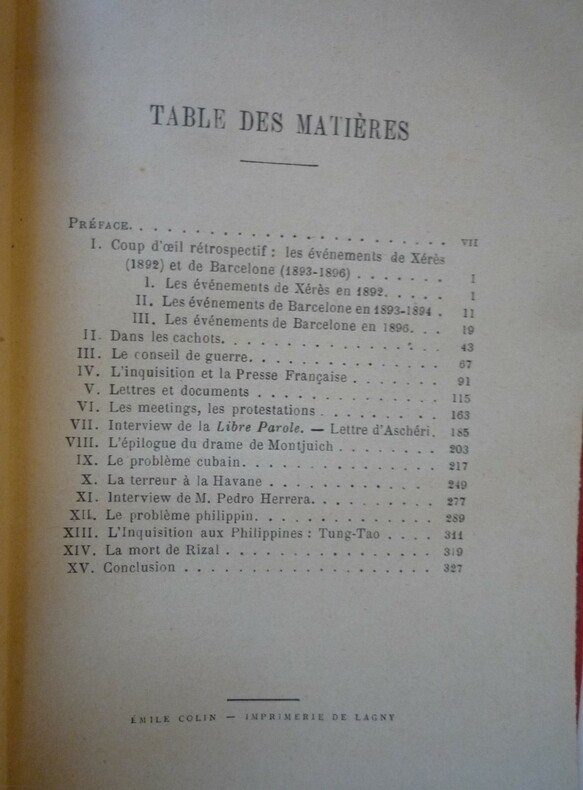
1897219Montjuich - Cuba - Philippines. Bibliothèque sociologique n° 17 Paris - STOCK- ancienne librairie Tresse et Stock - 1897- Format : 12 x 19 cm, broché, 346 pages couverture un peu salie sinon BON ETAT
18865767Paris, Londres Librairie Hachette et Cie 1886 in-4° 436 pp, Nouveau journal des voyages publié sous la direction de Edouard Charton le premier semestre 1886 ; très nombreuses gravures N&B in-texte, 11 cartes et plans. rousseurs et nombreuses traces d'humidité, dos à 4 nerfs orné de caissons et filets dorés. Epidermures avec légers manques sur dos insolé. coiffe inférieure, coupes et coins frottés. mors du 2d plat fendu sur l'intérieur
188420664Paris Hachette 1884 In4° 435 pp , toutes tranches dorées rousseurs éparses 25 ème année deux semestres
1878114493Paris Maisonneuve 1878 1 vol. relié in-8, demi-chagrin marron, dos à nerfs, XX + 737 pp., 2579 numéros décrits. Bel exemplaire en reliure d'époque portant le cachet de la Maison de la bibliophilie qui fut un temps adossé au Marché de livre ancien Georges Brassens.
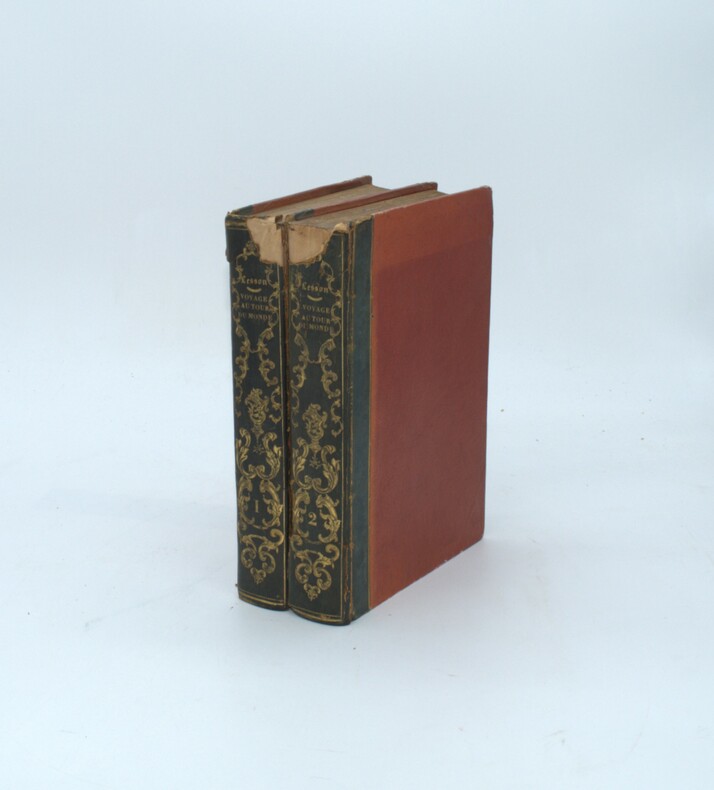
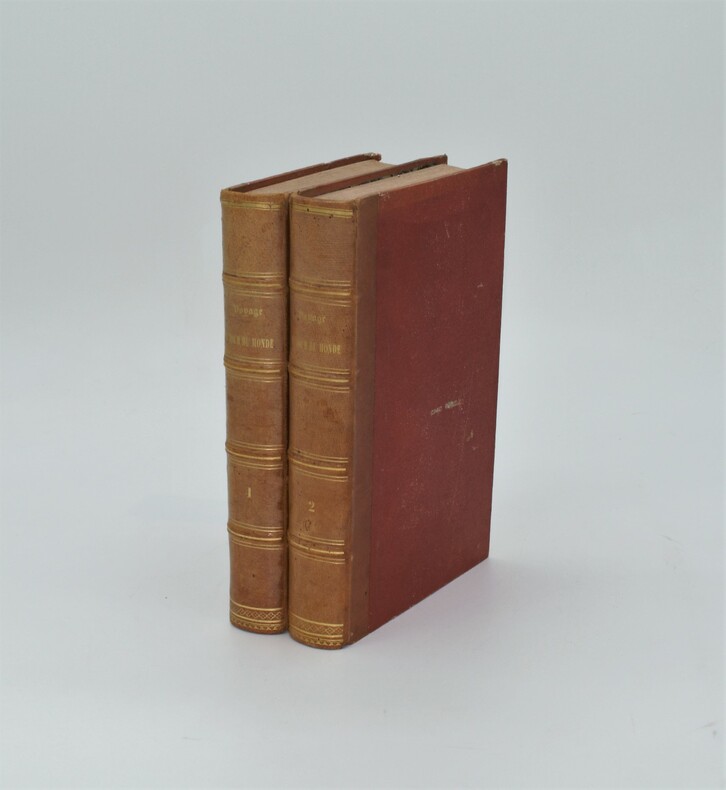
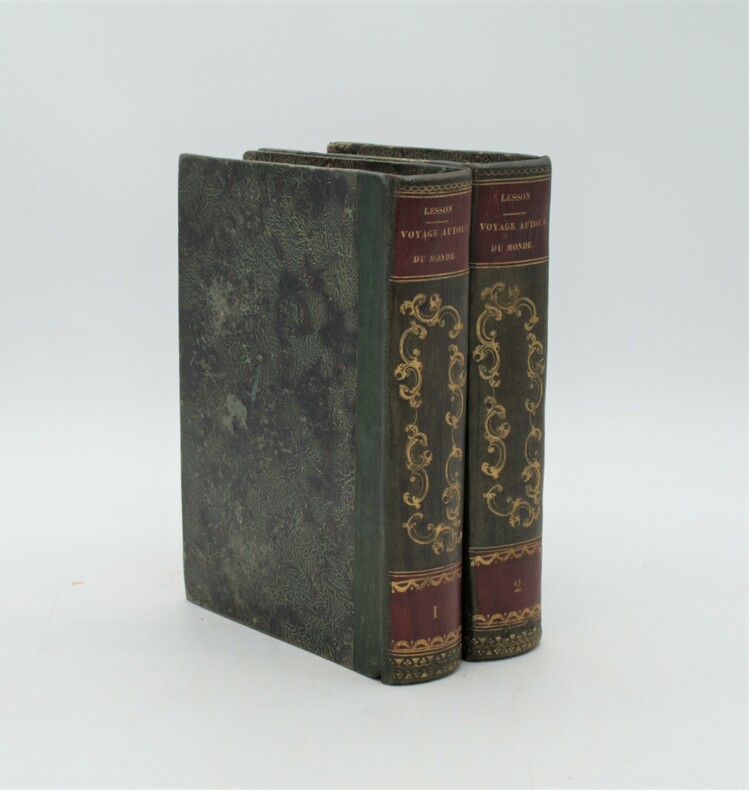
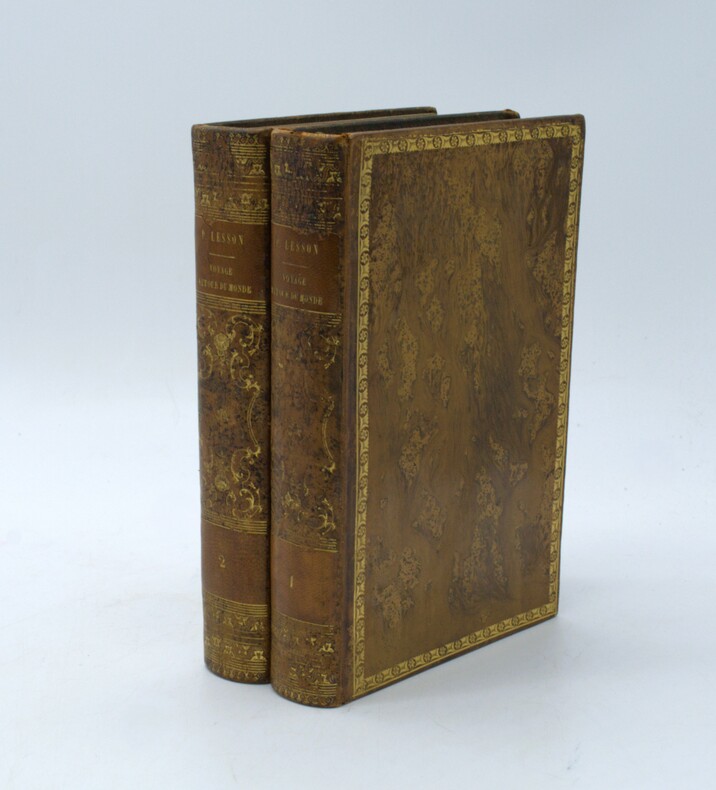
1839PHO-900Paris (Pourrat Frères), 1839 2 vols In-8°, 220 x 160mm, relié demi cuir époque (reliure différente), portrait,manque les planches , 51pp-546pp , défauts de reliure ,rousseurs, quelques feuillets détachés (tome 2).P2-8D
1847GITk103In-4 2ff non chiffrés (faux-titre, titre) 112pp 1 feuillet non chiffré table des matières. Demi basane vert foncé, dos lisse orné de filets et chaînettes dorés, reliure de l'époque. Nombreuses vignettes dans le texte et 19 belles planches de costumes en couleurs. Rousseurs, reliure en bon état. Relié à la suite, paginé 1 à 56 et 1 feuillet non chiffré de table (planches pour l'Afrique) on trouvera les textes de la même collection intitulés Syrie, Asie Mineure, Arménie, Kurdistan, Ottoman, Al-Djeziren, Irak-Arabi avec seulement des vignettes dans le texte.
189957494New York: The Macmillan Company London: Macmillan & co. Ltd 1899. Early edition first printed the year before. Illustrated with plates and folding map. 529 pp. 1 vols. 8vo. Original tan cloth some minor darkening to spine else fine with the armorial bookplate of Van Nest on endpaper. Early edition first printed the year before. Illustrated with plates and folding map. 529 pp. 1 vols. 8vo. The Macmillan Company, London: Macmillan & co., Ltd unknown books
18841708030617xbvkManilae, apud typographiam vulgo 'Amigos del Pais', 1881-1884. (12) 526 (1) / 424 / 317 / 512 / 531 pages. - Heavy treecalf-marbled full leather bindings of the period with gently gilt-decorated spines and two red gilt-decorated and -titled spinelabels (each), 'dizzily' purple-ornamented endpapers; Folio (ca. 30 x 21 x 17 cm; ca. 7,9 kg.).
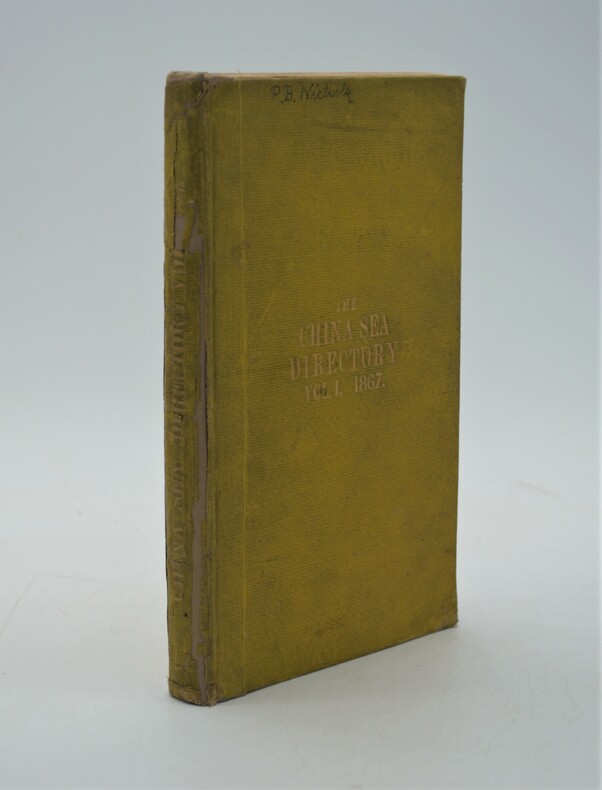
1867P2-7DLondon, Hydrographic office, Admiralty, 1867, in-8 (24x15) , IX-312pp ,relié percale avec titre doré sur le plat , dos lisse avec titre , manque de toile au dos , ex-libris sur le 1er plat et sur la page de garde «Capt P.B. Nichole ,ship RR Thomas , New-york ,1882», timbre , rousseurs sur le titre.
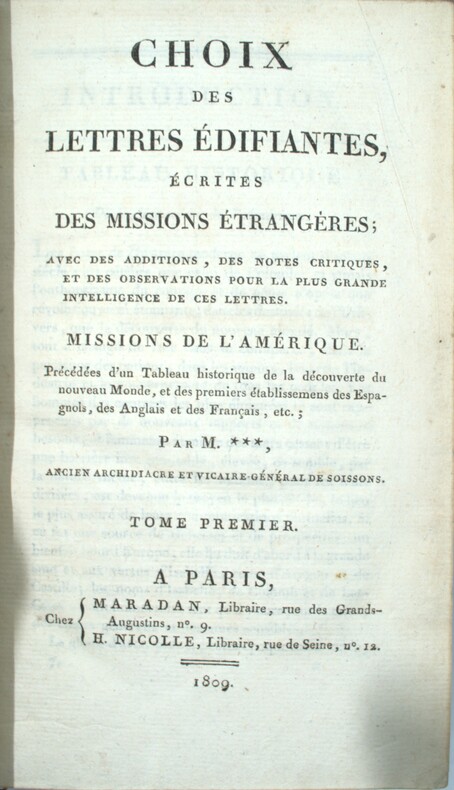
1808P2-2DParis, Maradan, 1808. 8 volumes in-8° (210x130mm) reliés plein basane époque, dos lisses richement décorés, pièces de titre maroquin rouge et de tomaison verte, lisière or sur les plats, frontispice, chaque volume comprend entre 400 et 500pp., coins émoussés, coiffes usés, mouillure sur 30 pages en fin de 2 volumes, bel ensemble.
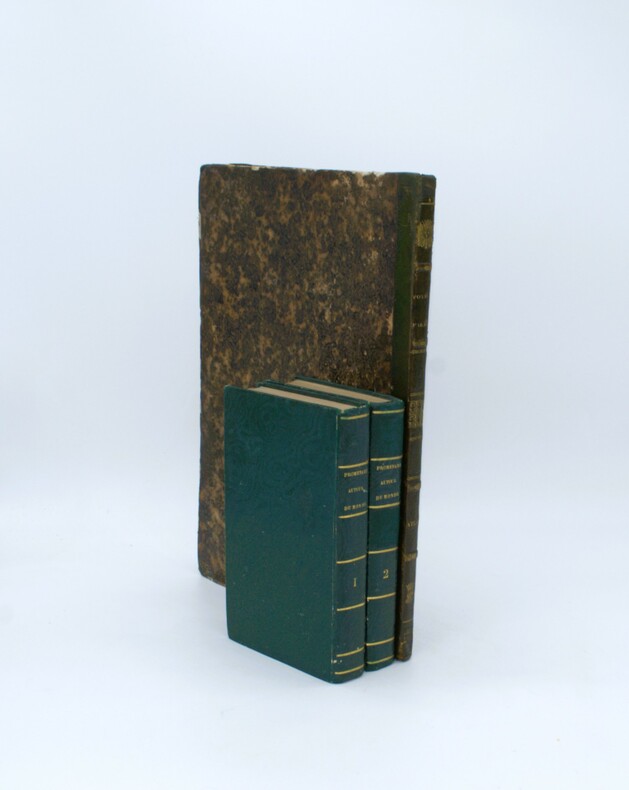
1839PHO-1346Paris, Pourrat frères, 1839. 2 volumes in-8 (220x150), demi veau vert contemporain, dos lisse orné avec titre et auteur ,tranches marbrées ,manque aux dos , charnières frottées ,rousseurs ,mouillure au début tome 2.
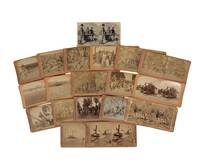
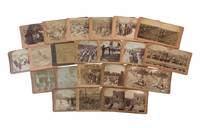
1898231701898. Stereoview archive documenting the rapid overseas deployment of American troops at the moment the Spanish American War gave way to a longer and more revealing imperial presence in the Philippines. This archive marks the transition from the 1898 defeat of Spain to the far more sustained American military occupation that followed. After the U.S. victory over Spain the Treaty of Paris transferred the Philippines to the United States for $20 million. This resulted in a battle between American forces and Filipino nationalists under Emilio Aguinaldo in February 1899 when Filipino hopes for independence collided with the reality of a new colonial ruler. This collection of photos preserves the process of colonialism through troop deployment provisioning medical treatment and the routines of military presence.<br /> Archive of 19 stereoview cards most published by B. W. Kilburn and James M. Davis centered on American military activity in the Philippines with additional views from Puerto Rico Cuba and the United States. Each measure 3.5" x 7". The core of the images remain in Philippine occupation; "The 17th Infantry crossing the river P.I." shows movement through tropical terrain; "Our Volunteers awaiting orders under the tropical sun in the Philippines" captures the idleness and bodily strain of expeditionary service; "2nd Division Hospital established in Angeles Church P.I." reveals improvised medical infrastructure inside a colonial religious building; "Dealing out pork and beans to the Oregon Volunteers P.I." appears in multiple variants and preserves the logistics of feeding American troops in camp; and "The Insurgent House of Congress on Fire Malolos P.I." places the war directly in relation to the destruction of Filipino political institutions. The remaining cards broaden that story outward: "Troop D 5th U.S. Cavalry lining up for dinner Mayaguez P.R." points to U.S. military operations in Puerto Rico; "Modern Krupp Gun Morro Castle Havana Cuba" preserves the Spanish imperial military landscape at Havana just as U.S. power displaced it; and the exhibition drill cards including "The Little Commodore" Boston '98 and "Grand Stand Exhibition Drill Boston '98" connect the overseas war to patriotic spectacle and military display at home. Stereographs were a common late nineteenth century format for circulating military imagery and was used to render mobilization and drill into mass-viewed visual media. <br /> Minor toning edge wear and rubbing; images and printed captions remain legible; overall very good condition. This collection preserves the American campaign in the Philippines not as abstract policy but as a contemporary visual record of how troops were deployed housed fed and sustained while the United States transformed victory over Spain into colonial rule in the Pacific. unknown
18489299Paris, A. Frank, 1848. In-4 de [10]-326-[4] pages, demi-veau brun, dos lisse orné de filets et fleurons dorés et à froid, étiquette de titre verte. Mors fendus et frottés, dos légèrement frotté, quelques rousseurs.
1839PHO-2300Paris, Pourrat frères, 1839. 2 volumes in-8 (24x16cm), 2ff.-510pp.-1f. , 2ff.-547pp.-2ff. , illustré d’un frontispice et de 41 planches dont 19 en couleurs d’époque représentant des animaux, des poissons et des oiseaux, demi basane époque, dos lisse orné avec titre et tomaison, étiquette de bibliothèque, 2 feuillets détachés, quelques rousseurs, dos insolé, petits frottements.
189813092New York: Muller Luchsinger & Co 1898. Color chromolithograph 16 x 20 inches printed on thick glossy paper. Corners a bit chipped several short closed edge tears minor surface wear. Image area still vibrant and clean. Very good overall. A striking and very rare lithograph capturing an important moment during the Spanish-American War specifically the American Navy's assault on Manila Bay in the Philippines in 1898. In the present scene three U.S. warships from the Asiatic Squadron in the left and middle including Admiral Dewey's flagship the U.S.S. Olympia fire their guns toward a few retreating ships flying the Spanish flag. A Spanish ship at middle right is almost completely sunken with just a portion of the flag peaking above the water. The scene depicts the first major engagement of the Spanish-American War a decisive victory for the American Navy that stands as one of the most lop-sided naval battles in history. During the course of the encounter the Spanish Pacific Squadron was destroyed and effectively ended Spanish colonial rule in the Philippines. The bombardment was commanded by Rear Admiral George Dewey 1837-1917 whose head-and-shoulders portrait appears in the bottom left corner.<br /> <br /> The work was accomplished by the New York firm of Muller Luchsinger & Company a prolific but still somewhat obscure producer of prints lithographs and chromolithographs in the latter-19th and early-20th centuries. OCLC records just two institutional copies at the Library of Congress and the Clements Library. A dynamic and patriotic American naval scene picturing the United States Navy's obliteration of the Spanish Navy in Manila. Muller, Luchsinger & Co unknown
1804PHO-2366Paris, Chez Buisson, 1804, in-4 (32x23,5cm), 2ff. et 41 planches dont 3 cartes (complet), reliure d’attente, étiquette au plat dans une pochette en toile bleu, réparations aux cartes.
1839PHO-1319Paris, Pourrat frères, 1839. 2 volumes in-8 (220x150), demi-basane maroquinée à grain long fauve , 2ff.-510pp.-1f. , 2ff.-547pp.-2ff. , illustré d’un frontispice et de 36 planches dont 19 en couleurs d’époque représentant des animaux, des poissons et des oiseaux, frottements aux plats , coins usés, très peu de rousseurs .
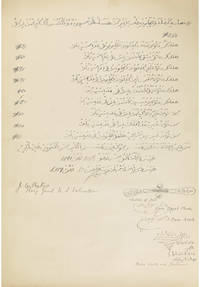
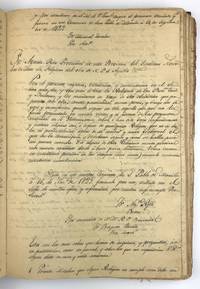
189924064<p><b>PHILIPPINES.</b>Facsimile of original treaty ceding sovereignty of the Archipelago of Jolo to the United States. Jolo Province of Sulu Philippines August 20 1899. Bound in 20th century cloth comprising a large three-page lithographed facsimile of the manuscript treaty written in the Tausug language and signed in print by the Sultan of Jolo and Brig. General John C. Bates 16½ x 12 in. With a small format copy of the document in English the first leaf mimeographed the final leaf lithographed with facsimile signatures. </p><p><b><br /></b></p><p><b>Historical Background</b></p><p>The Sultanate of Sulu began in the early 15th century and once included the northeastern side of Borneo and many islands to the northeast including the island of Jolo. By the late 19th century it had been reduced to a string of islands under Spanish occupation rule. The Treaty of Paris that ended the Spanish-American War transferred control of the Philippines including the Sulu to the United States. The sultanate was home to several ethnic groups including the Moro and Tausug.</p><p>On August 20 1899 the United States signed this treaty with Sultan Hadji Mohammed Jamalul Kiram II and several of his tribal chiefs. The "Bates Treaty" after General John C. Bates recognized U.S. sovereignty over the whole archipelago of Jolo. The U.S. agreed to protect the sultan and his subjects and not to sell any island in the archipelago to any other nation without the sultan's consent. The treaty promised religious freedom especially for the Muslim Moros and free trade with the Philippines. It prohibited piracy and the introduction of war material. The most controversial article recognized slavery but allowed any slave to purchase his or her freedom by paying "the usual market value" to the master. Finally the treaty promised monthly payments to the Sultan and his chiefs totaling 730 Mexican dollars per month approx. $365.</p><p>This treaty theoretically removed the Sultanate of Sulu from participation in the Philippine American War 1899-1902. Some Americans criticized the treaty for granting too much autonomy to the Sultan and for allowing slavery to continue. Over the next five years political conditions deteriorated and there were revolts in several areas even threatening Jolo City where U.S. authorities were stationed.</p><p>In March 1904 the United States abrogated the treaty unilaterally per Secretary of War William Howard Taft's telegram to Gov. General Luke E. Wright 1846-1922: "By order of the President you are hereby directed to notify the sultan of Sulu and the dattos who signed the so-called Bates treaty of August 20 1899 which was a modus vivendi and mere executive agreement that in view of the failure on the part of the sultan … to discharge the duties and fulfill the conditions imposed upon them by said agreement they have forfeited all rights to the annuities therein stipulated to be paid to them and all other considerations… they are subject to the laws enacted therein under the sovereignty of the United States."</p><p>Although the Philippine-American War officially ended in July 1902 with the dissolution of the First Philippine Republic resistance continued for several more years especially in remote areas and the islands occupied by the Moro people. In June 1913 American troops under General John "Black Jack" Pershing 1860-1948 attacked a group of fighters atop Mount Bagsak on the island of Jolo. At the Battle of Bud Bagsak the Americans destroyed the Moro resistance and killed its leader Datu Amil.</p><p>In the text of the treaty there was a critical "translation error." The Treaty in the Tausug version discussed "The support aid and protection of the Jolo Island and Archipelago" but the word "sovereignty" was not used. The English-language version noted that "The sovereignty of the United States over the whole Archipelago of Jolo and its dependencies is declared and acknowledged." In 1946 the English text provided justification for America's decision to incorporate the Sulu Archipelago into the Philippine state.</p><p><b>Sultan Hadji Mohammed Jamalul Kiram II</b> 1868-1936 was a member of the Muslim royal house that ruled the Sulu archipelago from the 15th to the 20th centuries. Proclaimed sultan when his older brother died in 1884 it took ten years to consolidate his authority. In 1912 he took a world tour and visited President William Howard Taft at the White House in Washington D.C. He surrendered his political powers to the United States government in 1915 but retained cultural and religious authority. He died leaving seven daughters but no male heir. His younger brother made an ineffectual claim to the abolished sultanate.</p><p><b>John C. Bates</b> 1842-1919 was born in Missouri the son of Abraham Lincoln's Attorney General Edward Bates and educated at Washington University in St. Louis. During the Civil War John C. Bates served as an aide to General George G. Meade. He served in the Indian Wars of the late nineteenth century and rose to the rank of colonel. In 1898 he received promotion to brigadier general and commanded in the Spanish-American War. He also commanded a division of volunteers in the Philippines during the early stages of the Philippine-American War. He later served as the Chief of Staff of the U.S. Army for several months before his retirement in 1906. He was the last Army Chief of Staff to have served in the American Civil War.</p><p><b>Condition</b></p><p>Dust soiling stains margins strengthened.</p> books
1839PHO-1115Paris, Pourrat frères, 1839. 2 volumes in-8 (220x150), demi veau vert contemporain, dos lisse orné avec pièces de titre et auteur , tomaison rouges ,petits frottements aux plats , manque de papier p299 avec atteinte et réparation p301,rousseurs ,mouillures. Édition originale, illustrée d'un portrait de l'auteur et 38 planches gravées sur cuivre et sous serpentes, dont 18 finement coloriées représentant des animaux, des poissons et des oiseaux.
1839PHO-1704Paris, Pourrat frères, 1839. 2 volumes in-8 (220x150), plein veau raciné époque, dos lisse orné avec pièces de titre, auteur et tomaison, frises aux plats et aux coupes, , 2ff.-510pp.-1f. , 2ff.-547pp.-2ff. , illustré d’un frontispice et de 41 planches dont 19 en couleurs d’époque représentant des animaux, des poissons et des oiseaux, un cahier (tome 2) dérelié, 1 planche volante, petits frottements, 1 coin usé, quelques rousseurs .
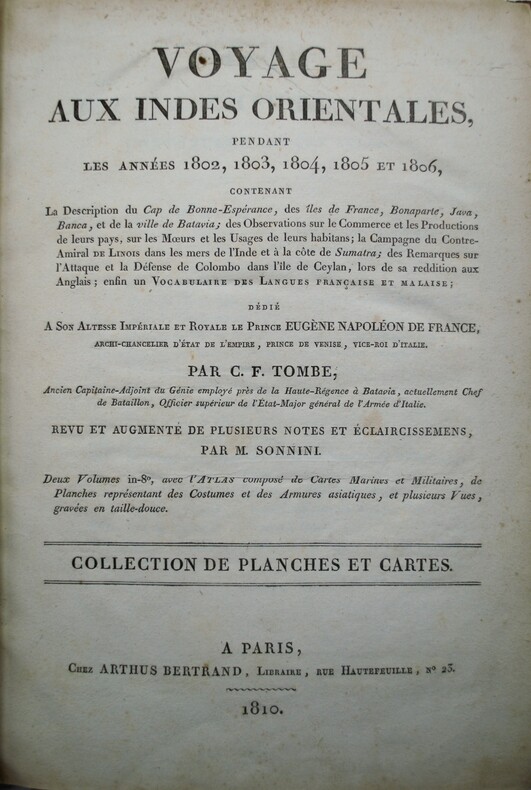
1810PHO-1157Paris: Arthus Bertrand, 1810. — Atlas in-4, (295x200) (2 ff.), 18 cartes et planches , la plupart dépliantes ,relié demi veau ,dos lisse avec fers de navire , manque au dos .
1898231301898. Spanish-American War stereoview archive circa 1898-1899 documenting how the war was pictured through mass-produced photographic views that followed U.S. mobilization battlefield action occupation and military life across both Cuba and the Philippines. These stereoviews preserves the visual system by which the war was circulated to American audiences showcasing camp organization troop movement burial hospital care naval power and overseas deployment. Particularly notable is the archive's coverage of the Rough Riders the Santiago campaign in Cuba and U.S. presence in Manila and Malate showing how stereoview photography helped normalize the war's expansion from anti-Spanish conflict into a broader American imperial presence.<br /> <br /> Archive of 21 stereoviews Various publishers. Spanish-American War stereoview archive. Cuba the Philippines and the United States circa 1898-1899. each measuring 3" x 7". The views are drawn from multiple phases and theaters of the war including camp and drill scenes in the United States embarkation and troop arrivals at Tampa battlefield and occupation imagery from Cuba and extensive and some grisly scenes from Manila and surrounding areas in the Philippines. Captions and images show soldiers in formation cavalry drill military reviews naval artillery hospital interiors encampments burial grounds and troops in active position. Cuban views include Morro Castle after bombardment dead and wounded on the battlefield of Santiago U.S. soldiers preparing to invade Cuba and troops dining near Cabañas Fortress. Philippine views include a departure for Manila American pickets routing a Filipino reconnoitering party the 18th Infantry engaged by Filipino outposts volunteers awaiting orders under the tropical sun Army Hospital Manila and "Our Boys in Camp at Malate P.I." One stereoview identifies Roosevelt's Rough Riders in the mobilization phase linking the archive to one of the war's most publicly mythologized units.<br /> <br /> As a group the stereoviews demonstrate the process by which the Spanish-American War was framed not simply as a short military victory over Spain but as a sustained structure of U.S. troop deployment and occupation extending from Cuba into the Philippines. The Manila and Malate scenes are especially important in this regard since they place American soldiers within the opening phase of the Philippine conflict where U.S. military presence quickly moved beyond liberation rhetoric into imperial control. The archive's mixture of battlefield casualties camp routine naval spectacle and celebratory review scenes shows how stereoscopic publishing converted war into a domestic viewing experience while reinforcing the legitimacy of American expansion abroad. Wear to mounts some toning; overall very good condition. A strong cross-theater visual archive of the Spanish-American War and the emergence of U.S. imperial power in Cuba and the Philippines. unknown
1822PHO-1375Paris, Leblanc, 1822 ,2 volumes in-8 de texte et un Atlas , petit in-folio (27,5x37,5cm) Texte ; 2 volumes in-8 , 2ff.-xxx-452pp. , 2ff.-506pp. , relié toile , dos lisse avec titre et tomaison. Atlas ; un volume in-folio ,2ffnch (Titre et liste des planches) et 26 planches dessinées par l’auteur dont une carte et 12 planches en couleurs d’époque, relié demi maroquin vert , dos orné avec titre et les armes royales et chiffre de Louis-Philippe, timbre de sa bibliothèque sur le titre (Neuilly) , ex-libris , exemplaire sur grand papier, frottements aux plats avec petit manque de papier , coins et coupes usés , quelques rousseurs.