821 résultats
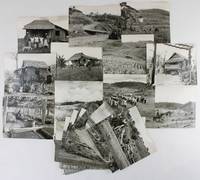
List2928Luzon Philippines likely early 20th century. Seventeen photographs: six measuring 3 ½ x 8 inches five measuring 4 ¾ x 6 ½ inches five measuring 3 ¼ x 3 ¾ inches and one measuring 4 x 5 inches. With Brown Brothers stamps and captions verso; some with editorial overpainting. Worn with some folding missing corners and small tears; excellent contrast; overall very good plus. The US occupation of the Philippines began with Spain’s cession of the islands to the US in 1898 and ended with the Treaty of Manila of 1946. Offered here is a small collection of photographs likely shortly postdating the Philippine-American war showing civilian life and industry in occupied Philippines especially the island of Luzon. The photos show copra processing—dried coconut flesh from which coconut oil is made—timber cutting and cigar and cigarette production. All three were and are important industries in the Philippines but tobacco in particular seems to have had a hold on the populace. Several of the photographs show young children smoking large cigars; one is captioned “A youthful smoker of Manila. The Filipinos smoke cigarettes from the cradle and cigars not long after.†Others show well-dressed young schoolgirls toddlers playing in a miniature nipa hut and panoramic views of the Pasig River and Manila Bay. Of interest to historians of the Philippines’ American colonial period especially its agricultural and productive history. unknown
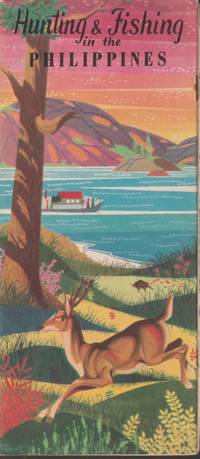
195721570Manila: Association Wth the Cooperation of the Philippine Gun and Tackle Club. 1957. Softcover. Very Good. A small illustrated hunting brochure promoting the hunt of deer snipes tamaraw wild boar crocodile wild ducks and for fishing dorado Spanish mackerel wahoo amerjack marlin barracuda sailfish and swordfish.; Oblong 8vo 8" to 9" tall . Association Wth the Cooperation of the Philippine Gun and Tackle Club paperback
N°297, d'avril 1971, de la revue mensuelle dirigée par Jean-Paul Sartre; au sommaire: "La terre ferme" de Christine DAURE, "Dictature du prolétariat, classes sociales et idéologie prolétarienne", article de Paul SWEEZY et sa réponse par Charles BETTLEHEIM, "L'idéologie mexicaine" par Léo GABRIEL, "L'Afrique recolonisée ?" par Basil DAVIDSON, "Le Mouvement de libération nationale aux Philippines" par Rodrigo ROJAS, des lettres de détenus de la prison californienne de Soledad, "La vie quotidienne dans l'empire du Fer (un voyage en Lorraine)" par Jacques-Alain MILLER et François REGNAULT, des critiques théâtrales (Vauthier, Shakespeare, Vassilikos) de Renée SAUREL et cinématographiques de Christian ZIMMER. Français
198610994S.l. P.A.F. Pour l'Analyse du Folklore 1986 Un volume in-8 broché, couverture verte, 168 pages. Bon état.
1987LFA-126740656Une revue de 98 pages, format 215 x 285 mm, illustrée, brochée couverture couleurs, bon état
191958763Washington D.C. National Geographic Society 1919. Two parts in one. Oblong 4to. 11 x 9 in. 24; 24 leaves printed on thick glossy paper stock w/ photo & colour illustrations on recto of each leaf slight shelfwear rubbing still NF set preserved in original printed envelope with instructional information and stamp “China & Philippines†on recto minor creasing edgewear former ownership ink markings. First edition of these scarce sets of plates designed for geography classroom use following World War I filled with text by Burrall 1883-1960 to increase geographical literacy of children as well as promote the ideas of preparing American youths to assume the role of a “World Power.†This first set focused on China includes text and photos describing the “Avenue of Stone Animals;†increasing number of girls attending school; rice fields street restaurants Chinese temples along with several parts with photos by E.H. Wilson of the Arnold Arboretum. The photographs are unidentified in the Philippines section and includes descriptions and photos of tree houses greased pole contests weaving cloth making pottery and growth of school bands and schools. Worldcat ostensibly locates 5 surviving China & Philippines portfolios at least 1 is microfilm; See: Katie Good Bring the World to the Child: Technologies of Global Citizenship in American Education 2020 pp. 44-47 227-228. National Geographic Society, hardcover
240267Lisbonne, monastère de S. Vincent hors les murs, 1749 2 vol. in-folio, [3] ff. n. ch. (titre avec belles armes des Bragance, avertissement, autorisations), 326 pp., un f. vierge, 80 pp. d'index, texte sur deux colonnes ; [4] ff. n. ch. (titre, avertissement, approbations), 498 pp., un f. n. ch. d'errata, avec une belle vignette en-tête gravée par O. Cor d'après Debrie, demi-basane fauve à coins, dos à nerfs ornés de fleurons et guirlandes dorés, pièces de titre cerise, tranches rouges (reliure de l'époque). Une coiffe rognée, coins abîmés.
194561658Manila P.I.: 25th Infantry Division 1945. Folio. 9 x 13 in. 92 pp unpaginated. consisting of illustrated title introduction leaf and then 176 numbered illustrated panels 2 to a page tracking the campaign. Blue publisher’s cloth colour plate title mounted on front cover w/ 25th Division “Tropic Lightning†badge minor dustsoiling slight fraying a little thumbing still a VG bright copy. First edition of this fascinating and well-illustrated graphic novel regimental history executed by the artist while serving with the 3rd Brigade 25th Infantry Division and filled with drawings depicting the life of a doughboy fighting the Japanese across Luzon. The book covers the 35th “Cacti†27th “Wolfhounds†and 161st Infantry Regiments the famous Battle of Balete Pass offering an essential first-hand visual record while they set the combat record of 165 consecutive days. The record would not be broken until later when the 3rd Brigade of the 25th Division went 235 consecutive days in combat operations during the Vietnam War in 1966. Rutherfoord 1919-2001 was a commercial artist from Roanoke VA who served from 1942-1946 in the 25th Infantry Division and later as commercial artist in New York who also illustrated a number of titles in the popular Little Golden Books series as well as later a successful painting career in and around Roanoke. 25th Infantry Division, hardcover
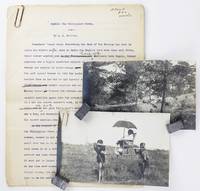
19055191N.p. 1905. About very good. 3pp. rectos only. About 900 words. Folio. Typescript with manuscript corrections and notations. Light wear and soiling slight creasing. Together with two silver gelatin photographs. A short but interesting essay on the mountain city of Baguio. It reads a bit like a travel article or potential newspaper puff piece for tourism and has been edited by hand with manuscript notations and corrections. It opens "Somewhere 'round about Petersburg the Czar of the Russias has what he calls his winter palace; down in Indian the English have what they call Simla their summer capital and here we Americans have Baguio." The author goes on to discuss the oppression of the tropics and therefore the need for cooler cities to enable functional government discussing the needs of the "white man" for livable conditions in such a place: "In the Philippines there are some months of the year that are extraordinarily summer summer in all the sense that the word implies summer until one can't rest and do it comfortably. It is during this time that the summer capital comes in as a life-saving station for the overworked and rundown public servant and such others as care to take advantage of the rural pueblo. . drudging all year in a comparatively warm atmosphere and then to be hit with a blast that seems like a draft from the furnace of the place that has its main thoroughfare paved with good resolutions is more than the average Anglo-Saxon can stand." He continues: "Shortly after the arrival of the civil commission in the islands the Governor wasn't long in deciding.that the English were pretty wise in having their summer capitals. He also decided the Philippines must have one. It was necessary if the white man was to stay indefinitely."<br /> <br /> He describes the process of locating Baguio in the pine forests and establishing a small town there despite the lack of a road and precipitous ascent to the area: "The committee reported the climate fine incomparable just like that of the United States in late fall and that one had to sleep under heavy blankets at night to keep warm. . despite skepticism . it proved a fact and one that was a blessing. Think of the pleasure of residing in the Philippines where flies seldom bother where mosquitos as a rule are few where patent leather shoes never crack.and having a delightfully hilly resort not ninety miles away to go to when one's spleen enlarges from a languid life or the malaria attacks with unrelenting persistence." He goes on to note that it costs nearly as much to go to Baguio as it does to travel to China "so that its full benefit has not yet been felt by the more humble in life". The typescript is accompanied by two photographs of the Philippines one depicting a trail through a pine forest presumably around Baguio and the other showing a Filipino woman being carried by two Filipino men in a sedan chair. unknown
17641400London: J. Dodsley 1764. Scare first edition of this document relating to the British occupation of Manila during the Anglo-Spanish War of 1762-3 and an interesting case of international law. In September of 1762 under the command of Draper and Cornish a British fleet of 13 ships containing over 6000 men attacked Manila and following a difficult landing quickly dispatched the Spanish garrison which they outnumbered 10 to 1.They entered the city on October 5 and part of the terms of capitulation was that Spain would pay the British an indemnity of 4 million pesos roughly a million pounds for not pillaging the city. The British evacuated in 1764 when hostilities ceased and Draper enjoyed the highly unusual privilege of presenting the standards of Spain taken in Manila to his alma mater Kings College Cambridge. But the Spanish did not honor this gentlemans agreement claiming that Draper dealt with an unauthorized agent that he himself broke the terms of the agreement etc. In order to press his claim which amounted to £25000 he published the present tract to pressure his government to collect. The tract contains a brief letter to the British Secretary of State outlining his grievance; a bilingual summary in English and French of the Spanish ambassadors grounds for not complying with the terms of the agreement; extracts from the treaty; a refutation by Draper of the claim that he dealt with an unauthorized agent; and an English language treaty signed by the original parties in Manila. But with hostilities over and their attention occupied by other foreign adventures chief among them America the British were in no position to insist and the suit was eventually abandoned.Griffin Bibliography of the Philippines p. 125; Dictionary of National Biography compact ed. I.573. 8vo. 43 pp. Bound in blue wrappers and housed in protective buckram case with title gilt on spine. Minor foxing in margins of final leaves but otherwise absolutely mint. J. Dodsley hardcover
19503741Philippines 1950. Very good. Thirty-one original photographs each measuring 4 x 5 inches. Minor wear and dust soiling. Mostly sharp clean images. Fascinating group of over thirty candid photographs depicting Philippine settlers and their homes on the large southern island of Mindanao just after World War II. Over half over these show settlers and their homes in the Panguantucan and Nabaliwa areas of Bukidnon province in the center of the island as wells as images of coffee and soybean farms a poultry enterprise rural roads and bridges and more. Additional photographs show similar scenes in Lanao del Sur also on Mindanao and a few in the Tinambac municipality of the more central Camarines Sur province -- farmers with their products by the road agricultural families at work a plant nursery and settlers' children in the fields. Mindanao is one of the principal centers of agricultural production in the Philippines and the island was subject to a series of resettlement efforts across the 20th century by both colonial and independent governments aimed at increasing production. The photos are captioned in manuscript in English on the versos and scattered images of crude roads and construction equipment suggest that these images were taken by a U.S. Army engineer or a private contractor after the war. unknown
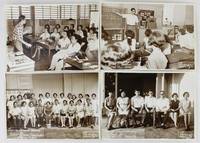
19693754Lucena City: Garcia's 1969. Very good plus. Fifteen sepia-toned photographs most 5 x 7 inches a couple slightly smaller all but one captioned in the negative. Minor wear otherwise very nice condition. A collection of fifteen photographs featuring the participants in the 1968 Division Science Workshop in the Philippine city of Lucena. The workshop appears to have concentrated on teacher training for instructors from grades 1 through 11. The present images capture the various training classes during instruction broken out by grade level with classes of Filipino men and women taught in English by two white men. Information on chalk boards can be seen in a couple of images. Six of the photographs feature group photographs featuring either the entire population of teacher-trainees or individual grade-level classes. One image features a Division Science Seminar for District Science Coordinator. An interesting assortment of photographs capturing teacher training in a notable Filipino city at the end of the 1960s. Garcia's unknown
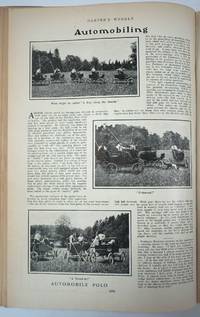
190228399New York: Harper's 1902. First printing. Hardcover. Good overall. Content on the Russo-Japanese & Spanish American War; Automobiling early cars playing polo!; Teddy Roosevelt Chinese rugby cartoon Blackwell Island Bridge Thomas Nast cartoon Henley regatta. Half year bound volume of Harper's Weekly with woodblock illustrations throughout.<br /> <br /> Color supplements were included in the Christmas issue. Chinese playing rugby cartoon p1582; US Naval Academy p1498; Blackwell Island Bridge p1308; Wall Street p1180; Thomas Nast p1972. <br /> <br /> Folio 1155pp. Weekly issues bound up into a large single volume with 3/4 leather and marbled boards. Leather spine chipped cracked at hinge binding firm internally very clean. Harper's hardcover
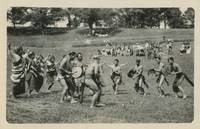
1940List2741Philippines and San Francisco 1940. pproximately 205 photographs: twenty 5 x 7†and smaller eighteen 3.75 x 5.5†and smaller and 167 2.5 x 3.5†and smaller. Most are glued into a scrapbook with some loose. Some photographs bent or with tears; some marked with pencil. Generally very good. The US’s military presence in the Philippines is long-standing beginning in 1898 with the Spanish-American War which ended that year with a treaty that sold the islands to the US. The Philippines was then an American colony until the country’s independence was recognized by the US in 1946. In 1947 the two countries signed the Military Bases Agreement allowing the US to keep military bases in the Philippines for a period of 99 years; this was finally overturned in 1991 and the bases were closed by 1992. However agreements signed in 1999 and 2014 allowed US troops to move freely through the Philippines and allowed the US government to build and operate military facilities.<br /> <br /> Offered here is a large archive of photographs likely belonging to—and likely with many taken by—an American soldier stationed in the Philippines. These were probably mainly taken in the 1930s as a photograph appears to show the Golden Gate Bridge under construction. Some are possibly from World War II as one photograph shows men standing on a ship under a large banner reading “CHINA BURMA INDIAâ€. However they are mostly unlikely to have been taken during the war as there is also a photograph of a pristine-looking Manila Central Post Office – the building was severely damaged during the fighting against the Japanese in the Battle of Manila and was rebuilt in 1946.<br /> <br /> In the archive are a mix of military photographs—generally of planes ships and life aboard them—and shots of Philippine life and scenery. One interesting scrapbook page places a photograph of a massive American steamer next to a shot of a wooden riverboat. Aboard the riverboat young Filipino boys pose and smile for the camera. The military shots emphasize the US’s outsized power: a man poses next to and is dwarfed by a seaplane; three men stand behind a chest-high pile of artillery; planes fly in formation straight overhead; men and women eat a lunch spread under the hulking wings of a plane parked on a lawn.<br /> <br /> The shots of Filipino life show the modernization of a largely agrarian society. On the one hand there are rice paddies huts with straw roofs plows and carts pulled by oxen. Women weave on large outdoor looms young people pose in traditional dress a smiling man stands wearing a loincloth and holding a spear and a circle of men and women dance around with drums. On the other hand a long line of cars is parked outside the Sunday market in Baguio men pose outside the Lanao Golf Club a train speeds by the camera and the neoclassical Manila Central Post Office watches over the wooden rowboats in the Pasig River. One set of photos shows penitents or magdarame performing the Good Friday practice of self-flagellation. As an audience looks on men in hoods many with crowns woven from plants whip themselves or are whipped. Though the Catholic Church in the Philippines discourages it these mortifications continue to be practiced to this day.<br /> <br /> Of interest to scholars of the Philippines’ American colonial period particularly for its documentation of ordinary Filipino life during this transitional time. unknown
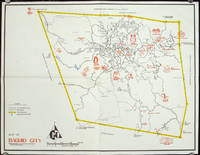
1960206510circa1960. Printed pictorial map 44.8 x 58 cms 46.7 x 60.3 cms sheet original folds a little wear but in very good condition. Attractive 1960s tourist map of Baguio city when it was the "Summer Capital" of the Philippines. Tourist attractions are shown pictorially in red blue triangles denote wood carving shops the city boundaries outlined in yellow sealed and unsealed roads are also shown. . unknown
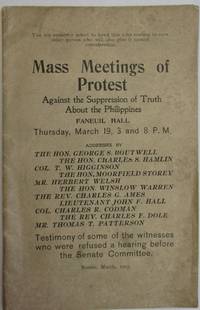
190337755Boston 1903. Original printed wrappers with wrapper title as issued and original staples. At head of title: "You are earnestly asked to hand this after reading to some other person who will also give it careful consideration." Rear wrapper repeats the first sentence of the title. 56 pages. Wrappers lightly dusted else Fine.<br /> <br /> An anti-imperialist protest against American efforts to "to conquer a foreign nation and to impose our sway upon it against its will. We are departing from the principles upon which our government is founded and which we have always held to be self-evident truths."<br /> The Philippine conflict was a guerilla war of unbridled brutality instigated by the American decision to become a Pacific power. unknown
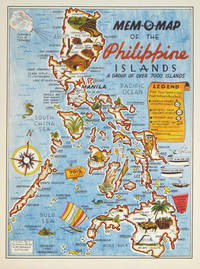
1945204557U.S.A.: Mem-O-Map Co. 1945. Colour pictographic / pictorial map 32.1 x 23.8 cms; 35.4 x 26.6 cms sheet very good condition. Rare pictorial map published in 1945 by John G. Drury aTechnical Officer who served with the 214th Ordnance Battalion to mark the end of World War II as souvenirs for the military. Military personnel could fill in banners "came in on good ship." and "departed on good ship." their name organisation and "Line of Advance or movement" blank in this example. Pictographs mark various memorable spots and wildlife including larger-than-life insects. A "Terrible Tillie Typhoon" looms over the coast at Luzon. <br>Drury published a series of five maps: Philippines and Okinawa in 1945; Japan and Korea Oahu and Europe in 1946. They are all scarce. “These almost whimsical maps are designed to support the creation of personalised geographies. At a time when digital mapping is beginning to experiment with the creation of personalised content that would render the same map in different ways for different users Mem-O-Maps demonstrate the principle in action." Kenneth Field ICA Commission on Map Design. . Mem-O-Map Co. unknown
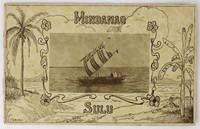
19055045Manila: Sugar News Press 1905. Very good. 22pp. Photographically illustrated. Oblong quarto. Original pictorial wrappers stapled. Moderate dust-soiling and edge wear. Light even toning to text. An early and seemingly-unrecorded promotional touting the people and scenery in Mindanao and Sulu in the southern Philippines in the first decade of the 20th century. The work opens with a Foreword detailing the positive aspects of Mindanao particularly its principal city described here as the "Metropolis of Mindanao and Sulu" with "a population of more than thirty thousand a mixture of Moros or Mohammedan Filipinos Christian Filipinos Chinese Japanese and Europeans." Following the Foreword the remainder of the work is mostly comprised of thirty-four duotone photographs printed mostly two per page but occasionally with from one to five per page. The photographs feature numerous scenic and street views in and around Zamboanga including various "Moro houses" and about fifteen portraits of indigenous Filipinos such as a "Moro woman weaving materials for head-turbans and sarongs" a view inside a "weaving school" "Yakan Moros on the island of Basilan" "Muhammad Jamallul Sultan of Sulu" "Joloano Warriors" "Moro Kulintang" and their musical instruments Bogobo and Cotabato warriors "Bajaos - the sea gypsies of Sulu" and "Bogobo musicians."<br /> <br /> The final two pages of the work are taken up with two poems -- the first is a traditional Filipino poem entitled "No Te Vayas" noted as "Zamboanga's 'Auld Lang Syne" and one titled simply "Zamboanga" by Susan Hart Dyer. The front cover is decorated with a central photograph of an indigenous sailing vessel surrounded by an illustrated beach scene signed at bottom left "Jh. Mendoza." The inside front cover contains an illustration of the Philippine Islands from Batanes down to Sulu. We could locate no other copies of the work by title and imprint information in OCLC. Sugar News Press unknown
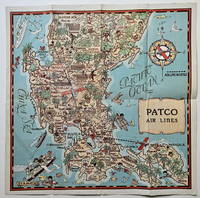
19363828<p>A wonderfully colorful map of a portion of the Philippines from the very early days of aviation in the country. PATCO the Philippine Aerial Taxi Company was organized in 1930 primarily to fly workers in the gold mining centers of Baguio and Paracale to and from Manila. With the fading of the mining boom in the late 1930s PATCO's fortunes waned; it ceased operations in 1940 and its franchise was assumed by the newly created Philippine Air Line in 1941.</p><p>The map was drawn by D.B. Santos. The cartoon-like illustrations portray a country rich in natural resources and agricultural hunting and fishing activities including a man spearing a shark from an outrigger canoe. The illustrations are very reminiscent of the style of Ruth Taylor White who coincidentally visited the Philippines in 1930 and produced <em>A Cartograph of the Major Philippine Islands. "The Riviera of the Orient."</em> in that year.</p><p>A delightful and uncommon pictorial map.</p><p><strong>Condition:</strong> Printed color map. Folded as issued with a bit of extraneous creasing. Wear at some fold lines including short separations in the blank margins. Very small fold intersection breaks in two spots. Overall good.</p><p>ICN 7816.</p> PATCO Air Lines
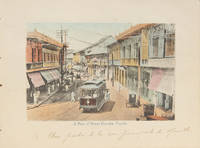
111950N.p. n.d. but early 20th century. . Lacquered album; landscape 8vo 19.5 x 15 cm; 22 coloured photograph illustrations printed captions in English below image French manuscript annotations in ink in an early hand below caption single horizontal splits to lacquer on both boards a very good copy.<br /> An evocative series of colour photographs of the Philippines ranging from views of Manilla harbour to domestic scenes such as a butcher's shop washer-women market scenes rice cleaning and a cock fight.<br /> N.p., n.d. [but early 20th century]. hardcover
194660810New York: Frederic H. Stevens Stratford House Inc. 1946. 8vo. xiv 569 1 pp. Frontisp. illust. of Santo Tomas Building numerous text illustrations. Beige cloth red & gilt lettering on front cover minor shelfwear & dustsoiling still VG copy from the library of former internee Charles Kurz 1891-1978 a business agent and later accountant for the Pascific Steamship Line World War I veteran and headed the labor safety battalion for American prisoners inside Santo Tomas w/ ownership markings on ffep. and 1950’s passport photo of Kurz laid-in. First edition of this scarce and graphic work chronicling the conditions of one of the largest of Prisoner-of-War Internee camps set up by the Japanese during World War II composed mostly of American civilians. The University of Santo Tomas in Manila was utilized for the camp and housed over 4000 civilians many of whom were near death at the end of the war due to starvation and poor conditions. The 1st Cavalry Division pushed forward in a 100 mile advance to Manila in 66 hours in order to prevent the Japanese from killing all of the internment camp prisoners and subsequently fought the Japanese forces across Manila. Frederic H. Stevens, Stratford House, Inc., hardcover
196359482Philadelphia & New York: J.B. Lippincott Co. 1963. Thick 8vo. 12 425 1 pp. Double-page map. Quarter-black over red publisher’s cloth silver stars & lettering front cover & spine slight shelfwear rubbing w/ d.j. cover art by Robert Hallock minor dustsoiling toning to spine price-clipped still NF/VG copy inscribed by Colonel Wendell Welby Fertig 1900-1975 to Eric Offret 1949-1986 upon his graduation from high school in San Diego June 1967 “This is a part of the story of our effort in the Philippines. “Chief†can supply some details. It is a story of a fight against odds -- and we won!†First edition 2nd printing of this work detailing the efforts of self-promoted Brigadier General Fertig a reservist mining engineer who had assisted in the evacuations of Bataan and Corregidor who accepted the offer from Major General Sharp to oversee the resistance in Visayan-Mindanao to the Japanese invasion. Fertig linked up with Filipino-American Luis Morgan a local constabulary officer as Fertig attempted to manage the disparate groups of Filipino guerillas managing non-Americans including Australian soldiers a Syrian engineer and German soldier of fortune and negotiating between Filipino Christians and Lanao Moros. J.B. Lippincott Co., hardcover
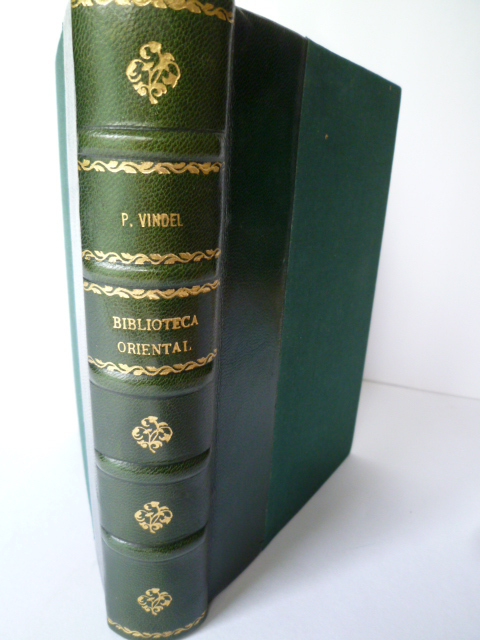
3750Madrid, P. Vindel, Librero-Anticuario, MCMXI (1911). 1 volume in-12, 436+251 pp., half-leather new binding, with cloth-boards, Illustrated with 14 fold out facsimiles and some drawings. Text in Spanish. Paper is toned, cover page of Tome I has been restored and is brittle, inside pages are clean but yellowed by time, a good copy.
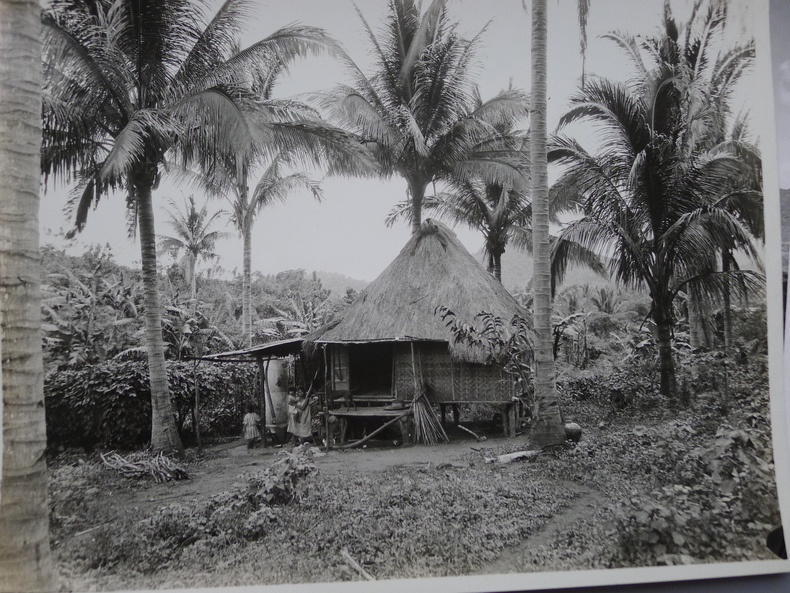
4883Philippines, years 50/60. 1 set of original photographs from Philippines, depicting natural sceneries, buildings, houses and people. Some pictures wear the Gerald Thomson (Masonic Temple) stamp. All photographs in good condition). Sold separately 40 each.
7777Philippines, years 50/60. 1 set of original photographs from Philippines, depicting natural sceneries, buildings, houses and people. Some pictures wear the Gerald Thomson (Masonic Temple) stamp, some others by Hamilton Wright from New York. All photographs in good condition. 12 photographs (26*20 cm) and 6 photographs (18*13 cm)