821 résultats
2021DBS-9781774076859Society Publishing 2021. 1st. Hardcover. New. Society Publishing hardcover
2021DBS-9781774076842Society Publishing 2021. 1st. Hardcover. New. Society Publishing hardcover
1020438274.Ghardcover. Good. Access codes and supplements are not guaranteed with used items. May be an ex-library book. hardcover

80p., illus. New World Neighbors series for children. Pictorial endpapers w/ map. Hardcover Very good condition w/ pictorial paste-on label.
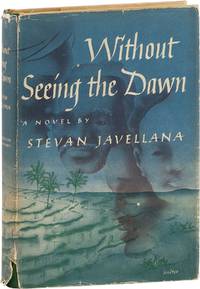
194782279Boston: Little Brown & Company 1947. First Edition. First Printing. Octavo 21cm; khaki cloth-covered boards blocked and titled in green and gilt on spine and decorations embossed to spine and front cover; dustjacket; xvi34-3591pp. Pictorial bookplate to front pastedown. Very slight waviness to lower edge of textblock; two very small nicks on rear endpaper and rear pastedown; Near Fine. Dustjacket designed by George Salter unclipped priced $2.75 shelf-worn with 1.5" closed tear to rear spine fold with several tiny chips small tears and attendant creases; Very Good. <br /> <br /> The Filipino author's only published novel later released under the title The Lost Ones. Javellana's experience as a guerrilla during the Japanese invasion of the Philippines is evident in his two-part novel "Day" and "Night" describing events before and during the war. He focuses on the struggle of his people through farmer folk characters feeling that was ".the most sincere most accurate and most moving story about the Philippines would be the story of those who dug their plows into the rich earth and prayed for the coming of rain and whose sons were with the guerrillas" from rear panel. <br /> <br /> A film adaptation Santiago! was directed by Filipino director Lino Brocka 1939-1991 who co-founded the Free the Artist Movement and the Concerned Artists for Phillipines CAP; he was appointed by President Corazon Aquino for Constitutional Commission to draft the country's new constitituion. Without Seeing the Dawn also received an award-winning TV mini-series adaptation Malayo Pa Ang Umaga. 82279. Little, Brown & Company unknown
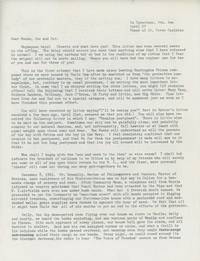
1945List2748Philippines 1945. Single letter; five 8.5 x 11†pages. Pinhole at top of first page missing final pages overall fine. The unknown author of this letter was an American Jesuit missionary in the Philippines who before the war was a novice living in Novaliches just outside Manila. He apparently had not written a significant letter home for a long time: in this letter written in April of what is likely 1945 he recounts his experiences from between December 8 1941 and early January of 1945 shortly before the civilian POW camp in which he was interned was liberated.<br /> <br /> After the “Nips†bomb Pearl Harbor “A feverish month ensuedâ€:<br /> <br /> “We proceeded to put the Community on ‘war-time alert’ with all hands occupied in digging air-raid trenches camouflaging our fortress-like house with a garlanded roof and mud-daubed walls; grain supplies were rushed in against the hour of need. We felt that all it might take Uncle Sam all of six months to put an end to the efforts of the pretender.â€<br /> Around Christmas they evacuated to the Jesuit Ateneo Grade School then in Intramuros as the Japanese were advancing quickly towards Novaliches. Of course this did not prove to be much safer:<br /> <br /> “When darkness came the Japs began their bombing of the Port Area. The bombs began to bounce off the pavement; bombers just skimming our roof-top on their way. We spent the night on our tummies and how we prayed. We thought that each decade of the beads would be our last this side of Purgatory. . When the church sto Domingo was hit the floor beneath us did some tricks and we were lifted up a bit and let down amidst the dust and smoke that poured in from above.â€<br /> <br /> The missionaries try to “salvage important papers and other valuables from the Mission House prior to abandoning it to the fire which threatened the entire Walled City.†During this time they and “a thousand refugees†live in the Ateneo while “Dawn and night raids were supplied by the Japs with nary an American plane to say to them no†– American forces had taken a serious hit and withdrawn outside Manila. It was declared an open city before “the little scrawny but arrogant Japs came into the city and took over†in January of 1942.<br /> <br /> The missionaries persuade the Japanese to let them stay in the Ateneo:<br /> <br /> “We convinced them that it was impossible for us to give up the building because it belonged to the Pope and the Vatican State would hold us responsible. This argument with many ingenious trimmings enabled us to hold on to the Ateneo until June ‘43 when the main building was taken for a military hospitalâ€.<br /> <br /> The author describes how despite what he calls his “partial internment†in Manila he is able to get around checkpoints by pretending to be Belgian. He finishes his studies and begins work at a Belgian convent in Paranaque in February of 1943 living between there and Manila:<br /> <br /> “Incidentally none of this would have been possible if the Japs had gumption enough to find out that I was one of the hated Americans. . All vehicles were obliged to stop here a checkpoint at Baclaran and all passengers get down and file between a Jap sentry and a Filipino constabulary soldier to be searched for hidden arms etc. Since several Belgian Fathers not considered enemy aliens frequently passed this way I was able to walk through unmolested as an unoffending Belgian. . I carefully kept my helmet covering the tell-tale red arm-band which was worn on the arm furtherest away from the Jap. The Filipino would do no more than give me a knowing grin.â€<br /> <br /> On July 10 1944 all of the American civilian POWs are taken to internment camps in Santo Tomas and then Los Baños. In Los Baños the POWs cut wood repair roads and farm. Los Baños would be liberated in February of 1945; the author paints a slightly confusing picture of the leadup to this:<br /> <br /> “Conditions generally ‘worsened’ when on Jan. 8th about the time that the American troops landed at Mindero an island just across from Batangas the Japs got jittery believing that the Yanks were going to do the obvious and cross over the bay to Batangas and they the Japs at Batanga decamped! ‘You are free but remain in camp until the Americans come. Outside your camp Japanese troops will shoot any who leave.’ Great was the joy in Mudville. From nowhere came flag poles on which we quickly unfurled American and British flags .; a short-wave radio was set up and we enjoyed daily Frisco broadcasts .â€<br /> <br /> It sounds as if the missionary was reporting contrary to the usual narrative of the Los Baños raid that the Japanese had essentially given up control of the camp and were like the prisoners simply waiting for the Americans to come get their people. Perhaps something further happened in the nearly two intervening months; however the remainder of the letter is missing.<br /> <br /> Of interest to scholars of modern Jesuit history and of the civilian POW experience during the Second World War. unknown
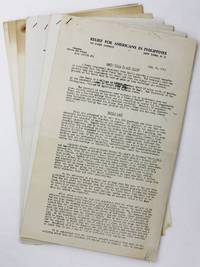
19454668New York 1945. Very good. Sixteen issues totaling 75pp. Legal-size sheets stapled. Previously folded. Light wear and toning. An extensive run of newsletters by a New York-based aid group Relief for Americans in the Philippines. Included here are issues 9 12 14 through 18 and 20 through 28 which were published between 1942 and 1945. The organization was devoted to the support of Americans who were imprisoned at San Tomas Gabuio and other camps after Japan occupied the Philippines during World War II. At the outset of the war the Philippines were a commonwealth of the United States but within three weeks of the attack on Pearl Harbor the Japanese seized control. The 20000 American and 80000 Filipino troops on the ground departed and any remaining American or British citizens were rounded up in Manila and transferred to the University of Santo Tomas where they were left to fend for themselves. The only exceptions were a 7:30 pm roll call each night and the use of room monitors. The background of the captives varied wildly from business executives and retired soldiers to prostitutes. At the end of the war the total number of prisoners liberated was 3785 2870 of which were American.<br />  <br /> Issue 14 remarks on the first anniversary of the non-profit organization: “On May 8th 1942 just a year ago and two days after the fall of Corregidor our organization came into being for furthering plans for the shipment of food medical supplies and other necessities for the internees and also to serve as a clearing house and point of dissemination for information concerning the welfare of these internees.†The monthly newsletter prints news and developments from the camps in the Pacific and documents the efforts of the organization to provide aid to the prisoners there. The issues also print a running list of all those believed to be in the Philippines “solely for the purpose of obtaining names and addresses of the nearest relatives of who we have no record.†A scarce record of this little-known relief effort during World War II. unknown
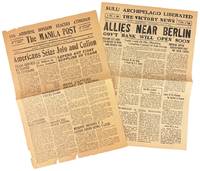
194548074Manila Philippines 1945. Very Good. Manila Philippines: April 11 1945. A pair of tabloid newssheets 35.5x24cm; previous folds light toning and a few small chips to margins else a Very Good set. <br /> <br /> Two different daily English-language newspapers published in Manila. Both share approximately the same format - headlines and small news articles relating to the war and local interests printed on recto advertisements on verso. The Manila Post's lead article announces "Americans Seize Jolo and Culion" while The Victory News announces "Allies Near Berlin." On April 11 1945 the American army was also famously freeing the Buchenwald concentration camp.<br /> <br /> Both periodicals rare in any issue in the trade and in OCLC. unknown
2000121005Paris, L'Asiathèque - maison des langues du monde, Unesco 2000 1 livre - 1disque compact. In-4 25 x 21 xm. Broché, couverture bleu-ciel à rabats, auteurs& titre en blanc sur le dos et le premier plat, 428 pp., 8 photographies hors texte, notes, bibliographie, table des matières - 1 disque compact 45 min. Exemplaire en très bon état.
1964LFA-126728725Revue mensuelle de 72 pages, format 140 x 210 mm, illustrée, brochée, Impr. de Sceaux, bon état
2000LFA017e0Revue mensuelle conernant la philatélie : environ 110 pages en couleurs, format 300 x 210 mm, illustrée, brochée couverture couleurs + fiches détachables
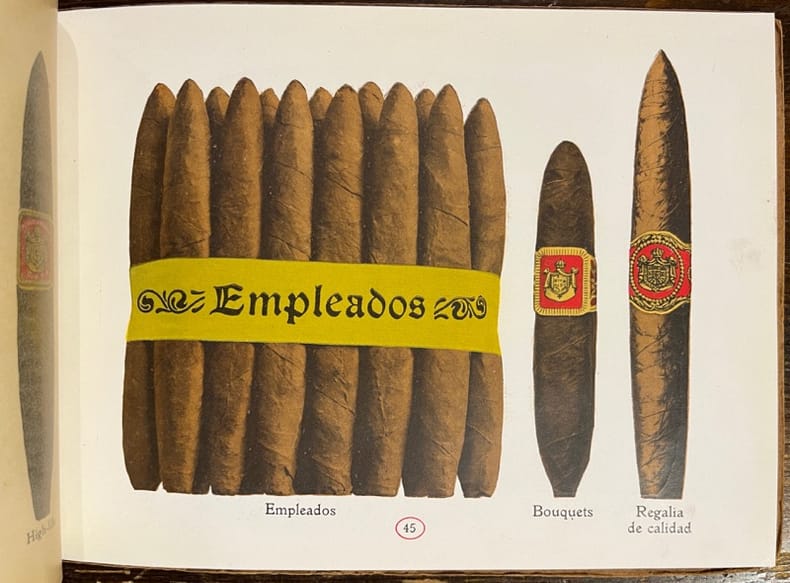
192520134Barcelona, Hermenegildo Miralles impr., 1925. In-8 oblong de [2]-66-[2] pages, couverture souple illustrée.
189813092New York: Muller Luchsinger & Co 1898. Color chromolithograph 16 x 20 inches printed on thick glossy paper. Corners a bit chipped several short closed edge tears minor surface wear. Image area still vibrant and clean. Very good overall. A striking and very rare lithograph capturing an important moment during the Spanish-American War specifically the American Navy's assault on Manila Bay in the Philippines in 1898. In the present scene three U.S. warships from the Asiatic Squadron in the left and middle including Admiral Dewey's flagship the U.S.S. Olympia fire their guns toward a few retreating ships flying the Spanish flag. A Spanish ship at middle right is almost completely sunken with just a portion of the flag peaking above the water. The scene depicts the first major engagement of the Spanish-American War a decisive victory for the American Navy that stands as one of the most lop-sided naval battles in history. During the course of the encounter the Spanish Pacific Squadron was destroyed and effectively ended Spanish colonial rule in the Philippines. The bombardment was commanded by Rear Admiral George Dewey 1837-1917 whose head-and-shoulders portrait appears in the bottom left corner.<br /> <br /> The work was accomplished by the New York firm of Muller Luchsinger & Company a prolific but still somewhat obscure producer of prints lithographs and chromolithographs in the latter-19th and early-20th centuries. OCLC records just two institutional copies at the Library of Congress and the Clements Library. A dynamic and patriotic American naval scene picturing the United States Navy's obliteration of the Spanish Navy in Manila. Muller, Luchsinger & Co unknown
9805Annales de l'Extrême-Orient et de l'Afrique, n° 99. Paris, Challamel, septembre 1886. In-4, broché.
List3148Vigan The Philippines early 20th century. Photograph measuring 5 x 6 ¾ inches mounted on heavy cardstock. Manuscript caption recto. Wear and some damage to edges; excellent. A photograph of a group of young Filipino men in suits with two white women and a child posing in front of a building. The caption reads “Grove Methodist Dormitory Boys and Missionaries Viganâ€. The Methodist Episcopal Church began planning its missionary outreach to the Philippines shortly after the 1898 American victory in the Spanish Civil War when the Philippines became an American colony. The mission center in Vigan the capital of Ilocos Sur on the island of Luzon was opened in 1904 headed by Kansan Berndt O. Peterson.1 Missionaries opened schools—with the aim of both educating and Americanizing their students—and made Vigan the base for evangelizing around the region. According to the UMC’s history of their activities in Asia many Filipinos saw the church’s activities as an extension of American imperialism leading to Nicolás Zamora’s foundation of the Iglesia Evangelica Metodista en las Islas Filipinas in 1909.<br /> <br /> 1 Wade Crawford Barclay History of Methodist Missions Vol. 4 The Board of Missions and Church Extension of the Methodist Church 1949. unknown
Aranjuez, 9 de Junio de 1807. Una hoja manuscrita firmada por Caballero.
36038Philippines: n.p. n.d. Photograph Album. Very good. Oblong plastic bound photograph album. 10.5 x 7.5". 52 photographs measuring approximately 3.75" x 2.5". These pictures are possibly prints. "United States Air Forces" embossed on the front cover. Inside the front cover is written "31st Div USMC New Britain Philippines." Album is clean and in very good condition. <br /> <br /> Photographs depict soldiers in camp in the jungle riding ox's picture of a downed planes pictures of jeeps and equipment tents and a couple of photographs of natives. No dates or names found inside. Unclear where the photographs were taken. The 31st Division was in the Philippines and New Guinea during World War Two. n.p. unknown
194561658Manila P.I.: 25th Infantry Division 1945. Folio. 9 x 13 in. 92 pp unpaginated. consisting of illustrated title introduction leaf and then 176 numbered illustrated panels 2 to a page tracking the campaign. Blue publisher’s cloth colour plate title mounted on front cover w/ 25th Division “Tropic Lightning†badge minor dustsoiling slight fraying a little thumbing still a VG bright copy. First edition of this fascinating and well-illustrated graphic novel regimental history executed by the artist while serving with the 3rd Brigade 25th Infantry Division and filled with drawings depicting the life of a doughboy fighting the Japanese across Luzon. The book covers the 35th “Cacti†27th “Wolfhounds†and 161st Infantry Regiments the famous Battle of Balete Pass offering an essential first-hand visual record while they set the combat record of 165 consecutive days. The record would not be broken until later when the 3rd Brigade of the 25th Division went 235 consecutive days in combat operations during the Vietnam War in 1966. Rutherfoord 1919-2001 was a commercial artist from Roanoke VA who served from 1942-1946 in the 25th Infantry Division and later as commercial artist in New York who also illustrated a number of titles in the popular Little Golden Books series as well as later a successful painting career in and around Roanoke. 25th Infantry Division, hardcover
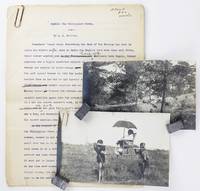
19055191N.p. 1905. About very good. 3pp. rectos only. About 900 words. Folio. Typescript with manuscript corrections and notations. Light wear and soiling slight creasing. Together with two silver gelatin photographs. A short but interesting essay on the mountain city of Baguio. It reads a bit like a travel article or potential newspaper puff piece for tourism and has been edited by hand with manuscript notations and corrections. It opens "Somewhere 'round about Petersburg the Czar of the Russias has what he calls his winter palace; down in Indian the English have what they call Simla their summer capital and here we Americans have Baguio." The author goes on to discuss the oppression of the tropics and therefore the need for cooler cities to enable functional government discussing the needs of the "white man" for livable conditions in such a place: "In the Philippines there are some months of the year that are extraordinarily summer summer in all the sense that the word implies summer until one can't rest and do it comfortably. It is during this time that the summer capital comes in as a life-saving station for the overworked and rundown public servant and such others as care to take advantage of the rural pueblo. . drudging all year in a comparatively warm atmosphere and then to be hit with a blast that seems like a draft from the furnace of the place that has its main thoroughfare paved with good resolutions is more than the average Anglo-Saxon can stand." He continues: "Shortly after the arrival of the civil commission in the islands the Governor wasn't long in deciding.that the English were pretty wise in having their summer capitals. He also decided the Philippines must have one. It was necessary if the white man was to stay indefinitely."<br /> <br /> He describes the process of locating Baguio in the pine forests and establishing a small town there despite the lack of a road and precipitous ascent to the area: "The committee reported the climate fine incomparable just like that of the United States in late fall and that one had to sleep under heavy blankets at night to keep warm. . despite skepticism . it proved a fact and one that was a blessing. Think of the pleasure of residing in the Philippines where flies seldom bother where mosquitos as a rule are few where patent leather shoes never crack.and having a delightfully hilly resort not ninety miles away to go to when one's spleen enlarges from a languid life or the malaria attacks with unrelenting persistence." He goes on to note that it costs nearly as much to go to Baguio as it does to travel to China "so that its full benefit has not yet been felt by the more humble in life". The typescript is accompanied by two photographs of the Philippines one depicting a trail through a pine forest presumably around Baguio and the other showing a Filipino woman being carried by two Filipino men in a sedan chair. unknown
17641400London: J. Dodsley 1764. Scare first edition of this document relating to the British occupation of Manila during the Anglo-Spanish War of 1762-3 and an interesting case of international law. In September of 1762 under the command of Draper and Cornish a British fleet of 13 ships containing over 6000 men attacked Manila and following a difficult landing quickly dispatched the Spanish garrison which they outnumbered 10 to 1.They entered the city on October 5 and part of the terms of capitulation was that Spain would pay the British an indemnity of 4 million pesos roughly a million pounds for not pillaging the city. The British evacuated in 1764 when hostilities ceased and Draper enjoyed the highly unusual privilege of presenting the standards of Spain taken in Manila to his alma mater Kings College Cambridge. But the Spanish did not honor this gentlemans agreement claiming that Draper dealt with an unauthorized agent that he himself broke the terms of the agreement etc. In order to press his claim which amounted to £25000 he published the present tract to pressure his government to collect. The tract contains a brief letter to the British Secretary of State outlining his grievance; a bilingual summary in English and French of the Spanish ambassadors grounds for not complying with the terms of the agreement; extracts from the treaty; a refutation by Draper of the claim that he dealt with an unauthorized agent; and an English language treaty signed by the original parties in Manila. But with hostilities over and their attention occupied by other foreign adventures chief among them America the British were in no position to insist and the suit was eventually abandoned.Griffin Bibliography of the Philippines p. 125; Dictionary of National Biography compact ed. I.573. 8vo. 43 pp. Bound in blue wrappers and housed in protective buckram case with title gilt on spine. Minor foxing in margins of final leaves but otherwise absolutely mint. J. Dodsley hardcover
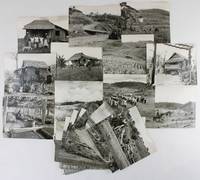
19503741Philippines 1950. Very good. Thirty-one original photographs each measuring 4 x 5 inches. Minor wear and dust soiling. Mostly sharp clean images. Fascinating group of over thirty candid photographs depicting Philippine settlers and their homes on the large southern island of Mindanao just after World War II. Over half over these show settlers and their homes in the Panguantucan and Nabaliwa areas of Bukidnon province in the center of the island as wells as images of coffee and soybean farms a poultry enterprise rural roads and bridges and more. Additional photographs show similar scenes in Lanao del Sur also on Mindanao and a few in the Tinambac municipality of the more central Camarines Sur province -- farmers with their products by the road agricultural families at work a plant nursery and settlers' children in the fields. Mindanao is one of the principal centers of agricultural production in the Philippines and the island was subject to a series of resettlement efforts across the 20th century by both colonial and independent governments aimed at increasing production. The photos are captioned in manuscript in English on the versos and scattered images of crude roads and construction equipment suggest that these images were taken by a U.S. Army engineer or a private contractor after the war. unknown
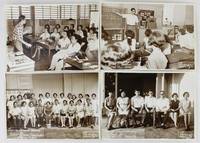
19693754Lucena City: Garcia's 1969. Very good plus. Fifteen sepia-toned photographs most 5 x 7 inches a couple slightly smaller all but one captioned in the negative. Minor wear otherwise very nice condition. A collection of fifteen photographs featuring the participants in the 1968 Division Science Workshop in the Philippine city of Lucena. The workshop appears to have concentrated on teacher training for instructors from grades 1 through 11. The present images capture the various training classes during instruction broken out by grade level with classes of Filipino men and women taught in English by two white men. Information on chalk boards can be seen in a couple of images. Six of the photographs feature group photographs featuring either the entire population of teacher-trainees or individual grade-level classes. One image features a Division Science Seminar for District Science Coordinator. An interesting assortment of photographs capturing teacher training in a notable Filipino city at the end of the 1960s. Garcia's unknown
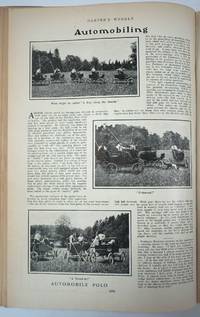
190228399New York: Harper's 1902. First printing. Hardcover. Good overall. Content on the Russo-Japanese & Spanish American War; Automobiling early cars playing polo!; Teddy Roosevelt Chinese rugby cartoon Blackwell Island Bridge Thomas Nast cartoon Henley regatta. Half year bound volume of Harper's Weekly with woodblock illustrations throughout.<br /> <br /> Color supplements were included in the Christmas issue. Chinese playing rugby cartoon p1582; US Naval Academy p1498; Blackwell Island Bridge p1308; Wall Street p1180; Thomas Nast p1972. <br /> <br /> Folio 1155pp. Weekly issues bound up into a large single volume with 3/4 leather and marbled boards. Leather spine chipped cracked at hinge binding firm internally very clean. Harper's hardcover