821 résultats
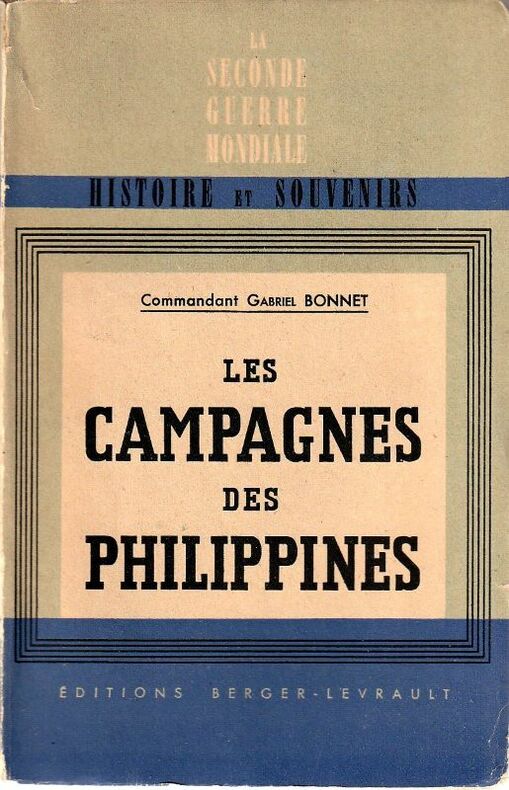
194823621948 1948 In "La Seconde guerre mondiale, histoire et souvenirs".Editions Berger-Levrault, Paris, 1948.1 volume in-8, demi chagrin vert, premier plat conservé, 256 pages.Parfait état.
1413In "La Seconde Guerre Mondiale, Histoire et Souvenirs", Editions Berger-Levrault, Paris, 1948. 1 volume in-8 broché, 256 pages. Bel état.
198739Paris, Berger-Levrault, 1948 in-12, 256 pp., cartes in-t., demi-chagrin vert, dos lisse orné de filets dorés, premier plat de couverture conservé (reliure de l'époque). Dos passé. Un cahier se détache. Cachets (annulés).
227102Paris, Berger-Levrault, 1948 in-12, 256 pp., cartes in-t., broché.
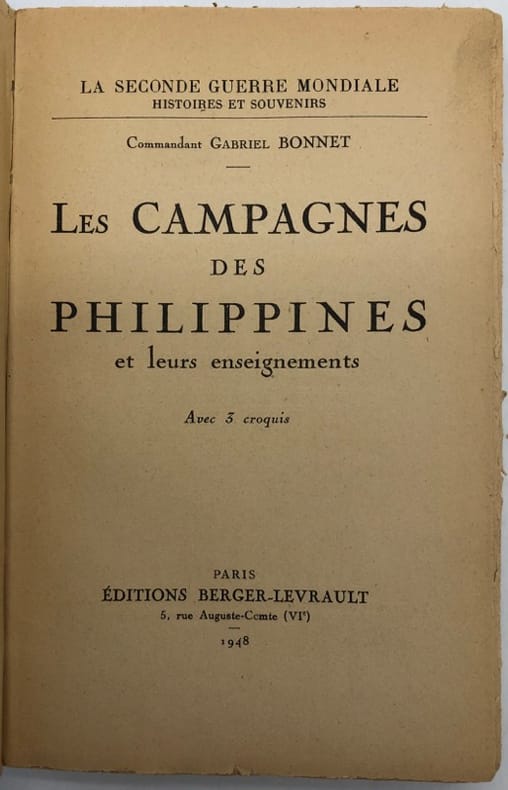
18850Editions Berger-Levrault, 1948.In-8, broché, 256 pages, cartes ht. Papier fané. Frottements d'usage. Propre et sain.
in-8°, 346 pages, ill. h.t. n./b., broche, couverture illustree Bel exemplaire. [AB-1]
1370715Paris: Jean-Pierre Delage, 1977 in-8, 200 pages. Broché, bon état.
11471Tientsin, Hautes Etudes, 1936 . En vente à la Procure de la Mission de Sienhsien, Tientsin. 1 volume in-8, broché, couvertures souples imprimées un peu défraîchies, 227 pp., frais intérieurement, bon exemplaire.
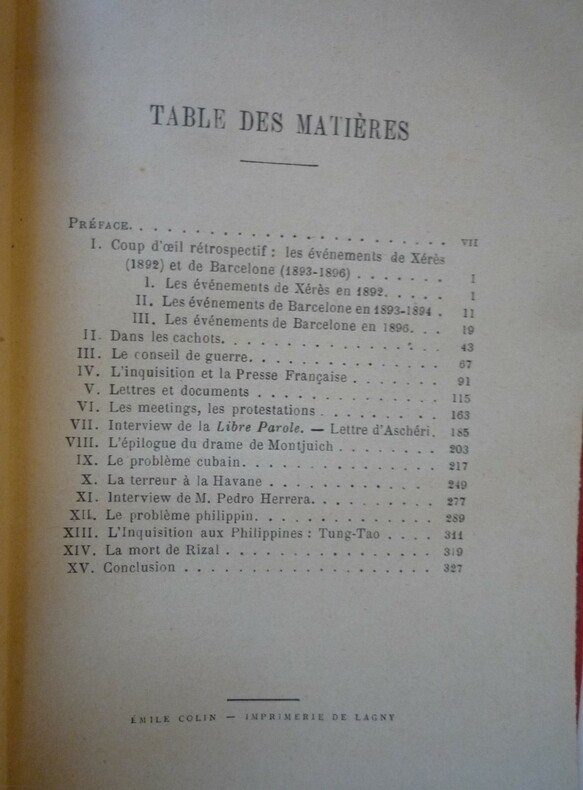
1897219Montjuich - Cuba - Philippines. Bibliothèque sociologique n° 17 Paris - STOCK- ancienne librairie Tresse et Stock - 1897- Format : 12 x 19 cm, broché, 346 pages couverture un peu salie sinon BON ETAT
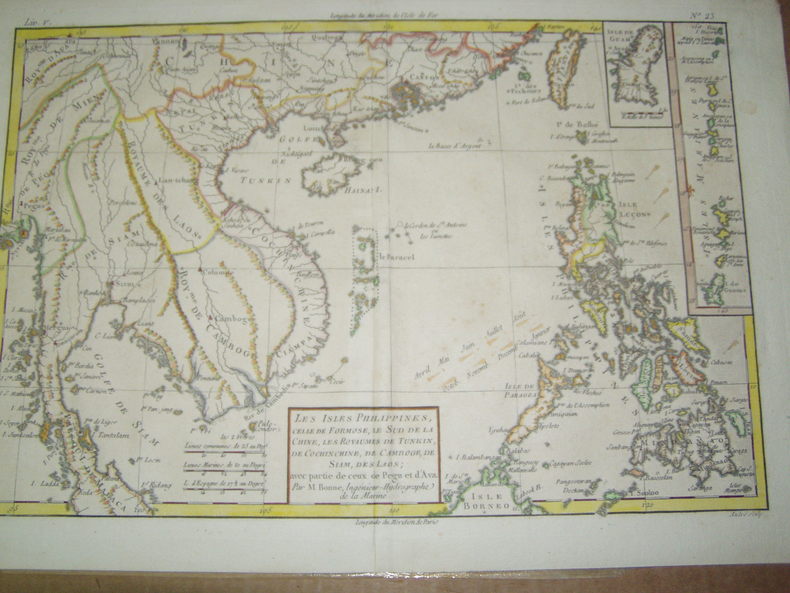
1782234851782 Paris, Lattré, 1782.; 310 x 470mm. Coloured.; Decorated with a title cartouche and the crests of the Cities.
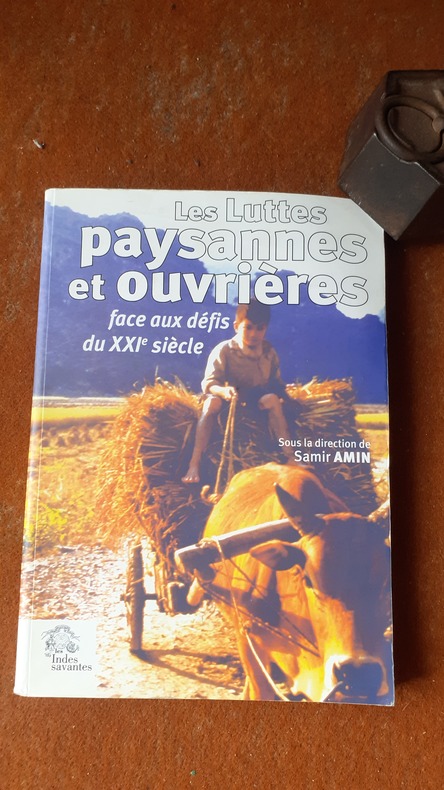
QWA-20725Les Indes savantes, 2005, in-8 br. (17 x 24), 366 p., "Forum du Tiers Monde / Forum mondial des Alternatives", bon état.
in-8°, 286 pages, reliure editeur cartonnagee sous jaquette illustree par Mayer. Exemplaire TTB, bien propre et bien complet de la jaquette. [SAS] Roman sur les luttes de guérilla dans les Philippines.
ORD-4376Masson. 1951. In-8 br. 259pp. croquis, photos et tableaux dans le texte. Exemplaire un peu abîmé, cachets de bibliothèque.
1965112084Nestlé, Peter, Cailler, Kohler 1965 In-4 relié 29,6 cm sur 23,2. 131 pages. Couverture et dos légèrement passés, intérieur très propre. Bon état d’occasion.
198024197Rome, IDOC et P., L'Harmattan, 1980, in-8°, 186 pp, 2 cartes, broché, bon état
in-8°, 347 pages, ill. hors texte N&B, carte, relie plein cuir decore ed. Tres bel exemplaire. [RE-3] L’aventure vécue du « général » américain Fertig chez les maquisards des Philippines (1942-1945).
1970124490Genève, Edito-Service, s.d. (1970) in-8°, 348 pp, traduit de l'américain (“They fought alone”), 32 pl. de photos hors texte (iconographie réunie par Roger Jean Ségalat), une carte, reliure simili-cuir bleu décorée de l'éditeur, mors fragiles (comme toujours), bon état
N°297, d'avril 1971, de la revue mensuelle dirigée par Jean-Paul Sartre; au sommaire: "La terre ferme" de Christine DAURE, "Dictature du prolétariat, classes sociales et idéologie prolétarienne", article de Paul SWEEZY et sa réponse par Charles BETTLEHEIM, "L'idéologie mexicaine" par Léo GABRIEL, "L'Afrique recolonisée ?" par Basil DAVIDSON, "Le Mouvement de libération nationale aux Philippines" par Rodrigo ROJAS, des lettres de détenus de la prison californienne de Soledad, "La vie quotidienne dans l'empire du Fer (un voyage en Lorraine)" par Jacques-Alain MILLER et François REGNAULT, des critiques théâtrales (Vauthier, Shakespeare, Vassilikos) de Renée SAUREL et cinématographiques de Christian ZIMMER. Français
197029657Couverture souple. Broché. Environ 200 pages. Cachet.
8vo., Second Edition, with plates and maps, small neat signature on front free endpaper; maroon cloth, upper board and backstrip lettered in gilt, a near fine copy in unclipped, mildly age-soiled dustwrapper. First published in 1956. VERY SCARCE IN THIS CONDITION.
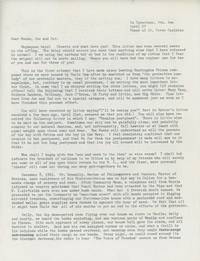
1945List2748Philippines 1945. Single letter; five 8.5 x 11†pages. Pinhole at top of first page missing final pages overall fine. The unknown author of this letter was an American Jesuit missionary in the Philippines who before the war was a novice living in Novaliches just outside Manila. He apparently had not written a significant letter home for a long time: in this letter written in April of what is likely 1945 he recounts his experiences from between December 8 1941 and early January of 1945 shortly before the civilian POW camp in which he was interned was liberated.<br /> <br /> After the “Nips†bomb Pearl Harbor “A feverish month ensuedâ€:<br /> <br /> “We proceeded to put the Community on ‘war-time alert’ with all hands occupied in digging air-raid trenches camouflaging our fortress-like house with a garlanded roof and mud-daubed walls; grain supplies were rushed in against the hour of need. We felt that all it might take Uncle Sam all of six months to put an end to the efforts of the pretender.â€<br /> Around Christmas they evacuated to the Jesuit Ateneo Grade School then in Intramuros as the Japanese were advancing quickly towards Novaliches. Of course this did not prove to be much safer:<br /> <br /> “When darkness came the Japs began their bombing of the Port Area. The bombs began to bounce off the pavement; bombers just skimming our roof-top on their way. We spent the night on our tummies and how we prayed. We thought that each decade of the beads would be our last this side of Purgatory. . When the church sto Domingo was hit the floor beneath us did some tricks and we were lifted up a bit and let down amidst the dust and smoke that poured in from above.â€<br /> <br /> The missionaries try to “salvage important papers and other valuables from the Mission House prior to abandoning it to the fire which threatened the entire Walled City.†During this time they and “a thousand refugees†live in the Ateneo while “Dawn and night raids were supplied by the Japs with nary an American plane to say to them no†– American forces had taken a serious hit and withdrawn outside Manila. It was declared an open city before “the little scrawny but arrogant Japs came into the city and took over†in January of 1942.<br /> <br /> The missionaries persuade the Japanese to let them stay in the Ateneo:<br /> <br /> “We convinced them that it was impossible for us to give up the building because it belonged to the Pope and the Vatican State would hold us responsible. This argument with many ingenious trimmings enabled us to hold on to the Ateneo until June ‘43 when the main building was taken for a military hospitalâ€.<br /> <br /> The author describes how despite what he calls his “partial internment†in Manila he is able to get around checkpoints by pretending to be Belgian. He finishes his studies and begins work at a Belgian convent in Paranaque in February of 1943 living between there and Manila:<br /> <br /> “Incidentally none of this would have been possible if the Japs had gumption enough to find out that I was one of the hated Americans. . All vehicles were obliged to stop here a checkpoint at Baclaran and all passengers get down and file between a Jap sentry and a Filipino constabulary soldier to be searched for hidden arms etc. Since several Belgian Fathers not considered enemy aliens frequently passed this way I was able to walk through unmolested as an unoffending Belgian. . I carefully kept my helmet covering the tell-tale red arm-band which was worn on the arm furtherest away from the Jap. The Filipino would do no more than give me a knowing grin.â€<br /> <br /> On July 10 1944 all of the American civilian POWs are taken to internment camps in Santo Tomas and then Los Baños. In Los Baños the POWs cut wood repair roads and farm. Los Baños would be liberated in February of 1945; the author paints a slightly confusing picture of the leadup to this:<br /> <br /> “Conditions generally ‘worsened’ when on Jan. 8th about the time that the American troops landed at Mindero an island just across from Batangas the Japs got jittery believing that the Yanks were going to do the obvious and cross over the bay to Batangas and they the Japs at Batanga decamped! ‘You are free but remain in camp until the Americans come. Outside your camp Japanese troops will shoot any who leave.’ Great was the joy in Mudville. From nowhere came flag poles on which we quickly unfurled American and British flags .; a short-wave radio was set up and we enjoyed daily Frisco broadcasts .â€<br /> <br /> It sounds as if the missionary was reporting contrary to the usual narrative of the Los Baños raid that the Japanese had essentially given up control of the camp and were like the prisoners simply waiting for the Americans to come get their people. Perhaps something further happened in the nearly two intervening months; however the remainder of the letter is missing.<br /> <br /> Of interest to scholars of modern Jesuit history and of the civilian POW experience during the Second World War. unknown
0332432904.Ghardcover. Good. Access codes and supplements are not guaranteed with used items. May be an ex-library book. hardcover
133269926X.Gpaperback. Good. Access codes and supplements are not guaranteed with used items. May be an ex-library book. paperback
139017025X.Gpaperback. Good. Access codes and supplements are not guaranteed with used items. May be an ex-library book. paperback