235 résultats
2002789842002. illustrations some color 116 156p. Wrapper. 30cm. Japanese text summaries in English. We used the English title which appears on the cover and title-page along with the Japanese. <br/><br/> unknown books
1935857951935. MAGICIANS - JAPAN. TAMC KAIHÔ OFFICIAL ORGAN OF THE TOKYO AMATEUR MAGICIANS CLUB. Vol.1 #1 thru Vol.2 #1 5 issues in all. Published in Tokyo from January 1935 to May 1936. Text in Japanese but the first 4 issues of 4 and 8 pp. include translations into English on mimeographed sheets the last issue of 12 pp. includes no such translation. Illustrated with photo plates throughout. The first issue is a bit tattered else the others are good or better condition. Very unusual and interesting run of this ephemeral magazine. unknown books
1748826931748. MAP - JAPAN. SETTSU NO KUNI MEISHO. Kyoto Kimura Juyodo Kan'en Gannen 1748. A handcolored woodblock printed map of Settsu provice containing the area of Osaka castle etc. 117.3 X 129.1 cm folds into heavy paper covers of approximately 27.7 x 18.9 cm. The original title slip is gone replaced by a handbrushed label: "Osaka no Kuni" "Carte Baie d'Osacca". Lovely and interesting map found at Beans main volume p.22 1748.1. Condition is very good printed on very strong and supple paper. For a detaiuled illustration see the record at UBC's website for the Beans copy: http://angel.library.ubc.ca/cdm4/item_viewer.phpCISOROOT=%2 Ftokugawa&CISOPTR=286&DMSCALE=50&DMWIDTH=600&DMHEIGHT=600&DM MODE=viewer&DMFULL=0&DMX=75&DMY=44&DMTEXT=&DMTHUMB=1&REC=2&D MROTATE=0&x=266&y=296 Our copy has different hand-coloring. The Beans copy hand-colors the harbor ours hand-colors the land primarily. From the collection of Roger Keyes. unknown books
1900857941900. MAP - JAPAN IMPERIAL GEOLOGICAL SURVEY OF JAPAN. TOPOGRAPHICAL MAP OF THE JAPANESE EMPIRE. Engraved by N. Matsudaira printed by G. Yoshii at the Toyodo in Tokyo 1900. This huge 5.33'x 6'164 x 183 cm map has a colored inset of the political divisions of the empire and another inset of Taiwan and environs as well as a superbly detailed map of Japan itself. There is some weakening of folds but overall in good condition folded and enclosed in a printed cover box. A monumental work in English throughout. By no means common. unknown books
1852864251852. MAP - JAPAN SEKISUI Chô & SUZUKI Kien. ZOTEI DAI NIHON KOKUGUN YOCHI ROTEI ZENZU. Edo Osaka & Kyoto. Zodiacal date of Kaei 5 1852. Identical to the copy illustrated online from the UC Berkeley collection save that their copy is a standard one-piece folding map in covers. See: http://www.lunacommons.org/luna/servlet/detail/RUMSEY~9~1~24 291~110045:Zotei-Dai-Nihon-kokugun-yochi-rotei Ours is the same size when assembled some 102 x 183 cm but is bound in 12 separate folding sections each identified on the cover by area each approximately 35 x 46 cm. This would seem to have been done by the publisher for ease of use a series of "pocket maps". They are all enclosed in a small clasped chitsu case some 12 x 8 x 3 cm in size with a mica-paper liner and a cloth exterior. There is a smaller size version some 72 x 40 at 1852.1 in the first volume of Beans referenced from Ramming 1934 at #28 - obviously a misprint of some kind as it would be hard to understand a smaller size recut map existing. In any case a very interesting format and a lovely detailed map in a "modern" style employing degrees of latitude but printed in traditional color woodblock. Very good condition impression and colors. An excellent example of Japanese cartography in transition. unknown books
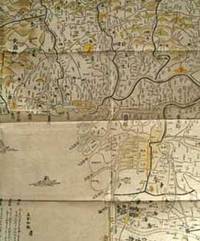
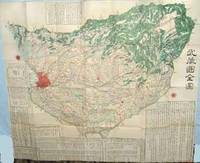
1856826971856. MAP - JAPAN Gyokuransai SADAHIDE & Kikuchi Shûzo. MUSASHI NO KUNI ZENZU. Edo Kikuya Kosaburo & 12 others. Ansei 3 1856 112 X 127 cm. An interesting colored woodcut map of the Musashi plain. Folds into its original titled covers 28 x 18.6 cm. Nice colors impression and colors. Sadahide was not only a talented printmaker but was also responsible for several important maps of the time. Beans 1856.13 in Supplement B page 41. See the UBC website at http://angel.library.ubc.ca/cdm4/item_viewer.phpCISOROOT=/t okugawa&CISOPTR=312&REC=3 for more info on this map. From The Keyes collection. unknown books
19072222218<p>First edition. Octavo. Illustrated by S. Morita and R. S. Hayata.Frontispiece portrait. Original green pictorial cloth with design in red white pink and gilt of rising sun flag Mt. Fuji and cherry blossom t.e.g. No dust jacket. Very good. 301 pages; 22 pages of reviews and ads. No signatures or bookplates.</p><p>Printed by The Wilkens-Sheiry Press Washington D.C.</p><p>Front pastedown with text in Japanese.</p> The Baker & Taylor Company hardcover books
198732154New York: Japan Society 1987. First edition. Stiff paper wrappers. A fine copy. 81 pp. Illus. with 15color & 16 b/w plates. 4to. Exhibition letter laid in loose. Issued in conjnction with the May 12-June 28 1987 exhibition. Two articles plates artists' biographies. Japan Society unknown books
1922409811922. NATIONAL RESEARCH COUNCIL OF JAPAN. JAPANESE JOURNAL OF BOTANY. Transactions and Abstracts. Tokyo: 1922-1941. Volumes 1-11 the serial continued until 1970. Vols. 2-11 bound in black cloth vol.1 #1-4 in wrappers. Wrappers torn at spines front wrapper missing of vol.1 #2. Some soiling at boards. Very good. unknown books
195332361Tokyo: Nihon Kotsu Kosha 1953. Cloth. A good copy discoloration to spine and front board a bit shaken. Unpaged. Illus. with approximately 400 b/w photos and 50 small maps. "Pictures of Japanese Hot Spring Spas." Covers approximately 70 spas most in two page spreads. Four pages of text eight pages of lists and twenty pages of advertisements. Nihon Kotsu Kosha hardcover books
2014215377San Francisco: Japanese Cultural and Community Center of Northern California 2014. 127p. very good softcover 8.5x11 inches. Color photographs. Report on aid by the San Francisco-based organization with help from community groups and institutions such as the Giants baseball team. Japanese Cultural and Community Center of Northern California unknown books
1977S8099Kyoto:: Organizing Committee of Japan 1977. 1977. 4to. 50 pp. Abstracts index. Printed wrappers. FINE. Includes a typed letter from a Japanese school boy to Caltech professor Norman Horowitz concerning the issue of life on Mars with an ms. response by Horowitz whose famous experiment to detect carbon based life on Mars is featured as an abstract in this publication. Organizing Committee of Japan, 1977. unknown books
1954254221954. Softcover. VG- some fading along cover edges a bit of writing on inside back cover. Pale green wraps. Appx. 75 pp. 1 color 64 bw plates. Includes a checklist of 64 works in English. Essays & descriptions of the plates in Japanese. Essays include "Chinese Clay Figures" "Remarks on the Han Tombs of To-chi-t'ai Shensi Province" and "Folk Tales Concerning Mortuary Ware" paperback books
1853WRCAM53554Edo 1853. 31; 31; 61pp. plus a loose sheet. Original paper wrappers stitched. Contemporary manuscript annotations in red ink in one volume. Scattered worming heavy in places. Some dampstaining and dust soiling. About very good. Three fascinating Japanese manuscript accounts of the arrival of Commodore Perry to Japan in 1853. Then first URAGA KUROTONE NI KANSARU or "The Black Ship Arriving in Uraga" comprises the official government report of events when Perry steamed into Uraga Bay. This volume contains contemporary edits to the text in red ink. The second account of Perry's arrival EDO URAGA BIKOKU FUNE TORAI IKKEN or "Arrival of the Ships at Uraga" contains a double-page manuscript sketch of the coastline of Uraga Bay together with the disposition of Perry's ships. The final volume consists of a third manuscript entitled GASSHUKKO SHOKAN WAGE UTSUSHI a copy of the report on the Perry arrival prepared by Abe Masahiro Chief Senior Councillor in the Toguwara Shogunate which includes translations of the letters from Fillmore and Perry delivered by Perry on July 8 1853. Also with a single manuscript sheet that provides a description of Perry's ship. <br> <br> Vital contemporary manuscript accounts of this monumental transformation in Japanese foreign relations from significant Japanese participants in events. unknown books
1854WRCAM52135Yokohama 1854. 1p. Oblong folio sheet previously folded. A couple minor creases with very light dampstaining at foot of sheet. Very good. An impressive survival from Commodore Perry's expedition a decorative manuscript menu from the banquet that celebrated the agreement of the Treaty of Kanagawa between the United States and Japan in 1854. Although an official and extensive trade agreement between the two countries was not reached until 1858 the Treaty of Kanagawa achieved Perry and the United States government's primary goal of opening Japan to U.S. trade by allowing the use of two ports at Shimoda and Hakodate by American ships granting a degree of freedom of movement to American sailors while in port and establishing diplomatic relations via the appointment of an American consul. <br> <br> The banquet was held in the Treaty House at Yokohama which had been purpose-built for negotiating the agreement between the two countries. It was a return engagement following a first event hosted by the Americans on board Perry's flagship the U.S.S. Powhatan at which copious amounts of lamb beef and whiskey were reportedly served. The menu for the Japanese meal reflected the country's altogether different culinary tastes offering a long series of soup and seafood courses including sea bream and a number of other fish. It is unclear which side found the other's food more distasteful but Perry remarked that the Japanese offerings "Seemed particularly meager in comparison with American fare and soup however desirable in its proper place was found to be but a poor substitute for a round of beef or a haunch of mutton." For their part the Japanese were unimpressed by the Americans' loud and uncouth behavior at the event and were amused by their inability to use chopsticks. <br> <br> Despite the reservations of each side the banquet served as a capstone to one of the most critical moments in the development of Japanese-American relations. This possibly unique piece of ephemera is a wonderful document of that entertaining cross-cultural episode and the culmination of the Perry expedition. unknown books
1859WRCAM55020Japan 1859. 354pp. including twelve full-page or double- page ink and watercolor wash illustrations. Contemporary Japanese wrappers string-tied paper label completed in manuscript on front cover. Noticeable wear and rubbing to the binding newer string. Uneven worming throughout mostly unobtrusive. About very good. In a half morocco and cloth clamshell box spine gilt with raised bands. Large bound collection of contemporary manuscript papers documents and drawings relating to Commodore Perry and the Black Ships entering Edo Bay in July 1853. The text is comprised of accounts of the event and transcriptions of official letters from President Millard Fillmore Secretary of State Edward Everett and Commodore Perry to the Japanese Emperor. Illustrations include two double-hemispheric world maps a map showing the course of the Black Ship squadron Edo Bay and the landing of the ships Perry's marines marching sketches of large cannons aboard Perry's ships and diagrams and fortifications protecting the Japanese people from foreign invasion. <br> <br> In 1852 Perry was appointed head of a naval expedition charged with inducing the Japanese government to establish diplomatic relations with the United States. The expedition involved two visits to Japan. On his first Perry arrived at Edo Bay on July 8 1853. After a brief standoff and show of force he was able to land the following week and deliver a letter from President Fillmore with the U.S. demands with the promise he would return the following year for a reply. On February 13 1854 Perry returned with a total of ten vessels and 1600 men. After another standoff and three weeks of negotiation Perry signed the Convention of Kanagawa at the end of March 1854 which opened the ports of Shimoda and Hakodate to American ships provided for care of shipwrecked sailors and the establishment of an American consulate in Shimoda. "The most important result however was that the visit contributed to the collapse of the feudal regime and to the modernization of Japan" - Hill. <br> <br> Altogether a very comprehensive manuscript archive of this important occasion that helped open Japan to world commerce and culture. HILL 1332 ref. hardcover books
1853WRCAM55689Japan 1853. 14pp. including three double-page woodblock illustrations. Gathered signatures stitched as issued. Mild wear. Near fine. Rare kawaraban newsbook announcing the arrival of Commodore Perry and the Black Ships to Japan in 1853. The work includes three double-page illustrations: a dominating portrait of Perry's flagship; Perry and a contingent of marines marching in procession to a meeting with local dignitaries at Kurihama with two cabin boys carrying boxes presumably official gifts or President Fillmore's letter requesting harmonious commerce; and a map of Edo Bay where the Black Ships entered. Listings of the Samurai and Daimyo Feudal Lords entrusted with the protection of Japan from foreign invasion are found on the final leaves. Such kawaraban - news sheets broadsides or small periodicals - provided the most immediate contemporary news of events in Japan including Commodore Perry's momentous first visit. unknown books
1853WRCAM52129Uraga Bay Japan 1853. Pen and ink manuscript scroll on thick mulberry paper in Japanese 10 1/2 x 125 inches. Mounted on a wooden roller and with a small contemporary cloth extension panel to the scroll cotton tie. Manuscript backed on thick paper a few worm holes at upper margin of the final panel occasional brown stain at upper margins of first few panels a few tiny holes some old creases. Very good. A Japanese manuscript depiction showing the parade of Commodore Matthew Perry and his forces on the shore at Uraga Bay to visit the Japanese Princes on July 14 1853. An important piece of American naval and diplomatic history and a rare survival of a Japanese "Black Ship" Scroll for the 1853 arrival of Perry this is one of only a handful to have survived. <br> <br> Perry's sudden arrival near the entrance to Tokyo Bay at Uraga on July 8 1853 with two sloops and two paddle-steamer battleships carrying letters and gifts to deliver to the Emperor threw the Japanese authorities into a tailspin. The reports went back to the Emperor who immediately took ill presumably fearing an invasion. For several days there was a stand-off the smaller Japanese vessels amassing around the American vessels one of which had ninety-two cannons. Local warlord families took up arms all around the Bay and made promises of men for the defense of Edo. For five days the stand-off continued and Perry stayed in his cabin and let it be known he had a letter from President Fillmore to deliver to the Emperor and only the Emperor or his emissary could receive it. The Japanese first threatened him then tried to bribe him to leave and go to Nagasaki to complete his mission. Perry stood firm and ignored the Japanese demands. <br> <br> Perry sent out smaller boats to start surveying the area and the Japanese stood aside wondering if the cannon would strike them. On July 14 a hastily erected tent was put up on the shore of the bay and two sons of the Emperor Princes Ido and Toda came down by Imperial barge from Edo and sat in the tent to receive the letters. Perry arrived with his troops his marching band playing the Stars and Stripes flags flying. He formally delivered the letters and said he would be back in a year for an answer to the President's call for a trade treaty with Japan protection for shipwrecked sailors and the establishment of refueling stations for American ships in the Western Pacific. The Japanese asked him to leave quickly but he stayed anchored for a further three days then spent some time doing surveys of other parts of Edo Bay returning via Okinawa to winter at the American station in Hong Kong. He returned the following February with a larger flotilla strengthened by newly- completed battleship steamers sent out from the States. The second meeting took place at Yokohama from February to June 1854 where Perry insisted that negotiations begin and at that time there was an exchange of diplomatic gifts. A provisional treaty was signed in 1854 but the full trading treaty was not completed until 1858 after Townsend Harris came to Japan as U.S. Consul and set about finalizing the negotiations. <br> <br> The artist of this piece certainly documented the action well. It begins with a panel showing an American officer and three soldiers from the ship continues with eight sketches of hats seven instruments of the band and a naval sword two small barges that brought the crew and troops to the shore a detailed annotated sketch of the flagship Susquehanna followed by the procession of the 300 Americans from the shore to the receiving tents the Stars and Stripes waving and including the band and a similar sketch of the Japanese procession with clan banners a sketch of the receiving area with a parade ground and two tents and a final view of Uraga Bay with the four American ships at anchor and the landing place on the shoreline. <br> <br> While the census for the scrolls and scroll fragments depicting Perry's second arrival in 1854 number at least twenty in institutional hands for the 1853 arrival of Perry we locate only one - a ten-foot watercolor scroll in the British Museum for which this is either a precursor or a contemporary near- copy. A close comparison with the British Museum scroll has yet to be accomplished but there are textual differences in some of the captions and it appears from the sketchy monochrome nature and uncolored state of this scroll that it is more likely a provisional sketch done from observation by a Japanese artist who attended the event rather than a contemporary finished scroll. It is likely that after the meeting with Perry the warlord attendees would have been presented with a finished watercolor scroll. This scroll may well be the original provisional version of that finished sketch. <br> <br> An extraordinarily rare and important "Black Ship" Japanese scroll. hardcover books
1856WRCAM55468N.p. but probably Tokyo 1856. Ink and watercolor on twenty-five linen- mounted rice paper panels joined into a scroll measuring approximately 10 1/2 inches x 29 1/2 feet. Mounted on a wooden roller with silk tie housed in a custom balsa wood box. Intermittent creasing fairly regular small chips to bottom edge sometimes costing a bit of the image area. Very good. An incredible informative and beautifully rendered "Black Ship Scroll" giving a thirty- foot long visual account of the visit of Commodore Perry's U.S. naval squadron to Shimoda in the wake of the signing of the Treaty of Kanagawa. It is an awe-inspiring artifact of a momentous event in American and Japanese history and a brilliant work of art. <br> <br> Perry's 1854 arrival in the remote port of Shimoda aroused great curiosity and was recorded both by anonymous artisans as well as real artists the latter being the case for the present scroll. One of Perry's interpreters S. Wells Williams reported seeing similar scrolls depicting the naval visit just a few weeks after they anchored. He wrote in his account of the visit: "A pictorial representation of our squadron and description annexed and an account of the war between England and China were seen today by officers." Williams goes on the remark that it was forbidden to sell these scrolls to Americans and in fact being a non- trading closed society Japanese officials discouraged personal purchases of any kind by U.S. personnel. <br> <br> Evident in the present scroll is the Japanese fascination with American military technology. Perry's official account made note of the Japanese being insatiably inquisitive when invited on board: "When visiting the ship the mandarins and their attendants were never at rest: but went about peering into every nook and corner peeping into the muzzles of the guns.They were not contented to merely observing with their eyes but were constantly taking out their writing materials their mulberry bark paper." <br> <br> The present scroll depicts the deck and equipment details of one of Perry's frigate steamers as well as handsome harbor scenes of the numerous ships at anchor including a moonlight view brilliantly-colored American flags flying from the masts of the ships undulating coastlines maps of the locations of Perry's ships the narrative of their travel from Edo Bay a portrait of Commodore Perry and two of his interpreters and an account of naval gun salutes and the burial of a sailor with a rendering of his tombstone. Also shown is a small American military band large portraits of several of Perry's ships a detail of an American landing party departing one of the imposing Black Ships and much more. On the whole the expert illustrations give not only the details of Perry his men ships and their armaments but a sense of the level to which the American squadron impressed the Japanese. Accomplished by an artist that would almost certainly have had firsthand knowledge of the visit of the American squadron it is a far more artistically-polished memorial of Perry's extraordinary visit than many of the more folk-art type scrolls that make up the majority of surviving examples. <br> <br> Perry's sudden arrival near the entrance to Tokyo Bay at Uraga on July 8 1853 with two sloops and two paddle-steamer battleships carrying letters and gifts to deliver to the Emperor threw the Japanese authorities into a tailspin. The reports went back to the Emperor who immediately took ill presumably fearing an invasion. For several days there was a stand-off the smaller Japanese vessels amassing around the American vessels one of which had ninety-two cannons. Local warlord families took up arms all around the Bay and made promises of men for the defense of Edo. For five days the stand-off continued and Perry stayed in his cabin and let it be known he had a letter from President Fillmore to deliver to the Emperor and only the Emperor or his emissary could receive it. The Japanese first threatened him then tried to bribe him to leave and go to Nagasaki to complete his mission. Perry stood firm and ignored the Japanese demands. <br> <br> Perry sent out smaller boats to start surveying the area and the Japanese stood aside wondering if the cannon would strike them. On July 14 a hastily erected tent was put up on the shore of the bay and two sons of the Emperor Princes Ido and Toda came down by Imperial barge from Edo and sat in the tent to receive the letters. Perry arrived with his troops his marching band playing flags flying. He formally delivered the letters and said he would be back in a year for an answer to the President's call for a trade treaty with Japan protection for shipwrecked sailors and the establishment of refueling stations for American ships in the Western Pacific. The Japanese asked Perry to leave quickly but he stayed anchored for a further three days then spent some time doing surveys of other parts of Edo Bay returning via Okinawa to winter at the American station in Hong Kong. <br> <br> Perry returned the following February with a larger flotilla strengthened by newly- completed battleship steamers sent out from the United States. The second meeting took place at Yokohama from February to June 1854 where Perry insisted that negotiations begin and at that time there was an exchange of diplomatic gifts. A provisional treaty was signed in 1854 but the full trading treaty was not completed until 1858 after Townsend Harris came to Japan as U.S. Consul and set about finalizing the negotiations. <br> <br> Perry's return in 1854 with a much more substantial force provoked the same curiosity and trepidation among the Japanese populace as his first visit if not more so and it is this second visit that is captured in the present scroll. The Americans arrived by steam frigates the "black ships of evil men" as well as under sail with their canons and howitzers conspicuous. This second visit to Edo Bay was a purposeful display of the United States' superior military force to impress an essentially feudal society - all the better for Perry to encourage the signing of a treaty allowing American whalers to use the islands as a resupply outpost of America's burgeoning economic empire and Pacific expansion. <br> <br> Following the signing of the Treaty of Kanagawa on March 31 1854 Perry visited the two ports named as open to American ships Shimoda and Hakodate. Americans were also allowed to travel inland from these ports to a proscribed distance of seven ri approximately seventeen miles. Officers were allowed onshore and the manners appearance and customs of the Americans were of nearly insatiable interest to the inhabitants of these remote fishing villages. This was the first interaction common Japanese citizens had with Westerners. <br> <br> The present scroll descends from the Perry family specifically Calbraith Perry Rodgers famed aviator and Commodore Matthew Calbraith Perry's great-grandnephew. The scroll is accompanied by a later typed transcription of an 1858 account of Commodore Perry's life by R.S. Rodgers. <br> <br> One of the more impressive examples of a Black Ship Scroll documenting Perry's second interaction with the Japanese rulers and people executed by an accomplished Japanese artist and descended through the Perry family. unknown books
1884859271884. PHOTO ALBUM - JAPAN. 25 OUTDOOR SCENES AND STUDIO POSED PHOTOS. Small late 19th century oblong 12 x 18.3 cm album of albumen photos of landscape and city scenes genre shots of trades and customs in the studio each about 9.5 x 13.5 cm image size. Brocade covered boards. The images are skillfully handcolored with very little fading. The covers have a bit of rubbing and the condition overall is very good. With the inscription of Capt. John C. Cooper from 1884 and hence a bit earlier than most albums one sees and certainly more interesting. unknown books
8482718. PHOTO ALBUM - JAPAN. 30 Albumen Scenes around Nikko. Small late 19th early 20th century oblong 11.5 x 17.8 cm album of albumen photos of Nikkô each about 9.5 x 14 cm. Simple lacquer covers. The images are bw with a bit of fading as usual. The condition overall is very good. $485.00. unknown books
8575718. PHOTO ALBUM - JAPAN. 50 ALBUMEN OUTDOOR SCENES AND WOMEN. Small late 19th early 20th century oblong 13.4 x 18.3 cm album of albumen photos Half of the album is made up of shots of Japanese women in kimono in the studio and out. The other half is a catalogue of tourist scenes each about 9 x 13 cm image size. Decorated lacquer covers with insets. The images are handcolored with quite a bit of differential fading the reds stand out. The covers have a bit of edgewear and gouges but the condition overall is good. Interesting for its emphasis on women. unknown books
1923851721923. PHOTOGRAPHY - JAPAN ALBUM OF 85 SNAPSHOTS OF JAPAN 1916 - 1923 FUJIYAMA AND MORE PLUS SIX LOOSE PHOTOGRAPHS AND A PHOTO POSTCARD. 5 1/2 x 8 inch flexible black cloth covers cord-bound with "Photographs" in gilt on front cover. Black paper mounts neatly captioned in white ink mostly in English with some Japanese. Images are b/w sepia or color only two are in color and range in size from 2 1/4 x 3 inches to 4 x 6 inches. The majority 63 are the smaller size. The album is in good condition as are the page mounts and the photographs are in very good condition. The loose photographs range in size from 2 1/4 x 3 inches to 4 x 6 inches and are sepia or b/w. They are captioned in ink on the reverse. Most of the album photos depict expeditions to climb Fujiyama and various of the Japan Alps with scenes along the way of people and places -ecstatic pilgrims the Imperial bodyguard women's groups schoolchildren and the photographer and his many climbing companions foreign and Japanese. The owner is not identified although some of his companions are: Arnold Bauer Charles W. Copp Harry Collins Professor Fujimura McKinnon etc. along with a group of boys from Matsumoto High School and several others. Excellent and interesting group of photos of the breathtaking mountain scenery of Japan. Mountaineering was and is a defining interest of the Japanese - there are still gods in those mountains. unknown books
1989267375Tokyo: Toppan 1989. hardcover. fine/very good. Text in English and Japanese. 561 pages thick square 4to grey cloth black glossy French fold dust wrapper. Tokyo: Toppan 1989. A fine copy in a very good dust wrapper just some light surface rubbing to wrapper.<br/><br/> In protective cardboard sleeve<br/><br/> Toppan unknown books
192222181Japan: International Newsreel 1922. Black and white photo of two traditionally-garbed Japanese men seated in a small shop; a ledger visible on floor hanging notices; Text of attached press notice states ".A customer who comes into the business department of a modern Japanese store to pay his bills sits on the edge of the "department" and keeps his dirty feet off the clean white matting for which the houses of Japan are famous."; approx. 6 1/2" x 8" size; notice attached to photo; International Newsreel studio stamp on back and 'Jap Drawer' handwritten; some edgewear crinkling to photo; in very good condition. . First Edition. Not Bound. Very Good. International Newsreel Paperback books