West Japan Historical Society [ed]Biblio.com
ORTELIUS (Abraham).Livre Rare Book
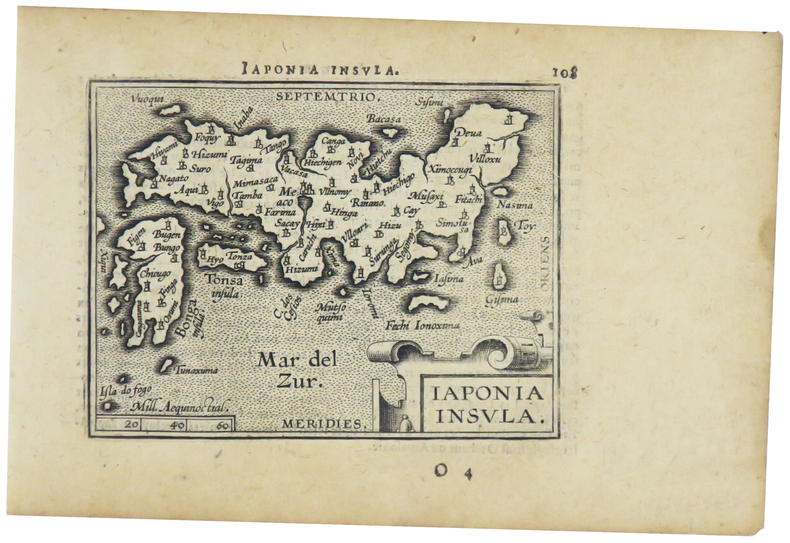
Japonia insula.
1598LBW-1424[Anvers, 1598]. 82 x 102 mm.
Librairie Le Bail · Paris, France250,00 €
19 résultats
15632080702109500041West Japan Historical Society 1563. Soft Cover. Fine. Number of pages: book size: 21cm West Japan Historical Society paperback
1524101861524 Programme du Théâtre Kabuki de Tokyo, Odéon Théâtre de France, 15 au 24 octobre 1964 - Agrafé,in8, 21 cm x 27 cm, 26 pages (non paginé), photos noir & blanc in et hors-texte Textes de René Sieffert et Jean-Louis Barrault, présentation des pièces, distribution Très bon éta
1598LBW-1424[Anvers, 1598]. 82 x 102 mm.
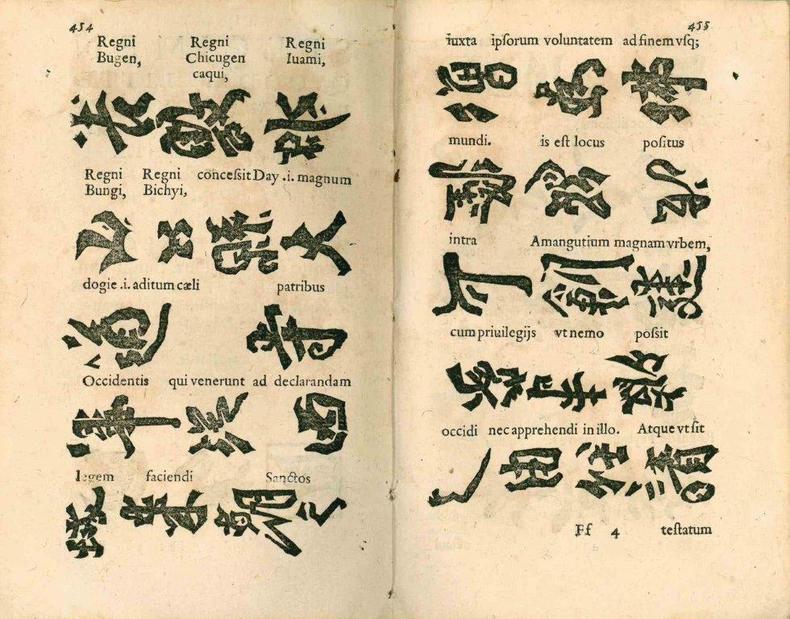
15742459Cologne, G. Calenius, 1574. 1574 1 vol. in-8° (164 x 111 mm) de : [16] ff. (titre avec vignette de bois gravé, epîtres, index) ; 472 pp. ; nombreuses lettrines historiées de bois gravé, 5 planches de caractères japonais de bois gravé. Plein vélin d'époque, dos titré à l'encre brune. (Restauration de papier à l'angle inférieur de la page de titre avec très léger manque de texte).
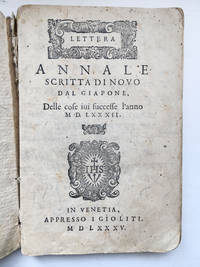
15854676<p>ENTRY NO. 1 IN BOSCARO<br />THE FIRST REFERENCE TO THE JAPANESE EMBASSY OF 1585 PRINTED ON THE TITLE-PAGE</p><p>Venice I Gioliti 1585.</p><p>Small 8vo 15.3 x 10 cm 103 pp. Bound in old vellum. Discrete former ownership stamp on title. Gutter margin of title reinforced; inconsequential toning otherwise excellent.</p><p>Rare early edition of this Jesuit letter containing news of missions and activity in Japan from the year 1582 the only edition of 5 printed that year to contain a title-page advertising the famous Japanese embassy of 1584-86. Significantly the work also discusses the embassy the participants and their noble lineage and expresses the hope that the embassy will prove a convincing sign of the Jesuit's spectacular success in Japan p. 7. The present imprint of this edition comprises the first entry in Boscaro's bibliography of printed works related to the embassy. It thus stands at the head of nearly 50 works printed in 1585 alone to record and commemmorate an event that-in addition to providing a public relations coup for the Jesuits-became a watershed moment in cross-cultural exchange between the Orient and the West: "no Japanese emissaries to Europe either before or since aroused comparable interest or enthusiasm" Lach.</p><p>In the annals of international relations between Europe and Japan in the 16th C it is particularly noteworthy "how the physical presence of the Japanese in Europe stimulated an unexpected number of typographical presentations" Boscaro of which this particular Gioliti edition with the titlepage advertising the embassy-Portata de Novo Dal Giapone Dai Signori Ambasciatori-is the very first. Boscaro notes that there were four other editions of Coehho's letter published in Italy in 1585 around the time the embassy arrived in Venice on June 25 including another by Gioliti but none of these uses the embassy as a way to market itself.</p><p>The report itself is also a significant document of the embassy's genesis: Coelho composed it in February 1582 the month that the embassy of four Japanese Christian converts departed from Nagasaki. In it he describes the ongoing missionary activity across the country: e.g. in Hirado Amasuka Bungo and especially Funai Oita City the home of a thriving Jesuit college. Presumably the contents of this letter as the title suggests were "brought from Japan by the eminent ambassadors" as the latest news on the Jesuits current success in that faraway land.</p><p>Though the embassy did not reach Lisbon until August 1584 it eventually was as Coelho had hoped a resounding success: from 1584-86 the four young Japanese nobles were the object of intense curiosity wherever they traveled and they were treated to lavish receptions in Lisbon Madrid Florence Rome Venice and other cities throughout Catholic Europe.</p><p>Provenance: Alfred Hamy 1838-1904 French Jesuit historian and prolific author of books relating to the history of the members of the Company of Jesus.</p><p>OCLC: Cornell NYPL HU and Newberry. Boscaro 1; Alt-Japan 812; Sommervogel II.1267; Cordier 78; Laures 169; Pagès 22; Lach I.2.690.</p><p> Boscaro 1; Alt-Japan 812; Sommervogel II.1267; Cordier 78; Laures 169; Pagès 22; Lach I.2.690.</p> I Gioliti
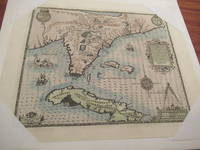
1592026339Frankfurt am Main 1591 1592. Original Antique Map . Single Sheet. Near Fine. Laid Paper. Size: Image And Border Approximately 17 7/8 Inches X 1M.5 Inches 45.2 Cm X 36.75 Cm. Debry Printed His Voyage To Virginia In 1590 As Part I Of His Works But Burden Mapping Of North America Provides No Record That A 1592 Printing Exists. This Map Has No Center Fold But Contemporary Engravings Exist Of The Offices Of The Great 17Th Century Cartographic Publishers With Row Upon Row Of Flat Drawers For Storage Of Single Maps; It Would Be Unreasonable To Believe That None Of These Unbound Maps Survived. This Appears To Be One Of Them Although The Consensus Of Modern Dealers Is That No Unfolded Large Map First Published In A Book Can Exist. Although We Have Been Unable To Locate A 1592 German Edition Of Debry We Believe This Is A Map As Issued In The 1592 German Edition Of De Bry Which Was First Published In 1591 And Subsequently Reprinted In 1592 And 1594 And In The Seventeenth Century. Small Cartouche At Lower Left Monogram With Text "Caesavece Matis. Privilegio Mdxcii" In The Plate Added After Original 1591 Printing. This Is An Unfolded Sheet Which Was Never Bound In A Book; A Strong Impression Without Damage And With Old Light Partial Coloring. Once Quite Aged Then Professionally Cleaned De-Acidified And Mounted Loosely With Archival Materials By A Museum-Experienced Conservator In About 2000. Scarce. And Now 430 Years Later It's Depicting A Hangout For Orangutans. <br/> <br/> unknown
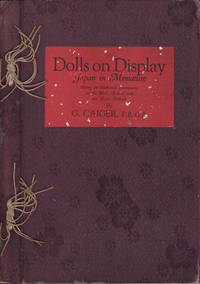
1519161165Tokyo: Hokuseido Press. 2nd Edition. Showa 15. 1940. 4 colour plates 2 folding numerous black and white photographic illustrations xi 141pp. Attractive purple cloth covered boards contrasting red cloth title label upper cover Japanese binding with tassel ties cloth worn with loss at corners and edges. Good copy. The author writing in the 1930s notes the young Japanese are becoming more Westernized "their bobbed heads buzz with thoughts of cinemas and sports. So it is that every year a decreasing number really understands the significance of the festival figures and their tiny trappings." The book is divided into two parts: The Girls Festival and The Boys Festival with an appendix. . Hokuseido Press. hardcover
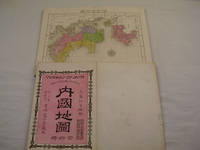
1518136414Bunkyu-do. Circa Meiji 11.5 1878. 2 volumes of a 4 volume atlas of Japan. Volume I: 4pp district list 22 double page copper engraved maps of Kinai Kyoto-Osaka region and Tokaido Tokyo-Kanto region 2 double page in colour 19 double page in black and white and one double page featuring 3 maps of island groups. Volume III: 27 double page maps 3 in colour and 24 in black and white map of the San'indo northern Chugoku region; San'yodo southern Chugoku region and Nankaid Chugoku region Shikoku. Relief shown by hachures. Printed on folded double leaves. Bound accordion style patterned paper covered boards. 26 x 17cm. Very nice clean volumes. Japanese text with Romanised titles on most maps and Romanised title on title page. The orientation of the maps vary. This atlas is surprisingly scarce. OCLC shows only one copy and even odd volumes are not often seen. A very nice example of late 19th century Japanese cartography. . Bunkyu-do. hardcover
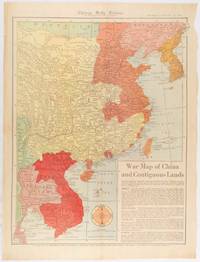
1519180794Chicago.: Chicago Daily Tribune. January 151942. Printed colour map on a single newspaper leaf 53 x 40.7 cm; 59.8 x 45 cm sheet inset text box marginal browning and at the folds but remarkably bright in very good condition. WWII map of China showing most of China Indo-China Thailand and Korea with territory captured and controlled by Japan shaded in orange and red published by the Chicago Daily Tribune barely six weeks after the bombing of Pearl Harbour. The text on the map reads "Since 1937 China has been at war with Japan. Lacking many essentials of war the Chinese nevertheless have managed to maintain a front against the aggressors. China's principal life line is the Burma road shown on the map which starts at Lashio Burma and extends to Kunming Yunnan province where it links with connections to Chunking the present Chinese capital". <br> <br>Based on a Rand McNally map the Tribune briskly got to work issuing maps for readers showing the beginnings of the war with Japan. Later maps were also published for sale separately but remarkably few have survived. <br>"… the historic Chicago Tribune was an innovator in color inks and printing but also a pioneer in bringing colorful art in the form of illustrations photographs cartoons and advertisements to the average person in an everyday medium." see The Janet A. Ginsburg Chicago Tribune Collection Michigan State University Libraries. . Chicago Daily Tribune. unknown
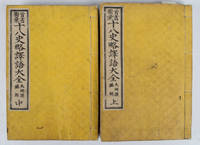
1518165201大阪.Osaka.: 明善堂. Meizendō. 明治15 1882. Volumes 1 and 2 only lacks volume 3. Map in text showing Chinese ancient battlefield of Fei River in 383 A.D. black and white illustrations original yellow embossed card covers four hole Japanese stab binding double leaves in oriental style paper title labels laid down upper covers. Covers a little marked and lightly worn at edges otherwise very good. Vol 1: 75 leaves; Vol 2: 76 leaves. Text in Chinese with Japanese translation. 17.8 x 12.1cm. Accompanying the Chinese text these volumes provide Japanese translations and some illustrations for words and terms which appeared in the 18 histories. . 明善堂. [Meizendō]. unknown
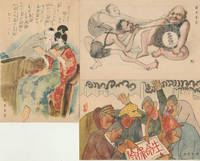
1572170401大阪. Osaka.: 日本生命保険株式会社. Nihon Seimei Hoken Kabushiki Kaisha. 昭和8 1933. 5 colour manga postcards 9 x 15 cm in slightly foxed original envelope. Postcards are all in very good condition. This set of manga postcards were published in1933 by Nippon Life Insurance Company to promote the benefits of life insurance. <br> <br>Nippon Life Insurance Company was established in Osaka in 1889. <br> <br>Instead of presenting figures and tables each manga tries to illustrate the sense of reassurance people would experience when they buy this company's insurance. For example a manga by Okamoto Ippei a famous manga illustrator in the pre-war Japan depicts a "Family Boat" where young and old members each wear a lifebelt represent their insurance policy while sailing. Its caption says that a insurance policy is a rescue buoy for life which would make people feel peaceful even on the roughest of seas. Another card features a young attractive geisha sitting coquettishly at home is an advertisement for an old age insurance policy. The text assures the viewer that their policy will be paid back in full when the policy matures. The couple plan to use the money to fund the granddaughter's honeymoon trip and their own holiday anticipating that they would live long enough to receive the matured fund. . [日本生命保険株式会社]. Nihon Seimei Hoken Kabushiki Kaisha. unknown
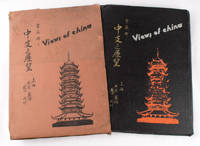
1572158424上海.Shanghai.: 三益社.Mimasusha. 昭和十三1938. Coloured folding map China as far north as Hebei Province south to Hong Kong west to Sichuan and Guizhou Provinces and corresponding coastal regions. Some folding black and white plates including one of the Bund looking north. 4 full page colour plates black and white photographic plates some highlighted with colour image of Chinese dragon wall sculptures on endpapers pictorial cover in red silver and gold titled in English and characters. The 54 leaves of photographic plates each captioned in Japanese are accompanied by a tissue guard with a somewhat more detailed explanation of the scenes in English and Japanese. Image of Chinese pagoda in red upper cover rubbed with a little loss. Upper corners bumped. Album measures 26.6 x 19.8cm. In original worn and marked pictorial card slipcase. Very good copy. This volume illustrates the famous sightseeing areas in Shanghai Suzhou Wuxi Zhenjiang Nanjing Wuhu Hangzhou Jiaxing and Songjiang. Additionally one leaf show three young Chinese beauties and two others the everyday lives of Chinese people. . 三益社.[Mimasusha]. unknown
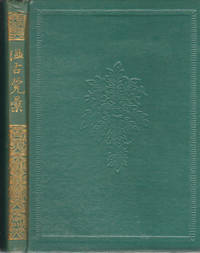
1572171337東京 Tokyo.: 日本古典全集刊行会. Nihon Koten Zenshu Kankokai. 昭和12. 1937. 92 colour plates tipped in 90 42 5pp 17.5 x 12.5cm attractive gilt spine appears to lack the facsimile title label otherwise all tipped in images are present a good hardback copy with embossed cloth covers. 17.3 x 12.2cm. A beautifully produced little book with colour illustrations showing the uses of traditional dyestuffs. Each small tipped in colour plate shows the colour produced by a dye plant or other dyestuff and examples of the designs in which they were used. This is followed by a section of explanatory text on the various fabric dyes illustrated in the volume. <br> <br>This book is a reprint of material originally produced by Haruta Nagatoshi 1753-1800 an eighteenth century armour-maker and was re-published in the 1930s as part of a series of reproductions of classical Japanese writings. . 日本古典全集刊行会. [Nihon Koten Zenshu Kankokai]. hardcover
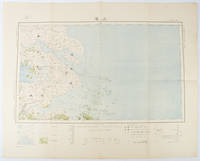
1519173266Tokyo.: 大日本帝國陸地測量部. Dainihon Teikoku Rikuchi Sokuryōbu. Taisho 15. 1926. Folding colour Japanese map of Shanghai and coastal areas of Jiangsu and Zhejiang Provinces. Scale 1:100000 embossed stamp lower right corner. Legend lower edge showing different landforms on the left section forests deserts wildlands plateaus rivers and lakes middle section showing various facilities such as post offices telecommunication offices temples ancestral halls ancient battle ground mines military fortifications submarine communications cables city walls and gates etc. right section showing different sizes of cities towns and villages and administrative boundaries. <br> <br>Occasional foxing along edges and folds ink annotation in Kanji on reverse good copy. Text in Japanese. Sheet measures 45.2 x 57.7cm. This very detailed map was originally surveyed by the Land Survey Department Empire of Japan in Taisho 7 1918. This revised edition features the railway line connecting Hangzhou - Jiashan - Shanghai - Suzhou - Wuxi. . 大日本帝國陸地測量部. [Dainihon Teikoku Rikuchi Sokuryōbu]. unknown
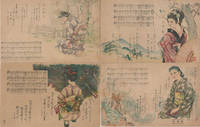
1572170402東京 Tokyo.: 新興音楽出版社. Shinkō Ongaku Shuppansha. 昭和18 1943. 5 very attractive colour postcards 9 x 14cm attractive pictorial paper envelope slightly browned and creased very good copies. These 5 postcards were published for sending to the front line soldiers from the home front. Each postcard has an illustration of a melancholy young Japanese woman dressed in a kimono printed around her are the words and musical score of a folk song from one of 5 Japanese regions - Akita Kusatsu Yoneyama Kagoshima and Yamanaka. On receipt the soldier would think fondly of home and maybe sing the folk song to or with his companions at the front. . 新興音楽出版社. [Shinkō Ongaku Shuppansha]. unknown
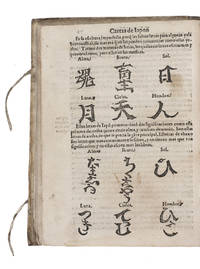
15755741Alcalá der Henares Spain: Juan Iniguez de Lequerica 1575. Contemporary limp vellum with ties. 4to in 8s. With woodcut of the Crucifixion on verso of the colophon 2R4v woodcut Japanese characters in the text I8v and woodcut decorated initials throughout. First Spanish edition of 87 Portuguese letters by Jesuit missionaries in Japan very valuable for the history of the Jesuits in Japan India and other parts of Southeast Asia. The work was first published in Portuguese in Coimbra in 1570 and contains 10 additional important Jesuit letters which had never published before. Noteworthy are the woodcut Chinese and Japanese characters included in the text on leaf I8v. Cordier gives a list of these additional letters dating from 1567 to 1571. Other newly added were: the life of Francis Xavier Relacion de las cosas de la India by Manuel Acosta with remarks on in order of appearance Goa Cochin Daman Ceylon Comorin Bassein Ormuz Ethiopia Inambay and Manomotapa Malaca the Moluccas Ambonia Solor Macassar etc. and Breve relacion de la Isla y Reynos del Iapon.Lacking 2 leaves ¶7 and ¶8 from the preliminaries containing the "Indulgencias que nuestro Sancto Padre el Papa Pio. 4 ". With 18th-century manuscript annotations in brown ink on the recto of the first free flyleaf the title-page at the start of the text on fol. 1r the recto of the final leaf and in the margins throughout; the margins show only marks to highlight certain passages the other annotations are variations of the same owner's inscription most elaborate on the front flyleaf: "Ex icDn. Francesco et Paula Caveda Costo 15 . Mad. a 4 . Octobre 1786". The vellum of the binding is somewhat creased and stained water stained throughout the first and last few leaves are frayed and slightly damaged in the margins without affecting the text somewhat browned throughout. Otherwise in good condition.l Alt-Japan-Katalog 298; Cordier Japonica cols. 67-68; Iberian Books 54608; Laures 140; Palau 46311; Porbase 363133 1 copy; Salva 3282; Streit IV 1519 with a full list of all letters; USTC 337147. Juan Iniguez de Lequerica, hardcover
1585125<p>Coelho Gaspar. <em>Lettera annale scritta di novo dal Giapone delle cose ivi successe l'anno MDLXXXII. </em>Venice: Gioliti 1585<em>.</em></p><p>8vo 154x99 mm contemporary <em>cartonato alla rustica</em> original sewing to spine preserved pp. 103. Woodcut printer's device woodcut initials.</p><p>The scarcest issue of Jesuits' report of their missions and activity for the year 1582: one of the earliest printed Western testimony of the ancient Japan.</p><p>Gaspar Coelho composed this report in February 1582 describing the ongoing missionary activity across the country: in Hirado Amasuka Bungo and especially Funai Oita City the home of a thriving Jesuit college.</p><p>Streit describes another edition printed by the same publisher in the same year and according to Boscaro there were four editions of Coehho's letter published in Italy in 1585 around the time the embassy arrived in Venice on June 25: two issue printed in Venice by Gioliti one printed in Rome by Zanetti and one printed in Milano by Pontio. A French edition translated by Michel Coyssard was published in Paris in 1586 and one German translation in Dilingen in 1586.</p><p>According to Edit 16 our variant issue is the scarcest one located only in 2 Italian institutional library Biblioteca Universitaria of Bologna and Biblioteca nazionale Marciana of Venice:</p><p>CNCE 14783: <em>Lettera annale scritta di novo dal Giapone delle cose ivi successe l'anno MDLXXXII. </em>Venice: Gioliti 1585<em>. </em><u>Our variant</u> 2 copies.</p><p>CNCE 12736: <em>Lettera annale portata di nuouo dal Giapone da i signori ambasciatori delle cose iui successe l'anno MDLXXXII</em>. Venice: Gioliti 1585 12 copies.</p> Gioliti
151960917Nikko Japan: n.p. possibly T. Hasegawa Publisher’s ca. 1915-1917. Oblong folio. 14.5 x 10.25 in. 24 pp unpaginated. brown bifolium leaves w/ slits cut into corners backing paper within the created pouch and 24 silver gelatin printed-out-paper hand-painted watercolour photographs a few w/ captions w/in the negative all printed on the special medium thickness gelatin printing-out-paper also no bleed-through from the nicely executed water-colouring. Contemporary beige-coloured rough raw padded silk post-binder punch-sewn at gutter margin w/ golden silk braid minor wear & fraying to upper & lower fore-edges wear to corners some scuffing occasional minor tears to brown paper fore-edges still a VG- exemplar from the library of Caroline Augusta Gray Kamm 1840-1932 noted socialite and philanthropist in Portland built home for poor women & girls with the YWCA and was daughter of PNW pioneer William H. Gray 1810-1889 who traveled to the Lapwai Mission in Lewiston ID in 1836 where he was the Nez Perce secular agent and subsequently later married Jacob Kamm 1823-1912 pioneering Oregon industrialist and entrepreneur. An exceptional Taisho-era souvenir album composed of nicely watercolour-painted gelatin printing-out-paper photographs allowing the artist to achieve an ethereal and mystical effect in the images almost as if there is frequently a mist overlaying the scene. These are definitely not photomechanical collotype or gravure process images and the softness achieved in the production indicates these were developed as glass-plate negative contact prints exposed to strong sunlight on an exceptional medium weight thickness matte-finish paper. This series of images capture the road to the Nikko Toshogu Shrine; the famed Five-Storied Pagoda located at the entrance; one wing of the Tokugawa Ieyasu Temple; the iconic Three Wise Monkeys on the inside of the shrine once part of what was originally 8 monkeys on the unpainted wooden sacred stable in front of the Yomoeimon. Also included here are photos capturing the splendid Yomeimon Gate famed for its glittering impact with more than 240000 pieces of gold leaf the Sukibei Wall at the Toshogu Shrine the Nikko Station at the Shrine and the interior of the Nikko Temple. One of the exceptional photos included here is that of the Jiun-ji Temple of the 74 Narabi Jizo Statues along the road to the Kanmangafuchi Abyss along with nicely executed photos of the Kegon Falls and Lake Chuzenji. Although unidentified by photographer’s imprint within negative or on verso of inserted images these types of souvenir photographs could be purchased from souvenir and stationery stands in Nikko Kyoto or other tourist spots from 1885 until after World War I. See: Worswick & Morris Japan: Photographs 1854-1905 1979 and Dower Century of Japanese Photography 1980. n.p., possibly T. Hasegawa Publisher’s, unknown
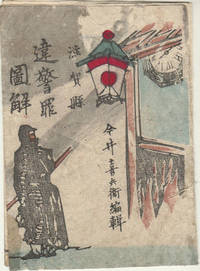
1518170899今井喜兵衛. Imai Kichibē. Meiji 15 1882. Woodblock Japanese printed booklet containing 3 folded leaves. Text accompanied by small handcoloured illustrations showing the minor criminal offences described above. 7 x 3cm section of loss upper section of colour woodblock upper cover stain lower cover upper cover and first two leaves lacks lower cover but contents are complete neatly rethreaded. Still an attractive copy of a fascinating and scarce item. A fascinating insight into crime and punishment in 1880s Japan this little booklet provides colour-illustrated explanations of minor crimes with details of the punishments which apply to them in Shiga Prefecture. It appears to have been designed for distribution to the public - perhaps to shops small businesses etc. From it we learn amongst other things that you could be imprisoned for between 3 and 10 days or fined a sum between 1 and 1.95 yen for giving lodging to a foreigner without recording their address properly. A sentence of 2 to 5 days imprisonment or a fine applied to people who sold raw fugu highly poisonous without proper treatment sold the meat of diseased animals offered photos or woodblock prints of the Emperor and Empress for sale or cremated the dead without official permission or in a place other than the officially approved cremation sites while a sentence of between 1 and 12 days applied to crimes which included flying paper kites near overhead telegraph lines. . 今井喜兵衛. [Imai Kichibē]. unknown