235 résultats
1904316621Boston: Dana Estes 1904. Illustrated with over 300 coloured plates and half tones. 438pp. 4to. Bound in modern half brown calf and marbled boards. Fine. Illustrated with over 300 coloured plates and half tones. 438pp. 4to. Dana Estes unknown books
1946271231946. Stiff pictorial wrappers spiral bound. VG showing but minor wear to maps. Ex-lib with discrete call letters to front board & occasional stamp to map lower margin. Over 40 folding maps of the region. Folio. 20-1/2" x 14-1/8" <br/><br/> unknown books
44211<p>Japan and Western Medicine. Oranda jin Geka ryoji no zu Dutch Surgery in Nagasaki. Original pen ink and watercolor drawing on light brown-toned silk with 4 vertical lines of Japanese characters in the upper left corner. Japan: late 18th or early 19th century. 483 x 363 mm. mounted as a scroll at a modern date on light grey silk backed with paper with a half-round hanging rail with braided ribbon attached at the top and a suspension bar at the foot measuring 914 x 443 mm. overall; preserved in a custom-made wooden box. A few tiny pinholes in upper corners of image but fine with the coloring fresh and bright.</p> <p> This striking image showing an amputation carried out by a Dutch surgeon in Japan was most likely painted in the late eighteenth or early nineteenth century during Japan's self-imposed period of national isolation. The hand-painted image is related but by no means identical to a Nagasaki woodblock print titled "Surgery by a Dutch Physician" one of many popular souvenir prints depicting scenes unique to Nagasaki which at the time was the sole point of contact between Japan and the outside world. See our reproduction of the print. It may be that our scroll is the original of the image; however it is also possible that both hand-painted and woodcut versions of the image were produced simultaneously.</p> <p> Western surgery came to Japan in the sixteenth and seventeenth centuries via the Portuguese who in 1543 became the first Europeans to make direct contact with Japan and the Dutch who became the only European nation allowed to trade with Japan after Japan's expulsion of the Portuguese in 1639. Surgeons attached to the Dutch East India Company established practices at the island of Dejima in Nagasaki Bay which led to the formation of several Japanese schools of surgery based on European methods. "This aspect of Western medicine known as K m -ry geka or ‘Surgery of the Red-Haired' has had a profound effect on the development of surgical practice in Japan" Van Gulik p. 37. Van Gulik "Dutch surgery in Japan" in Red-Hair Medicine: Dutch-Japanese Medical Relations ed. Beukers et al. pp. 37-50. </p> <p>. unknown books
1980018134Chicago: Japan America Society of Chicago 1980. Book. Very good condition. Hardcover. First Edition. Octavo 8vo. viii 57 pages of text. Hardcover binding with minor shelfwear including a small bump to one corner. Illustrated with numerous black-and-white photographs. The text is clean and unmarked. First edition. Japan America Society of Chicago Hardcover books
15854676Venice: I Gioliti 1585. Hardcover. Very Good. 8vo - over 7¾ - 9¾" tall. 8vo. 103 pp. Bound in old vellum. Discrete former ownership stamp on title. Gutter margin of title reinforced; inconsequential toning otherwise excellent. Rare early edition of this Jesuit letter containing news of missions and activity in Japan from the year 1582 the only edition of 5 printed that year to contain a title-page advertising the famous Japanese embassy of 1584-86. Significantly the work also discusses the embassy the participants and their noble lineage and expresses the hope that the embassy will prove a convincing sign of the Jesuit's spectacular success in Japan p. 7. The present imprint of this edition comprises the first entry in Boscaro's bibliography of printed works related to the embassy. It thus stands at the head of nearly 50 works printed in 1585 alone to record and commemmorate an event that-in addition to providing a public relations coup for the Jesuits-became a watershed moment in cross-cultural exchange between the Orient and the West: "no Japanese emissaries to Europe either before or since aroused comparable interest or enthusiasm" Lach. In the annals of international relations between Europe and Japan in the 16th C it is particularly noteworthy "how the physical presence of the Japanese in Europe stimulated an unexpected number of typographical presentations" Boscaro of which this particular Gioliti edition with the titlepage advertising the embassy-Portata de Novo Dal Giapone Dai Signori Ambasciatori-is the very first. Boscaro notes that there were four other editions of Coehho's letter published in Italy in 1585 around the time the embassy arrived in Venice on June 25 including another by Gioliti but none of these uses the embassy as a way to market itself.The report itself is also a significant document of the embassy's genesis: Coelho composed it in February 1582 the month that the embassy of four Japanese Christian converts departed from Nagasaki. In it he describes the ongoing missionary activity across the country: e.g. in Hirado Amasuka Bungo and especially Funai Oita City the home of a thriving Jesuit college. Presumably the contents of this letter as the title suggests were "brought from Japan by the eminent ambassadors" as the latest news on the Jesuits current success in that faraway land.Though the embassy did not reach Lisbon until August 1584 it eventually was as Coelho had hoped a resounding success: from 1584-86 the four young Japanese nobles were the object of intense curiosity wherever they traveled and they were treated to lavish receptions in Lisbon Madrid Florence Rome Venice and other cities throughout Catholic Europe.OCLC: Cornell NYPL HU and Newberry. Boscaro 1; Alt-Japan 812; Sommervogel II.1267; Cordier 78; Laures 169; Pagès 22; Lach I.2.690. I Gioliti hardcover books
0000544Albums rubbed one flaking with joints beginning to split certainly Good or better. The images show occasional creasing silver mirroring & fading but are generally Very Good. Approximately 430 presumably amateur silver gelatin photographs 6.5†x 5†and smaller and a couple of real photo postcards housed in three commercial albums oblong or vertical quartos measuring about 11 inches by 8 inches. The compiler is unknown but quite possibly “Takamasa†first name or his descendants. His photograph is the first image in the album we have identified as album A. The photos are dated as early as 1909 and as late as 1954 with most from the mid twenties to late thirties. Many of the images include manuscript and occasionally rubber-stamped or printed annotations in Japanese on the versos. An eight page English translation accompanies the archive. <br/><br/>An impressive archive documenting life in Japan between the wars. Particularly interesting are several images depicting a banquet with Geisha and other events at a convention of the Japan Brewing Equipment Merchant’s Association in November 1926. Other images depict the building of the Sankyo Corporation on the day of the Great Kanto Earthquake scenes along the Tama River in Western Tokyo and various views of Temples Shrines Hot Springs etc. The accompanying translation is categorized by album A B & C with photos identified by numbers which correspond to added post-it slips. In addition to providing versions in English of the annotations the photos are described as to place etc. when known unknown books
13932Original 19th Century Hand colored photograph of the Festival of Lanterns at Yokohama Japan. The photograph measures 8"x10" and is matted to 10-1/2"x13". Lower right hand corner label reads "A 264 Festival Lanterns at Bentendori Yokohama." Festival lanterns cheer up the business district of Bentendori 2-chome and 3-chome in Yokohama. During the Meiji Period this was Yokohama's premier shopping street. Foreign visitors came here to buy porcelain curios ivory silk and photographs. The photographer of this very image Kimbei Kusakabe actually had a studio on this street between 1881 and 1889. Unfortunately the exotic amalgamation of Japan and the Western world that existed on Bentendori was forever destroyed by the Great Kanto Earthquake of 1923. Photographs such as this are all that is left of a bygone era. In very good condition. unknown books
19250379901925. Original photograph album. Very Good. Oblong string-tied album of black cardstock leaves 11" x 13" photographs mounted on 35pp blanks at the rear. Bound in black flexible boards with an embossed sailing ship and gilt lettering Photo-Album on the cover. Pasted in are 116 albumen and silver gelatin prints ranging from small candids to 8 ½" x 10 ½" group portraits a few fading overall sharp and clean. Laid into the album are a Japanese news article a small head-shot of an older gentleman and a watercolor portrait 10" x 8 ¼" of a man's face. Most of the photographs in this album. circa 1895-1925 were taken in Mie-Ken or "Mie prefecture" part of the Kansai region on the main island of Honshu. The group and individual portraits reflect new social and economic developments and cultural norms that emerged during this period. Subjects are shown in either traditional Japanese garments or in Western dress. Group shots often depict people wearing both styles within the same picture. There are many group shots of schoolchildren of both sexes young people in uniforms posed before buildings with Japanese signs on them as well as many formal group shots of families some "nuclear"-husband wife children- others extended by relatives. Individual shots of young children show them almost invariably in western dress one posed with his tricycle young boys in uniform a young girl in kimono showing a dance move while holding a fan infants in traditional robes and young men in business suits. Several birdseye views feature very large groups of rural people in traditional dress posed outdoors. Among the most striking photographs are: one 8 ½" x 10 ½" showing 11 doctors/ medical students posed around two corpses one smiling happily being dissected on two tables; four women and one man posed around a table doing handwork weaving tatting; men in western dress "strap-holding" inside a streetcar; and 5 actors 2 male 3 female on stage in costume. ~~ The Meiji period 1868-1912 saw the restoration of the Emperor this time with a centralized bureaucracy behind him after years of shogun rule. Japan was under heavy influence from Western political economic and educational models and the country became more capitalist industrial and progressively democratic offering free education to youngsters of both genders. Transportation and communications systems were modernized the feudal lords and samurai lost their power and a powerful national army and navy were created. By the early 1870s the government declared all classes of people to be equal. The Taishu period 1912-26 saw the continued influence of Western culture and values such as efficiency and individualism continued to replace more traditional ones. Japanese participation on the world stage continued to grow as the nation co-founded the League of Nations and emerged on the winning side in WWI. By 1925 there was universal male suffrage in Japan. Corruption in government increased however and the West began to form negative views of this newly-powerful non-white nation exacerbated by Japan's poor treatment of China. <br/><br/> hardcover books
193832594Tokyo: Asiatic Society of Japan 1938. First edition. Self wrappers. A very good clean copy with edgewear. 4 pp. 8vo. [Asiatic Society of Japan] unknown books
192928505Paris: Musee du Jeu de Paume Jardin des Tuileries 1929. First Edition. Illustrated with 180 plates with 352 figures. 2 vols. 4to. Cloth wrappers printed in gold wrappers in chemise one joint split else fine. 2. First Edition. Illustrated with 180 plates with 352 figures. 2 vols. 4to. Musee du Jeu de Paume (Jardin des Tuileries) unknown books
181954848Washington D.C.: Army Air Forces. 10-18- 1943. Color poster / map 47 x 35 1/2 inches 120 x 90 cm folding as issued now professionally mounted on linen backing. Wear and a little paper loss along the fold lines has been infilled light toning to lower centrefold; the poster presents very well with bright color. Stunning image of a hemispherical view with Japan at the centre encompassing the area from Iran in the west Australia in the south and as far as the west coast of the U.S. at the east of the map. The map maker is F.E. Manning one of the distinguished news illustrators of the war in a style very similar to that of Richard Edes Harrison. There is a scale along the lower edge which was intended to be clipped and used to measure distances of places on the map from Tokyo. Text reads: "This map is a photographic view of the world with the center at Tokyo. Thus with the detachable scale distances can be measured along any line running thru Tokyo. It should be noted that an inch at the center represents less mileage than an inch closer to the edges. The detachable scale has been designed to compensate for this and should be used only with the center at Tokyo. The photographic process used in making this map makes all distances measured with the tape approximate only. Distances are shown in statute miles. Lines between key cities do not represent regular air routes in all cases. They show distances between points that do not fall on a line going thru the center of the projection." The Newsmap posters were displayed in offices and factories to keep the American public updated with news of the war and to encourage their participation in the winning of it. . Army Air Forces. unknown books
23566Japan Two volumes; 255 266 pages; color black and white illustrations some folding showing Japanese swords and sword-making techniques blacksmithing various sword furniture tsuba sheaths decorative work portraits of famous makers; text entirely in Japanese; part of a larger set; these are volumes numbered 6 & 7; approximately 7 1/4" x 10 1/2" size; bound in light gray cloth gilt cover titles with blindstamped design of swordsmith at anvil; black spine titles; purple silk page-markers; a little wear and ageing to the cloth faint old discoloration on one unobtrusive; contents clean and bound very well in very good condition and a good reference to the ancient techniques & craft of sword-making in Japan. Hard Cover. Very Good. Hardcover books
26128Japan In two volumes. The large illustrated volume with hundreds of photographic examples of tea and rice bowls with a text volume accompanying; thoroughly illustrated in black and white and with a few color examples Japanese text throughout. A heavy set approx. 6 lbs with the shipping. Approx. 8 3/4" x 12" size; bound in gray-blue silk patterned cloth over paper side bound in silk string; illustration volume with paper cover title label pasted-down. Some edge tips wear to the cloth of the binding loose folds around cloth edges; contents clean and in very good condition; an extensive reference. . Brocade Covers. Good. paperback books
191521786Japan: No Publisher 1915. Including: The Tsuragaoka-torii Kamakura Protected officially; The Daibutsu the grand Buddha; The Shariden at the Engakuji Temple; The volume of pictures explaining the origin of the Taemano-mandara; The statue of Buddha in his sermon; The statue of Shaka Buddha the chief object of worship at the Gokarakuji temple; The Arai-No Emma; The Statue of Hojo Tokiyori; The Idol of the Jizoson boddhisattva; The portrait of the boddhisattva Kokoozo painted by Kose Kanaoka; The statue of Uyesugi Shigefusa; The Mask of Aku; all noted as 'protected officially'; text in Japanese and English; final leaf with additional and untranslated Japanese text; approx. 3 1/2" x 5 1/2" size with the mounting edges the group slightly larger in its packet; original gray and black paper covers side sewn with red silk cording; wear soiling corner chip to bottom corner of front cover; cards clean postally unused and in very good condition; interesting ephemeral travel and cultural information from the early part of 20th century Japan. First Edition. Soft Cover. Good. No Publisher Paperback books
199124636Yokohama Japan: Yokohama Archives of History 1991. 59 pages. Color and black and white illustrated a catalog of an exhibition held at the Yokohama Archives of History. Giving history early Japan travel and exploration writing artworks and photography. Text in Japanese. Inscribed and signed by YAH archivist Hisako to Bob Greene with thanks - laid in is a list of the items which had been part of the exhibition that are part of the Paul C. Blum collection held at YAH; Greene was Blum's nephew and instrumental in establishing the collection at Yokohama. Approx. 9 1/2" x 9 7/8" size oblong format illustrated & printed polished paper covers. Light wear in very good condition. . First Edition. Soft Cover. Very Good. Yokohama Archives of History Paperback books
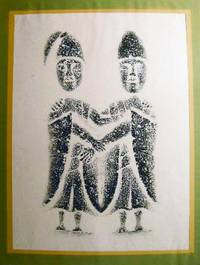
197223967Japan: Otosaburo Moriizumi 1972. 10 rubbings made by Otosaburo Moriizumi; these are printed in black and white on fine thin Japanese paper; each rubbing tipped-on by its corners to a thin cardstock backer and with a dark blue gray or green stiff paper "window" surround; with a 4-sided folding explanatory sheet text in Japanese & English including a brief introduction by Shoji Hamada; with an illustration of Mr. Moriizumi biographical details and information on the rubbings; the author-collector "chose ten lovely carvings found in the Matsumoto district" for this selection; images and titles in Japanese of the images with the dates of creation if known these from 1695 - 1870 - the undated images from earlier times; and with the sizes of the original carvings in cm.; from the author's text: ".We often find a group of three or four naive stone-carved images at the village borders and crossings when we travel along olden ways of Shinano Province. It became popular among farmers to make this sort of stone images from the middle Edo period based on their belief. They prayed for fertility and prosperity by erecting such images representing Buddhist Shinto and folkloric deities. Among them the most prevalent is Dosojin a pair of male and female folkloric gods. They were considered to be patron gods for children and young couples and gods who brought the peace of the village and abundance of crops.Besides these independent images there are stone carvings known as koshin tower. .the relief of Blue-headed Kongo a Buddhist deity as the main image and that of the sun and moon above."; all items loosely contained in a blue paper-covered hardcover folding portfolio with paper title label printed in two colors; the overall size is approx. 15" x 19 3/4"; the art of varying sizes some taking the entire sheet some smaller; the portfolio contained in the original protective cardboard slipcase also with paper title label; some edgewear age-darkening and closed tears to cardstock slipcase; blue portfolio with light wear a few cover scratches; text portion with a little edge-creasing; one of the rubbing plates with a ¾" paper flaw or rub in the background paper; two of the green paper surrounding 'window' mounts with sunning to gold on the inner ½" of the border; the artwork in very good condition; an interesting Japanese folk-art collection iconic imagery. First Edition. Portfolio. Very Good. Otosaburo Moriizumi Hardcover books
191044085Kobe: Tamamura Photographic Studio / T. Takagi N.d. ca 1910. Oblong octavo 18cm x 26cm. Original silk-covered boards bouond with red silk cord; 19 colored collotype plates. Gift inscription from an N.L. Thacker on verso of title page dated 1914; child's ownership inscription on verso of final plate "Ermy Tharp Novato Cal" dated 1936. Rubbing and wear to board edges; internally clean and sound - a Very Good copy with all plates present. An attractive Meiji Era souvenir album with subtly hand-tinted collotype plates depicting a traditional Japanese wedding ceremony. One of several editions produced between 1906 and 1920; per the excellent bibliography of Tamamura's souvenir albums at ours would appear to be the Third Edition of 1910. Tamamura Photographic Studio / T. Takagi unknown books
195021606Japan: Artist Published 1950. Group includes two country landscape scenes in color both signed lower left in black ink both approx. 9" x 13"; with 2 ink and wash heightened and accented with white paint winter scenes approx. 10" x 14 1/2" one signed lower right; and 2 ink washes waterside scenes 10" x 14 1/4" one signed lower left. Not dated and circa 1950s; all are laid-down on to paper backers. Light wear; one of the wash pieces with a thin line-scrape; the paper backers with wear and wrinkling in margins creasing couple short tears. The artworks are in very good condition. First Edition. Not Bound. Very Good. Artist Published Paperback books
196724625Tokyo Japan: The Japan Times Ltd. 1967. 30 pages with black and white illustrations. Contents with Kabuki miscellanea discussing the Hanamichi: a Second Stage and the various presentations including Ayatsuri Sambaso Yoshinogawa the Kongen Kusozuri Biki and Fuji Musume dances Nozaki Mura Ehon Taiko Ki Saigo to Butahime Kohjo ceremony with participants being recognized for their great skills earned in the world of Kabuki performers; also the Honcho Nijushi Ko Sannin Katawa. Advertisements on endpapers for the Hamaseiho and the Crescent restaurants and other ads within. Printed by Seiko-sha Co. Ltd. Approx. 7 1/4" x 10" size stapled illustrated softcover wraps. A little edge tips wear to covers; in very good condition. First Edition. Soft Cover. Very Good. The Japan Times, Ltd. Paperback books
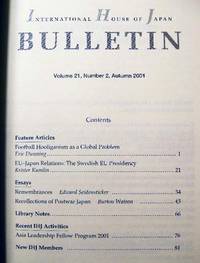
200124631Tokyo Japan: International House 2001. 84 pages with articles on Football Hooliganism as a Global Problem by Eric Dunning; EU-Japan Relations: The Swedish EU Presidency by Krister Kumlin; an essay of Remembrances by Edward Sedensticker and Recollections of Postwar Japan by Burton Watson. Also listing recent library notes from the IHJ the Asia Leadership Fellow Program and new IHJ members. Approx. 6" x 9" size printed paper covers. Light wear little rolling to the binding; in very good condition. First Edition. Soft Cover. Very Good. International House Paperback books
195122671Tokyo Japan: Kaizosha 1951. 264 pages; with a black and white photo-illustrated section at front "Franco's Spain"; small illustrations throughout via line drawings some caricatures accompanying articles; text in Japanese; fold-out advertisement section printed in orange; approx. 5 7/8" x 8" size; paper browned not brittle; covers soiled darkened; closed tear to last few leaves; still about good condition. First Edition. Soft Cover. Good. Kaizosha Paperback books
193022672Tokyo Japan: Dai Nippon Yubenkai Kodansha 1930. 512 pages; with a color fold-out plate of a woman in traditional Japanese costume; another single-page color plate by Kodera; an approx. 23" long folding cartoon-illustrated story tinted in reds; a blue half-tone fold-out section illustrated with male athletic sculptural figures; and black and white illustrations throughout via line drawings cartoon stories some photo-portraits accompanying articles sporting figures including American swim team; text in Japanese; approx. 6" x 8 1/2" size; illustrated paper covers with information for California importation perhaps the publication targeted for the Japanese community there; front cover edge-chipped about detached old tape residue; colors faded; no back cover or spine covering; still about good condition and an interesting compendium of pre-WWII Japanese culture and society in good condition. . First Edition. Soft Cover. Good. Dai Nippon Yubenkai Kodansha Paperback books
196824630Tokyo Japan: American Chamber of Commerce in Japan 1968. 68 pages with color & black and white illustrations including a 3-panel folding color plate of Ginkon Taiken No Ongoshiki The Great Celebration of the Silver Wedding Anniversary of Their Majesties by Yosai Nobukazu found within the article on the Role of Emperor Meiji in Japan's industrial growth. With pieces on the first direct trade between the U.S. and Japan Nakahama Manjiro house-hunting in Tokyo "Japan-America Relations Threatened by Disharmony" and others including U.S.- Japan export & import statistics trade opportunities social and business news of the Chamber. Approx. 7" x 10" size color-illustrated stapled paper covers. Light wear little spotting to the binding; in very good condition. First Edition. Soft Cover. Very Good. American Chamber of Commerce in Japan Paperback books
187826953Gotha Germany: Justus Perthes 1878. Color map of this area only. Approx. 10 1/2" x 16" overall size. from Petermann's Geographische Mitteilungen Schnellpressendruck v. C. Hellfarth in Gotha. Small faint previous ownership stamp on one of the back blank panels of the map of collector Dr. George R. Brush U.S. Navy; served as a surgeon and medical inspector from 1861-1894 & often on-station in various locales in Japan; he has noted a couple of dates on the map journeying from Ozaka to Nara in 1889. A little splitting along old fold lines; in good condition. Map. Not Bound. Good. Justus Perthes paperback books
188726924Chicago Illinois: Rand McNally & Co. 1887. Pocket map of Japan printed in colors detailing the Japanese island system in two separate maps: Northern Japan with an inset at top of Chishima; with the previous owner noting the location of the volcano Bandai-San. Approx. 13 3/4" x 21" overall size; and Southern Japan with inset of Yayeyama and Riukiu Island chain approx. 14" x 20 3/4". With a folding Index and Population of Towns in Japan having a pronunciation list and giving the districts islands lakes mountains provinces rivers and towns; this is printed two sides approx. 13 3/4" x 19 3/4" size. Bookseller's ticket on front inner panel of the cover of Kelly & Walsh Ltd. Printers Publishers Booksellers Stationers &c. &c. &c. No. 28. Yokohama. Small faint previous ownership stamps on the blank panels on the back of the maps as well as on the front endpaper of the cover of collector Dr. George R. Brush U.S. Navy; served as a surgeon and medical inspector from 1861-1894 & often on-station in various locales in Japan. Maps & index contained in the publisher's dark brown cloth binding approx. 3 1/2" x 6 1/4" size gilt titled. Some color mottling to the case light wear; map papers darkened a little; Northern Japan & the Index loose; Southern Japan still attached to the inner cover; in very good condition. Pocket Map. Hard Cover. Very Good. Rand, McNally & Co. hardcover books