33 résultats
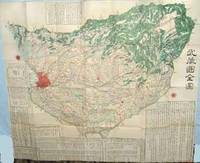
1852864251852. MAP - JAPAN SEKISUI Chô & SUZUKI Kien. ZOTEI DAI NIHON KOKUGUN YOCHI ROTEI ZENZU. Edo Osaka & Kyoto. Zodiacal date of Kaei 5 1852. Identical to the copy illustrated online from the UC Berkeley collection save that their copy is a standard one-piece folding map in covers. See: http://www.lunacommons.org/luna/servlet/detail/RUMSEY~9~1~24 291~110045:Zotei-Dai-Nihon-kokugun-yochi-rotei Ours is the same size when assembled some 102 x 183 cm but is bound in 12 separate folding sections each identified on the cover by area each approximately 35 x 46 cm. This would seem to have been done by the publisher for ease of use a series of "pocket maps". They are all enclosed in a small clasped chitsu case some 12 x 8 x 3 cm in size with a mica-paper liner and a cloth exterior. There is a smaller size version some 72 x 40 at 1852.1 in the first volume of Beans referenced from Ramming 1934 at #28 - obviously a misprint of some kind as it would be hard to understand a smaller size recut map existing. In any case a very interesting format and a lovely detailed map in a "modern" style employing degrees of latitude but printed in traditional color woodblock. Very good condition impression and colors. An excellent example of Japanese cartography in transition. unknown books
1853WRCAM52129Uraga Bay Japan 1853. Pen and ink manuscript scroll on thick mulberry paper in Japanese 10 1/2 x 125 inches. Mounted on a wooden roller and with a small contemporary cloth extension panel to the scroll cotton tie. Manuscript backed on thick paper a few worm holes at upper margin of the final panel occasional brown stain at upper margins of first few panels a few tiny holes some old creases. Very good. A Japanese manuscript depiction showing the parade of Commodore Matthew Perry and his forces on the shore at Uraga Bay to visit the Japanese Princes on July 14 1853. An important piece of American naval and diplomatic history and a rare survival of a Japanese "Black Ship" Scroll for the 1853 arrival of Perry this is one of only a handful to have survived. <br> <br> Perry's sudden arrival near the entrance to Tokyo Bay at Uraga on July 8 1853 with two sloops and two paddle-steamer battleships carrying letters and gifts to deliver to the Emperor threw the Japanese authorities into a tailspin. The reports went back to the Emperor who immediately took ill presumably fearing an invasion. For several days there was a stand-off the smaller Japanese vessels amassing around the American vessels one of which had ninety-two cannons. Local warlord families took up arms all around the Bay and made promises of men for the defense of Edo. For five days the stand-off continued and Perry stayed in his cabin and let it be known he had a letter from President Fillmore to deliver to the Emperor and only the Emperor or his emissary could receive it. The Japanese first threatened him then tried to bribe him to leave and go to Nagasaki to complete his mission. Perry stood firm and ignored the Japanese demands. <br> <br> Perry sent out smaller boats to start surveying the area and the Japanese stood aside wondering if the cannon would strike them. On July 14 a hastily erected tent was put up on the shore of the bay and two sons of the Emperor Princes Ido and Toda came down by Imperial barge from Edo and sat in the tent to receive the letters. Perry arrived with his troops his marching band playing the Stars and Stripes flags flying. He formally delivered the letters and said he would be back in a year for an answer to the President's call for a trade treaty with Japan protection for shipwrecked sailors and the establishment of refueling stations for American ships in the Western Pacific. The Japanese asked him to leave quickly but he stayed anchored for a further three days then spent some time doing surveys of other parts of Edo Bay returning via Okinawa to winter at the American station in Hong Kong. He returned the following February with a larger flotilla strengthened by newly- completed battleship steamers sent out from the States. The second meeting took place at Yokohama from February to June 1854 where Perry insisted that negotiations begin and at that time there was an exchange of diplomatic gifts. A provisional treaty was signed in 1854 but the full trading treaty was not completed until 1858 after Townsend Harris came to Japan as U.S. Consul and set about finalizing the negotiations. <br> <br> The artist of this piece certainly documented the action well. It begins with a panel showing an American officer and three soldiers from the ship continues with eight sketches of hats seven instruments of the band and a naval sword two small barges that brought the crew and troops to the shore a detailed annotated sketch of the flagship Susquehanna followed by the procession of the 300 Americans from the shore to the receiving tents the Stars and Stripes waving and including the band and a similar sketch of the Japanese procession with clan banners a sketch of the receiving area with a parade ground and two tents and a final view of Uraga Bay with the four American ships at anchor and the landing place on the shoreline. <br> <br> While the census for the scrolls and scroll fragments depicting Perry's second arrival in 1854 number at least twenty in institutional hands for the 1853 arrival of Perry we locate only one - a ten-foot watercolor scroll in the British Museum for which this is either a precursor or a contemporary near- copy. A close comparison with the British Museum scroll has yet to be accomplished but there are textual differences in some of the captions and it appears from the sketchy monochrome nature and uncolored state of this scroll that it is more likely a provisional sketch done from observation by a Japanese artist who attended the event rather than a contemporary finished scroll. It is likely that after the meeting with Perry the warlord attendees would have been presented with a finished watercolor scroll. This scroll may well be the original provisional version of that finished sketch. <br> <br> An extraordinarily rare and important "Black Ship" Japanese scroll. hardcover books
1860347451860. Two small broadsides each 9 x 11 3/4 inches. Previously folded. Moderate toning and dust soiling faint foxing at outer margins. Good plus. Japanese news sheet on foreigners.<br/> <br/>Two interesting Japanese Kawaraban woodblock news sheets documenting some of the foreigners who visited Japan's shores in the 1850s as the country opened up to the west. The first sheet is in four sections and titled "Western Products and Strange Things." It contains images of an English Captain a black sailor a microscope of Dutch style and a mummified body wrapped in sheets. The second shows a Captain's wife and her wolfhound dog an American Flag and a depiction of four Russian coins obverse and reverse and two other coins dated 1843 and 1854. unknown books
1900859831900. ASIATIC SOCIETY OF JAPAN. TRANSACTIONS OF THE ASIATIC SOCIETY OF JAPAN VOL XXVII SUPPLEMENT. n.p n.p. 1900. Possible reprint of original 19th century edition. 53 pp. 8vo. blue leather boards stamped in gilt spine missing boards chipped detached. Complete. Includes: Minutes of Meetings. Members. Constitution and By-Laws. As is. unknown books
1887859851887. ASIATIC SOCIETY OF JAPAN. TRANSACTIONS OF THE ASIATIC SOCIETY OF JAPAN VOL XV PART II. Yokohama: R. Meiklejohn & Co. 1887. pp. 131 - 142. xviii. 8vo. blue leather boards stamped in gilt spine missing boards chipped detached. Complete. Includes: Gubbins J. H. The Feudal System in Japan under the Tokugawa Shoguns. Minutes of Meetings. As is. unknown books
1900859841900. ASIATIC SOCIETY OF JAPAN. TRANSACTIONS OF THE ASIATIC SOCIETY OF JAPAN VOL XXVIII. n.p. n.p. 1900. Possibly an early 20th century reprint of original 19th century edition. 58 pp. xxviii pp. 8vo. blue leather boards stamped in gilt spine missing boards chipped detached contents disbound. Complete. Includes: Aston W. G. Chhoi-Chhung a Korean Marchen. Ballard Miss S. Some Tales from the Uji Shui Monogatari. Kirby R. J. Dazai on Japanese Music. Minutes etc. As is. unknown books
1888859941888. ASIATIC SOCIETY OF JAPAN. TRANSACTIONS 0F THE ASIAATIC SOCIETY OF JAPAN VOL V PART II.Tokyo: Hakubunsha 1888.Reprint of original edition published in 1877. 129 pp. 8vo. blue leather boards stamped in gilt spine mostly missing boards chipped detached. Complete. Includes: Longford Joseph H. A Summary of the Japanese Penal Codes. As is. unknown books
1883859891883. ASIATIC SOCIETY OF JAPAN. TRANSACTIONS OF THE ASIATIC SOCIETY OF JAPAN VOL III PART I. Yokohama: Lane Crawford & Co Kelly & Co. 1883. Reprint of original edition published in 1874. 104 pp. 8vo. blue leather boards stamped in gilt spine missing boards chipped detached partially disbound. Complete. Includes: Geerts Dr. Useful Minerals and Metallurgy of the Japanese. St. John Capt. Observations on the Bay of Sendai. Lindo J. A. Description of a Trip to Niigata along the Shinshiu Road and back by the Mikuni Pass. Gribble Henry. The Preparation of Vegetable Wax. As is. $45.00. unknown books
1888859911888. ASIATIC SOCIETY OF JAPAN. TRANSACTIONS OF THE ASIATIC SOCIETY OF JAPAN VOL IV. Tokyo: Hakubunsha 1888. Reprint of original edition published in 1876. vii 178 pp. 12 folding plates. 8vo. blue leather boards stamped in gilt spine missing boards chipped detached partially disbound. Complete. Includes: Geerts Dr. Preliminary Catalogue of the Japanese Kinds of Woods. Smith R. H. Experiments upon the Strength of Japanese Woods. Kanda Takahira. On Some Copper Bells. Geerts Dr. Useful Minerals and Metallurgy of the Japanese: Quicksilver. Lindo J. A. On Some Japanese Woods. Scott Capt. On the Winds and Currents of Japan. Dupen J. H. On the Temperature of the Japanese Waters. Brunton R. H. Notes taken during a visit to Okinawa Shima - Loochoo Islands. Eldridge Stuart. On the Arrow Poison in use among the Ainos of Japan. Geerts Dr. Useful minerals and Metallurgy of the Japanese: Gold. Robertson Russell. The Bonin Islands. Poate T. B. On Cotton in Japan. Marshall D. H. Motes of a Trip from Yedo to Kioto via Asama-yama the Hokurokudo and Lake Biwa. Chalybeate Springs. As is. unknown books
1884859901884. ASIATIC SOCIETY OF JAPAN. TRANSACTIONS OF THE ASIATIC SOCIETY OF JAPAN VOL III PART II. Yokohama: R. Meiklejohn & Co. Kelly & Co. 1884. Reprint of original edition published in 1875. 138 pp. 8 folding plates at rear. 8vo. blue leather boards stamped in gilt spine missing boards chipped detached partially disbound. Complete. Includes: Descharmes Capt. Itinerary of Two Routes between Yedo and Niigata. Brunton R. H. Constructive Art in Japan. St. John Capt. An Excursion into the Interior Parts of Yamato Province. Goodwin C. W. On Some Japanese Legends. Geerts Dr. Observations on the Climate at Nagasaki during the year 1872. see plates at end of volume Gubbins J. H. Notes of a Journey from Awomori to Niigata and of a visit to the Mines of Sada. Dallas Charles H. Notes Collected in the Okitama Ken with an Itinerary of the Road leading to it. Aston W. G. An Ancient Japanese Classic. Grigsby W. E. The Legacy of Iyeyasu. Dallas Charles H. The Yonezawa Dialect. As is. unknown books
1900857941900. MAP - JAPAN IMPERIAL GEOLOGICAL SURVEY OF JAPAN. TOPOGRAPHICAL MAP OF THE JAPANESE EMPIRE. Engraved by N. Matsudaira printed by G. Yoshii at the Toyodo in Tokyo 1900. This huge 5.33'x 6'164 x 183 cm map has a colored inset of the political divisions of the empire and another inset of Taiwan and environs as well as a superbly detailed map of Japan itself. There is some weakening of folds but overall in good condition folded and enclosed in a printed cover box. A monumental work in English throughout. By no means common. unknown books
1853WRCAM53554Edo 1853. 31; 31; 61pp. plus a loose sheet. Original paper wrappers stitched. Contemporary manuscript annotations in red ink in one volume. Scattered worming heavy in places. Some dampstaining and dust soiling. About very good. Three fascinating Japanese manuscript accounts of the arrival of Commodore Perry to Japan in 1853. Then first URAGA KUROTONE NI KANSARU or "The Black Ship Arriving in Uraga" comprises the official government report of events when Perry steamed into Uraga Bay. This volume contains contemporary edits to the text in red ink. The second account of Perry's arrival EDO URAGA BIKOKU FUNE TORAI IKKEN or "Arrival of the Ships at Uraga" contains a double-page manuscript sketch of the coastline of Uraga Bay together with the disposition of Perry's ships. The final volume consists of a third manuscript entitled GASSHUKKO SHOKAN WAGE UTSUSHI a copy of the report on the Perry arrival prepared by Abe Masahiro Chief Senior Councillor in the Toguwara Shogunate which includes translations of the letters from Fillmore and Perry delivered by Perry on July 8 1853. Also with a single manuscript sheet that provides a description of Perry's ship. <br> <br> Vital contemporary manuscript accounts of this monumental transformation in Japanese foreign relations from significant Japanese participants in events. unknown books
188358137Boston: Lee and Shepard Publishers 1883. First edition. 169 illustrations. xiii 301 pp. 1 vols. Small 4to. Green cloth stamped in black and gilt designed by the author. Spine ends chipped extremities rubbed. Very Good. First edition. 169 illustrations. xiii 301 pp. 1 vols. Small 4to. Lee and Shepard Publishers unknown books
1876318091New York: Harper & Brothers Publishers Franklin Square 1876. First edition. Illustrated. 625 1 12 ads pp. 1 vols. 8vo. Bound in three quarter modern green morocco and marbled boards red leather title label. Fine. First edition. Illustrated. 625 1 12 ads pp. 1 vols. 8vo. Harper & Brothers, Publishers, Franklin Square unknown books
181954848Washington D.C.: Army Air Forces. 10-18- 1943. Color poster / map 47 x 35 1/2 inches 120 x 90 cm folding as issued now professionally mounted on linen backing. Wear and a little paper loss along the fold lines has been infilled light toning to lower centrefold; the poster presents very well with bright color. Stunning image of a hemispherical view with Japan at the centre encompassing the area from Iran in the west Australia in the south and as far as the west coast of the U.S. at the east of the map. The map maker is F.E. Manning one of the distinguished news illustrators of the war in a style very similar to that of Richard Edes Harrison. There is a scale along the lower edge which was intended to be clipped and used to measure distances of places on the map from Tokyo. Text reads: "This map is a photographic view of the world with the center at Tokyo. Thus with the detachable scale distances can be measured along any line running thru Tokyo. It should be noted that an inch at the center represents less mileage than an inch closer to the edges. The detachable scale has been designed to compensate for this and should be used only with the center at Tokyo. The photographic process used in making this map makes all distances measured with the tape approximate only. Distances are shown in statute miles. Lines between key cities do not represent regular air routes in all cases. They show distances between points that do not fall on a line going thru the center of the projection." The Newsmap posters were displayed in offices and factories to keep the American public updated with news of the war and to encourage their participation in the winning of it. . Army Air Forces. unknown books
1853WRCAM55689Japan 1853. 14pp. including three double-page woodblock illustrations. Gathered signatures stitched as issued. Mild wear. Near fine. Rare kawaraban newsbook announcing the arrival of Commodore Perry and the Black Ships to Japan in 1853. The work includes three double-page illustrations: a dominating portrait of Perry's flagship; Perry and a contingent of marines marching in procession to a meeting with local dignitaries at Kurihama with two cabin boys carrying boxes presumably official gifts or President Fillmore's letter requesting harmonious commerce; and a map of Edo Bay where the Black Ships entered. Listings of the Samurai and Daimyo Feudal Lords entrusted with the protection of Japan from foreign invasion are found on the final leaves. Such kawaraban - news sheets broadsides or small periodicals - provided the most immediate contemporary news of events in Japan including Commodore Perry's momentous first visit. unknown books
1859WRCAM55020Japan 1859. 354pp. including twelve full-page or double- page ink and watercolor wash illustrations. Contemporary Japanese wrappers string-tied paper label completed in manuscript on front cover. Noticeable wear and rubbing to the binding newer string. Uneven worming throughout mostly unobtrusive. About very good. In a half morocco and cloth clamshell box spine gilt with raised bands. Large bound collection of contemporary manuscript papers documents and drawings relating to Commodore Perry and the Black Ships entering Edo Bay in July 1853. The text is comprised of accounts of the event and transcriptions of official letters from President Millard Fillmore Secretary of State Edward Everett and Commodore Perry to the Japanese Emperor. Illustrations include two double-hemispheric world maps a map showing the course of the Black Ship squadron Edo Bay and the landing of the ships Perry's marines marching sketches of large cannons aboard Perry's ships and diagrams and fortifications protecting the Japanese people from foreign invasion. <br> <br> In 1852 Perry was appointed head of a naval expedition charged with inducing the Japanese government to establish diplomatic relations with the United States. The expedition involved two visits to Japan. On his first Perry arrived at Edo Bay on July 8 1853. After a brief standoff and show of force he was able to land the following week and deliver a letter from President Fillmore with the U.S. demands with the promise he would return the following year for a reply. On February 13 1854 Perry returned with a total of ten vessels and 1600 men. After another standoff and three weeks of negotiation Perry signed the Convention of Kanagawa at the end of March 1854 which opened the ports of Shimoda and Hakodate to American ships provided for care of shipwrecked sailors and the establishment of an American consulate in Shimoda. "The most important result however was that the visit contributed to the collapse of the feudal regime and to the modernization of Japan" - Hill. <br> <br> Altogether a very comprehensive manuscript archive of this important occasion that helped open Japan to world commerce and culture. HILL 1332 ref. hardcover books
1870811701870. BASEBALL - JAPAN Shihon Gakkou-hen. SHÔGAKU TOKUHON Maki no Ichi. Aichi-ken Nagoya Shihongakkô Teacher's College n.d. 1870's An interesting little elementary school reader from the first series of textbooks designed and created by the Teachers College Normal School system in Japan after the Meiji restoration to introduce "Western Learning" to the country. What follows is a series of excerpts from an informative article found online at http://wwwwp.mext.go.jp/hakusyo/book/hpbz198103/hpbz198103_2 _035.html "The Normal School which was under the direct jurisdiction of the Department of Education was also requested to compile elementary school textbooks on the basis of its practical experience. Also an office for editing elementary school textbooks was set up in the Normal School in December 1872. The Department of Education encouraged independent prefectures to reprint the textbooks and other educational material which it and the Normal School had compiled and it was not long before most of the prefectures adopted this practice and the reprinted textbooks were in nationwide use. Especially following the establishment of regulations for the course of study for elementary schools by the Normal School the textbooks prepared by this institute gained wide acceptance. These textbooks included elementary school readers introductory geography outlines of Japanese topography outlines of world topography outlines of Japanese history outlines of world history elementary school arithmetic etc. .The elementary school textbooks proved to be an interesting introduction of the new knowledge based on the Civilization and Enlightenment Bunmeikaika thought and they were accepted not only as textbooks but also as popular reading material for the public at large. Thus their influence was of considerable importance in the dissemination of the new culture." It is pretty clear that the introduction of Western culture also entailed the introduction of a least a variety of baseball in the 1870's as well a fact confirmed by other sources on the origins of baseball in Japan. The American educational consultants and their Japanese colleagues in Aichi saw fit to include a cut and a story with a group of boys playing with bats and balls pitching and hitting - interesting proof that baseball is nearly as old in Japan as it is in the States. The text of the story crude. unknown books
1900WRCAM45650Various locations in Japan 1900. Ten leaves containing eighty photographs each 2 1/4 x 3 1/4 inches. Oblong octavo. Contemporary black three- quarter morocco and cloth. Hinges and corners lightly worn. Bookplate on front pastedown. Light foxing primarily to mounts and not images. Prints sharp and clear. Very good. Eighty attractive images of turn-of-the- century Japan as seen through a Western lens. Evidently narrating a trip in Japan each photograph is captioned in English usually stating location which include Kagoshima the Kuma River Kumamoto Nakatshu Fukuoka Nagasaki and Isahaya. While most of the images show landscapes and the scenery of the area many of them include local people - at temple and shrines in city streets going about every day life. Of particular interest are a photograph of a woodcutter's hut with the family in the foreground a fortuneteller plying his trade a group of young men washing vegetables a view of Suizenji Park a Buddhist Temple threshing rice the sulphur springs at Nagasaki and various scenes in native villages. A nice collection of images with the bookplate of New Zealand photo-historian Frederic Hardwicke Knight. hardcover books
188726924Chicago Illinois: Rand McNally & Co. 1887. Pocket map of Japan printed in colors detailing the Japanese island system in two separate maps: Northern Japan with an inset at top of Chishima; with the previous owner noting the location of the volcano Bandai-San. Approx. 13 3/4" x 21" overall size; and Southern Japan with inset of Yayeyama and Riukiu Island chain approx. 14" x 20 3/4". With a folding Index and Population of Towns in Japan having a pronunciation list and giving the districts islands lakes mountains provinces rivers and towns; this is printed two sides approx. 13 3/4" x 19 3/4" size. Bookseller's ticket on front inner panel of the cover of Kelly & Walsh Ltd. Printers Publishers Booksellers Stationers &c. &c. &c. No. 28. Yokohama. Small faint previous ownership stamps on the blank panels on the back of the maps as well as on the front endpaper of the cover of collector Dr. George R. Brush U.S. Navy; served as a surgeon and medical inspector from 1861-1894 & often on-station in various locales in Japan. Maps & index contained in the publisher's dark brown cloth binding approx. 3 1/2" x 6 1/4" size gilt titled. Some color mottling to the case light wear; map papers darkened a little; Northern Japan & the Index loose; Southern Japan still attached to the inner cover; in very good condition. Pocket Map. Hard Cover. Very Good. Rand, McNally & Co. hardcover books
1858WRCAM52130AJapan 1858. Five volumes. 58; 58; 54; 58; 58pp. Original stiff textured tan wrappers stitched as issued each with printed paper title label. Some minor shelf wear and dust soiling. Very good. An attractive set of the "Ansei Five-Power Treaties" the formal diplomatic engagements between Japan and the United States United Kingdom France Russia and the Netherlands ending Japan's 250 years of seclusion and opening its ports to worldwide commercial trade so named for their signing in the fifth year of the Ansei era. The first treaty also known as the Harris Treaty was signed by the U.S. on the deck of the USS "Powhatan" in Edo now Tokyo Bay on July 29 1858. It opened the ports of of Shimoda Hakodate Kanagawa and Nagasaki to foreign trade effective July 4 1859 and then Niigata and Hyogo on January 1 1860 and January 1 1863 respectively. In addition to extensive trade and consular provisions the treaty also established the rights of U.S. citizens to reside permanently lease property purchase real estate and construct residences and warehouses; established a system of extraterritoriality whereby U.S. residents were subject only to the laws of their own consular courts and not the Japanese legal system; and established freedom of religious expression and the right to construct churches to serve the needs of U.S. residents within the confines of designated foreign settlements. The treaty followed the Convention of Kanagawa signed under threat of force in 1854 after Commodore Matthew Perry's aggressive visits to the Shogunate in 1853 and 1854. The Convention had granted coaling rights for U.S. ships and allowed for an American consul in Shimoda but Perry left the more important trading negotiations to Townsend Harris New York businessman and eventually the first U.S. Consul General to Japan. <br> <br> Each of the five volumes details the negotiations between Japan and a specific foreign power. These other accords are similar and duly inspired by the U.S. treaty; each nation forced Japan to grant the same "favored nation" provisions they had granted to the U.S. The Dutch already had several treaties with Japan; they were the only Western power to retain trade relations with Japan after the final expulsion of Europeans in 1638 and had been advising and supplying the Japanese navy since 1853. However once the U.S. had sealed its "Treaty of Amity" the Dutch quickly revised theirs to match on August 18 1858; Russia followed on August 19; Lord Elgin signed for Britain on August 26; and Jean-Baptiste Louis Gros commander of the French expedition in China signed for France on October 9 1858. Subsequent Japanese and Chinese scholars refer to these treaties and subsequent agreements as the "unequal treaties" as none of the provisions were ever reciprocated. <br> <br> This set is uncommon. We found only one record for another incomplete set at auction. This is the first time we have handled this title. unknown books
1856WRCAM55468N.p. but probably Tokyo 1856. Ink and watercolor on twenty-five linen- mounted rice paper panels joined into a scroll measuring approximately 10 1/2 inches x 29 1/2 feet. Mounted on a wooden roller with silk tie housed in a custom balsa wood box. Intermittent creasing fairly regular small chips to bottom edge sometimes costing a bit of the image area. Very good. An incredible informative and beautifully rendered "Black Ship Scroll" giving a thirty- foot long visual account of the visit of Commodore Perry's U.S. naval squadron to Shimoda in the wake of the signing of the Treaty of Kanagawa. It is an awe-inspiring artifact of a momentous event in American and Japanese history and a brilliant work of art. <br> <br> Perry's 1854 arrival in the remote port of Shimoda aroused great curiosity and was recorded both by anonymous artisans as well as real artists the latter being the case for the present scroll. One of Perry's interpreters S. Wells Williams reported seeing similar scrolls depicting the naval visit just a few weeks after they anchored. He wrote in his account of the visit: "A pictorial representation of our squadron and description annexed and an account of the war between England and China were seen today by officers." Williams goes on the remark that it was forbidden to sell these scrolls to Americans and in fact being a non- trading closed society Japanese officials discouraged personal purchases of any kind by U.S. personnel. <br> <br> Evident in the present scroll is the Japanese fascination with American military technology. Perry's official account made note of the Japanese being insatiably inquisitive when invited on board: "When visiting the ship the mandarins and their attendants were never at rest: but went about peering into every nook and corner peeping into the muzzles of the guns.They were not contented to merely observing with their eyes but were constantly taking out their writing materials their mulberry bark paper." <br> <br> The present scroll depicts the deck and equipment details of one of Perry's frigate steamers as well as handsome harbor scenes of the numerous ships at anchor including a moonlight view brilliantly-colored American flags flying from the masts of the ships undulating coastlines maps of the locations of Perry's ships the narrative of their travel from Edo Bay a portrait of Commodore Perry and two of his interpreters and an account of naval gun salutes and the burial of a sailor with a rendering of his tombstone. Also shown is a small American military band large portraits of several of Perry's ships a detail of an American landing party departing one of the imposing Black Ships and much more. On the whole the expert illustrations give not only the details of Perry his men ships and their armaments but a sense of the level to which the American squadron impressed the Japanese. Accomplished by an artist that would almost certainly have had firsthand knowledge of the visit of the American squadron it is a far more artistically-polished memorial of Perry's extraordinary visit than many of the more folk-art type scrolls that make up the majority of surviving examples. <br> <br> Perry's sudden arrival near the entrance to Tokyo Bay at Uraga on July 8 1853 with two sloops and two paddle-steamer battleships carrying letters and gifts to deliver to the Emperor threw the Japanese authorities into a tailspin. The reports went back to the Emperor who immediately took ill presumably fearing an invasion. For several days there was a stand-off the smaller Japanese vessels amassing around the American vessels one of which had ninety-two cannons. Local warlord families took up arms all around the Bay and made promises of men for the defense of Edo. For five days the stand-off continued and Perry stayed in his cabin and let it be known he had a letter from President Fillmore to deliver to the Emperor and only the Emperor or his emissary could receive it. The Japanese first threatened him then tried to bribe him to leave and go to Nagasaki to complete his mission. Perry stood firm and ignored the Japanese demands. <br> <br> Perry sent out smaller boats to start surveying the area and the Japanese stood aside wondering if the cannon would strike them. On July 14 a hastily erected tent was put up on the shore of the bay and two sons of the Emperor Princes Ido and Toda came down by Imperial barge from Edo and sat in the tent to receive the letters. Perry arrived with his troops his marching band playing flags flying. He formally delivered the letters and said he would be back in a year for an answer to the President's call for a trade treaty with Japan protection for shipwrecked sailors and the establishment of refueling stations for American ships in the Western Pacific. The Japanese asked Perry to leave quickly but he stayed anchored for a further three days then spent some time doing surveys of other parts of Edo Bay returning via Okinawa to winter at the American station in Hong Kong. <br> <br> Perry returned the following February with a larger flotilla strengthened by newly- completed battleship steamers sent out from the United States. The second meeting took place at Yokohama from February to June 1854 where Perry insisted that negotiations begin and at that time there was an exchange of diplomatic gifts. A provisional treaty was signed in 1854 but the full trading treaty was not completed until 1858 after Townsend Harris came to Japan as U.S. Consul and set about finalizing the negotiations. <br> <br> Perry's return in 1854 with a much more substantial force provoked the same curiosity and trepidation among the Japanese populace as his first visit if not more so and it is this second visit that is captured in the present scroll. The Americans arrived by steam frigates the "black ships of evil men" as well as under sail with their canons and howitzers conspicuous. This second visit to Edo Bay was a purposeful display of the United States' superior military force to impress an essentially feudal society - all the better for Perry to encourage the signing of a treaty allowing American whalers to use the islands as a resupply outpost of America's burgeoning economic empire and Pacific expansion. <br> <br> Following the signing of the Treaty of Kanagawa on March 31 1854 Perry visited the two ports named as open to American ships Shimoda and Hakodate. Americans were also allowed to travel inland from these ports to a proscribed distance of seven ri approximately seventeen miles. Officers were allowed onshore and the manners appearance and customs of the Americans were of nearly insatiable interest to the inhabitants of these remote fishing villages. This was the first interaction common Japanese citizens had with Westerners. <br> <br> The present scroll descends from the Perry family specifically Calbraith Perry Rodgers famed aviator and Commodore Matthew Calbraith Perry's great-grandnephew. The scroll is accompanied by a later typed transcription of an 1858 account of Commodore Perry's life by R.S. Rodgers. <br> <br> One of the more impressive examples of a Black Ship Scroll documenting Perry's second interaction with the Japanese rulers and people executed by an accomplished Japanese artist and descended through the Perry family. unknown books
1856826971856. MAP - JAPAN Gyokuransai SADAHIDE & Kikuchi Shûzo. MUSASHI NO KUNI ZENZU. Edo Kikuya Kosaburo & 12 others. Ansei 3 1856 112 X 127 cm. An interesting colored woodcut map of the Musashi plain. Folds into its original titled covers 28 x 18.6 cm. Nice colors impression and colors. Sadahide was not only a talented printmaker but was also responsible for several important maps of the time. Beans 1856.13 in Supplement B page 41. See the UBC website at http://angel.library.ubc.ca/cdm4/item_viewer.phpCISOROOT=/t okugawa&CISOPTR=312&REC=3 for more info on this map. From The Keyes collection. unknown books
18802560561880. Albumen print mounted and captioned beneath image "Fusiyama highest mt. in Japan 14500 feet high-90 miles from Yokohama.". 1 vols. 8-3/4 x 11-3/4 inches Image. Foxing waterstain on mount extending into top of image. Albumen print mounted and captioned beneath image "Fusiyama highest mt. in Japan 14500 feet high-90 miles from Yokohama.". 1 vols. 8-3/4 x 11-3/4 inches Image. WH/9/Box D unknown books
189827983London: Edward Stanford 1898. Colored map. 1 vols. 22 x 26 1/2 inches. Bound in green cloth paper label folding paper over linen backing. Fine. Colored map. 1 vols. 22 x 26 1/2 inches. Edward Stanford unknown books