[JAPANESE WORLD WAR II BOARD GAME].Biblio.com
24 655 résultats
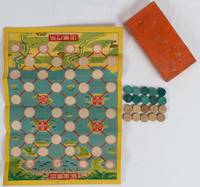
1940216804Japan. Circa 1940. Colour folding game sheet 36.5 x 26cm 10 wooden playing pieces each with embossed images in beige and blue complete original box 15.5 x 7.6 x 2.3cm considerably worn and soiled and corners reinforced the game itself is in very good bright condition. This is a two-player board game where air planes and war ships fight against each other. Fascinatingly the game sheet illustration shows the battle ground is in the Pacific where islands with palm tree are dotted. Consequently the game might be produced at the early stage of the Pacific War. The players attack each other after starting from a naval base and an air base. There are two islands each where they are safely protected from their enemies. The playing pieces are made out of paper with embossed images of war ships and air planes in beige air power and blue sea power colours. . unknown
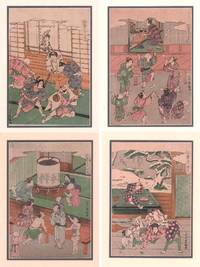
214282Japan. Late 19th Century. Set of four Japanese woodblock prints of the original series of twelve prints. Approx 26 x 18 cms preserved in modern window mounts 40.5 x 30.5 cms images in very good condition. These delightful scenes of children's play were originally depicted by Ishikawa Toyomasa in the mid-18th century as a series of 12 scenes for a year. Each print here shows how children play for the particular time of the year; May July October and December. Ishikawa was a talented artist who died very young. . unknown
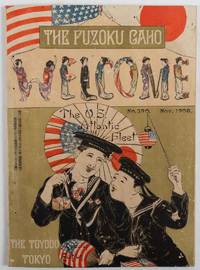
1908178293東京. Tokyo.: 東陽堂. Tōyōdō. Meiji 41 1908. Four double page colour plates a double page and a full page illustration in green ink black and white photographic illustrations. 25.5 x 18.5cm illustrations 23pp text: 50 13 36pp captions and text in Japanese and English. Original colour illustrated wrappers. Text evenly browned upper wrapper and first leaves a little insect damaged but still a very attractive souvenir issue. This fascinating magazine special issue was published to commemorate the Atlantic Fleet's the Great White Fleet visit to Japan in October 1908. The issue was published in November 1908 and reports all the activities of welcoming the fleet in Yokohama. Fuzoku Gaho was the first illustrated magazine which covered Japanese culture and was published between between 1889 and 1916. This special issue shows the enthusiasm Japanese government and the public displayed to the visiting US naval officers and sailors. <br> <br>The US Atlantic Fleet which consisted with 16 war ships went around the world between 1908 and 1909. As the ships were painted in white the fleet was also known as the Great White Fleet. In Japan they were called white ships 白船 in contrast to the black ships of Matthew Perry. This US naval exercise was to show off the American naval power to the world particularly in the Pacific after the Russo-Japanese War. The Japanese government decided to invite the fleet to Japan and welcome the ships with heightened enthusiasm. The contemporary social atmosphere and details of numerous events are covered extensively in this issue. Text is both in Japanese and English. The issue includes some pages of cartoon illustrations of American sailors on shore leave in Yokohama. With a title of "Jackass in Yokohama" and "U.S Jackies on the Spree" the sailors' experiences in Yokohama are illustrated with humour. . 東陽堂. [Tōyōdō]. unknown
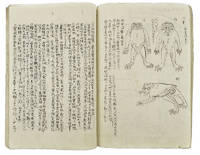
15702519th century. Black and white ink sketches 120 folded leaves paper covers titled in ink stab binding. Edges and corners creased on a number of leaves covers a little soiled occasional browning but generally very good. 24.5 x 17cm. A collection of manuscript abstracts from various books. The upper cover is titled in ink 雜書鈔錄 Abstracts from Various Books together with the signature of the transcriber Murakami Gozan 村上呉山 and his seal which reads "Gozan". <br> <br>The abstracts in this manuscript come from 26 different books and journals which were published or written in the Edo to Meiji period and mainly cover biography history and encyclopaedic information. <br>On the inside of the upper covers Murakami Gozan has written 28 titles however this list is not entirely accurate as one title appears twice and another does not seem to appear in the content at all. <br> <br>The abstracts that Gozan transcribed include: <br>Shōtei zakki 松亭雑記 Miscellaneous Notes by Shōtei a work which we were not able to locate so may be an unpublished manuscript. <br>Tsureduregusa shoshō taisei 徒然草諸抄大成 Complete Collection of Annotations on Tsureduregusa 1688; <br>Seppō innen-shū 説法因縁集 A collection of Buddhist stories. <br>Kinsei gōketsu-tan 近世豪傑譚 Biographies of the Great People in Pre-modern Times 1892 <br>Meiji shinshi-tan 明治紳士譚 Biographies of Prominent People in Meiji 1892 <br>Naigai kokon itsuwa bunko 内外古今逸話文庫 Library of Episodes of Great People of All Times in and outside of Japan 1893-94 <br>Hyakka setsurin 百家説林 Collection of Essays by Many Scholars1890-92; <br>Nihon taika ronshū 日本大家論集 Anthology of Articles by Japanese Great Experts journal 1887- 89 <br>Tōyō bijutsu 東洋美術 Far Eastern Art journal date <br>Yōnen zasshi 幼年雜誌 Magazine for Young Children journal 1891-94. <br> <br>The manuscript includes some illustrations and notable amongst these are: portraits of Toyotomi Hideyoshi and Oda Nobunaga; kappa lit. "river child" the legendary water animal which appears in Japanese folklore; scenery of Mt.Fuji from Hyaka setsurin; Chinese coins and seals and two Chinese figures painted by legendary painter Gu Kaizhi from Tōyō bijutsu; and water plant and water insects from Yōnen zasshi. . unknown
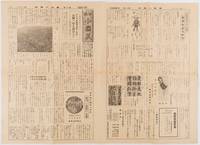
1936178377京都. Kyoto.: 関西小国民社. Kansai Shōkokuminsha. Showa 11 1936. Newspaper black and white photographic and art illustrations 39 x 27cm 4pp. Folded and light but even browning still a very good copy. The lead article on the front page of the June 6 1931 issue of this weekly newspaper aimed at children around 10 to 11 years old addresses the Trade Diversion Policy implemented by the Australian government against the Japanese textile industry. Australia imposed high tariffs on textile imports dealing a significant blow to Japan as a primary exporter of cotton and rayon to Australia. The article furnishes comprehensive information on the trade dynamics between Australia and Japan ultimately asserting that the diversion policy aimed to counter cheap imports from Japan safeguarding the interests of the British textile industry. <br> <br>In addition to this primary piece the children's newspaper features educational exercises and showcases calligraphy works submitted by its young readers. The diverse content aims to engage and inform its youthful audience on both current affairs and creative endeavors. . 関西小国民社. [Kansai Shōkokuminsha]. unknown
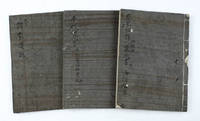
1573393 manuscript volumes neatly written in black and red ink. Original wrappers with later string ties. Wrappers damaged with a little loss in places. Some worming. Still overall very good. 19 x 13.5cm. These three volumes are a collection of manuscripts written in the late Edo period probably the 1860s. Most of the original documents on which the manuscripts were based were written shortly after the arrival of the American delegation led by Commodore Matthew Perry in July 8 1853 June 3 in Japanese calendar. These documents written in the face of this national crisis were mostly driven by the patriotic fervour of the authors. They show a variety of thoughts about the threat from the foreign powers. None of these were published at the time and only Watanabe Kazan’s Shinki-ron was published in modern times. <br> <br>Kazan wrote his treatise inspired not by the arrival of Perry but by the Edo government’s hostile treatment of the American merchant ship Morrison in 1837. <br> <br>Titles and short synopses of these works follow: <br> <br>Volume 1: Chiyoda mondō Questions and Answers in Chiyoda 千代田問答 1853; Momijiyama shinrei-ki紅葉山神靈記 Message from the Holy Spirit in Momijiyama <br> <br>The author of Chiyoda mondō is unknown. The word "Chiyoda" in Chiyoda mondō is the name of the area where the Edo Castle sat and refers to the god in the Tōshōgū Shrine in Momijiyama next to the western part of the Edo Castle. This document is difficult to read but it appears to explain how a group of mysterious people or possibly divine spirits tell stories related to Japan's national affairs in 1853 discussing the country's national defence against foreigners and the situation regarding Christianity. <br> <br>In Momijiyama shinrei-ki the anonymous author who was an attendant to the group of the high government officials visiting the Tōshōgū Shrine in Momijiyama fell asleep and in his dream a Holy Spirit appeared and told him the necessity of enhancing the coastal defence in the face of the American expansion. <br> <br>Volume 2: Daimyō shoka kengi 大名諸家建議 Proposals from War Lords and Various People <br> <br>This manuscript is a collection of proposals and opinions expressed by Daimyō war lords and the retainers of the Edo government on the subject of Japan's foreign policy after the arrival of the American delegation led by Commodore Perry which requested trade with Japan. The Daimyō discuss how to deal with the crisis in terms of such issues as trade and coastal defence. Some even proposed possible war with the American fleet. The daimyo some of whom were high-rank officials of the Edo government included Shimadu Nariakira島津斉彬 1809-58 Maeda Nariyasu 前田斉泰 1811-84 Matsudaira Shungaku 松平春嶽 1928-90 Tokugawa Yoshinobu 徳川慶喜 1837-1913 Ii Naosuke 井伊直弼 1815-60 Nabeshima Naomasa 鍋島直正 1815-71 and the retainers included Inoue Saburōemon 井上三郎右衛門 - and Katsu Rinsuke 勝麟助 1823-99. Katsu became a capable mediator when the Edo castle was surrendered peacefully to the new Meiji government in 1868. <br> <br>Volume 3: 海防備言 Kaibō bigen Words on Coastal Defence. Habu Kumagorō 土生熊五郎- Rifujutsui 嫠不恤緯 Widow Does Not Worry the Shortage of Weft the latter a Chinese expression referring to strong patriotism; Watanabe Kazan 渡辺崋山 1793-1841 Shinki-ron愼機論 Essay on Attention to an Opportunity 1838; Hakura Morochika羽倉用九 1790-1862 Gakaisho 畫灰書 Drawing in Ash and Gasuisho畫水書 Drawing in Water 1854; Fujimori Kōan 藤森弘庵 1799-1862 Kaibō biron 海防 備論Treatise on Coastal Defence 1853 <br> <br>Habu Kumagorō was a Confucian scholar in Wakayama. He proposed the developing the land of Ezo 蝦夷 Hokkaido. Rifujutsui discusses such topics as the advance of the Russians to Siberia and the necessity of developing Hokkaido as well as the art of war. <br> <br>Watanabe Kazan was a chief retainer of the Tahara Domain eastern part of present Aichi Prefecture Confucian scholar and also famous as a painter. Shinki-ron criticises the xenophobic foreign policy of the Edo government. <br> <br>Hakura Morochika was a Confucian scholar in Osaka. After the arrival of Perry he discussed the measures against foreign enemies. In Gakaisho a collection of historical essays Hakura objected to trade with America in the form of an answer to the sovereign message from America seeking trade with Japan. He also wrote an answer to the sovereign message from Russia but he was more sympathetic to the Russians because they sought trade through the official channel in Nagasaki while the American delegate in the military fleet came to Uraga in a threatening manner. In Gasuisho also Hakura mentions the harmful effects of Christianity. <br> <br>Fujimori Kōan was a Confucian scholar of the Ono Domain in present Ono City Hyogo Prefecture. In his later life he opened a private school in Edo and wrote the comprehensive treatise on Japanese coastal defence Kaibō biron after the arrival of Perry. . unknown
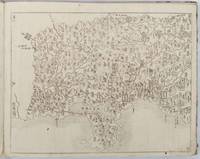
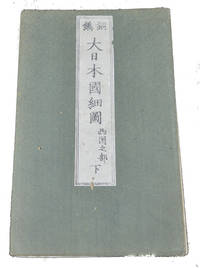
1864219844京都. Kyoto.: 村上勘兵衛. Murakami Kanbei. Genji 2 1864. Maps 16.5 x 21.5cm 47pp accordion style binding previous owner's chop worm holes lower edge or corners of many leaves and more centrally on 10 leaves cloth on boards torn with loss particularly on lower cover. Sold as a collection of delicately engraved maps. Even though the printed title label on the upper cover states that this volume covers the eastern provinces it in fact includes both eastern and western regions of Japan extending to Shikoku Kyushu Tsushima and the Okinawa Islands. The atlas opens with general maps of Japan and the world. Each delicately executed black and white map depicts towns transport routes and the principal topographical features including mountain ranges. . 村上勘兵衛. [Murakami Kanbei]. hardcover
1865154031Kyoto Edo Osaka Ise and Nagoya. 元治2. 1865. Part 2 of this atlas only. 4pp of text in Japanese 34 double page copper engraved maps showing the provinces of western Japan accordion style binding. 16.5 x 11cm. A little insect damage lower cover last six leaves of text and final map causing loss to some characters though the text it is still legible some very minor spotting or soiling but generally very good. This atlas shows the provinces in the western part of Honshu Island and those of Shikoku and Kyushu Islands including Okinawa Islands. Each delicate black and white map shows towns traffic routes and rough geographic features of mountains. . unknown
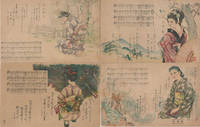
1572170402東京 Tokyo.: 新興音楽出版社. Shinkō Ongaku Shuppansha. 昭和18 1943. 5 very attractive colour postcards 9 x 14cm attractive pictorial paper envelope slightly browned and creased very good copies. These 5 postcards were published for sending to the front line soldiers from the home front. Each postcard has an illustration of a melancholy young Japanese woman dressed in a kimono printed around her are the words and musical score of a folk song from one of 5 Japanese regions - Akita Kusatsu Yoneyama Kagoshima and Yamanaka. On receipt the soldier would think fondly of home and maybe sing the folk song to or with his companions at the front. . 新興音楽出版社. [Shinkō Ongaku Shuppansha]. unknown
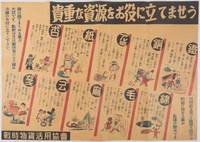
1942219987Japan.: 戰時物資活用協會. Senji Busshi Katsuyō Kyōkai. Circa1942. Folded colour poster 52 x 74cm very good copy. <br>We could find no institutional holdings of this poster. This poster published during the Pacific War was intended to educate the public about the importance of conserving and recycling everyday resources. The materials listed include steel copper aluminium paper cotton wool rubber and glass. The text stresses that many of these resources had to be imported from overseas and could be redirected for use in the war effort. Although the message itself is serious the poster is enlivened by cartoon-style illustrations that introduce humour and a sense of humanity. The recycling campaign was organised by Senji Busshi Katsuyō Kyōkai The Wartime Resource Utilisation Association which operated through a nationwide network and coordinated the collection of materials at a local community level. . 戰時物資活用協會. [Senji Busshi Katsuyō Kyōkai]. unknown
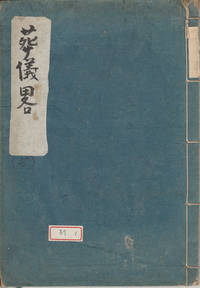
1865163632No place of publication.: No details of publisher. 慶應元 1865. Japanese late Edo book woodblock printed book on funeral etiquette black and white line illustrations showing objects used at funeral 21 leaves four-hole stabbing binding with strings handwritten title label laid down upper cover a little worming upper margin and in two small places on covers small sticker minor wear and marking covers lower corner a little bumped a good copy. Text in Japanese calligraphy style. 26.8 x 18.7cm. This book explains Shinto style funeral arrangements equipment and etiquette with some illustrations. . No details of publisher. unknown
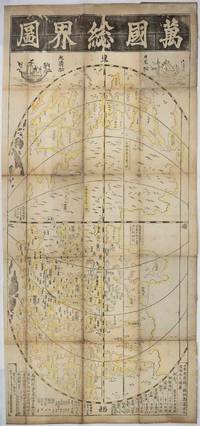
1708219243東京. Tokyo.: 須原屋茂兵衛. Suwaraya Mohei. Hoei 5 1708. Black and white woodblock map with yellow outlining in original hand colour 55.8 x 127cm map; 59.5 x 131cm sheet folding into the original Japanese wrappers chipped and rather worn 26.4 x 17.4cm the map with old repairs laid down on washi rather browned and wormed at the folds but with no serious loss the sheet age-toned and a little dusty but overall in remarkably good condition. Preserved in a modern blue linen Japanese case with toggle-closures. A famous woodblock-printed Japanese map of the world by renowned Edo Period map-maker Ishikawa Tomonobu who is also known as Ishikawa Ryūsen. This is a revised version of an earlier map produced by Ishikawa in 1688. <br> <br>The map appears to draw on Chinese and Portuguese geographical knowledge. The Chinese production of world maps had been transformed by the influence of the Italian Jesuit Matteo Ricci who collaborated with Chinese cartographers to produce a 1584 map of the world. In Japan the production of maps of "the myriad countries" or "the international countries" bankoku had been inspired by contact with Portuguese missionaries and with the Dutch in the 16th century. <br> <br>Ishikawa's map broadly resembles the Ricci map in being placed in an oval frame with the Pacific and thus also China and Japan at the centre. The content though is different. While Ricci's map is oriented to the north Ishikawa's is oriented to the east with America at the top of the page and the sketchy outlines of Europe including 'Ikiresu' England and a large and clearly marked Holland and Africa 'Kafuri' at the bottom. This orientation apparently influenced by the first world map in Japan "Bankoku Sōzu" 万国総図 which was published in 1645. Interestingly although Ishikawa had earlier produced a quite detailed and fairly accurate map of Japan the Japan shown on this world map is a rather loosely outlined collection of islands in which for example Ryūkyū the Ryukyu Kingdom now Okinawa and Hachijōjima appear much larger than they are in reality. Japan is also unusually oriented making it appear as though Ezo now Hokkaido is in the middle of the Pacific. It seems that the cartographer's interest here was less in outlining Japan in detail than in broadly setting out the country's place in relation to the land masses to the east and west. <br> <br>Like other Japanese world maps of the Edo period and like Ricci's map Ishikawa's image of the world includes imagined countries such as 'The Land of Giants". The continuing centrality of China in Japanese thought is indicated by the fact that Ishikawa's map contains a very clearly marked depiction of the Great Wall and that the map is decorated at the top with depictions of a Japanese and a Chinese sailing ship. The text at the bottom gives estimated distances between Hizen Province where the port of Nagasaki provided Japan's main official outlet to the world in this age of seclusion and various places in China and between Hizen and the Ryūkyū Kingdom. It also gives the estimated distance from Korea to Tsushima Island which served as Japan's gateway for diplomatic and trade relations with Korea. <br> <br>Engelbert Kaempfer a German physician and explorer brought back the 1688 edition of this map printing to Europe after his stay in Japan between 1690 and 1692. The map was introduced to European audiences in the 17th century and impacted on later European cartographic endeavours. <br> <br>Copies of this rare and historically significant map are held only in a handful of major collections: the British Library National Diet Library NDL of Japan the Staatsbibliothek of Berlin University of California Berkeley's Japanese Historic Maps Collection and the University of British Columbia. . 須原屋茂兵衛. [Suwaraya Mohei]. unknown
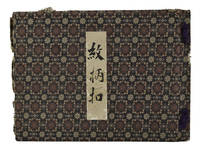
19001549731900. Sample album of designs most probably for weaving. The album contains 196 numbered paper slits for holding the design samples in place with 68 samples included. Handwritten paper tabs some damaged with loss attached to the edges of 17 leaves give the names of customers. Bound in cloth covered boards with tassel ties one place on the spine a little gnawed some other minor wear to cloth. Paper title label upper cover. A sample book which has been used for the purpose but is overall in good condition. This album contains samples of design which appear to be designs for the weaving of fabric. Many leaves have paper tabs attached which indicate the names of the customers ordering or interested in a particular design. Below each design is the name of the design and a hiragana letter and number given to the design. It is possible this album comes from Gifu Prefecture as there is a part of the letterhead of "鏡島尋常高等小學校 Kagashima Higher Elementary School. The seal of Sugiyama Shōten 杉山商店Sugiyama Shop is also included but we have not been able to locate this shop. . hardcover
1855154076Edo. 1855. Volume 5 only. 4 double page black and white woodblocks from copper engravings 18 folded leaves some worming throughout original wrappers considerably worn and wormed with a little loss. A reading copy only of the 5th and last volume of 米利幹新誌 巻之5 New Account of America. 1853 the year the first volume of this set was published was the year Commodore Matthew Perry's American fleet came to Uraga Bay. The four illustrations show: the UK fleet attacking the US port the US volunteers fighting to regain the territories taken by the Western forces a scene of the city of Boston and a family having lunch together. <br> <br>This set deals with the geography and history of North and South America. The author was well-known for his ready reception of western ideas. His work "Gogaku shinsho" is one the first books of Japanese grammar based on Western grammatical rules and conceptions . unknown
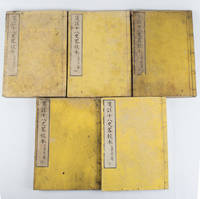
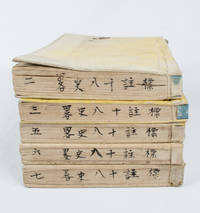
1880165397大阪.Osaka.: 中川勘助.Nakagawa Kansuke. 明治131880. 5 volumes of 7. Missing volumes two and three bound in Japanese 5 hole stab binding double leaves oriental style. Paper title labels laid down upper covers rubbed with loss soiling and creasing on covers edges little soiled occasional worming still text clean and sound. Text in Chinese with Japanese reading marks. 26 x 18.5cm. A Japanese edition of Jūhasshiryaku 十八史略 Shi ba shi lue in pinyin with extra notes. The text was checked against the authorative text by Japanese scholar 近藤元粹 Kondō Gensui. The Summary of the Eighteen Histories is an introductory Chinese history for children compiled by Zeng Xianzhi 曾先之 in the Yuan period. The full set is complete in 7 volumes. . 中川勘助.[Nakagawa Kansuke]. unknown
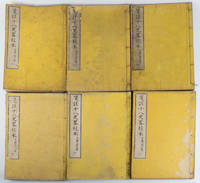
1880165396大阪.Osaka.: 中川勘助.Nakagawa Kansuke. 明治131880. 6 volumes of 7. Lacks volume 1 bound in Japanese 5 hole stab binding double leaves oriental style. Paper title labels laid down upper covers soiling and creasing on covers edges little soiled occasional worming and chops insect damage upper edge volume one still text clean and sound. Text in Chinese with Japanese reading marks. 26 x 18.5cm. A Japanese edition of Jūhasshiryaku 十八史略 Shi ba shi lue in pinyin with extra notes. The text was checked against the authorative text by Japanese scholar 近藤元粹 Kondō Gensui. The Summary of the Eighteen Histories is an introductory Chinese history for children compiled by Zeng Xianzhi 曾先之 in the Yuan period. The full set is complete in 7 volumes. . 中川勘助.[Nakagawa Kansuke]. unknown
1880165395大阪.Osaka.: 中川勘助.Nakagawa Kansuke. 明治131880. 6 volumes of 7. Lacks volume one bound in Japanese 5 hole stab binding double leaves oriental style. Paper title labels laid down upper covers soiling and creasing on covers edges little soiled ink annotation upper edge some volumes string split volume seven with some browning still text clean and sound. Text in Chinese with Japanese reading marks. 26 x 18.5cm. A Japanese edition of Jūhasshiryaku 十八史略 Shi ba shi lue in pinyin with extra notes. The text was checked against the authorative text by the Japanese scholar 近藤元粹 Kondō Gensui. The Summary of the Eighteen Histories is an introductory Chinese history for children compiled by Zeng Xianzhi 曾先之 in the Yuan period. The full set is complete in 7 volumes. . 中川勘助.[Nakagawa Kansuke]. unknown
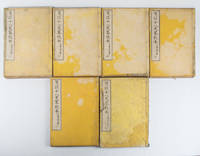
1878165197Tokyo.: 山中市兵衛.Yamanaka Ichibee. 1878. Volumes 2 3 5-7 of 7 volumes a Japanese edition of 18 Chinese histories classics spanning from pre-Qing to Song Dynasty. Originally edited by a Chinese scholar 曽先之 Zeng Xianzhi in Yuan Dynasty it was later annotated by another Chinese scholar 陳殷 Chen Yin in Ming Dynasty. This is Japanese edition compiled by 大賀富二 Ōga Tomoji has Japanese reading marks. Four-hole stab binding double leaves oriental style paper title label missing on volume 2 some marking covers particularly volumes 2 and 3 occasional worming string volume 3 split but still holding in good condition. 18.4 x 12.7cm. . [山中市兵衛?].[Yamanaka Ichibee?]. unknown
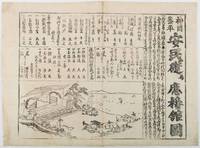
1854177799Japan. Circa1854. Black and white woodblock kawaraban printed on two joined sheets vertical central crease 41 x 63cm a little worming mainly on margins and repaired with paper on the reverse a little light browning but still presents very well. This kawaraban reports on how foreign visitors from the United States and Russia were treated in order to keep the peace and safety of God's country Japan. <br> <br>It reports that foreigners had arrived in Uraga this being the time of the second visit of Perry to Japan in 1854. The kawaraban goes on to list official gifts from the Shogunate to the President and his delegation members from the United States as well as to the Russian delegation. The gifts include lacquer boxes silk textiles as well as rice and chickens for the crew. <br> <br>The attractive black and white image at the foot of the report depicts a meeting in Yokohama at which a high ranking Tokugawa official received foreign visitors. The visitors are shown prostrating themselves in the open outdoor space in front of the building where the official sits. . unknown
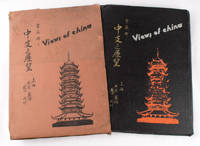
1572158424上海.Shanghai.: 三益社.Mimasusha. 昭和十三1938. Coloured folding map China as far north as Hebei Province south to Hong Kong west to Sichuan and Guizhou Provinces and corresponding coastal regions. Some folding black and white plates including one of the Bund looking north. 4 full page colour plates black and white photographic plates some highlighted with colour image of Chinese dragon wall sculptures on endpapers pictorial cover in red silver and gold titled in English and characters. The 54 leaves of photographic plates each captioned in Japanese are accompanied by a tissue guard with a somewhat more detailed explanation of the scenes in English and Japanese. Image of Chinese pagoda in red upper cover rubbed with a little loss. Upper corners bumped. Album measures 26.6 x 19.8cm. In original worn and marked pictorial card slipcase. Very good copy. This volume illustrates the famous sightseeing areas in Shanghai Suzhou Wuxi Zhenjiang Nanjing Wuhu Hangzhou Jiaxing and Songjiang. Additionally one leaf show three young Chinese beauties and two others the everyday lives of Chinese people. . 三益社.[Mimasusha]. unknown
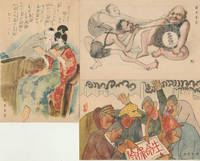
1572170401大阪. Osaka.: 日本生命保険株式会社. Nihon Seimei Hoken Kabushiki Kaisha. 昭和8 1933. 5 colour manga postcards 9 x 15 cm in slightly foxed original envelope. Postcards are all in very good condition. This set of manga postcards were published in1933 by Nippon Life Insurance Company to promote the benefits of life insurance. <br> <br>Nippon Life Insurance Company was established in Osaka in 1889. <br> <br>Instead of presenting figures and tables each manga tries to illustrate the sense of reassurance people would experience when they buy this company's insurance. For example a manga by Okamoto Ippei a famous manga illustrator in the pre-war Japan depicts a "Family Boat" where young and old members each wear a lifebelt represent their insurance policy while sailing. Its caption says that a insurance policy is a rescue buoy for life which would make people feel peaceful even on the roughest of seas. Another card features a young attractive geisha sitting coquettishly at home is an advertisement for an old age insurance policy. The text assures the viewer that their policy will be paid back in full when the policy matures. The couple plan to use the money to fund the granddaughter's honeymoon trip and their own holiday anticipating that they would live long enough to receive the matured fund. . [日本生命保険株式会社]. Nihon Seimei Hoken Kabushiki Kaisha. unknown
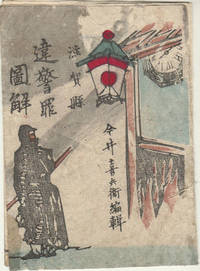
1518170899今井喜兵衛. Imai Kichibē. Meiji 15 1882. Woodblock Japanese printed booklet containing 3 folded leaves. Text accompanied by small handcoloured illustrations showing the minor criminal offences described above. 7 x 3cm section of loss upper section of colour woodblock upper cover stain lower cover upper cover and first two leaves lacks lower cover but contents are complete neatly rethreaded. Still an attractive copy of a fascinating and scarce item. A fascinating insight into crime and punishment in 1880s Japan this little booklet provides colour-illustrated explanations of minor crimes with details of the punishments which apply to them in Shiga Prefecture. It appears to have been designed for distribution to the public - perhaps to shops small businesses etc. From it we learn amongst other things that you could be imprisoned for between 3 and 10 days or fined a sum between 1 and 1.95 yen for giving lodging to a foreigner without recording their address properly. A sentence of 2 to 5 days imprisonment or a fine applied to people who sold raw fugu highly poisonous without proper treatment sold the meat of diseased animals offered photos or woodblock prints of the Emperor and Empress for sale or cremated the dead without official permission or in a place other than the officially approved cremation sites while a sentence of between 1 and 12 days applied to crimes which included flying paper kites near overhead telegraph lines. . 今井喜兵衛. [Imai Kichibē]. unknown
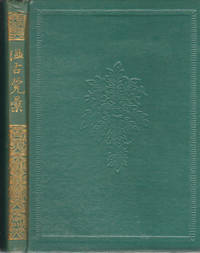
1572171337東京 Tokyo.: 日本古典全集刊行会. Nihon Koten Zenshu Kankokai. 昭和12. 1937. 92 colour plates tipped in 90 42 5pp 17.5 x 12.5cm attractive gilt spine appears to lack the facsimile title label otherwise all tipped in images are present a good hardback copy with embossed cloth covers. 17.3 x 12.2cm. A beautifully produced little book with colour illustrations showing the uses of traditional dyestuffs. Each small tipped in colour plate shows the colour produced by a dye plant or other dyestuff and examples of the designs in which they were used. This is followed by a section of explanatory text on the various fabric dyes illustrated in the volume. <br> <br>This book is a reprint of material originally produced by Haruta Nagatoshi 1753-1800 an eighteenth century armour-maker and was re-published in the 1930s as part of a series of reproductions of classical Japanese writings. . 日本古典全集刊行会. [Nihon Koten Zenshu Kankokai]. hardcover
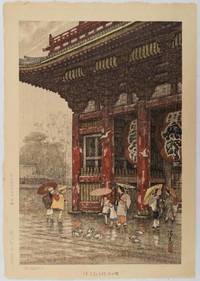
1935218363Yokohama.: Self published. 1935. Colour woodblock print 41.1 x 28.5 cms including margins title in the lower margin publisher's seals in the left margin with artist's signature lower left and chop lower right limited edition stamp on the verso 177 of 300 sheet a little age-toned but the image in very good condition. Exceedingly rare limited edition woodblock print by Ginnosuke Yokouchi also known as Kiyoharu Youkouchi a Yokohama-based artist who began his career as a watercolour landscape painter before producing eight self-published woodblock prints in the 1930s. See "Guide to Modern Japanese Woodblock Prints: 1900-1975" by Helen Merritt and Yamada Nanako. Little is known of his life but his work is representative of the Shin Hanga movement. This beautiful playful composition has a great delicacy of tone and a painterly fluidity of line. <br> <br>From the collection of the late John Caiger 1930-2022 lecturer in Asian studies ANU. . Self published. unknown
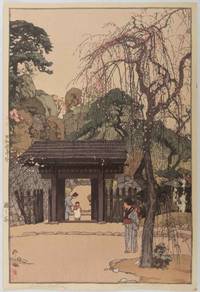
1935218323Japan.: Self published. 1935. Colour woodblock print 39 x 26.5cms including margins signed in ink with seal Hiroshi pencil signature Hiroshi Yoshida and the jizuri seal faded in the top left-hand margin margins a little toned and two small patches of paper abrasion removing surface colour in the lower right of the image but overall in good condition. Atmospheric woodblock print with delicate tonings the colour of the sky echoing the pink plum blossom of early spring a small child attended by their mother in costume waits at the gateway while a baby sitter looks on; a late career work by the great Hiroshi Yoshida 1876-1950. <br> <br>From the collection of the late John Caiger 1930-2022 lecturer in Asian studies ANU. . Self published. unknown