940 résultats
19902091502133904098Kei Jin bunka-sha 1990. Soft Cover. Fine. Number of books: 5 Kei Jin bunka-sha paperback
197924493Tokyo, Gakken / Gakushu Kenkyusha, 1978-1979. 3 volumes complete: Vol. 1: Nihon. [Japanese folk arts.]. - Vol. 2: Toyo. [Asian folk arts: mainly from China and Korea.]. - Vol. 3: Obei sonota / O-Bei, sono-ta. [Folk arts of Europe, the Americas and other places.]. - Text in Japanese; captions and essays by Bernard Leach and Hiroshi Mizuo also in English. 230; 228; 229 pages with numerous illustrations (some color). Fol. (38 x 27 cm), Original gray cloth bindings with illustrated original dust jackets in original cloth slipcases with two-tone title lettering in red and silver. [9 Warenabbildungen]
198237515Seoul: Po Chin Chai 1982. 488 S., 25 Taf. m. z.T. farb. Abb. u. Ill., 82 eingekl. Schriftmuster auf Taf., Lit.verz. 2° HLn.iS. *neuwertig* Widmung des Autors auf Vorsatz eingeklebt*
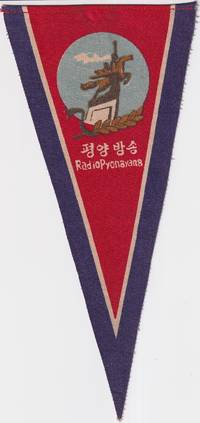
1960219665No publication details. circa1960s –70s based on design and material. Printed fabric pennant promoting Radio Pyongyang North Korea’s official broadcasting service. The image shows a stylised monument of two figures possibly symbolising industry and broadcasting with a laurel motif and radio waves under a red sky. Text in both Korean and English. Radio Pyongyang. “평양 방송” translates directly as Pyongyang Broadcasting. Text in Korean and English. 23.5 height x 11cm at top edge. <br> <br>A scarce example of early North Korean visual propaganda. Radio Pyongyang was founded in October 1945 and inaugurated programming with a live broadcast of Kim Il Sung's victory speech when he returned to Pyongyang at the end of WWII. The image on this pennant features a statue of two figures a worker and a peasant woman carrying a sheaf of rice riding the mythical horse Chollima symbolising speed strength and the spirit of the North Korean people. The Chollima movement which began in 1956 encouraged citizens to achieve extraordinary production and labour targets indicated by the sheaf of wheat symbolic of agricultural abundance. Radio Pyongyang helped to disseminaate the ideals of the Chollima movement and this pennant probably dates from after the Chollima Monument was unveiled in 1961. <br> <br>Provenance: Bought in China by a western collector in the late 20th century. . No publication details. unknown
193874971N.p.: South Manchuria Railroad. ca. 1938. This map has no date that we can see but history would likely place it at the end of the 30s. It is a full color and artistic panorama measuring 40 1/2 x 8 inches. The color map is on the recto and the verso is filled with text and illustrations of all the desirable and holy sites that the train's path goes through. The eight panels show the area of Kongosan or the Diamond Mountains. Some soiling to front panel and a recurring 1 inch tear to top border of each panel. Very bright and attractive.In 1910 Japan formally annexed Korea as a colony although in actuality Japan had been ruling Korea in some manner since 1876. The Japanese felt that their growing empire needed a buffer zone between the other two powers in the regions; China and Russia. Manchuria was also rich agricultural land with vast fields of soy. The laying out of a railway is a godd method of establishing borders so the Japanese were quick to lay down tracks. The Diamond Mountain or the Kumgang Mountains are a mountain/mountain range with a 1638-metre-high 5374 ft Birobong peak in Kangwon-do North Korea. It is about 50 kilometres 31 mi from the South Korean city of Sokcho in Gangwon-do. It is one of the best-known mountains in North Korea. The area often called "12000 Peaks" is one of the most revered sites for natural beauty on the Korean penisula. Koreans have perceived Kumgangsan as their muse since well before the Middle Ages. Practically every poet and artist who lived during the Joseon dynasty 1392-1910 made a pilgrimage to Kumgangsan. Among other well-known works are the Geumgang jeondo and the Pungaknaesan chongramdo painted in the 1740s by Jeong Seon. It was an area of religious interest as well and there were as many as 400 monasteries in the area. South Manchuria Railroad. unknown
1985145179Los Angeles: CBS / Universal City Studios 1985. Draft script for the 1986 pilot episode for the television show "Outlaws." <br/><br/>A sheriff and his deputies are transported from the year 1899 into the future by a lightning storm and they establish a new life as private detectives. <br/><br/>Set in Houston in 1899 and 1999. <br/><br/>Gray titled wrappers. Title page present noted as production No. 86084 dated November 26 1985 with credits for screenwriter/executive producer Nicholas Corea. 123 leaves with last page of text numbered 120. Xerographic duplication rectos only. Pages Fine wrapper Fine bound with three gold brads. CBS / Universal City Studios unknown books
19392080202103701573Railway Bureau of the Government General of Korea 1939. Soft Cover. Fine. Size: 20cm B6 Railway Bureau of the Government General of Korea paperback
19822091502135413878Research Institute of Ethnic Culture Korea University Publishing Department 1982. Soft Cover. Fine. Number of books: 2 Research Institute of Ethnic Culture, Korea University Publishing Department paperback
19372091502135416819Not Available 1937. Soft Cover. Fine. Number of books: 1 Not Available paperback
19842092902141900101Minzoku en 1984. Soft Cover. Fine. Size: 23cm Number of books: 3 in total Minzoku en paperback
19372083002117300251Korea Gyeongseong Imperial Local Administration Society Korea Headquarters 1937. Soft Cover. Fine. The book is in fine condition. Korea Gyeongseong Imperial Local Administration Society Korea Headquarters paperback
19912091502135420474Korea Institute of Spiritual Culture 1991. Soft Cover. Fine. Number of books: 7 Korea Institute of Spiritual Culture paperback
19922080302106805442Not Available 1992. Soft Cover. Fine. The book is in fine condition. Not Available paperback
19252091502133904181Not Available 1925. Soft Cover. Fine. Volume: 1 Not Available paperback
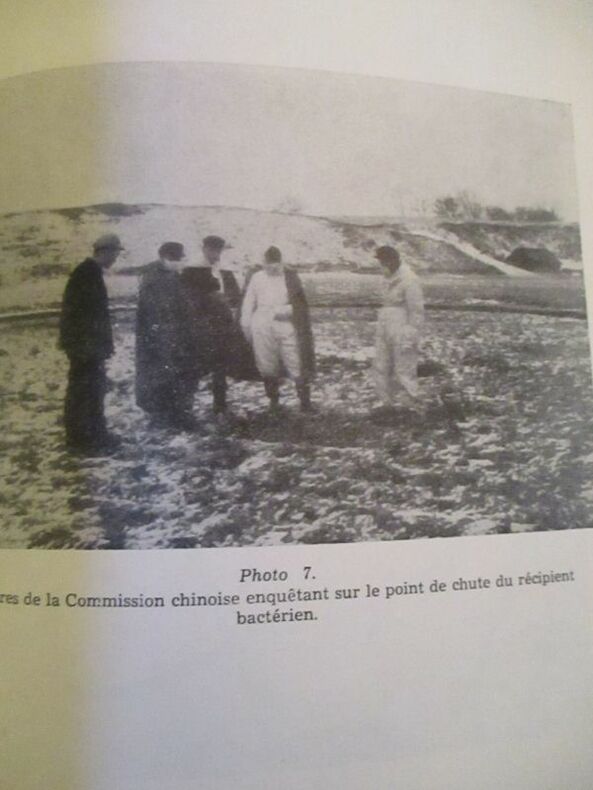
195265131952 Pekin 1952 fort volume In8 659 pages très grandes planches dépliantes et reproductions photographiques dans le texte
19292091502133904137Not Available 1929. Soft Cover. Fine. Volume: 1 Not Available paperback
190641143BBLondon:, W. Heinemann, 1906. Lex.-8°. XII, 473 S., zahlreiche sw-Abbildungen, Leinen (Besitzervermerk auf Innedeckel; altersgemäss gut erhalten)
19272091502133905685Not Available 1927. Soft Cover. Fine. Volume: 1 Not Available paperback
1920008584Paris Aux Editions de la Sirène, Les Tracts 1920 In-12 Broché, couverture rempliée Ed. originale
19262091502133902945Not Available 1926. Soft Cover. Fine. Volume: 1 Not Available paperback
19612091502135415129Not Available 1961. Soft Cover. Fine. Volume: 23 Not Available paperback
19872091202133212230Not Available 1987. Soft Cover. Fine. Volume: 1 Not Available paperback
190421119Leipzig, Spamer, 1904. Mit 114 Abbildungen nach photographischen Aufnahmen sowie einer Karte des Kriegsschauplatzes in Ostasien. XXXI, 296 SS., eine faltbare Landkarte und zahlreiche, tls. ganzseitige s.w. Abbildungen. 8°, (ca. 17 x 24 cm). Handeinband. Halbfranzband über 4 Bünden, vergoldete Deckel- und Rückenfileten, goldgeprägtes Rückenschildchen, Goldschnitt. Einbanddeckel und Vorsätze mit schönem Buntpapier in Farbverläufen bezogen. Einliegend in einer Kassette, diese mit goldgepr. vierfachen Fileten.
1964197821964. Anonymous photographs of African American soldiers stationed in Korea and Europe produced c. 1960s document Black military service during the Cold War and provide primary-source evidence for the study of U.S. Army deployments racial integration in the post-World War II military and lived experience within forward operating environments near geopolitical flashpoints. The images place African American servicemen at installations including Camp Kaiser in South Korea located within proximity to the Korean Demilitarized Zone and in European urban and alpine settings indicating rotational or multi-theater deployment. The archive supports research into the role of Black soldiers in Cold War containment strategy as well as the everyday conditions mobility and social environments encountered by enlisted personnel across Asia and Europe during a period of sustained global military presence.<br /> <br /> Archive of 24 original black and white silver gelatin photographs c. 1960s primarily measuring approximately 4" x 3". At least half of the images are identified as taken in Korea with multiple captions including "Camp Kaiser" "Korean Home" "Village" and "CO Area" situating the group within a U.S. Army installation environment composed of cinder block structures and Quonset huts approximately 60 miles north of Seoul and within range of North Korean artillery positions. One overhead view shows the full layout of Camp Kaiser while other images depict African American soldiers in field conditions described as "Cold Wet" trekking and camping in rugged terrain. Additional Korean scenes include a soldier leaning against a tank marked "Kimchee" and an airfield photograph showing a chrome fighter jet surrounded by personnel alongside additional aircraft including a biplane. European photographs include a parade observed from an apartment window in a German-speaking alpine town featuring a float labeled "General Knuller" as well as street-level images of crowds deployed fire engines and soldiers observing from a Volkswagen Beetle. One image shows an African American soldier standing outside a synagogue marked by a Star of David with a flag bearing the inscription "Troop Att 1964" indicating interaction with local religious or commemorative sites.<br /> <br /> The photographs align with the global positioning of U.S. forces during the Cold War particularly in South Korea following the Korean War armistice and across Western Europe as part of NATO-aligned defense strategy. African American soldiers serving in an officially desegregated military after 1948 participated in these deployments while navigating both military hierarchy and broader social transformations associated with the Civil Rights era. The archive captures a range of activities from patrol and training environments to civic encounters and public events offering a geographically dispersed visual record of Black military presence within U.S. Cold War operations. Light wear and minor handling present; captions and details remain legible; overall very good condition. unknown
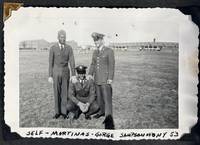
1953212881953. African American military photo album 1953-1960 documenting the service and personal life of a Black U.S. Air Force serviceman across multiple postings during and after the Korean War. The album records military duty daily routines and interpersonal relationships within an increasingly integrated armed forces providing visual evidence of African American participation in Cold War military infrastructure. The material captures both overseas deployment in Korea and domestic life across U.S. bases situating individual experience within broader patterns of military service and social change following desegregation.<br /> <br /> Album comprises 101 black-and-white silver gelatin photographs most measuring approximately 3.5" x 3.5" mounted on black pages with corner mounts. Early images place the serviceman at Kessler Air Force Base in Mississippi followed by extensive documentation of his time in Korea likely associated with the 650th Aircraft Control and Warning Squadron as indicated by a tent marked with unit insignia. Photographs show military encampments with tents and barracks vehicles including trucks and jeeps and groups of soldiers engaged in daily routines. One caption identifies "Our home in Korea" accompanying images of base infrastructure. Additional scenes include a USO performance at "K-6 Korea 54" where servicemen gather beneath a "Camp Shows" banner. The album continues with postings at Ellsworth Air Force Base in South Dakota and locations in Alaska where winter conditions specialized vehicles and outdoor activities are visible. Social and interpersonal life is extensively documented with repeated appearances of individuals identified as "Daril" "Bunky" "Peanuts" and others shown in uniform at leisure and in group settings. Domestic scenes include family gatherings such as "Roger's Birthday Party June 59" and images of women and children identified as "Mary" "Rochelle" and "Teresa" indicating sustained family connections. Travel photographs include roadside markers such as "Welcome to Illinois" and "Entering Indiana" while Alaska-based images depict community events including dog sled races and local festivals.<br /> <br /> Created during the transitional period following the desegregation of the U.S. military these photographs provide a sustained record of African American service members operating within integrated units while maintaining personal and family networks across geographic distances. The combination of overseas deployment domestic postings and family life offers a comprehensive view of military and social experience during the 1950s. Album pages show some loss and covers are detached; photographs remain sharp with strong tonal quality and are largely well-preserved; overall very good condition. This album offers an extensive documentary record of African American military life and community formation in the Korean War and early Cold War period. unknown