27 résultats
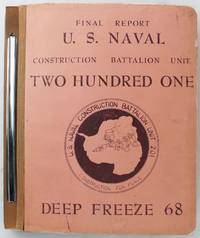
19685022Antarctica 1968. Very good. 65pp. report typed on rectos only plus 28 leaves illustrated with eighty-six black-and-white mounted photographs each approximately 5 x 7 inches most accompanied by typed paper caption strips plus three loose photographs. Quarto. Original pressboard wrappers with metal spine fastener with printed title leaf pasted to front board. Minor wear to binding photos in generally nice condition. A typed report accompanied by detailed photographs documenting the 1967-1968 projects carried out by U.S. Naval Construction Battalion Unit 201 in Antarctica dubbed "Deep Freeze '68." The projects involved the upgrading and expansion of facilities at McMurdo Station and Palmer Station including water sewer and energy infrastructure improvements and laboratory and living-quarters construction. The original photographs here provide more than eighty-five detailed and well-captioned views of Antarctic construction architecture and engineering involved in the execution of “Deep Freeze ‘68†with sixty-five pages of typed reports providing a dense written summary in support of the project.<br /> <br /> Battalion Unit 201 had been newly established in 1967 as a Seabee unit specializing solely in Antarctic construction to continue supporting the series of "Operation Deep Freeze" missions first headed by Admiral Richard E. Byrd in the 1950s to establish a permanent research infrastructure on the then-largely unexplored Antarctic continent. Plagued by material shortages and the savage regional climate Unit 201 was disbanded at the end of “Deep Freeze ‘71†as the brief building season made the continuation of a dedicated Antarctic construction unit unfeasible. unknown
1906ANTARCTI024617William Blackwood Edinburgh and London. 1906. First edition. Prefatory Note by William S. Bruce. Octavo. pp xxiv 375. Numerous black-and-white photographs; two folding maps one at rear. Original slate-grey pictorial cloth lettered in white. An account of the Scottish Antarctic Expedition 1902-1905. Peter Speak author of William Speirs Bruce: Polar Explorer and Scottish Nationalist 2003 describes the expedition as "by far the most cost-effective and carefully planned scientific expedition of the Heroic Age" and yet it received no formal honour or recognition from the British government and its members were denied even the prestigious Polar Medal. A major achievement of the expedition was the cataloguing of more than 1100 species of animal life 212 of them previously unknown to science. R.H. Rudmose Brown was the chief botanist. Presentation copy inscribed on the half-title page: "With the kind regards of R.N. Rudmose Brown" and with a short inscription on the headed notepaper of The University Sheffield: "To Mr Hendrickson with happy memories of a day in Green Harbour - R N Rudmose Brown". The recipient Peder Leonard Henrickson 1859-1932 was a harpooner and because of his extensive experience of hunting in Arctic waters was taken on by Fridjof Nansen for the 1893-6 Norwegian Polar Expedition on board the Fram. J. Arthur Bain in his Fridtjof Nansen: His Life and Explorations 1895 describes him thus: "He is a tall square-built man of exceptional physical powers which have often been severely tested. When off Novaya Zemlya in 1888 the schooner Enigheden of Christiansund on which he was harpooner became a total wreck. The storm continuing he was compelled to remain on deck for several days during which he was literally encased in ice. He at last managed to crawl ashore and report says 'was able to thaw and dry his clothes.' His herculean strength has enabled him to endure all hardships and he entered on his latest voyage with an iron constitution and strong resolve." Green Harbour or Gr�nfjorden in Norwegian lies on the southern side of Isfjorden on Spitsbergen's west coast. Rudmose Brown published a book Spitsbergen: An Account of Exploration Hunting the Mineral Riches & Future Potentialities of an Arctic Archipelago 1920 and presumably he met Hendricksen during the course of his researches. Most of the white enamel lettering on the spine had flaked off but is intact together with the illustration on the upper cover. Three closed tears to the folds of the last large map about 5-6cm each. Bump to top corner of front cover. Top corner of the text block of the first few pages slightly bumped. Overall a very good copy indeed. William Blackwood, Edinburgh and London. hardcover
