4 751 résultats
New Turkish Paperback. Roy. 8vo. (24 x 17 cm). In Turkish. 223 p., ills. Amerika'nin yüz yillik Ortadogu hayali: Chester Projesi (Tarih Subesi Yayinlari No. 16). Study on the Chester railway concession project of the U.S.A.
M., El Progreso Editorial, 1890, 22 x 14,5 cm., láminas e ilustraciones intercaladas, XXVI págs. + mapa plegado + 457 + IX págs. (Falto de la cubierta original anterior).
Roma, Adnkronos, 2003, 8vo brossura con copertina illustrata a colori, pp. 94 ( allegato a "Il Riformista" ) .
180926192Imprimerie Impériale | Paris 1809-1829 | 71 x 53.50 cm | une feuille
180926315Imprimerie Impériale | Paris 1809-1829 | 71 x 53.50 cm | une feuille
Small folio (ca. 210 x 314 mm). (10), 308, (12) pp. With engraved title-page and 5 full-page engraved illustrations in the text, as well as several woodcut initials and woodcut printer's device. Contemporary full vellum. All edges red. Second, improved Latin edition of this famous account of a pilgrimage to the Holy Land by the Polish Prince Mikolaj Krzysztof Radziwill (1549-1616), frequently translated and reprinted. First published in 1601; the present edition is corrected and expanded. - During his two-year journey from 1582 to 1584 Radziwill visited not only Palestine, but also Syria, Egypt, Crete, Cyprus, Italy and Greece. "Radziwill, in his account of the pilgrimage to the Holy Land and Egypt, described the ethnic diversity of the inhabitants of these lands. Critics underline the fact that his descriptions were ethnographic in character and quite objective. His 'Peregrynacja' was published in Latin and in Polish and apparently was quite widely read" (S. Grodz, Islam in Polish-Lithuanian/Ottoman Encounters, in: The Character of Christian-Muslim Encounter, Leiden 2015, p. 234). - The emblematic illustrations show sailboats in a fierce storm, such as Radziwill himself encountered, as well as appropriate Biblical quotations in banners decorated with maritime elements, but also a plan of the Church of the Holy Sepulchre in Jerusalem (a separate appendix describes the prayers and songs there to be sung). - Binding somewhat brownstained and a little warped; upper hinge starting. Paper evenly browned throughout, occasional brownstains. Provenance: from the library of Duke Franciszek Maksymilian Ossolinski (1676-1756), Polish politician in the service of the exiled Stanislaus I. Leszczynski and an important collector, with his autograph ownership inscription "Ex Libris F. M. Ducis de Tencryn-Ossolinski", dated Lunéville, 12 Sept. 1741, to front pastedown, and a three-line handwritten French quotation from St. Augustine to lower pastedown. In all a good copy of a widely received work; this edition rarely seen at auction. Weber II, 204. Röhricht p. 208, no. 787. Estreicher XXVI, 90. Brunet IV, 1087. Graesse VI, 17. Baumgarten, Hall. Bibl. VI, 65f. Ebert II, 18596. Tobler 83. Cf. Aboussouan 769.
In-8° pp. 16, bross. edit.
Royal folio (375 x 488 mm). VII, (1), 204, VIII pp. With 64 plates (46 full-page, 17 half-page and 1 folding), mostly engraved after Ludwig Christian Fuhrmann, some after drawings by the author; 8 engraved text vignettes, 1 engraved tughra as headpiece; lithographed dedication. Modern half calf over contemporary marbled boards with printed title label on spine. First edition. - The very rare original edition of this important account of a journey through Turkey and Asia Minor. According to Brunet the finest publication ever to leave a Polish press, it was soon translated into German as "Malerische Reise in einigen Provinzen des Osmanischen Reichs" (last sold for £20,400 at Sotheby's 2004 Natural History and Travel Sale; no copy of the present original edition has appeared at German auctions during the last decades). - The Polish statesman Count Edward Raczynski (1786-1845), a patron of the arts and founder of the Raczynski Library in Poznan, travelled to Constantinople by way of Odessa during the months of July through November 1814. He was accompanied by the artist Ludwig Christian Fuhrmann (1783-1829), and most of the plates are engraved after his drawings. Raczynski also visited the Troad, the peninsula containing the ruins of Troy, of which a detailed description is given. This beautifully illustrated work is highly sought after for its many detailed engravings, including a folding map of Istanbul, illustrations of the ruins of Troy and Assos, the bay of Lesbos, a portrait of Sultan Muhammad IV, the mosque of the Sultan, etc. - In the present set, most of the plates are early or proofs prints, still lacking numbers and/or captions, which are frequently supplied in meticulous pencil calligraphy (in Polish and English). Leaves of pp. 1/2 and 3/4 transposed; the former bound showing page 2 before 1. Interior severely browned throughout as common. Tears to title and dedication repaired; a few edge flaws due to brittleness of paper. Only 5 copies of this original edition listed in library catalogues internationally (BL, BnF, LoC, Stabi Berlin, NL Sweden). Brunet IV, 20412. Weber 133 (note). Not in Atabey. Cf. Blackmer 1375 (1824 German edition).
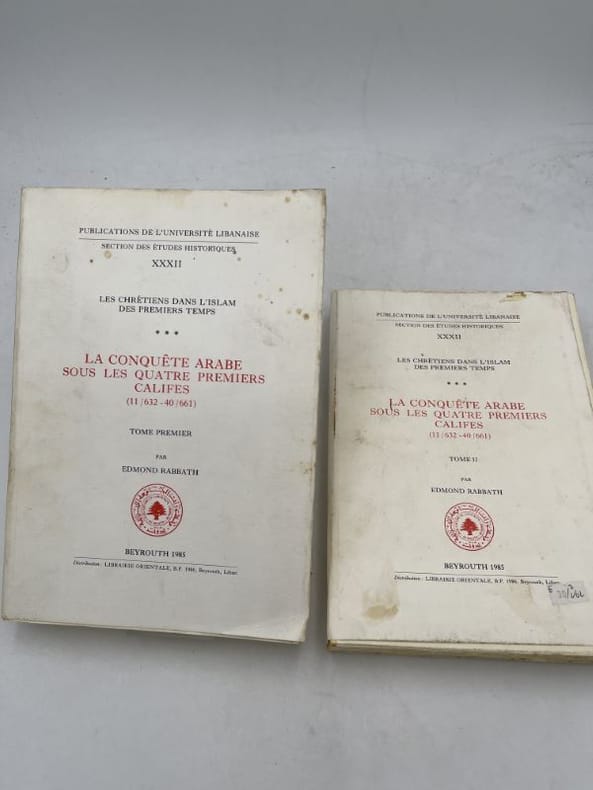
1985180082Librairie Orientale Beyroyth, Librairie Orientale, 1985. 2 volumes grands In-8 brochés de XIX + 1084 pages en pagination continue. Publication de l'université Libanaise. Section des études historiques XXXII. Les chrétiens dans l'Islam des premiers temps. Les couvertures sont salies, l'intéreieur très propre.
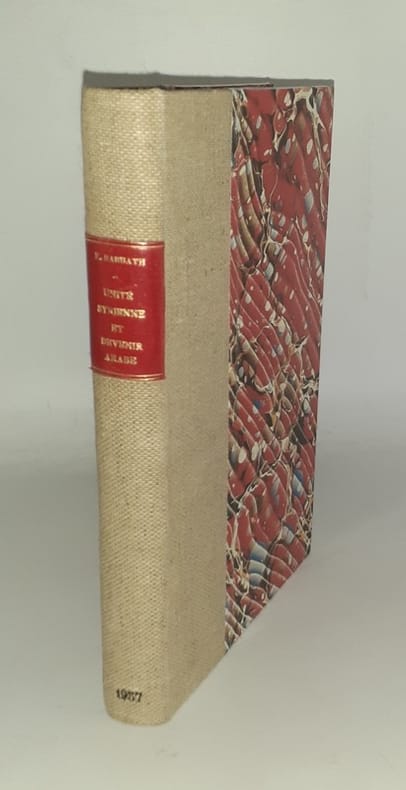
604706Paris, Lib. Marcel Rivière et Cie, 1937. In-12, rel. post. demi-toile beige, pièce de titre rouge, titre doré, date en noir en queue, tr. mouchetées, 410 pp. Qq. annotations manuscrites au crayon. Première édition.
Fine English Paperback. Cr. 8vo. (20 x 14 cm). In Turkish. , 156 p. Islam ve ulus devlet. Translated by Enis Arslanoglu.
1950100143609J. Gabalda et Cie Éditeurs 1950 in4. 1950. Broché.
8vo. 307 ff. Naskh calligraphy, 15 lines. Black ink on polished paper; borders in red and gold; sura headings in white ink on gilt; gilt discs for verse divisions. Double-page 'unwan on first two pages shows elaborate gilt ornamentation; colophon shows floral ornamentation in green and gilt. Coloured floral decoration to margins. Later cloth. Colophon in Arabic: "Finished Thursday afternoon 3 o'clock. The scribe is the son of Mehmed Halil Ibrahim, what is done is determined by Allah". - Provenance: acquired in Istanbul, Turkey, in the 1960s.
26 x 37 mm. 819, (5) pp. Original leather leather binding richly gilt with floral motifs, with leather clasp and cord with attached magnifying lens. All edges gilt. In original cardboard box. A charming miniature Quran in excellent condition, preserved in its original gilt binding and cardboard box. With richly decorated opening double page frontispiece. Fully vocalized text set in a frame, verse separators, sura headings and section markers in the margins printed in black throughout. These miniature Qurans were printed at the press of Hans Steinbrener since the early 1900s; with the new millennium, the shop closed down and ceased production. These miniature editions of the Holy Quran, with their elaborate gilt leather bindings and attached magnifying glass, count among the finest examples of their kind and as masterpieces of Bohemian printing and craftsmanship. "The firm advertised itself as the continent's largest producer of artistic bindings for prayer books and the largest publisher of prayer books [...] This publisher supplied a market ranging from Manila to New York" (Marija Dalbello, "Franz Josef's Time Machine: Images of Modernity in the Era of Mechanical Photoreproduction", in: Book History, Vol. 5 [2002], pp. 67-103). - Available colours: green, red, blue, brown, maroon. Gilt cover design, box design, and clasp design may vary. Coin shown for size comparison only.
8vo (129 x 83 mm). Illuminated Arabic ms. on paper, 303 ff., 15 lines, Naskh script. Double-page 'unwan on first two pages shows elaborate gilt ornamentation; colophon shows coloured ornamentation. Text framed by three parallel golden, black and red wires. Gold discs between verses, sura headings written in gold. Contemporary blind- and giltstamped binding with fore-edge flap, decorated with borders and corner stamps. Some slight restoration to first leaves, otherwise in very good condition.
8vo (124 x 180 mm). Illuminated Arabic ms. on polished paper. 301 ff., final blank. 15 lines, Naskh script. Black ink on polished paper. Double-page 'unwan on first two pages shows elaborate gilt ornamentation. Borders in red, black and gold. Gold discs between verses, sura headings written in red. Contemporary blindstamped gilt calf. Complete Quran ms. with occasional coloured floral decoration to the margins. First leaf remargined; some fingerstaining and occasional browning; a very few ink smudges. Spine rebacked in different leather. Altogether a good example.
8vo (149 x 94 mm). Illuminated Arabic ms. on paper, 211 ff., 20 lines, Naskh script. Double-page 'unwan on first two pages shows elaborate gilt and coloured ornamentation. Framed by strings of three gold and black lines. Gold discs between verses, sura headings written in gold. Original lacquer binding decorated with flowers. Traces of use, otherwise in good condition. Binding restored.
467p. Paperback. Nice copy. Eleventh U.S. edition. ISLAM BOX 2
prima ediz., in 4, pp. XXIII, 232, leg. edit. ill.; civiltà islamiche antiche e moderne, con un saggio di André Miquel, 120 foto a col. 175 in b/n e 14 cartine n.t. 072/23
4to. XVII, (1), 224, (2) pp. With 5 photographic full-page illustrations and 4 maps. Hardbound. Dustjacket. First edition. - Providing the first comprehensive history of manufacturing in the Ottoman Empire and its Turkish successor state through case studies of manufacturing activities in their social and political contexts, by integrating first-hand research with surveys of the literature. Quaetaert was a Middle East/Ottoman historian teaching at Binghamton University in New York. He resigned as board chairman of the Institute of Turkish Studies in 2006, following his statement that scholars should not avoid researching the Armenian Genocide, which displeased the Turkish government, thus endangering the Institute's funding. - In excellent condition.
4to (165 x 213 mm). Arabic manuscript on polished oriental paper. 53 pp. on 28 ff. 19 lines, per extensum, written in a Naskhi script in black ink, some words in red, some marginal notes. Contemporary half leather binding over marbled boards with fore-edge flap. A manuscript on Arabic prosody and metrics, forming a commentary on the well-known prosodic manual "Kitab al-'Arud al-Andalusi" by Abu al-Jaysh al-Ansari al-Qisti al-Andalusi (d. 626 H / 1229 CE). - The commentator Al-Qaysari, who flourished in Anatolia in the 14th century CE, both condensed and expanded on the work of Al-Jaysh, with the aim of providing a summary for students as well as adding his own perspective on the study of poetic metre and verse. He dedicated his effort to Emir Süleyman bin Tashun, an important political figure in Anatolia, who had commissioned the book. After a traditional introduction and long foreword, Al-Qaysari's work contains quotations from the original text, which he then juxtaposes with his own opinions. For his commentary, Al-Qaysari also drawn upon the standard works of Al-Khalil ibn Ahmad al-Farahidi (who first systematized the art of Arabic prosody) and Al-Khalil's student Al-Akhfash al-Avsat. - By tradition, Arabic prosody ('Arud) scans poetry not in terms of syllables (as in most Western languages), but in terms of vowelled and unvowelled letters, which are combined into larger units, which in turn make up feet. Sixteen types of metre are distinguished, some very common, others exceedingly rare. - The present copy was written in the early 18th century CE by a scribe who names himself as Ali ibn Muhammad ibn Ali ez-Zuhri es-Shirvani al Madani, a scholar who is known to have resided in Medina all his life. On the recto of the first leaf are a few later pencil notes which erroneously attribute the work's authorship to Al-Madani himself, though the copyist did indeed add several notes of his own supercommentary in the margins. - Binding a little rubbed; hinges chipped and weakened in places, interior very well preserved with minimal staining or smudging. A fine example. GAL I 310, 8 & S I 544, 9. Cf. Joan Maling, The Theory of Classical Arabic Metrics (1973). Ernest N. McCarus, "Identifying the Meters of Arabic Poetry", in: Al-’Arabiyya 16.1/2 (1983), pp. 57-83.
8vo. 54, 52, 58 pp. With numerous photographic illustrations, 2 folding maps (both of Qatar: one in English, the other in Arabic). Original brightly coloured pictorial wrappers. First edition. A publication created by the Government of Qatar, to represent the progress the country had made in a number of fields: from Legislative Development to Education. An interesting insight into the various facets of Qatar's modernization. The book contains the same text, printed in three languages: English, French and Arabic. Very rare; OCLC located a mere three copies (French National Library; University of Haifa; School of Oriental and African Studies, London). OCLC 460812475.
Small quarto in grey illus paper wraps; 440 p. ; 25 cm; bibliographical references. In Arabic. || Judaism -- History -- Sources. Jews -- Civilization. Civilization, Assyro-Babylonian. Bible. O.T. -- Criticism, interpretation, etc. Bible. O.T. -- Sources.
VIII, 36, 33, (1), 30 SS. In arabischer und lateinischer Schrift. Grüner Leinenband mit Goldprägung. 8vo. Persisches Schauspiel nebst deutscher Übersetzung, herausgegeben durch den Wiener Orientalisten Wahrmund (1827-1913), seit 1885 Direktor der Orientalischen Akademie, wo die Ausgabe auch als Lehrmittel diente. - Einige Bleistiftanmerkungen, insgesamt gutes Exemplar. Zu Wahrmund vgl. Fück 187.
686 pp. Publisher's original wrappers. 4to. Third edition of this history of the Arabian Gulf, first published 1965. Includes a few maps as well as extensive bibliographical references (pp. 675-681). - Well preserved. OCLC 71425250.