481 résultats
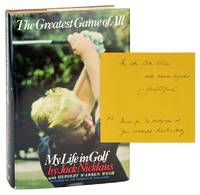
196938536New York: Simon and Schuster 1969. Very Good/Very Good. New York: Simon and Schuster 1969. First Edition First Printing Stated. Octavo; publisher's cloth in unclipped photo-illustrated dust jacket; 416pp.; half tone photographic frontispiece illus. throughout. Light wear to jacket margins top textblock edge foxed else a Very Good copy. <br /> <br /> Inscribed and signed on front free endpaper "For Sir Peter Allen / with warm regards / Harold Wind / P.S. Thanks for the photographs at your wonderful Masters party." Sir Peter Allen 1905-1993 was a noted British industrialist and trained chemist who was part of the team that developed polythene plastic. In 1969 Allen had just been named Chairman of the Imperial Chemical Industries but more importantly Allen was the author of the guide "Play the Best Courses: Great Golf in the British Isles. Simon and Schuster unknown
1967Paris: Firmin-Didot 1879-1880. Two volumes complete. Best and most complete edition of the most important of all crusade narratives the French recension of Guilaume de Tyr often called the "Roman d'Eracle". xxvii 561; 535 pp. Focuses on the period from the late 11th century until 1183. Volume I is ONE OF 100 NUMBERED COPIES PRINTED ON FINE LAID PAPER. 4to. Original wraps. UNCUT FINE AND BRIGHT WITH NO DEFECTS. Very scarce and much more so in pristine condition. <br/><br/> Paris: Firmin-Didot, 1879-1880 paperback
Two volumes, complete. Best and most complete edition of the most important of all crusade narratives, the French recension of Guilaume de Tyr, often called the "Roman d'Eracle". xxvii, 561; 535 pp. Focuses on the period from the late 11th century until 1183. Volume I is ONE OF 100 NUMBERED COPIES PRINTED ON FINE LAID PAPER. 4to. Original wraps. UNCUT, FINE AND BRIGHT, WITH NO DEFECTS. Very scarce, and much more so in pristine condition.
Half-leather binding. Telephone Talk was the glossy bimonthly publication of the British Columbia Telephone Company. It was written by employees for employees to present information of interest to those engaged in the plant, traffic, commercial, operating, accounting and other departments of the service. Each issue is replete with black and white photos and information on topics such as: company, industry and technological news, traffic levels, expansion plans, personnel announcements, publicity and social events, deaths, weddings, lists of exchanges, and more. As such, these issues serve as a vital preserve of rare and fascinating British Columbia history. This volume covers topics including: Long Distance enters Canada's North Country; Telephone reunites B.C. Mother, Whilma Hincks, with son in Switzerland; Bayview and West win traffic service contest; Telephone calls that keep the doctor away; Article on diet/eating by K.F. Robins, Health Supervisor; The dial telephone's magic wheel and how it works - 4 page illustrated article; 2 photos and caption of the only Chinese telephone office outside of China - Pacific Telephone and Telegraph Company, San Francisco; Statistics re: number of telephone sets per community province-wide; Numerous changes in Vancouver's new telephone directory; Many merry mix-ups followed the directory changes; Calls to Australia now routed across the Pacific; Fred Buckle; A visit to London, England via its telephone directory; The Rolling Pin to the Rescue - the tabulators in the information office; B.C. Ship-to-Shore service expands rapidly in year; Harley D. Miller; Paving the way for Vancouver's dial system; White Rock to have dial system; Carrier now used on Gulf cables linking Vancouver and Nanaimo; New submarine cable laid from Copper Cove to Bowen Island; Greater Vancouver and Royal City have big cable programme; Half a million calls daily in Vancouver; William Tyre; Robert Browning Smith; Vacation from work but not from health; Cover photo of King George and Queen Elizabeth bidding farewell at Chilliwack; Gordon Farrell's yacht on Burrard Inlet; Telephones at the fingertips of Royal Couple throught the tour - 5 page article with great photos; Australia wins telephone 'ashes' in Port Day 'word match'; Wire Photos Transmitted from Vancouver for First Time - 3 pages with photos; "Our PNE exhibit was a crowd magnet - voice mirror"; Cecil Austin McMaster; Robert Smyth; Telephoning popular pastime of singers; Telephone equipment in new Hotel Vancouver - many photos plus article entitled "The House with 700 Phones"; White Rock now has dial system; Percy H. Wilson; Miss Dorothy Howard; Ernest E. Harris; Article on operators by Damon Runyon; Our Al Hunter now a one-man phone company in Liberia, Africa; Vancouver's First Dial Office now in service - 8 page article with photos; Thirtieth Year of Telephone Talk; Flood waters fail to keep Courtenay operators from work; Photos of heavy gang work near Kamloops; Fraser Office will go dial in fall of 1941; The Marine Office Power Plant; A.L. Creech; Some highlights of Vancouver's first dial office - 3 page article with photos; Take Care of your Skin; West Vancouver Office is doubled in size to keep pace with growth; Miss Grace D. Smith; Telephone displays are features of 'Bay' anniversary windows; Walter Hughes, Royal City Plant Man; Sunspots 'sabotage' service - one page article with diagram; Community gift of phone to Colebrook couple Mr. and Mrs. George Frith; Phone Company joins Vancouver's dial system; Allan W. Hunter in Liberia - 4 pages with photos; UBC Silver Jubilee section with many nice photos; Frederick J. Tremblay; Back cover devoted to Dunkerque (Dunkirk); Lumber for the Empire - 9 super pages of great photos (all with captions) of sawmills, logging scenes, buildings constructed of B.C wood; 3 page PNE report with photos; Marine Office now serves over 11,000 telephones; sensational 11-page photographic tribute to B.C's fishing industry; New Book
1824002122Paris Crapelet 1824
20162-0692783261LexNoir Foundation 2016. Paperback. New. 598 pages. 11.00x8.50x1.35 inches. LexNoir Foundation paperback
016399Porphyre de Tyr ; Jean Levesque de Burigny [traducteur], Traité de Porphyre, touchant l'Abstinence de la chair des animaux ; avec la vie de Plotin par ce philosophe et une dissertation sur les génies : par M. de Burigny. Paris, de Bure, 1747. In-12, [11]-[1bl]-498-[5]p. Edition originale de la première traduction française de Burigny. Il s'agit de l'oeuvre majeure de Porphyre et d'un des deux ouvrages antiques sur le végétarisme. Cet ouvrage est une véritable ode au végétarisme et un des premiers ouvrages sur le sujet. S'adressant au philosophe Castricius Firmus, qui a abandonné l'abstinence de viande, il cherche à contredire tous les arguments en faveur de la consommation de viande. Il était ainsi militant végétarien et défenseur du droit des animaux. On dit que c'est par ce texte de Porphyre que Voltaire aurait été converti au végétarisme. Le terme conversion n'est pas de trop tant Porphyre y voyait des raisons philosophiques et religieuses. Notons aussi que Burigny était ami de Voltaire. Provenance : Jules Hériot de Vroil (1820-1893), économiste, avec son cachet sur le titre, « ex musaeo Julii de Vroil », et son ex-libris armorié sur le contreplat. Reliure signée Marius Michel, plein maroquin janséniste havane, roulette en bordure des contreplats, tête dorée, non rogné. Petites usures aux coins, quelques petites éraflures. Exemplaire resté probablement broché jusqu'à cette reliure. Très bel exemplaire.
163029027<p>This 1630 edition of Dissertationes by Maximus of Tyre printed by Claudius Larjot in Lyon features forty-one short philosophical works on theology metaphysics and ethics. The text appears in Greek and Latin side by side a printing style suited to early modern readers familiar with classical languages. Themes include moral character gods evil and spiritual beings. A 19th-century bookplate identifies its past ownership in the Bibliothèque de Henri Tardivi a private French collection. Condition: Very Good. Binding is leather tight and secure. No loss to corners or edges. Moderate internal staining is visible but does not affect reading. Format: Duodecimo 12mo single volume. Collation: 8 406 1 pp. Illustrations: None. Edition: First Claudius Larjot edition. References: None cited. #29027. PHOTOS AVAILABLE UPON REQUEST.</p> Sumptibus Claudii Larjot hardcover
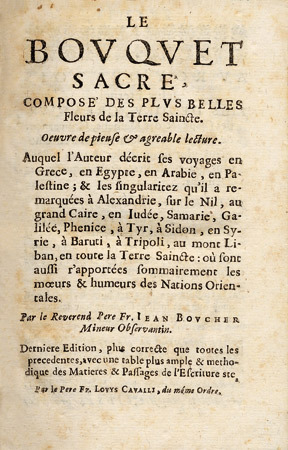
167914487Lyon, Claude La Roche, 1679 ; petit in-8 ; demi-basane fauve, titre doré (reliure du XIXe) ; (16), 497, (15) pp.
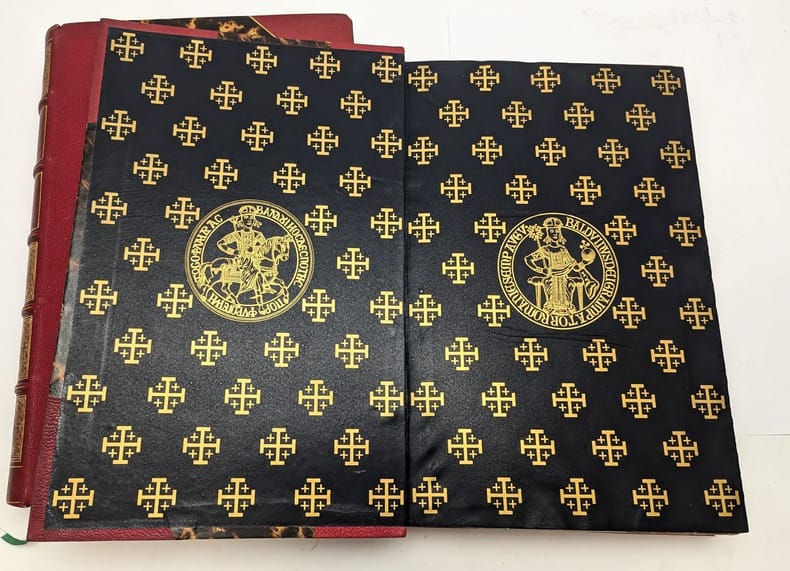
187997348Paris, Firmin Didot, 1879-1880, in-4, 2 vol. : XXVII-559 pp, 4 plans et cartes (dont 1 carte à double pp. en coul.); 527 pp, 1 carte à double page en coul, Demi-chagrin rouge à coins de l'éditeur, dos à faux nerfs ornés de croix de Jérusalem, gardes noires tapissées des mêmes croix et de médailles centrales à l'effigie de Baudouin IV, têtes dorées [Smeers], L'Historia rerum in partibus transmarinis gestarum, restée inachevée à la mort l'archevêque de Tyr Guillaume (entre 1184 et 1186), est une source de première main pour l'histoire de la Première Croisade. Le médiéviste Paulin Paris (1800-1881) présente ici le texte français du XIIIe siècle, revu et annoté. Bel exemplaire. Légers frottements. Couverture rigide
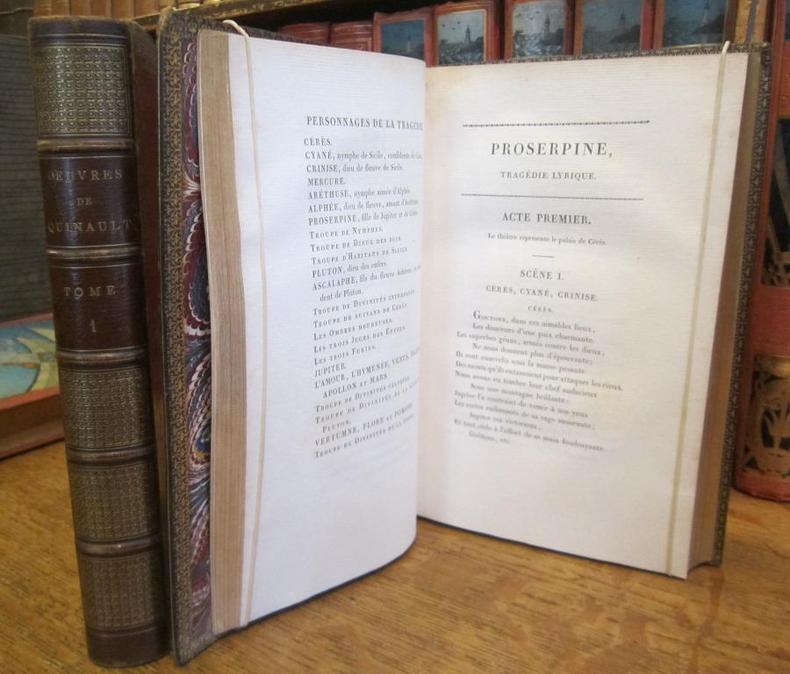
17020044481702 Paris, André Pralard, 1702. In-12 veau fauve marbré, dos cinq nerfs, caissons dorés, pièce de titre maroquin grenat, tranches marbrées (reliure de l'époque). Infimes traces d'encre en tête du feuillet de titre, probables restes d'un ex-libris manuscrit en grande partie effacé.
2994Classical Authors: Londini- London. Excudit Gulielmus Bowyer Sumptibus Societatis ad Literas Promovendas institutæ 1740. 4to. pp. 17 v 727 ix. Greek and Latin text. Speckled calf 5 raised bands; gilt. The second edition of John Davies' critical edition of the works of Maximus of Tyre second century Platonist originally published 1703 with revisions by Jeremiah Markland. Maximus of Tyre reputed to have been the tutor of Marcus Aurelius writes dissertations on theological ethical and philosophical subjects include quotations from Plato and Homer. The philosophical content derives from Platonism and Cynicism. Head cap and tail of spine chipped; joints starting; internally crisp and bright. MAXIMUS OF TYRE Cassius Maximus Tyrius a Greek rhetorician and philosopher who flourished in the time of the Antonines and Commodus 2nd century A.D. After the manner of the sophists of his age he travelled extensively delivering lectures on the way. His writings contain many allusions to the history of Greece while there is little reference to Rome; hence it is inferred that he lived longer in Greece perhaps as a professor at Athens. Although nominally a Platonist he is really an Eclectic and one of the precursors of Neoplatonism. There are still extant by him forty-one essays or discourses διαλέξεις on theological ethical and other philosophical commonplaces. With him God is the supreme being one and indivisible though called by many names accessible to reason alone; but as animals form the intermediate stage between plants and human beings so there exist intermediaries between God and man viz. daemons who dwell on the confines of heaven and earth. The soul in many ways bears a great resemblance to the divinity; it is partly mortal partly immortal and when freed from the fetters of the body becomes a daemon. Life is the sleep of the soul from which it awakes at death. The style of Maximus is superior to that of the ordinary sophistical rhetorician but scholars differ widely as to the merits of the essays themselves. 1911 Encyclopædia Britannica Volume 17 John Davies 1679–1732 was an English cleric and academic known as a classical scholar and President of Queens' College Cambridge from 1717. William Bowyer 16991777 was educated at St John's College Cambridge in 1722 became a partner in his father's business. In 1729 he was appointed printer of the votes of the House of Commons and in 1736 printer to the Society of Antiquaries of which he was elected a fellow in 1737. In 1737 he took as apprentice John Nichols who was to be his successor and biographer. In 1761 Bowyer became printer to the Royal Society and in 1767 printer of the rolls of the House of Lords and the journals of the House of Commons. He died on the 13th of November 1777 leaving unfinished a number of large works and among them the reprint of Domesday Book. He wrote a great many tracts and pamphlets edited arranged and published a host of books but perhaps his principal work was an edition of the New Testament in Greek with notes. Brunet:31552; Graesse:4453. Classical Authors Philosophy Maximus of Tyre Londini- London. Excudit Gulielmus Bowyer, Sumptibus Societatis ad Literas Promovendas institutæ 1740 hardcover
1610001421Venetia: Antonio Pinelli 1610. Full Vellum. Very Good. 8 8 615 pp. 8vo 8.25 by 6.25 inches 21 by 16 cm. Considered one of the most significant pieces of literature from the Middle Ages and a seminal work of literature written in the French language. Also a milestone in historiography as the most important account of the first and second crusades and especially the latter for which William of Tyre was a contemporary witness. The author produced this work at the request of Almaric I in about 1170 and he continued to work on it until 1183. The work was indeed accepted as unquestioned fact for many centuries and only recently have biases been discerned owing from William's entanglement in the political disputes of the day. Antonio Pinelli unknown
1610001421Venetia: Antonio Pinelli 1610. Full Vellum. Very Good. 8 8 615 pp. 8vo 8.25 by 6.25 inches 21 by 16 cm. Considered one of the most significant pieces of literature from the Middle Ages and a seminal work of literature written in the French language. Also a milestone in historiography as the most important account of the first and second crusades and especially the latter for which William of Tyre was a contemporary witness. The author produced this work at the request of Almaric I in about 1170 and he continued to work on it until 1183. The work was indeed accepted as unquestioned fact for many centuries and only recently have biases been discerned owing from William's entanglement in the political disputes of the day. <br/><br/> Antonio Pinelli hardcover books
1619V75121London: Richard Field 1561-1624 1619. Hardcover. Very Good-. Large publisher's emblem of an anchor held by the hand of God entwinned with laural branches in a baroque cartouche frame motto Anchora Spei In total there are 5 titlepages with the same publisher's woodcut in two sizes. Folio contemporary blind ruled calf on 6 raised bands gilt ruled to each side of bands worn/corners exposed & sl.damaged/hinges cracked but covers securely held by cords titlepage 4 ff 598pp 9 ff=index lacks the blank before the title and the blank at the end of the index. The first few leaves incl.the title are sl.creased the title has an owner's name and date 1628 written in ink in the top margin this has been read as "H Cromwell Upwood 1628" likley the uncle of future Lord Protector Oliver Cromwell. Chronography from p544 which contains some worming to bottom corner. One leaf with marginal tear without loss and not near any text and a few marginal old worm tracks never touching text otherwise a well-margined copy with side notes. Text in mostly black letter but also other fonts incl. italic. The contents of this book are distributed as such: Eusebius Pamphilus Bishop of Caesarea in Palaestina wrote 10 bookes pp1-192 203-207 -- Socrates Scholasticus of Constantinople wrote 7 bookes p209-401 -- Evagrius Scholasticus of Antioch wrote 6 bookes P403-512 -- Dorotheus Bishop of Tyrus of the lives and ends of the prophets apostles and 70 disciples p513-540 -- Chronographie p541-598. This work provides a detailed account of the first six centuries of Christian history using near contemporary sources translated into English with a Chronography in parallel columns of the reigning emperorsthe kings of Judea/high priests of Jerusalem & Succession of Bishops the acts of christians the Sects & heretics the fathers of the church etc down to AD 595. Eusebius hs been accused of propagandising the life of Constantine the Great his works are also notable for their accusation that Jewish people were responsible for the death of Christ a popular anti-semitic trope throughout the middle ages. Meredith Hanmer was a popular Welsh controversialist historian who spent much of his life in Ireland. Coat of Arms Bookplate of Robert Fell Moore to pastedown. Richard Field (1561-1624) hardcover
15578313Geneva: ex officina Henrici Stephani Parisiensis typographi. 1557. Editio princeps. 2 vols. in one. 8vo. pp. viii 263 numbered 363 i; xvi 320. C and D in the second work misbound. Contemporary limp vellum 17th century ownership inscriptions to title later cancelled ink library stamp to free endpaper. First edition in the original Greek followed by Archbishop Cosimo Pazzis Latin translation revised and corrected by Henri Estienne. Dibdin II 232. Schreiber 141a and 141b; Adams M-939 and M-940. Book ex officina Henrici Stephani Parisiensis typographi. hardcover
102464Black and white photograph of Bobby Jones swinging a wood on the fairway. Boldly inscribed by Jones in his earlier signature "For Art With best wishes Robert T. Jones Jr." Double matted and framed. The entire piece measures 16.25 inches by 18.25 inches. Robert T. Jones was an American golfer who was one of the most influential figures in the history of the sport. Jones founded and helped design the Augusta National Golf Club and co-founded the Masters Tournament. The innovations that he introduced at the Masters have been copied by virtually every professional golf tournament in the world. Jones was the most successful amateur golfer ever to compete at a national and international level. During his peak from 1923 to 1930 he dominated top-level amateur competition and competed very successfully against the world's best professional golfers. Jones often beat stars such as Walter Hagen and Gene Sarazen the era's top pros. Jones earned his living mainly as a lawyer and competed in golf only as an amateur primarily on a part-time basis and chose to retire from competition at age 28 though he earned significant money from golf after that as an instructor and equipment designer. Explaining his decision to retire Jones said "It championship golf is something like a cage. First you are expected to get into it and then you are expected to stay there. But of course nobody can stay there." Jones is most famous for his unique "Grand Slam" consisting of his victory in all four major golf tournaments of his era the open and amateur championships in both the U.S. & the U.K. in a single calendar year 1930. In all Jones played in 31 majors winning 13 and placing among the top ten finishers 27 times. After retiring from competitive golf in 1930 Jones founded and helped design the Augusta National Golf Club soon afterwards in 1933. He also co-founded the Masters Tournament which has been annually staged by the club since 1934 except for 1943-45 when it was canceled due to World War II. The Masters evolved into one of golf's four major championships. Jones came out of retirement in 1934 to play in the Masters on an exhibition basis through 1948. Jones played his last round of golf at East Lake Golf Club his home course in Atlanta on August 18 1948. A picture commemorating the event now sits in the clubhouse at East Lake. Citing health reasons he quit golf permanently thereafter. unknown books
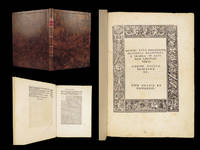
151728702<p>Rome: Apud Iacobum Mazochium 1517. First Latin edition of Maximus of Tyre's forty-one philosophical sermons translated from the original Greek by Cosmo Paccio. Issued as a post-incunable folio this example is bound in modern full leather tooled in a Renaissance style with five raised bands and a red gilt-titled spine label. The book is complete collated at CXV 1 leaves pagination errors expected and printed in a clear Roman typeface consistent with early sixteenth-century presses. The leaves are clean and well-preserved with margins measuring generously across the gatherings. Subject matter includes moral discourses and mythological references such as Achilles Anacreon Helen and Vulcan. This edition is cited in Adams M 936 and USTC 841641. A preserved Roman folio from a noted press. Questions and photo requests welcome.</p> Apud Iacobum Mazochium hardcover
1966100288Garden City NY: Doubleday & Company 1966. First edition of "the most practical and useful golf book ever written covering every shot in the game and every aspect of play." Octavo original half cloth illustrated by Anthony Ravielli. Presentation copy inscribed by the author on the half-title page "For Gene Ballard With best regards Bob Jones." The recipient was a member of The Peachtree Golf Club which was designed by Bobby Jones. Bookplate of the recipient fine in a near fine price-clipped dust jacket. Introduction by Charles Price. One of the more uncommon titles to find signed and inscribed as Jones passed away in 1971. Bobby Jones left an enduring legacy of athletic prowess and exemplary personal characteristics. No one is likely to break his records of thirteen U.S. and British national championships and four in one year he won the U.S. Open a total of four times the U.S. Amateur five times the British Open three times and the British Amateur one time. The Masters seems to have a secure place in the pantheon of golf; and the name Bobby Jones will continue to represent the highest standards of amateurism sportsmanship and self-mastery" ANB. Doubleday & Company hardcover books
19541000471954. Attractive signed large color portrait of golfer Bobby Jones swinging his driver. Boldly inscribed by Bobby Jones "For Will Grimsley with best regards Bob Jones." Annotated below the portrait "Reproduced from a painting by Thomas E. Stephens and presented by ninety-nine members of the Augusta National Golf Club Augusta Georgia. Number 282 of a limited edition." In fine condition. Matted and framed the entire piece measures 33.5 inches by 29.5 inches. Robert T. Jones was an American golfer who was one of the most influential figures in the history of the sport. Jones founded and helped design the Augusta National Golf Club and co-founded the Masters Tournament. The innovations that he introduced at the Masters have been copied by virtually every professional golf tournament in the world. Jones was the most successful amateur golfer ever to compete at a national and international level. During his peak from 1923 to 1930 he dominated top-level amateur competition and competed very successfully against the world's best professional golfers. Jones often beat stars such as Walter Hagen and Gene Sarazen the era's top pros. Jones earned his living mainly as a lawyer and competed in golf only as an amateur primarily on a part-time basis and chose to retire from competition at age 28 though he earned significant money from golf after that as an instructor and equipment designer. Explaining his decision to retire Jones said "It championship golf is something like a cage. First you are expected to get into it and then you are expected to stay there. But of course nobody can stay there." Jones is most famous for his unique "Grand Slam" consisting of his victory in all four major golf tournaments of his era the open and amateur championships in both the U.S. & the U.K. in a single calendar year 1930. In all Jones played in 31 majors winning 13 and placing among the top ten finishers 27 times. After retiring from competitive golf in 1930 Jones founded and helped design the Augusta National Golf Club soon afterwards in 1933. He also co-founded the Masters Tournament which has been annually staged by the club since 1934 except for 1943-45 when it was canceled due to World War II. The Masters evolved into one of golf's four major championships. Jones came out of retirement in 1934 to play in the Masters on an exhibition basis through 1948. Jones played his last round of golf at East Lake Golf Club his home course in Atlanta on August 18 1948. A picture commemorating the event now sits in the clubhouse at East Lake. Citing health reasons he quit golf permanently thereafter. unknown books
19541000471954. Attractive signed large color portrait of golfer Bobby Jones swinging his driver. Boldly inscribed by Bobby Jones "For Will Grimsley with best regards Bob Jones." Annotated below the portrait "Reproduced from a painting by Thomas E. Stephens and presented by ninety-nine members of the Augusta National Golf Club Augusta Georgia. Number 282 of a limited edition." In fine condition. Matted and framed the entire piece measures 33.5 inches by 29.5 inches. Robert T. Jones was an American golfer who was one of the most influential figures in the history of the sport. Jones founded and helped design the Augusta National Golf Club and co-founded the Masters Tournament. The innovations that he introduced at the Masters have been copied by virtually every professional golf tournament in the world. Jones was the most successful amateur golfer ever to compete at a national and international level. During his peak from 1923 to 1930 he dominated top-level amateur competition and competed very successfully against the world's best professional golfers. Jones often beat stars such as Walter Hagen and Gene Sarazen the era's top pros. Jones earned his living mainly as a lawyer and competed in golf only as an amateur primarily on a part-time basis and chose to retire from competition at age 28 though he earned significant money from golf after that as an instructor and equipment designer. Explaining his decision to retire Jones said "It championship golf is something like a cage. First you are expected to get into it and then you are expected to stay there. But of course nobody can stay there." Jones is most famous for his unique "Grand Slam" consisting of his victory in all four major golf tournaments of his era the open and amateur championships in both the U.S. & the U.K. in a single calendar year 1930. In all Jones played in 31 majors winning 13 and placing among the top ten finishers 27 times. After retiring from competitive golf in 1930 Jones founded and helped design the Augusta National Golf Club soon afterwards in 1933. He also co-founded the Masters Tournament which has been annually staged by the club since 1934 except for 1943–45 when it was canceled due to World War II. The Masters evolved into one of golf's four major championships. Jones came out of retirement in 1934 to play in the Masters on an exhibition basis through 1948. Jones played his last round of golf at East Lake Golf Club his home course in Atlanta on August 18 1948. A picture commemorating the event now sits in the clubhouse at East Lake. Citing health reasons he quit golf permanently thereafter. unknown
92769Photograph of Bobby Jones boldly inscribed by him "For Dave Christensen with warmest regards Bob Jones." The photograph measures 7 inches by 9 inches. Double matted and framed. The entire piece measures 15.5 inches by 18 inches. Robert T. Jones was an American golfer who was one of the most influential figures in the history of the sport. Jones founded and helped design the Augusta National Golf Club and co-founded the Masters Tournament. The innovations that he introduced at the Masters have been copied by virtually every professional golf tournament in the world. Jones was the most successful amateur golfer ever to compete at a national and international level. During his peak from 1923 to 1930 he dominated top-level amateur competition and competed very successfully against the world's best professional golfers. Jones often beat stars such as Walter Hagen and Gene Sarazen the era's top pros. Jones earned his living mainly as a lawyer and competed in golf only as an amateur primarily on a part-time basis and chose to retire from competition at age 28 though he earned significant money from golf after that as an instructor and equipment designer. Explaining his decision to retire Jones said "It championship golf is something like a cage. First you are expected to get into it and then you are expected to stay there. But of course nobody can stay there." Jones is most famous for his unique "Grand Slam" consisting of his victory in all four major golf tournaments of his era the open and amateur championships in both the U.S. & the U.K. in a single calendar year 1930. In all Jones played in 31 majors winning 13 and placing among the top ten finishers 27 times. After retiring from competitive golf in 1930 Jones founded and helped design the Augusta National Golf Club soon afterwards in 1933. He also co-founded the Masters Tournament which has been annually staged by the club since 1934 except for 1943-45 when it was canceled due to World War II. The Masters evolved into one of golf's four major championships. Jones came out of retirement in 1934 to play in the Masters on an exhibition basis through 1948. Jones played his last round of golf at East Lake Golf Club his home course in Atlanta on August 18 1948. A picture commemorating the event now sits in the clubhouse at East Lake. Citing health reasons he quit golf permanently thereafter. unknown books
92769Photograph of Bobby Jones boldly inscribed by him "For Dave Christensen with warmest regards Bob Jones." The photograph measures 7 inches by 9 inches. Double matted and framed. The entire piece measures 15.5 inches by 18 inches. Robert T. Jones was an American golfer who was one of the most influential figures in the history of the sport. Jones founded and helped design the Augusta National Golf Club and co-founded the Masters Tournament. The innovations that he introduced at the Masters have been copied by virtually every professional golf tournament in the world. Jones was the most successful amateur golfer ever to compete at a national and international level. During his peak from 1923 to 1930 he dominated top-level amateur competition and competed very successfully against the world's best professional golfers. Jones often beat stars such as Walter Hagen and Gene Sarazen the era's top pros. Jones earned his living mainly as a lawyer and competed in golf only as an amateur primarily on a part-time basis and chose to retire from competition at age 28 though he earned significant money from golf after that as an instructor and equipment designer. Explaining his decision to retire Jones said "It championship golf is something like a cage. First you are expected to get into it and then you are expected to stay there. But of course nobody can stay there." Jones is most famous for his unique "Grand Slam" consisting of his victory in all four major golf tournaments of his era the open and amateur championships in both the U.S. & the U.K. in a single calendar year 1930. In all Jones played in 31 majors winning 13 and placing among the top ten finishers 27 times. After retiring from competitive golf in 1930 Jones founded and helped design the Augusta National Golf Club soon afterwards in 1933. He also co-founded the Masters Tournament which has been annually staged by the club since 1934 except for 1943–45 when it was canceled due to World War II. The Masters evolved into one of golf's four major championships. Jones came out of retirement in 1934 to play in the Masters on an exhibition basis through 1948. Jones played his last round of golf at East Lake Golf Club his home course in Atlanta on August 18 1948. A picture commemorating the event now sits in the clubhouse at East Lake. Citing health reasons he quit golf permanently thereafter. unknown
87895Photograph of Bobby Jones swinging a wood on the fairway. Boldly inscribed by Bobby Jones "For Dave my best as ever Bob." The photograph measures 7 inches by 9 inches. Bouble matted and framed. The entire piece measures 16.25 inches by 18.25 inches. Photographs signed by Bobby Jones are uncommon. Robert T. Jones was an American golfer who was one of the most influential figures in the history of the sport. Jones founded and helped design the Augusta National Golf Club and co-founded the Masters Tournament. The innovations that he introduced at the Masters have been copied by virtually every professional golf tournament in the world. Jones was the most successful amateur golfer ever to compete at a national and international level. During his peak from 1923 to 1930 he dominated top-level amateur competition and competed very successfully against the world's best professional golfers. Jones often beat stars such as Walter Hagen and Gene Sarazen the era's top pros. Jones earned his living mainly as a lawyer and competed in golf only as an amateur primarily on a part-time basis and chose to retire from competition at age 28 though he earned significant money from golf after that as an instructor and equipment designer. Explaining his decision to retire Jones said "It championship golf is something like a cage. First you are expected to get into it and then you are expected to stay there. But of course nobody can stay there." Jones is most famous for his unique "Grand Slam" consisting of his victory in all four major golf tournaments of his era the open and amateur championships in both the U.S. & the U.K. in a single calendar year 1930. In all Jones played in 31 majors winning 13 and placing among the top ten finishers 27 times. After retiring from competitive golf in 1930 Jones founded and helped design the Augusta National Golf Club soon afterwards in 1933. He also co-founded the Masters Tournament which has been annually staged by the club since 1934 except for 1943-45 when it was canceled due to World War II. The Masters evolved into one of golf's four major championships. Jones came out of retirement in 1934 to play in the Masters on an exhibition basis through 1948. Jones played his last round of golf at East Lake Golf Club his home course in Atlanta on August 18 1948. A picture commemorating the event now sits in the clubhouse at East Lake. Citing health reasons he quit golf permanently thereafter. unknown books
81016Original photograph of Bobby Jones swinging a wood on the fairway. Boldly inscribed by Bobby Jones. The photograph measures 7.5 inches by 9.25 inches. Triple matted and framed. The entire piece measures 15.5 inches by 18 inches. Photographs signed by Bobby Jones are uncommon. Robert T. Jones was an American golfer who was one of the most influential figures in the history of the sport. Jones founded and helped design the Augusta National Golf Club and co-founded the Masters Tournament. The innovations that he introduced at the Masters have been copied by virtually every professional golf tournament in the world. Jones was the most successful amateur golfer ever to compete at a national and international level. During his peak from 1923 to 1930 he dominated top-level amateur competition and competed very successfully against the world's best professional golfers. Jones often beat stars such as Walter Hagen and Gene Sarazen the era's top pros. Jones earned his living mainly as a lawyer and competed in golf only as an amateur primarily on a part-time basis and chose to retire from competition at age 28 though he earned significant money from golf after that as an instructor and equipment designer. Explaining his decision to retire Jones said "It championship golf is something like a cage. First you are expected to get into it and then you are expected to stay there. But of course nobody can stay there." Jones is most famous for his unique "Grand Slam" consisting of his victory in all four major golf tournaments of his era the open and amateur championships in both the U.S. & the U.K. in a single calendar year 1930. In all Jones played in 31 majors winning 13 and placing among the top ten finishers 27 times. After retiring from competitive golf in 1930 Jones founded and helped design the Augusta National Golf Club soon afterwards in 1933. He also co-founded the Masters Tournament which has been annually staged by the club since 1934 except for 1943-45 when it was canceled due to World War II. The Masters evolved into one of golf's four major championships. Jones came out of retirement in 1934 to play in the Masters on an exhibition basis through 1948. Jones played his last round of golf at East Lake Golf Club his home course in Atlanta on August 18 1948. A picture commemorating the event now sits in the clubhouse at East Lake. Citing health reasons he quit golf permanently thereafter. unknown books