JORDAN, CamilleBiblio.com
99 résultats
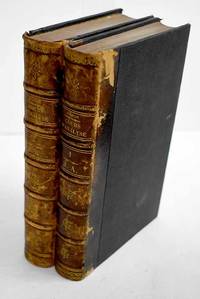
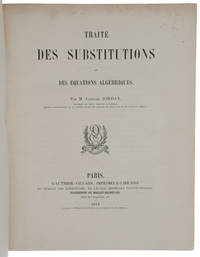
18704912Paris: Gauthier-Villars 1870. First edition. <p>First edition a notorious rarity of "the book that established group theory as a subject in its own right in mathematics" Gray. "Jordan's monumental work Traité des Substitutions et des Équations algébriques published in 1870 is a masterpiece of mathematical architecture. The beauty of the edifice erected by Jordan is admirable" Van der Waerden. It has been suggested that most copies of the book were destroyed in a fire at the publisher's warehouse during the violent suppression of the Paris Commune early in 1871.</p>. THE FOUNDATION WORK OF MODERN GROUP THEORY. <p>First edition very rare of "the book that established group theory as a subject in its own right in mathematics" Gray p. 149. "Jordan's monumental work Traité des Substitutions et des Équations algébriques published in 1870 is a masterpiece of mathematical architecture. The beauty of the edifice erected by Jordan is admirable" Van der Waerden A History of Algebra p. 117. "In 1870 Jordan gathered all his results on permutation groups for the previous ten years in a huge volume Traité des Substitutions which for thirty years was to remain the bible of all specialists in group theory. His fame had spread beyond France and foreign students were eager to attend his lectures; in particular Felix Klein and Sophus Lie came to Paris in 1870 to study with Jordan" DSB. "An instant classic his Traité set a new research agenda of creating a theory of groups as opposed to the older agenda of devising ways to calculate the solutions of polynomial equations" Katz & Parshall p. 316. "The title of this comprehensive work of 667 quarto pages is excessively modest and therefore misleading. The work represents not only the definitive solution of the problem formulated by Galois but also a review of the whole of contemporary mathematics from the standpoint of group-theoretic thinking" Wussing pp. 141-142. "Jordan's place in the tradition of French mathematics is exactly halfway between Hermite and Poincaré. Like them he was a 'universal' mathematician who published papers in practically all branches of the mathematics of his time . but it is chiefly as an algebraist that he reached celebrity when he was barely thirty; and during the next forty years he was universally regarded as the undisputed master of group theory. When Jordan started his mathematical career Galois's profound ideas and results which had remained unknown to most mathematicians until 1846 were still very poorly understood despite the efforts of Serret and Liouville to popularize them; and before 1860 Kronecker was probably the only first-rate mathematician who realized the power of these ideas and who succeeded in using them in his own algebraic research. Jordan was the first to embark on a systematic development of the theory of finite groups and of its applications in the directions opened by Galois . He also was the first to investigate the structure of the general linear group and of the 'classical' groups over a prime finite field and he very ingeniously applied his results to a great range of problems; in particular he was able to determine the structure of the Galois group of equations having as roots the parameters of some well-known geometric configurations the twenty-seven lines on a cubic surface the twenty-eight double tangents to a quartic the sixteen double points of a Kummer surface and so on" ibid. This is an extremely rare book on the market and very uncommon even in institutional collections. ABPC/RBH list only the two copies in the Duarte sale in 1977. It has been suggested that most copies of the book were destroyed in a fire at the publisher's warehouse during the violent suppression of the Paris Commune early in 1871 and that the marginal browning seen in many of the surviving copies was caused by the heat of the fire.</p> <br /> <p>Évariste Galois 1811-32 published a few short papers in his lifetime but his most important works were posthumous. He first set down his ideas on the relationship between what we call group theory and the solvability of polynomial equations in his most important work 'Mémoire sur les conditions de résolubilité des équations par radicaux' usually called the 'Premier Mémoire' which he submitted to the Paris Académie des Sciences but which they rejected and returned to the author on 4 July 1831. He followed this with 'Des équations primitives qui sont solubles par radicaux' also known as the Second Mémoire. Both Mémoires were published for the first time together with Galois's other works by Joseph Liouville in his Journal de Mathématiques pures et appliquées in 1846 and it was through this publication that Galois's works became known to the wider mathematical world.</p> <br /> <p>"The publication of Galois's work in Liouville's Journal was a challenge to all mathematicians to understand it extend it and apply it. Ultimately it stimulated the emerging generation of mathematicians as Wussing has described. He noted an initial period in which Betti Kronecker Cayley Serret and some others filled in holes in Galois's presentation of the idea of a group. These modest yet difficult pieces of work established the connection between group theory and the solvability of equations by radicals i.e. by expressions involving the sums differences products and quotients of whole numbers and their square cube and higher roots and then explored the solution of equations by other means than radicals. The implicit idea of a group was expressed in terms of permutations of a finite set of objects amalgamating Cauchy's presentation of the theory of permutation groups in 1844-46 and Galois's terminology.<br /> </p> <br /> <p>"The crucial presentations of the idea of permutation groups were made by Jordan in his 'Commentaire sur Galois' Mathematische Annalen 1 1869 141-160 and his Traité des Substitutions et des Équations algébriques 1870. Jordan's systematic theory of permutation groups was much more abstract; he spoke of abstract properties such as commutativity conjugacy centralizers transitivity 'normal' subgroups and one might say obliquely of quotient groups group homomorphisms and isomorphisms. So much so that one can argue that Jordan came close to possessing the idea of an abstract group. Jordan said Traité p. 22 'One will say that a system of substitutions form a group if the product of two arbitrary substitutions of the system belongs to the system itself.' He spoke Traité p. 56 of isomorphisms which he called an isomorphisme holoédrique between groups as one-to-one correspondences between substitutions which respect products.<br /> </p> <br /> <p>"A further indication of the high level of abstraction at which Jordan worked is his use of technical concepts of increasing power . Another is the wide range of situations in the Traité in which groups could be found permuting geometrical objects: the 27 lines on a cubic surface the 28 bitangents to a quartic the symmetry groups of the configuration of the nine inflection points on a cubic and of Kummer's quartic with sixteen nodal points. Powerful abstract theory and a skilled recognition of groups 'in nature' suggests that Jordan had an implicit understanding of the group idea that he presented in the language of permutation groups only for the convenience of his audience. This is not to deny the role of permutation-theoretic ideas in Jordan's work indicated by the emphasis on transitivity and degree = the number of elements in the set being permuted but rather to indicate that ideas of composition and action . were prominent and could be seized upon by other mathematicians" Gray pp. 152-153.</p> <br /> <p>"The Traité des Substitutions et des Équations algébriques begins with an introduction of extraordinary scope which demonstrates the scientific staring point as well as the greatness and limitations of Jordan's conception. In a certain sense the Traité contains formulations of problems belonging to a development yet to come .</p> <br /> <p>"Jordan begins his introduction by stressing the fundamental difference between Galois's papers on the theory of equations and the relevant papers of Galois's predecessors from Lagrange to Abel. By associating to every equation a permutation group whose structure mirrors its essential properties including its possible solution by radicals Galois had supplied the ultimate basis of the theory of equations. This assigned a special role to the theory of permutations. As the foundation of all questions bearing on the theory of equations permutation theory became an independent area of investigation . In view of this development and of algebraic questions that had just arisen Jordan concludes that the theory of equations had acquired a new and very different character. The old quest for solutions of given equations in the form of transparent solution formulas had become the study of the structure of algebraic number fields although Jordan did not use the concept of a field .</p> <br /> <p>"He designates in the introduction two large groups of problems to be studied in the Traité with the aid of permutation theory:</p> <br /> <br /> The study of 'division' of transcendental functions expressing fx/n in terms of f when f is an elliptic function. This study had already given Galois the opportunity to make a new and brilliant application of his method. It had been advanced by Hermite who using Galois's methods built on the relevant work of Abel and Gauss .<br /> The use of permutation theory in studying the new direction of developments of analytic geometry. This new development had been initiated by O. Hesse largely in the fifties in papers on the number of inflection points of cubic curves. Through these papers algebra with its then very modern tools began to appear as the direct representation of geometric propositions .<br /> <br /> <p>"It thus appears that Jordan had grasped an objective tendency that pointed to the use of group theory in geometry and that was to gain general acceptance two years after the Traité as a result of Klein's Erlangen Program . He was able to classify earlier isolated results by group-theoretic means; more specifically he could describe such results in terms of statements about subgroups of the 'linear group' a group that he had investigated in great detail" Wussing pp. 154-156.</p> <br /> <p>"The short Livre I picks up on the topic of Galois's 'Sur la théorie des nombres' Bulletin des Sciences Mathématiques Physiques et Chimiques de M. Férussac 13 1830 428-435 and is about congruences modulo a prime or prime power what we today would call finite fields. The material on modular arithmetic is needed because the Traité is entirely about finite groups often described as matrix groups with entries modulo a prime number.</p> <br /> <p>"Livre II is about substitutions Galois's word for what would later become permutations. It ranges widely bringing in work by Lagrange Cauchy Mathieu Kirkman Bertrand and Serret. Its themes are transitivity simple and multiple primitivity the topic of Galois's second memoir and composition factors. It also gives a flawed proof that the alternating group An is simple when n ≠ 4 the alternating group consists of permutations that can be effected by making an even number of exchanges of pairs of elements. Here Jordan presented the opening propositions of the theory of groups: Lagrange's theorem and Cauchy's theorem. Lagrange's theorem and proof is stated in the form it retains to this day: the order of = number of elements in a subgroup divides the order of the group . Cauchy's theorem §40 is the partial converse: if a prime p divides the order of a group then there is an element of order p in the group i.e. an element whose pth power is the identity element .</p> <br /> <p>"Then comes an account of transitivity and the 'orbit-stabilizer' theorem: Jordan proved §44 that given a set of objects permuted by a group G if these elements can be sent to m different systems of places and n is the order of the subgroup that leaves these elements fixed then the order of the group is mn. Jordan was very interested in how transitive a group could be and in §47 recorded the 'remarkable' example of the Mathieu group on 12 letters that is 5-fold transitive i.e. any 5 different letters can be sent to any other or the same 5 different letters by some element of the group.</p> <br /> <p>"Then we get some 160 pages on what we might call finite linear groups groups whose elements are matrices with entries in a finite field. They come in various types and the names have not always retained the meaning Jordan gave them: primary orthogonal abelian hyperabelian. A typical theme is the 'normal' subgroups and composition factors of the different groups. He was also interested in the concept of primitivity which he defined negatively: a group is non-primitive better imprimitive if the elements being permuted by the group can be divided into blocks containing the same number of elements and the group maps blocks to blocks. </p> <br /> <p>Livre III 'The irrationals' is about the behaviour of a given irreducible equation under successive adjunction of irrationals roots of other polynomial equations. It deals with the solution of the quartic by radicals and the insolubility of the general quintic. Then we get a treatment of equations with particular kinds of group: abelian groups and what Jordan called 'Galois's equation' xp = A. Then we get the geometrical examples mentioned above in which discoveries by Hesse Clebsch Kummer and Cayley the 27 lines on a cubic surface are shown to have interesting group-theoretic interpretations. Then comes material from elliptic function theory: the modular equation and the discovery in 1858 of the solution of the quintic equation according to Hermite and Kronecker. Jordan reworked their contributions in his own way and then extended their work to show that all polynomial equations can be solved by a similar use of hyper-elliptic functions.</p> <br /> <p>"The books ends with Livre IV of almost 300 pages entitled 'Solution by radicals.' Jordan quickly rehearsed the argument that an equation is solvable by radicals if and only if the composition factors of its group are all prime and called such a group solvable. This led him to proclaim three problems of which for brevity I give the first only: construct explicitly for every degree the general i.e. maximal solvable transitive groups . Jordan used his theory of composition factors to suggest that a massive process of induction might suffice to find all permutation groups . it might be possible to construct the given group from its composition series if all groups of order less than the given group are known. In the event this ambitious programme failed - groups are vastly more varied than can be handled this way - but it has the germ of a process that was later made more precise by Hölder and became the search for all simple groups" Gray pp. pp. 153-154. </p> <br /> <p>Some possibly all of the four 'Livres' into which the Traité is divided may have been issued separately: we have seen copies of two or three of the Livres bound separately in contemporary bindings.</p> <br /> <p>Marie-Ennemond-Camille Jordan 1838-1922 was a professor of mathematics at the École Polytechnique in Paris from 1876 to 1912. He edited Liouville's Journal des mathématiques pures et appliquées from 1885 until his death. Apart from the Traité des Substitutions which brought him the Poncelet Prize of the French Academy of Sciences he published his lectures and researches on analysis in the influential Cours d'analyse de l'École Polytechnique three vols. 1882-87 about which the great English mathematician G. H. Hardy wrote: "As a student I was advised to read Jordan's Cours d'analyse; and I shall never forget the astonishment with which I read that remarkable work the first inspiration for so many mathematicians of my generation and learnt for the first time as I read it what mathematics really meant." In the third edition of this work 1909-15 Jordan gave the proof of what is now known as Jordan's curve theorem: any closed curve that does not cross itself divides the plane into exactly two regions one inside the curve and one outside.</p> <br /> <p>Gray A History of Abstract Algebra 2018. Katz & Parshall Taming the Unknown 2014. Wussing The Genesis of the Abstract Group Concept 2007.</p> <br/> <br/> 4to 269 x 221 mm pp. xviii 667 some marginal browning. Contemporary half-morocco and marbled boards spine lettered in gilt spine faded. Gauthier-Villars unknown
181319194PALMA: Sin imprenta 1813. Segunda impresión.- 4 tomos grabados.- Medidas totales: 32 x 44 cm.- Medidas plancha de estampación: 18 x 265 cm.- Escala en palmos Mallorquines.- Al pie de los grabados: ""Medida y diseñada por el Arquitecto Isidoro Velazquez - grabada por Francisco Jordán en Mallorca 1813"". Por la filigrana del papel ""A. Romanit T."" sabemos que pertenece a Antonio Romani y Tarres que trabajó en Capellades a partir de 1850. Por la textura de impresión podemos asegurar que se trata de una segunda estampación realizada entre 1850 y 1860. sidro González Velázquez 1765-1829 fue probablemente el arquitecto español más importante entre finales del siglo XVIII y principios del XIX. Nacido en el seno de una familia de artistas se matriculó en la Academia de San Fernando en 1777 y en 1779 empezó a trabajar en el estudio del arquitecto Juan de Villanueva. Entre 1791 y 1796 fue pensionado extraordinariamente por Carlos III para estudiar en Roma. Durante la ocupación francesa José I le confirmó como teniente de Villanueva en las obras reales pero a pesar de ello en diciembre de 1810 salió de la corte con su familia y se exilió en Palma donde permaneció hasta 1814. A su regreso a Madrid Fernando VII le nombró arquitecto mayor. Francisco Jordan 1778-1832 fue un grabador natural de Muro Alicante. Fue otro de los grandes grabadores de la época de la Ilustración. Al igual que Isidro Velázquez se exilió en Palma durante la invasión napoleónica 1808-1814 y a su regreso se retiró al Convento de Cartujos de Porta Coeli donde continuó trabajando hasta su muerte. Muy buen ejemplar limpio y con todos los márgenes sin cortar. Elena Páez 'Repertorio de grabados españoles en la Biblioteca Nacional' 1110-10-13 Sin imprenta unknown
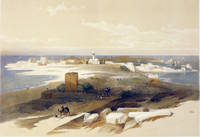
184626563London: F.G. Moon and Co. 1846. From the Standard Folio First Edition limited to 500 sets only. A single original hand-coloured lithographic plate drawn on stone by Louis Haghe after David Roberts' paintings done on location in 1838. Printed on a single folio sheet 23" x 17.5" the captioned image is 19.25" x 13" now presented in cream mounting boards 30" x 24" glazed behind clear mylar. Beautifully hand-coloured to the highest standards of the time. An example in excellent condition clean fresh beautifully preserved. FROM One of the most desirable of all travel and COLOURplate books. This is an especially well-coloured and atmospheric plate of a broad view of Tyre showing both ancient ruins and more recent inhabited buildings.<br> We have a good number of impressive images from the Standard Folio Edition of this classic work available for purchase. As well as Tyre there are many views available of Egypt Nubia Petra Sinai the Jordan Sidon and Baalbec. Please inquire for further details.<br> In the course of two and a half months in 1838 traveling some 800 miles south from Cairo Roberts recorded the monumental temple sites along the Nile in more than a hundred sketches. As the first British artist to sketch the monuments of Ancient Egypt set on "Plains so vast.that until you come near them you have no idea of their magnificence" Roberts was well aware of the stir his drawings would create in London. According to John Ruskin writing in PRAETERITA Roberts's drawings "were the first studies ever made conscientiously by an English painter not to exhibit his own skill but to give true portraiture of scenes of historical and religious interest. F.G. Moon and Co. hardcover
1882E0844<p>309 pages with tables illustrations and 15 folding maps. Royal octavo 9 1/4" x 6" bound in half leather over marbled boards with gilt lettering to spine housed in a custom enclosure. 47th Congress Senate Document 70. First edition.</p><p>The letter of transmittal is followed by Book 9 of the boundary survey including the field log beginning on 20 January 1859 describing movements of the team along with all of the station markers chain measurements.</p><p>The joint commission of the United States and the State of Texas commenced work together on the Rio Grande but the Texas commissioner did not remain long in the field on account of personal differences between himself and the United States commissioner. A new Texas commissioner came and assisted the survey of a part of the west boundary or one hundred and third meridian west longitude. In the next year 1860 when the United States commissioner surveyed the north and east boundaries it does not appear from the records that the Texas commissioner took part in the work and the United States commissioner did the work without any cooperation.</p><p>The east boundary being part of the lime between Texas and Indian Territory along the one hundredth meridian west longitude had been in part previously established by Jones and Brown surveyed in 1859 marking the boundary line of certain Indian lands which boundary by treaty of 22 January 1855 was the one hundredth meridian or the line between the State of Texas and the Indian country. Said surveyors had marked the one hundredth meridian from the north bank of Red River north to the Canadian River and about 19 miles further north and under instructions issued to the United States commissioner by the Secretary of the Interior for the survey of the United States and Texas boundary he was only required to retrace so much of said meridian as had been previously established by surveyors jones and Brown.</p><p>No part of the boundary survey has ever been agreed upon or accepted by the two governments as contemplated by in the act of Congress authorizing the survey.</p><p><strong>Condition: </strong>Corners gently bumped light self wear else better than very good in a custom enclosure.</p> Government Printing Office hardcover
189763165611897 printing with red cloth boards and black lettering. TEXT BLOCK UNMARKED! No dust jacket if issued. NOT ex library NO USED stickers & NO sticker residue! From a private collection. Packed carefully with cardboard for extra protection during shipment. ISBN MATCHES description. Great copy tight binding has some light wear from shelf storage and reading; cover corners lightly bumped/rubbed. some pages have very light spots/very light foxing top page ends have some light foxing. Clean pages; TEXT is CLEAN: NO underlining highlighting or writing. Page edges are free of remainder marks; NO sun fading. Book is ready to go & ships FAST in new protective mailer with cardboard with tracking with Amazon electronic shipping label based in the Northeast U.S. New or clean recycled cardboard will be used internally/externally to protect book from drops dings creases and bumps during shipment. Thanks for supporting a small family business!!! Please message us with any questions or concerns! Books are shipped with standard book rate shipping but expedited shipping via USPS Priority is available. International shipping available upon request. 3'23 The Whitaker & Ray Company hardcover
186556840San Francisco California 1865. Hardcover. Very Good. Small 1865 hardcover in excellent condition: slight wear small piece of the front endpaper missing slight page foxing. 101 pages. "Forty-seventh edition" referred to so this edition may be subsequent to that. 4oz <br/> <br/> hardcover
186548322San Francisco Ca: Privately Printed 1865. First Edition. Hardcover. Near fine. 125p 12mo frontispiece of author's museum bound with Handbook & Descriptive Catalogue of the Pacific Museum one of the earliest cons in San Francisco. Jordan displayed dramatic maladies and encouraged people who came to his museum to take tests for healing. Wearing along the bottom edge otherwise a very good copy in original black cloth. <br/><br/> Privately Printed hardcover
18950767967London: Osgood McIlvaine & Co. Very Good/No Jacket. 1895. First Edition. Hard Cover. 8vo - over 7 3/4" - 9 3/4" Tall Used In original green cloth with red and black titling 8vo 306pp. A solid copy of an very scarce title. light shelfwear and dulling to cloth extremities browning and soiling to page edges . Osgood, McIlvaine & Co. hardcover
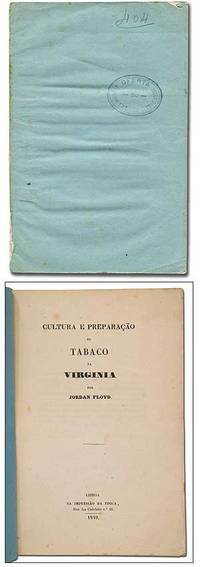
1849295181Lisboa: Da Epoca 1849. Softcover. Near Fine. First edition. Text in Portuguese. Unprinted blue wrappers. 20pp. Folding plate showing a tobacco preparation building. An old historical society stamp on the front wrap light edgewear slight foxing else near fine. Scarce. Da Epoca unknown
186810017New Orleans: Blelock & Company 1868. 1868. 8vo. Frontispiece engraved portrait. xv 704 pp. Illustrated with 7 maps 3 folding 5 portrait plates including the frontis and a number of text maps. Original embossed brown cloth. Cloth chipped along the spine front hinge starting very good minus/good plus. 1st Edition. Hardcover. Good. New Orleans: Blelock & Company, 1868. hardcover
1868643471868. JORDAN Thomas and PRYOR J.P. The Campaigns of Lieut.-Gen. N.B. Forrest and of Forrest's Cavalry. New-Orleans: Blelock & Company 1868. 1st ed. 704pp. Portrait frontis. portraits maps some folding. Contemporary 3/4 polished calf and marbled boards raised spine bands spine gilt black morocco spine label marbled endpapers all edges marbled. Boards spine ends and corners rubbed light scattered foxing else very good. HOWES J-251. "An early detailed account of Forrest's operations; written by strongly sympathetic admirers" Nevins I p. 34. unknown
18522148jJ.-B. Bailliere 1852. First Edition. Softcover. Good. Latin text. 148 pages with a new spine. The wraps are shelf rubbed edge worn and tanned with ink handwriting on the front. They remain whole and intact. Internally there is substantial foxing throughout but the text is neat legible and complete. Tightly bound and in good condition for its age. JK. Our orders are shipped using tracked courier delivery services. J.-B. Bailliere paperback
186576233San Francisco: The Author 1865. Twelvemo. 1 8-124 59 3 pp. Modern faux burgundy morocco with gilt cover lettering. The first leaf is merely a change of address from Geary to Kearny Street the second leaf is a woodcut illustration of Jordan's Pacific Museum. Both of these leaves have the bottom corner absent due to poor quality paper the title page has an old cellotape repair to the same corner. Text block toned throughout but aside from the first three leaves no real problem.Hard to find in any format this huckster's come-hither publication was obviously not printed in 1865 as it is on wood pulp paper not doubt he kept the plates for a good many years and didn't want his 'Clientele' to know the exact year. Following the family tradition of chicanery Louis Jordan opened his 'medical' practice in San Francisco in 1865 although there is no proof he had a medical degree at that time. The first thing Dr. Jordan did when getting into town was to assemble a museum of terrible and horrifying objects; much like a carney side show. "The horrifying visuals were used to startle visitors into agreeing to an unexpected medical examination by Dr. Jordan. The proprietor would convince his guest with an alarmist lecture warning of some dire unseen malady which inevitably would require pricey medication to cure. Similar outfits popped up around the same time in Boston New York and Melbourne Australia all run by a Dr. Jordan or Jourdain with a different first name." A. Periera SFGATE 2018. Naturally he was eventually exposed but his fate remains a mystery.This author who used the names H.J. Jordan L.J. Jordan Louis J. Jordan Luis J. Jordan P.J. Jordan R.J. Jourdain and Robert Jourdain as well as Drs. Jordan & Beck and Drs. Jordan & Davieson is listed in NYC directories beginning in 1864 and continuing into the 1880s as Henry or Henry J. Jordan; in San Francisco directories beginning in 1865 and continuing into the 1880s as Louis J. Jordan; in Boston directories beginning in 1868 and continuing at least until 1876 as Robert J. Jourdain; and in Philadelphia directories from 1872 to 1877 as Philip J. Jordan and in 1879 and later as Robert J. Jordan. In each of these cities Dr. Jordan was also proprietor of a museum or gallery of anatomy./ Wood-engraving of the Pacific Museum of Anatomy & Natural Science signed: J. Walker James M. Walker./ Copyright 1865 by Dr. L.J. Jordan./ "Francis & Valentine Commercial Steam Printing House 517 Clay Street S.F."--Title page verso./ "Hand-book & descriptive catalogue of the Pacific Museum of Anatomy and Natural Science now open at the Eureka Theatre. Montgomery St. between California and Pine San Francisco. . Principal Louis J. Jordan M.D. M.R.C.S. ."--59 3 p. at end. Includes on p. 61: Notice. Dr. Louis J. Jordan . begs to state for the privacy and convenience of those desirous of consulting him that his house and office is at no. 211 Geary Street . Consultation fee $5. . The Author unknown
189637737New York: Charles Scribner's Sons 1896. First Edition. Hardcover. Very good. 306pp octavo ExLibrary with the usual treatments but this a very good tight and bright copy in the original green cloth a scarce title with a small paper label on the spine <br/><br/> Charles Scribner's Sons hardcover
18692508180021J.B. Lippincott & Co. Philadelphia 1869. First Edition. Hardcover. Good. Chromolithography: Polyglot Lord's prayer Heavy folio 40 cm. Hardcover. Rebound in red buckram. Good binding and cover. Library stamps and markings. 323 1 pages: color illustrations. Color illustrated title page. All edges gilt. Sabin 51756. Includes American Indian languages Cherokee Micmac Totonic Delaware Greenland etc. This is an oversized or heavy book which requires additional postage for international delivery outside the US. J.B. Lippincott & Co., Philadelphia hardcover
1898013919Washington: Government Printing Office. Fair. 1898. Hardcover. Four volume set of House of Representatives Document No. 92 "Seal and Salmon Fisheries and General Resources of Alaska." All volumes are in fair condition and are ex-library: all volumes have full leather bindings; boards have moderate chipping; moderate wear and soiling to all edges; text blocks and plates of all volumes have light toning; front board is detached from spine on volumes 2 and 4. Vol 1 513pp; Vol 2 477pp; Vol 3 727pp plus plates; Vol 4 772pp plus plates and fold-out maps. Volumes 3 and 4 have numerous plates and fold-out maps some maps are in color. Sold as a set. ; 8vo 8" - 9" tall . Government Printing Office hardcover
187331067Cincinnati: Robert Clarke & Company 1873. Hardcover. First Edition. 5 x 7.25in. 158pp. Publisher's cloth boards with gilt decoration and titling. The former owner has signed and dated the first blank 1893 and notes the book was "brought my Mrs. Jordan." Presumably their acquaintance resulted in the signed autograph manuscripts of two poems on three separate leaves laid in; "No More Farewells" and "A Prim Guest." NEAR FINE. Shows the extremities slightly shelf rubbed else Fine. An exceptionally maintained copy. As pictured. Robert Clarke & Company hardcover
186952165Leipzig B.G. Teubner 1869. 8vo. Bound in later half cloth with gilt lettering to spine. In "Mathematische Annalen" Volume 1. 1869. Entire volume offered. Library stamp to front free end-paper and title-page. Internally a few light brown spots. Pp. 141-160. Entire volume: Pp. IV-636. <br/><br/><em>First printing of the very first issue of the influential mathematical journal "Mathematische Annalen" containing Camille Jordan famous paper on Galois group theory. "When Jordan started his mathematical career Galois's profound ideas and results Which had remained unknown to most mathematicians until 1845 were still very poorly understood. Jordan was the first to embark on a systematic development of the theory of finite groups and of its applications in the directions opened by Galois. Chief among his first results were the concept of composition series and the first part of the famous Jordan-Hölder theorem proving the invariance of the system of indexes of consecutive groups in any composition series up to their ordering. He also was the first to investigate the structure of the general linear group and of the "classical" groups over a prime finite field and he very ingeniously applied his results to a great range of problems; in particular he was able to determine the structure of the Galois group of equations having as roots the parameters of some well-known geometric configurations the twenty-seven lines on a cubic surface the twentyhyphen;eight double tangents to a quartic the sixteen double points of a Kummer surface and so on.Another problem for which Jordan's knowledge of these classical groups was the key to the solution and to which he devoted a considerable amount of effort from the beginning of his career was the general study of solvable finite groups. From all we know today in particular about p groups. a field which was started in the generation following Jordan with the Sylow theorems it seems hopeless to expect a complete classification of all solvable groups which would characterize each of them for instance by a system of numerical invariants. Perhaps Jordan realized this; at any rate he contented himself with setting up the machinery that would automatically yield all solvable groups of a given order n." DSB"There have been few mathematicians with personalities as engaging as that of Galois who died at the age of twenty years and seven months from wounds received in a mysterious duel. He left a body of work-for the most part published posthumously less than 100 pages the astonishing richness of which was revealed in the second half of the nineteenth century. Far from being a cloistered scholar this extraordinarily precocious and exceptionally profound genius had an extremely tormented life. A militant republican driven to revolt by the adversity that overwhelmed him and by the incomprehension and disdain with which the scientific world received his works to most of his contemporaries he was only a political agitator. Yet in fact continuing the work of Abel he produced with the aid of group theory a definitive answer to the problem of the solvability of algebraic equations a problem that had absorbed the attention of mathematicians since the eighteenth century; he thereby laid one of the foundations of modern algebra. The few sketches remaining of other works that he devoted to the theory of elliptic functions and that of Abelian integrals and his reflections. on the philosophy and methodology of mathematics display an uncanny foreknowledge of modern mathematics." </em> hardcover
1893ZB1350285Paris: Gauthier-Villars et Fils 1893. second edition published 1893 1894 1896 respectively; 3 vols. xviii 2 errarta 612 xviii 627 xi 1 errata 542 pp. contemporary quarter leather hardcovers ex library else text clean & bindings tight. - If you are reading this this item is actually physically in our stock and ready for shipment once ordered. We are not bookjackers. Buyer is responsible for any additional duties taxes or fees required by recipient's country. Photos available upon request. Paris: Gauthier-Villars et Fils hardcover
18981006B22Washington; Chicago: Government Printing Office; Field Museum of Natural History 1898-1937. First edition. Paperback. Good Only. 10" by 6.5". Not Stated. A scarce seven-volume collection of highly illustrated botanical and natural history first editions from the Field Museum of Natural History and the United States National Museum. Collection comprised of:1898 The Fishes of North and Middle America: Part II by David Starr Jordan and Barton Warren Evermann;1927 Citrus Products: Part II by James B. McNair;1931 Flora of the Lancetilla Valley Honduras by Paul C. Standley;1936 The Forests and Flora of British Honduras by Paul C. Standley and Samuel J. Record;1936 Index of American Palms by B. E. Dahlgren and Fossil Palms by A. C. Noe;1937 The Genus Bidens: Part I by Earl Edward Sherff;1937 The Genus Bidens: Part II by Earl Edward Sherff.All volumes are scarce first editions bound in the publisher's original soft covers. Excluding The Fishes of North and Middle America: Part II which is a bulletin of the United States National Museum of the Smithsonian Institution all remaining works are the publications of the Field Museum of Natural History Chicago.Citrus Products: Part II contains a frontispiece and sixteen further plates. Flora of the Lancetilla Valley Honduras contains sixty-seven plates to the rear. The Forests and Flora of British Honduras contains sixteen pages of plates to the rear including the back cover. Both parts of The Genus Bidens are profusely illustrated with 189 plates across the two texts. Collated complete. In the publisher's original soft covers. Ex-libris copies with archival annotations to the spines and front covers and again to the rear of the front free endpapers. Additional library stamps to title pages and at points throughout texts for example to the rear of plates. Externally moderate shelf wear as can be expected from examples of this age with several tears and chips to edges more signficant to the front cover of The Forests and Flora of British Honduras which also features a chip to the spine tail. Light discolouration spotting and marking to all works sunning more prominent to Flora of the Lancetilla Valley Honduras and Index of American Palms. Internally generally firmly bound fragile front hinges leading to the occasional delicate page. Bright and clean collection with any spotting mainly contained to the first and last few pages. Good Only Government Printing Office; Field Museum of Natural History paperback
189823929Washington DC:: Government Printing Office 1898. First Printing of the First Edition. Both volumes are in Very Good plus condition bound in blue cloth. Northern fur seals have been a staple food of native northeast Asian and Alaskan Inuit peoples for thousands of years. The arrival of Europeans to Kamchatka and Alaska in the 17th and 18th centuries first from Russia and later from North America was followed by a highly extractive commercial fur trade. The commercial fur trade was accelerated in 1786 when Gavriil Pribylov discovered St. George Island a key rookery of the seals. An estimated 2.5 million seals were killed from 1786 to 1867. This trade led to a decline in fur seal numbers. Restrictions were first placed on fur seal harvest on the Pribilof Islands by the Russians in 1834. Shortly after the United States purchased Alaska from Russia in 1867 the U.S. Treasury was authorized to lease sealing privileges on the Pribilofs which were granted somewhat liberally to the Alaska Commercial Company. From 1870 to 1909 pelagic sealing proceeded to take a significant toll on the fur seal population such that the Pribilof population historically numbering on the order of millions of individuals reached a low of 216000 animals in 1912. Part One concerns: The History Condition and Needs of the Herd of Fur Seals Resorting to the Pribilof Islands; Part Two addresses: Observations on the Fur Seals of the Pribilof Islands 1872-1897 as extracted from the log of St. Paul Island and as recorded in the daily journal of the commission of 1896 and 1897. Both volumes 606 pages. Numerous photographs and illustrations. Fully indexed. Government Printing Office, hardcover
18833562312Paris.: Gauthier-Villars. 1883. Hardcover. Cubierta deslucida. Good. 22 cm. 2 v. Encuadernación en tapa dura artesanal lomo en piel con nervios. Idioma francés . Cubierta deslucida. Gauthier-Villars. hardcover
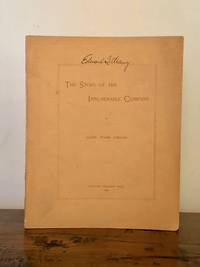
189512687Stanford University Press 1895. First Edition. Printed wrappers. Near Fine. Square 8vo. Pp. 39. Brown wraps lettered in red light soiling nick to foot of spine. Meany's signature to top of front wrap with his gift inscription "Passed on to my friend Frank McCaffrey Saturday 30 March 1935" on title page. First book by Jordan the Ichthyologist and president of Stanford University 1891 - 1913.<p>Meany was known for his informal Saturday meetings at the UW where students alumni mountaineers and Seattle cultural figures gathered to talk about all things Northwest. This copy is certainly a product of those gatherings. Scarce thus and a strong association between Seattle's eminent historian and its leading fine press printer and publisher whose Dogwood Press remains a sought-after imprint. Stanford University Press unknown
188127909Boston: Press of Wright & Potter Printing Co. 1881. First edition. Stapled paper wrappers. A very good copy chips on the wrappers and spine mail fold some minor foxing small edge tear to one leaf otherwise very clean. 80 pp. 8vo. Reports an explosive growth in the mail order business in the preface to the catalogue: "A single glance at this method of making purchases is enough to show the convenience economy and satisfaction to be derived therefrom." Scarce. OCLC locates none of this year a few scattered copies from later years at Harvard's Baker Lib. Hagley and UFLA and only one earlier 1878 at the UVA in the Albert H. Small American Trade Catalogs Collection. Press of Wright & Potter Printing Co. unknown
1866d0538London: Longmans Green & Co. G: in good condition without dust jackets. Covers marked and faded. Edge-wear. Inner hinge cracking. Page edge browning. Some pages uncut. Ex Royal College of Surgeons Ireland Library. 1866. First Edition. Blue hardback cloth cover. 260mm x 170mm 10" x 7". xix 104pp; xiv 60pp. 13 plates 2 fold-out some with colour outlines. Published 1886 and 1887. . Longmans, Green, & Co hardcover