16 968 résultats
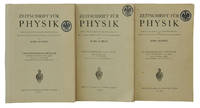
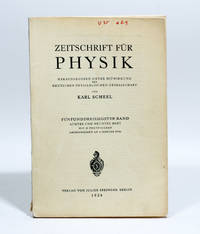
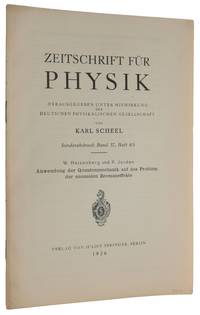
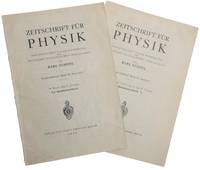
19266575Berlin: Springer 1926. First edition. <p>First edition extremely rare offprints of the two papers that founded matrix mechanics. Building on Heisenberg's demand that quantum theory be formulated in terms of observable quantities Max Born recognised that Heisenberg's rule of combination was in effect matrix multiplication. The first offprint Born-Jordan introduced the new formalism and established the non-commutative relation between position and momentum. The second the celebrated "Three-Man Paper" Born-Heisenberg-Jordan gave the first sustained presentation of quantum mechanics in matrix language recasting physical quantities as matrices and applying Hamilton's equations. In its closing section Jordan extended the method to the electromagnetic field-an early step towards quantum electrodynamics.</p>. The Birth of Modern Quantum Mechanics. <p>First edition extremely rare offprints of Born and Jordan's explication of Heisenberg's quantum mechanics - in their joint paper On Quantum Mechanics which introduced matrix mechanics to the world - and the more detailed sequel with Heisenberg himself the famous "three-man paper" which was the first comprehensive exposition of quantum mechanics in matrix language. Quantum mechanics first emerged in Heisenberg's 'Uber quantentheoretische Umdeutung kinematischer und mechanischer Beziehungen' 'Quantum-theoretical reinterpretation of kinematic and mechanical relations' published on 18 September 1925. In that paper "Heisenberg 1901-76 points out that on the atomic level the orbits of electrons and their period of revolution are not measurable but that theory should be based only on quantities that can at least in principle be experimentally observed. He went on to replace the usual position x of a point-like particle by an 'ensemble of quantities' xmn and proposed a rule for the multiplication of such ensembles . After Pauli's approval Heisenberg gave the paper to Born 1882-1970. He asked him to study it and in case he agreed to forward it to a journal for publication . Only some days later Born studied the paper. He was impressed sent the paper off for publication and began to think about more formal aspects of Heisenberg's approach. The multiplication rule Heisenberg had used for his ensembles seemed vaguely familiar to him and then he realized that this was the rule of matrix multiplication. The ensembles could be taken as matrices which were well studied by mathematicians. It was well known that in general matrix multiplication is not commutative i.e. the result of a product depends on the order in which the factors are written. For the matrices x of position and p of momentum this means that the elements of the matrix px are not necessarily equal to those of the matrix xp. Born conjectured that the commutator px − xp was equal to h/i times the unit matrix 1 although he could show that property only for the diagonal elements of the commutator. For the general proof he asked the help of Jordan 1902-80 who found it within two days . Born and Jordan began to work out quantum mechanics in matrix notation on the basis of Heisenberg's ideas. Born . left the actual writing of their paper On Quantum Mechanics to Jordan. Heisenberg Jordan and Born now began a collaboration - mostly by correspondence - in which they worked out a comprehensive exposition of quantum mechanics. Their publication On Quantum Mechanics II is usually referred to as the 'three-men paper' Drei-Männer-Arbeit. It contains the fundamental assumptions of the theory i.e. the reinterpretation of physical quantities as matrices with their special multiplication laws or 'commutation relations' and Hamilton's equations written down for these quantities . Moreover it presents a systematic way for the solution of these equations and there is a discussion of perturbation theory and of several examples. The three men were together in Göttingen for only about two weeks before Born who had written the mathematical part departed for the United States and left the final editing to Heisenberg and Jordan both twenty-three years old at the time. The paper was completed in mid-November. Its last section carries the title 'Coupled Harmonic Oscillators. Statistics of Wave Fields'. It was written by Jordan alone and practically no notice was taken of it at that time. Now it is recognized as the first description of the electromagnetic field in terms of quantum mechanics and thus as the very first step towards quantum electrodynamics" Brandt pp. 155-157. RBH lists only the Plotnick copies Christie's NY 2002.</p> <br /> <p>"Even those intimately familiar with matrix mechanics as we now understand it will find Heisenberg's 1925 paper daunting. But happily this obscurity is much less true of the article by Born and Jordan that followed Heisenberg's by about two months in the next volume of Zeitschrift für Physik and largely reformulated his theory in terms of matrix operations.</p> <br /> <p>"It happened that while or shortly after reading Heisenberg's manuscript before it was submitted for publication in July of 1925 Born quickly realized that the noncommutativity that Heisenberg had discovered could be interpreted as matrices which in general do not commute. After Pauli declined Born was able to induce his 23-year-old assistant Pascual Jordan who had studied with the mathematician Courant to help him with the mathematics of the theory. They immediately began their very lucid reformulation of Heisenberg's paper which they worked up in those two months opening with an introduction to the properties of matrices including their noncommutativity and adopting Heisenberg's assumption from the correspondence principle that Hamilton's equations of motion apply in the quantum theory a well as classically. In short order they discovered the operator or matrix expression xp - px = h/2piI. With the Hamiltonian in hand they could obtain an expression for the time dependence of an operator and using Hamilton's laws of motion treat a problem like the harmonic oscillator. Application was made to the one-dimensional oscillator from which the now familiar result E = n ½hw was obtained and the simple rotor was treated as well. The paper is a tour de force succinct and clear. It is not at all hard to see why Born always felt that he and Jordan should have been given something like equal credit for the discovery of matrix mechanics which was never the case. The details of the paper which hinted at the role of Hermitian bilinear or quadratic forms in representing observables though the specific language of Hermitian operators on a Hilbert space was not yet used were mostly the work of Jordan .</p> <br /> <p>"The third paper this one by all three Born Heisenberg and Jordan BHJ . submitted eight weeks after Born and Jordan's paper introduced the language of Hermitian forms quite explicitly . Perhaps the most startling discovery by Heisenberg and more explicitly by Born and Jordan was that the products xp and px were different that is that as 'operators' x and p do not commute in quantum mechanics. Thus a quantity like p x = px - xp came in the BHJ paper to be known as a 'commutation rule' or 'commutation relation' after the common notion of commutativity. In this paper we also find the general expression for the time dependence of a dynamical variable or as the authors put it 'any quantum mechanical quantity' in terms of the commutator with the Hamiltonian which is equivalent to giving the time dependence of an operator in what we know as the 'Heisenberg picture'. Throughout the development emphasis is placed on the canonical transformations that lead to a diagonal matrix representing the dynamical variable typically the energy the Hamiltonian.</p> <br /> <p>"Another important application found in the BHJ paper is to time-dependent perturbation theory. An examination of their chapter 2 reveals the equations for the energy eigenvalues in first- and higher-order perturbation theory in a fairly transparent form for even the modern reader and in the same chapter degenerate perturbation theory is treated by diagonalizing a submatrix of the perturbing interaction involving the degenerate states.</p> <br /> <p>"In the next chapter of the paper the challenging problems of continuous spectra involving continuous matrices are addressed although in a less than mathematically rigorous way therefore leaving some unanswered questions. It is worth noting that Heisenberg was not entirely comfortable with Born and Jordan's casting the theory in what for the time was a fairly sophisticated mathematical form. He wrote Pauli saying that: 'I am pretty unhappy about the whole theory and thus was glad that you were so completely on my side in your views on mathematics and physics. Here Göttingen I'm in an environment that thinks the exact opposite and I do not know if I'm not just too stupid to understand mathematics.' In the same vein Pauli wrote Ralph Kronig that 'one must next attempt to free Heisenberg's mechanics from the Göttingen torrent of erudition.' Of course these two founders of quantum mechanics would soon be proved wrong .</p> <br /> <p>"The BHJ paper was titled 'On quantum mechanics. II' thus deliberately announcing it as the successor to the Born-Jordan paper rather than of Heisenberg's original work. Hilbert . since 1895 had been at Göttingen where all three authors BHJ were working at the time - before Heisenberg's move to Leipzig. It is in this paper BHJ that Jordan provided the first sketch of transformation theory . On the other hand although dynamical variables are transformed the states have not yet emerged as vectors in Hilbert space. But the relationship of these results to the eigenvalues of Hermitian operators are clearly spelled out and Hilbert's work is cited.</p> <br /> <p>"One of the most important aspects of the paper is to be found in its chapter 4 'Physical applications of the theory' the introductory section of which is titled 'Laws of conservation of momentum and angular momentum: intensity formulae and selection rules.' Here we see the angular momentum algebra for the first time using the new commutation rules which were obtained directly from the commutators of p and x . Here are to be found the standard expressions for the commutators involving the angular momentum operators not using that term of course the matrix elements of the angular momentum operators . and implicitly the 'ladder operators' for angular momentum . Although the paper was submitted in November 1925 the advance over Heisenberg's original paper from the end of July is enormous. Among other things it led directly to Pauli's treatment of the hydrogen atom. In all the early papers including those of Heisenberg of Born and Jordan of BHJ and even of Dirac the problem of the hydrogen atom was ducked as being too difficult in favor of the harmonic oscillator or the simple rotor for example" Purrington pp. 59-62.</p> <br /> <p>"The endeavours of Born Heisenberg and Jordan led to the development of the theory of matrix mechanics which was applicable to all types of multiply periodic systems to nondegenerate and degenerate ones and in principle even to aperiodic systems. In addition the authors realized that the matrix equations had a simpler structure than the corresponding classical equations . the discussion of conservation laws also appeared to be considerably more elementary. The three authors succeeded in presenting the theory in a finished and compact form" Mehra p. 92.</p> <br /> <p>In the last chapter of the three-man paper Jordan introduced the process of 'second quantization' the first attempt at a quantum-mechanical treatment of the electromagnetic field thinking of the electromagnetic field in terms of quanta is 'first quantization'; that picture has to treated using quantum mechanics hence 'second quantization'. "Jordan himself rated his calculation as 'almost the most important contribution I ever made to quantum mechanics' . Jordan's original approach to second quantization not Dirac's became the standard procedure among researchers and in textbooks to formulate quantum field theory" Dittrich. Jordan tends to be overlooked today due to his Nazi-era writings that praised Hitler's regime. Some feel that this probably prevented him from being awarded the Nobel Prize in 1954 jointly with Born and Bothe. Heisenberg received the Nobel Prize in 1932 "for the creation of quantum mechanics".</p> <br /> <p>Brandt The Harvest of a Century 2009. Dittrich 'The cofounder of quantum field theory: Pascual Jordan' The European Physical Journal H 40 2015 pp. 241-260. Mehra The Historical Development of Quantum Theory vol. III 1982 see Chapter III for a full account of the three-man paper. Purrington The Heroic Age. The Creation of Quantum Mechanics 1925-1940 2018.</p> <br/> <br/> Two vols 8vo 228 x 156 mm. I. Offprint from: Zeitschrift für Physik Bd. 34 Heft 11/12 28 November 1925; II. Offprint from: Zeitschrift für Physik Bd. 35 Heft 8/9 4 February 1926. Berlin: Springer 1925 -1926. Springer unknown
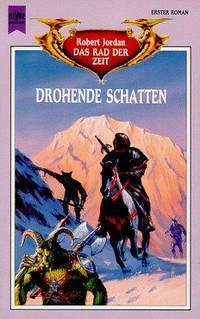
1993894HEYNE WILHELM 1993-07/2001. softcover. Rad der Zeit Das 5026-50375521-553190009201-9202 HEYNE, WILHELM paperback
1990188913New York: Tor 1990-2013. Legend fades to myth and even myth is long forgotten when the Age that gave it birth comes again First editions the first twelve works signed by Jordan the latter three signed by Sanderson. The Great Hunt and A Memory of Light are inscribed by Jordan and Sanderson respectively: "For Pat Best Wishes" and "For Jamie light illumin sic you!". The Eye of the World is one of 1500 copies in the desirable hardcover issue most of which went to libraries. Some additional copies of the wrappers issue were also bound up in hardcover to supplement the high demand; copies of this hybrid issue are distinguishable by being perfect-bound rather than in gatherings as here. 15 vols large octavo. Illustrated with maps and head- and tailpieces. Original blue boards spines lettered in various colours endpapers illustrated in colour. With dust jackets. Gathering Storm with promotional material loosely inserted; Towers of Midnight with promotional sticker on jacket front panel; sticker sometime removed from same of Memory of Light. Bumps to spine ends and corners particularly Knife of Dreams extending to front board edges small marks to edges a handful of production flaws to endpapers boards and contents clean; jackets unclipped light creasing to extremities versos occasionally lightly browned mostly the earlier works small abrasion to Crown of Swords spine verso: a near-fine set in like jackets. hardcover
199343441HEYNE WILHELM 1993. 4. softcover. Shadowrun Deutsche Erstausgabe! HEYNE, WILHELM paperback
199643442HEYNE WILHELM 1996. 9.ND. softcover. Shadowrun Deutsche Erstausgabe! SF-Simbolo sur la Dorso! HEYNE, WILHELM paperback
1990666555444338TOR 1990. First Edition. Hardcover. Near fine/Fine. First edition thirteenth printing. All pages are clean and unmarked. Slight lean to spine else binding and hinges tight and secure. Jacket is vibrant free of any scuffing or tears and not price clipped. Minor bumping to spine ends else board corners remain sharp. TOR hardcover
199543437HEYNE WILHELM 1995. 7. softcover. Shadowrun Deutsche Erstausgabe! HEYNE, WILHELM paperback
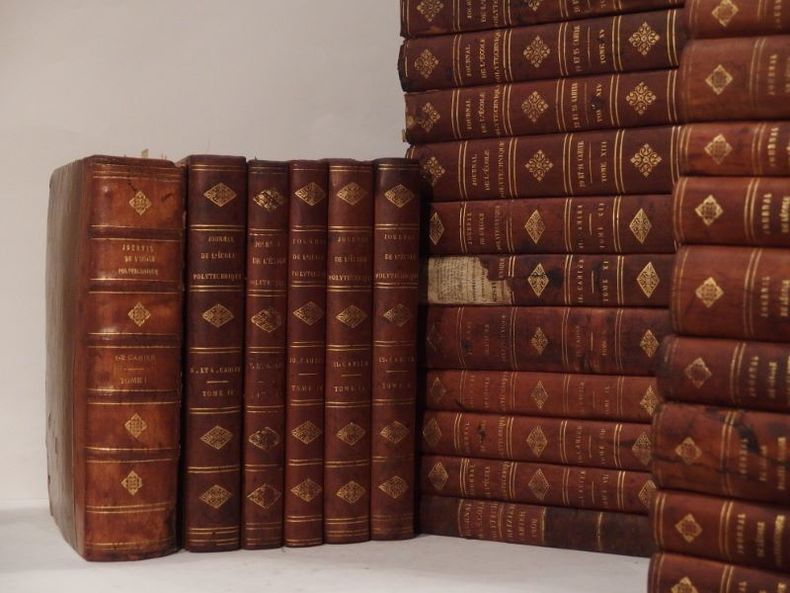
13594Paris, De l'Imprimerie de la République, Régent et Bernard, Bachelier, Mallet-Bachelier, Gauthier-Villars, An III (1794) - 1881. 48 tomes (1 à 8 et 10 à 49) in-4 reliés en 27 volumes, 160 planches hors-texte, quelques figures dans le texte, reliure demi-basane ou veau à coins (reliure frottée, manques à quelques coiffes, quelques mors fendillés, manque la moitié du dos au tome 11, dos du tome 20 tabîmé, mors supérieur du tome 1 fendu, rousseurs éparses). Tampons humides ("Bibliothèque de l'Université de France", "Echange autorisé", "Dons n° 12961", "Ecole Polytechnique") et ex-libris : Citoyen Messier (manuscrit), Lefebure de Fourcy 1869 (impr.) et "Monsieur Lefebvre" (manuscrit), Paul Serret (d'après un certificat de la Librairie scientifique A. Hermann, daté 1884 et signé par le libraire, qui confirme qu'il s'agit d'une collection ayant fait l'objet d'un échange autorisé avec la Bibliothèque de l'Université - cf. cachets, et par exemple l'ex-dono manuscrit suivant, répété : "à Mr. Lefebvre, Elève de l 'Ecole Polytechnique, De la part du Conseil de la dite Ecole").
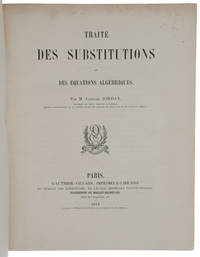
18704912Paris: Gauthier-Villars 1870. First edition. <p>First edition a notorious rarity of "the book that established group theory as a subject in its own right in mathematics" Gray. "Jordan's monumental work Traité des Substitutions et des Équations algébriques published in 1870 is a masterpiece of mathematical architecture. The beauty of the edifice erected by Jordan is admirable" Van der Waerden. It has been suggested that most copies of the book were destroyed in a fire at the publisher's warehouse during the violent suppression of the Paris Commune early in 1871.</p>. THE FOUNDATION WORK OF MODERN GROUP THEORY. <p>First edition very rare of "the book that established group theory as a subject in its own right in mathematics" Gray p. 149. "Jordan's monumental work Traité des Substitutions et des Équations algébriques published in 1870 is a masterpiece of mathematical architecture. The beauty of the edifice erected by Jordan is admirable" Van der Waerden A History of Algebra p. 117. "In 1870 Jordan gathered all his results on permutation groups for the previous ten years in a huge volume Traité des Substitutions which for thirty years was to remain the bible of all specialists in group theory. His fame had spread beyond France and foreign students were eager to attend his lectures; in particular Felix Klein and Sophus Lie came to Paris in 1870 to study with Jordan" DSB. "An instant classic his Traité set a new research agenda of creating a theory of groups as opposed to the older agenda of devising ways to calculate the solutions of polynomial equations" Katz & Parshall p. 316. "The title of this comprehensive work of 667 quarto pages is excessively modest and therefore misleading. The work represents not only the definitive solution of the problem formulated by Galois but also a review of the whole of contemporary mathematics from the standpoint of group-theoretic thinking" Wussing pp. 141-142. "Jordan's place in the tradition of French mathematics is exactly halfway between Hermite and Poincaré. Like them he was a 'universal' mathematician who published papers in practically all branches of the mathematics of his time . but it is chiefly as an algebraist that he reached celebrity when he was barely thirty; and during the next forty years he was universally regarded as the undisputed master of group theory. When Jordan started his mathematical career Galois's profound ideas and results which had remained unknown to most mathematicians until 1846 were still very poorly understood despite the efforts of Serret and Liouville to popularize them; and before 1860 Kronecker was probably the only first-rate mathematician who realized the power of these ideas and who succeeded in using them in his own algebraic research. Jordan was the first to embark on a systematic development of the theory of finite groups and of its applications in the directions opened by Galois . He also was the first to investigate the structure of the general linear group and of the 'classical' groups over a prime finite field and he very ingeniously applied his results to a great range of problems; in particular he was able to determine the structure of the Galois group of equations having as roots the parameters of some well-known geometric configurations the twenty-seven lines on a cubic surface the twenty-eight double tangents to a quartic the sixteen double points of a Kummer surface and so on" ibid. This is an extremely rare book on the market and very uncommon even in institutional collections. ABPC/RBH list only the two copies in the Duarte sale in 1977. It has been suggested that most copies of the book were destroyed in a fire at the publisher's warehouse during the violent suppression of the Paris Commune early in 1871 and that the marginal browning seen in many of the surviving copies was caused by the heat of the fire.</p> <br /> <p>Évariste Galois 1811-32 published a few short papers in his lifetime but his most important works were posthumous. He first set down his ideas on the relationship between what we call group theory and the solvability of polynomial equations in his most important work 'Mémoire sur les conditions de résolubilité des équations par radicaux' usually called the 'Premier Mémoire' which he submitted to the Paris Académie des Sciences but which they rejected and returned to the author on 4 July 1831. He followed this with 'Des équations primitives qui sont solubles par radicaux' also known as the Second Mémoire. Both Mémoires were published for the first time together with Galois's other works by Joseph Liouville in his Journal de Mathématiques pures et appliquées in 1846 and it was through this publication that Galois's works became known to the wider mathematical world.</p> <br /> <p>"The publication of Galois's work in Liouville's Journal was a challenge to all mathematicians to understand it extend it and apply it. Ultimately it stimulated the emerging generation of mathematicians as Wussing has described. He noted an initial period in which Betti Kronecker Cayley Serret and some others filled in holes in Galois's presentation of the idea of a group. These modest yet difficult pieces of work established the connection between group theory and the solvability of equations by radicals i.e. by expressions involving the sums differences products and quotients of whole numbers and their square cube and higher roots and then explored the solution of equations by other means than radicals. The implicit idea of a group was expressed in terms of permutations of a finite set of objects amalgamating Cauchy's presentation of the theory of permutation groups in 1844-46 and Galois's terminology.<br /> </p> <br /> <p>"The crucial presentations of the idea of permutation groups were made by Jordan in his 'Commentaire sur Galois' Mathematische Annalen 1 1869 141-160 and his Traité des Substitutions et des Équations algébriques 1870. Jordan's systematic theory of permutation groups was much more abstract; he spoke of abstract properties such as commutativity conjugacy centralizers transitivity 'normal' subgroups and one might say obliquely of quotient groups group homomorphisms and isomorphisms. So much so that one can argue that Jordan came close to possessing the idea of an abstract group. Jordan said Traité p. 22 'One will say that a system of substitutions form a group if the product of two arbitrary substitutions of the system belongs to the system itself.' He spoke Traité p. 56 of isomorphisms which he called an isomorphisme holoédrique between groups as one-to-one correspondences between substitutions which respect products.<br /> </p> <br /> <p>"A further indication of the high level of abstraction at which Jordan worked is his use of technical concepts of increasing power . Another is the wide range of situations in the Traité in which groups could be found permuting geometrical objects: the 27 lines on a cubic surface the 28 bitangents to a quartic the symmetry groups of the configuration of the nine inflection points on a cubic and of Kummer's quartic with sixteen nodal points. Powerful abstract theory and a skilled recognition of groups 'in nature' suggests that Jordan had an implicit understanding of the group idea that he presented in the language of permutation groups only for the convenience of his audience. This is not to deny the role of permutation-theoretic ideas in Jordan's work indicated by the emphasis on transitivity and degree = the number of elements in the set being permuted but rather to indicate that ideas of composition and action . were prominent and could be seized upon by other mathematicians" Gray pp. 152-153.</p> <br /> <p>"The Traité des Substitutions et des Équations algébriques begins with an introduction of extraordinary scope which demonstrates the scientific staring point as well as the greatness and limitations of Jordan's conception. In a certain sense the Traité contains formulations of problems belonging to a development yet to come .</p> <br /> <p>"Jordan begins his introduction by stressing the fundamental difference between Galois's papers on the theory of equations and the relevant papers of Galois's predecessors from Lagrange to Abel. By associating to every equation a permutation group whose structure mirrors its essential properties including its possible solution by radicals Galois had supplied the ultimate basis of the theory of equations. This assigned a special role to the theory of permutations. As the foundation of all questions bearing on the theory of equations permutation theory became an independent area of investigation . In view of this development and of algebraic questions that had just arisen Jordan concludes that the theory of equations had acquired a new and very different character. The old quest for solutions of given equations in the form of transparent solution formulas had become the study of the structure of algebraic number fields although Jordan did not use the concept of a field .</p> <br /> <p>"He designates in the introduction two large groups of problems to be studied in the Traité with the aid of permutation theory:</p> <br /> <br /> The study of 'division' of transcendental functions expressing fx/n in terms of f when f is an elliptic function. This study had already given Galois the opportunity to make a new and brilliant application of his method. It had been advanced by Hermite who using Galois's methods built on the relevant work of Abel and Gauss .<br /> The use of permutation theory in studying the new direction of developments of analytic geometry. This new development had been initiated by O. Hesse largely in the fifties in papers on the number of inflection points of cubic curves. Through these papers algebra with its then very modern tools began to appear as the direct representation of geometric propositions .<br /> <br /> <p>"It thus appears that Jordan had grasped an objective tendency that pointed to the use of group theory in geometry and that was to gain general acceptance two years after the Traité as a result of Klein's Erlangen Program . He was able to classify earlier isolated results by group-theoretic means; more specifically he could describe such results in terms of statements about subgroups of the 'linear group' a group that he had investigated in great detail" Wussing pp. 154-156.</p> <br /> <p>"The short Livre I picks up on the topic of Galois's 'Sur la théorie des nombres' Bulletin des Sciences Mathématiques Physiques et Chimiques de M. Férussac 13 1830 428-435 and is about congruences modulo a prime or prime power what we today would call finite fields. The material on modular arithmetic is needed because the Traité is entirely about finite groups often described as matrix groups with entries modulo a prime number.</p> <br /> <p>"Livre II is about substitutions Galois's word for what would later become permutations. It ranges widely bringing in work by Lagrange Cauchy Mathieu Kirkman Bertrand and Serret. Its themes are transitivity simple and multiple primitivity the topic of Galois's second memoir and composition factors. It also gives a flawed proof that the alternating group An is simple when n ≠ 4 the alternating group consists of permutations that can be effected by making an even number of exchanges of pairs of elements. Here Jordan presented the opening propositions of the theory of groups: Lagrange's theorem and Cauchy's theorem. Lagrange's theorem and proof is stated in the form it retains to this day: the order of = number of elements in a subgroup divides the order of the group . Cauchy's theorem §40 is the partial converse: if a prime p divides the order of a group then there is an element of order p in the group i.e. an element whose pth power is the identity element .</p> <br /> <p>"Then comes an account of transitivity and the 'orbit-stabilizer' theorem: Jordan proved §44 that given a set of objects permuted by a group G if these elements can be sent to m different systems of places and n is the order of the subgroup that leaves these elements fixed then the order of the group is mn. Jordan was very interested in how transitive a group could be and in §47 recorded the 'remarkable' example of the Mathieu group on 12 letters that is 5-fold transitive i.e. any 5 different letters can be sent to any other or the same 5 different letters by some element of the group.</p> <br /> <p>"Then we get some 160 pages on what we might call finite linear groups groups whose elements are matrices with entries in a finite field. They come in various types and the names have not always retained the meaning Jordan gave them: primary orthogonal abelian hyperabelian. A typical theme is the 'normal' subgroups and composition factors of the different groups. He was also interested in the concept of primitivity which he defined negatively: a group is non-primitive better imprimitive if the elements being permuted by the group can be divided into blocks containing the same number of elements and the group maps blocks to blocks. </p> <br /> <p>Livre III 'The irrationals' is about the behaviour of a given irreducible equation under successive adjunction of irrationals roots of other polynomial equations. It deals with the solution of the quartic by radicals and the insolubility of the general quintic. Then we get a treatment of equations with particular kinds of group: abelian groups and what Jordan called 'Galois's equation' xp = A. Then we get the geometrical examples mentioned above in which discoveries by Hesse Clebsch Kummer and Cayley the 27 lines on a cubic surface are shown to have interesting group-theoretic interpretations. Then comes material from elliptic function theory: the modular equation and the discovery in 1858 of the solution of the quintic equation according to Hermite and Kronecker. Jordan reworked their contributions in his own way and then extended their work to show that all polynomial equations can be solved by a similar use of hyper-elliptic functions.</p> <br /> <p>"The books ends with Livre IV of almost 300 pages entitled 'Solution by radicals.' Jordan quickly rehearsed the argument that an equation is solvable by radicals if and only if the composition factors of its group are all prime and called such a group solvable. This led him to proclaim three problems of which for brevity I give the first only: construct explicitly for every degree the general i.e. maximal solvable transitive groups . Jordan used his theory of composition factors to suggest that a massive process of induction might suffice to find all permutation groups . it might be possible to construct the given group from its composition series if all groups of order less than the given group are known. In the event this ambitious programme failed - groups are vastly more varied than can be handled this way - but it has the germ of a process that was later made more precise by Hölder and became the search for all simple groups" Gray pp. pp. 153-154. </p> <br /> <p>Some possibly all of the four 'Livres' into which the Traité is divided may have been issued separately: we have seen copies of two or three of the Livres bound separately in contemporary bindings.</p> <br /> <p>Marie-Ennemond-Camille Jordan 1838-1922 was a professor of mathematics at the École Polytechnique in Paris from 1876 to 1912. He edited Liouville's Journal des mathématiques pures et appliquées from 1885 until his death. Apart from the Traité des Substitutions which brought him the Poncelet Prize of the French Academy of Sciences he published his lectures and researches on analysis in the influential Cours d'analyse de l'École Polytechnique three vols. 1882-87 about which the great English mathematician G. H. Hardy wrote: "As a student I was advised to read Jordan's Cours d'analyse; and I shall never forget the astonishment with which I read that remarkable work the first inspiration for so many mathematicians of my generation and learnt for the first time as I read it what mathematics really meant." In the third edition of this work 1909-15 Jordan gave the proof of what is now known as Jordan's curve theorem: any closed curve that does not cross itself divides the plane into exactly two regions one inside the curve and one outside.</p> <br /> <p>Gray A History of Abstract Algebra 2018. Katz & Parshall Taming the Unknown 2014. Wussing The Genesis of the Abstract Group Concept 2007.</p> <br/> <br/> 4to 269 x 221 mm pp. xviii 667 some marginal browning. Contemporary half-morocco and marbled boards spine lettered in gilt spine faded. Gauthier-Villars unknown
199243440HEYNE WILHELM 1992. 5. softcover. Shadowrun Deutsche Erstausgabe! HEYNE, WILHELM paperback
1925140940045Berlin: Julius Springer 1925. First Edition. Very Good. 1925-26. First edition. Three extremely influential papers marking the theoretical foundation for modern quantum mechanics and defining the discipline: "Uber quantentheorestische Umdeutung kinematischer und mechanischer Beziehungen" by Werner Heisenberg; "Zur Quantenmechanik" by Max Born and Pasqual Jordan; and "Zur Quantenmechanik II" by Born Heisenberg and Jordan. In Zeitschrift fur Physik Vols. 33 total pp.879-950 Heisenberg paper pp. 879-893; Vol. 34 total pp. 795-953 lean to spine; Born Jordan paper 858-888; Vol. 35 total pages pp. 557-722; Born Heisenberg Jordan pp 557-615. In publisher's original wrappers with new spines ink stamp to top right of front wrappers minor creasing and soiling to wraps. Heisenberg received the Nobel Prize for physics in 1932 for his establishment of quantum mechanics. Julius Springer unknown books
1925140940045Berlin: Julius Springer 1925. First Edition. Very Good. 1925-26. First edition. Three extremely influential papers marking the theoretical foundation for modern quantum mechanics and defining the discipline: "Uber quantentheorestische Umdeutung kinematischer und mechanischer Beziehungen" by Werner Heisenberg; "Zur Quantenmechanik" by Max Born and Pasqual Jordan; and "Zur Quantenmechanik II" by Born Heisenberg and Jordan. In Zeitschrift fur Physik Vols. 33 total pp.879-950 Heisenberg paper pp. 879-893; Vol. 34 total pp. 795-953 lean to spine; Born Jordan paper 858-888; Vol. 35 total pages pp. 557-722; Born Heisenberg Jordan pp 557-615. In publisher's original wrappers with new spines ink stamp to top right of front wrappers minor creasing and soiling to wraps. Heisenberg received the Nobel Prize for physics in 1932 for his establishment of quantum mechanics. Julius Springer unknown
19262822Berlin: Julius Springer 1926. 1st Edition. original wrappers. Very Good. FIRST EDITION IN ORIGINAL WRAPPERS of the famous "three-man paper" the first complete self-consistent description of quantum mechanics. "In 1925 after an extended visit to Bohr's Institute of Theoretical Physics at the University of Copenhagen Heisenberg tackled the problem of spectrum intensities of the electron taken as an anharmonic oscillator a one-dimensional vibrating system. His position that the theory should be based only on observable quantities was central to his paper of July 1925 "Über quantentheoretische Umdeutung kinematischer und mechanischer Beziehungen" "Quantum-Theoretical Reinterpretation of Kinematic and Mechanical Relations". Heisenberg's formalism rested upon noncommutative multiplication; Born together with his new assistant Pascual Jordan realized that this could be expressed using matrix algebra which they used in a paper submitted for publication in September as "Zur Quantenmechanik" "On Quantum Mechanics". By November Born Heisenberg and Jordan had completed "Zur Quantenmechanik II" "On Quantum Mechanics II" colloquially known as the "three-man paper" which is regarded as the foundational document of a new quantum mechanics" Britannica's Guide to the Nobel Prizes. <br /> <br /> Particle Physics: One Hundred Years of Discoveries: "Development of matrix formalism for the Heisenberg quantum mechanics. Systems with arbitrary many degrees of freedom."<br /> <br /> IN: Zeitschrift für Physik Band 35 February 1926 pp. 557-615. Berlin: Julius Springer 1926. Octavo original wrappers. Small chip at base of spine. "Born Heisenberg 35" in pencil on spine. Volume/issue number written in ink at top of front wrapper. <br /> <br /> One of the foundational papers in quantum mechanics rare in original wrappers. Julius Springer unknown
19266418Berlin: Springer 1926. First edition. <p>First edition an extremely rare offprint presenting Heisenberg and Jordan's groundbreaking explanation of the anomalous Zeeman effect through matrix mechanics. By incorporating the newly identified spin property of the electron this pivotal paper successfully accounted for all previously unexplained phenomena related to the anomalous Zeeman effect marking a major milestone and according to Rechenberg "perhaps the greatest triumph" of the matrix formulation of quantum mechanics.</p>. <p>PERHAPS THE GREATEST TRIUMPH OF MATRIX MECHANICS</p> . <p>First edition very rare offprint of the explanation of the anomalous Zeeman effect on the basis of matrix mechanics. "By including the spin property of the electron Heisenberg and Jordan obtained perhaps the greatest triumph of matrix mechanics: they were able to derive all observed phenomena connected with the anomalous Zeeman effect" Rechenberg p. 211. When an atom is placed in a magnetic field its spectral lines split into a series of equidistant lines - always an odd number - whose separation is proportional to the field strength. This the normal Zeeman effect was explained in 1916 by Debye and Sommerfeld in terms of the 'old' quantum theory: the splitting was due to the interaction between the magnetic field and the orbital magnetic moment of the electrons in the atom. However there is also an anomalous Zeeman effect observed particularly in atoms with odd atomic number in which the lines split in a more complex fashion. "During 1920-24 many physicists attacked the problem of the anomalous Zeeman effect including Landé who was able to give a phenomenological explanation of the observed splitting of spectral lines. However neither Landé Sommerfeld Pauli Heisenberg nor other physicists occupied with the problem could justify their results in terms of quantum theory. "It's a great misery with the theory of anomalous Zeeman effect" Pauli wrote to Sommerfeld on July 19 1923" Kragh p. 158. Heisenberg and Jordan described their results in the abstract of the paper as follows: "For explaining the anomalous Zeeman effect Uhlenbeck and Goudsmit have applied Compton's hypothesis of the rotating electron. In the present paper we investigate the quantum mechanical behaviour of the atomic model characterized by this hypothesis. The result is that the Zeeman effect and the fine structure of the doublet spectra can be explained completely by the said hypothesis" Mehra & Rechenberg p. 273. This paper was of crucial importance in the early history of quantum mechanics because its success in explaining the hitherto mysterious anomalous Zeeman effect validated not only the new quantum mechanics itself but also the highly controversial concept of electron spin discovered by Uhlenbeck and Goudsmit in the previous year. OCLC lists Oregon State only. Not on RBH.</p> <br /> <p>After Heisenberg's introduction of matrix quantum mechanics in 1925 one of the first problems he wanted to address using his new theory was the anomalous Zeeman effect. The crucial ingredient was electron spin which Uhlenbeck and Goudsmit had discovered by studying the regularities in the anomalous Zeeman effect documented by Landé. "Although based originally upon the classical concept of a rotating electron electron spin is a purely quantum mechanical property intrinsic to the electron. Opinions were strongly divided about the validity of the concept Pauli taking a strongly negative position while Bohr Heisenberg and Jordan took a more positive view. The challenge taken up by Heisenberg was to find a quantum mechanical solution for the anomalous Zeeman effect using the concept of a spin-½ particle within the context of their recently completed matrix formalism .</p> <br /> <p>"Despite the less than encouraging views of Pauli in November 1925 Heisenberg set about finding the stationary states and line splittings associated with the anomalous Zeeman effect. Disappointingly he almost reproduced Landé's formula for the anomalous Zeeman effect but the crucial spin-orbit coupling term resulted in a factor of 2 discrepancy from Landé's expression a result which cast doubt on the whole scheme.</p> <br /> <p>"In early January 1926 Heisenberg became aware of the new operator formulation of quantum mechanics of Born and Wiener 1926 which opened up the route for extending matrix mechanics to the more general operator formalism. He was then able to re-evaluate the problem using action-angle variables but nonetheless the stubborn factor of 2 remained causing general disappointment among the proponents of electron spin.</p> <br /> <p>"The solution was however at hand thanks to the insight of Llewellyn Thomas who had arrived recently at Bohr's Institute in Copenhagen as a visiting graduate student . Thomas was aware of the fact that there is an additional kinematic effect associated with the orbital motion of a vector such as the spin vector of the electron according to the special theory of relativity. This purely kinematic effect results in an additional contribution to the precession and hence interaction energy of the electron. and can account completely for the discrepant factor of 2. After considerable debate even Pauli was convinced and the paper on the quantum mechanical explanation for the anomalous Zeeman effect was published by Heisenberg and Jordan in June 1926. Rechenberg has written in his summary of the history of quanta and quantum mechanics that the explanation of the anomalous Zeeman effect was one of the greatest triumphs of matrix mechanics" Longair pp. 312-5. </p> <br /> <p>"The main theoretical task which Heisenberg wanted to achieve in the paper with Jordan was to calculate the eigenvalues of the quantum-theoretical formulation of the Hamiltonian . and to obtain from them the anomalous Zeeman effects and fine structure of spectral lines. To achieve this goal the authors proceeded in several steps. First they studied the question of whether the well-known selection and intensity rules which had been obtained from the analysis of the anomalous Zeeman effect data could be derived from the matrix mechanical treatment of the problem. The calculation of the amount of magnetic splitting turned out to be strenuous work involving as it did the exact evaluation of certain inverse powers of the matrix of the radial variable for realistic three-dimensional atoms. With the extension of the matrix scheme to include angle variables such as the one developed by Heisenberg and Pauli in January 1926 the authors succeeded in obtaining the desired results.</p> <br /> <p>"The actual calculations of Heisenberg and Jordan were straightforward for they followed exactly the pattern of matrix methods which had been developed in the three-man paper and in Pauli's treatment of the hydrogen atom . The formulae they obtained were identical with the ones obtained by Sommerfeld when he rinterpreted Woldmar Voigt's equations for the anomalous Zeeman effects in accordance with the Bohr-Sommerfeld theory of atomic structure. The theoretical understanding of the anomalous Zeeman effects in the old approach was however fundamentally different from the present calculation based on quantum mechanics; the coincidence of the</p> <br /> <p>results obtained by so different means was therefore deemed fortunate. Heisenberg was really 'excited and enthusiastic about the fact that the old formulae of Voigt actually did come out of quantum mechanics'.</p> <br /> <p>"The difference between the methods used by Sommerfeld on the one hand and by Heisenberg and Jordan on the other showed up in particular in the calculation of the intensities of the Zeeman lines. Voigt had discussed the question of line intensities on the basis of the classical electromagnetic theory of emission of light by bound charges and Sommerfeld had not changed this aspect in his treatment of 1922. In Heisenberg and Jordan's calculation the intensities had to be obtained from the matrix elements of the position vector matrix of the orbiting electron .</p> <br /> <p>"Heisenberg and Jordan's matrix calculation in the case of spin = 1â„2 accounted perfectly for the observations of the anomalous Zeeman effect in alkali doublets and all the expressions obtained were equivalent to Sommerfeld's successful formulae of 1922. The new theory described equally well the situation for the spectra of alkaline earths. The latter have series of singlet and triplet spectral lines when no external magnetic field is present which may be readily explained by assuming that the spin angular momenta of the two outer electrons responsible for the radiation either subtract from each other to give total spine = 0 or add up to give total spin = 1 . </p> <br /> <p>Heisenberg was also happy to derive another result a 'summation principle'</p> <br /> <p>'Summationsprinzip' from the equations of perturbation theory . Heisenberg and Jordan drew further conclusions applicable to all multiplets that is independent of the specific system under investigation .</p> <br /> <p>"The methods of matrix mechanics thus turned out to be very successful in dealing with the multiplet structure and the anomalous Zeeman effects. Especially Landé's empirical rules followed automatically. The question remained however whether also certain violations of Landé's rules which had been observed in connection with the so-called partial Paschen-Back effect could be explained in the new theory . Lucie Mensing then took up the problem . Mensing's calculation showed that the transition elements were always nonzero and the experimental data did not indeed exhibit any anomalies in this case. Moreover with respect to the nonzero intensities of the lines experiments and the quantum-mechanical results agreed completely. Lucie Mensing the young lady who proved herself capable of performing the most delicate theoretical calculations of anomalous Zeeman effects was offered a post-doctoral research position at Tübingen where Back and Landé were the leading lights of atomic spectroscopy" Mehra & Rechenberg pp. 273-282.</p> <br /> <p>Helge Kragh Quantum Generations 1999; Malcolm Longair Quantum Concepts in Physics 2013; Helmut Rechenberg Ch. 3 'Quanta and Quantum Mechanics' in Twentieth Century Physics Vol. 1 L. Brown B. Pippard & A. Pais eds. 1995. For a detailed analysis of the paper see Jagdish Mehra & Helmut Rechenberg The Historical Development of Quantum Theory Vol. 3 1982. </p> <br/> <br/> 8vo 229 x 156 mm pp. pp. 263-277. Original printed wrappers. Springer unknown
19904950<p>First Edition/First Printing with the complete number line; A Very Good book in a Near Fine dust jacket. SIGNED by the author to the title page. An outstanding copy of this first novel of the Wheel of Time series a global phenomenon included in PBS' Great American Read; rare in the first printing and signed. This copy is in very good condition showing some light rubbing to the spine ends and edges a few soiled spots to the boards and a mild separation of the text block at the spine head common for this heavy book else a clean tight copy with white unmarked pages throughout. Housed in a crisp and bright near fine dust jacket that shows only some slight rubbing to the edges and a mild sunning to the spine else Fine. A well preserved highly collectible copy of this now classic work basis for the coming mini-series. Not remaindered not price-clipped not ex-library; in a protective Mylar cover and will ship securely wrapped in a sturdy box.</p> Tor Books hardcover
198286441New York University Press. As New. 1982. Hardcover. 0814741606 . FREE UPGRADE to Courier/Priority Shipping Upon Request - IN STOCK AND IMMEDIATELY AVAILABLE FOR SHIPMENT - AS NEW THE TEXT BLOCK IS PRISTINE CLEAN UNMARKED AND IN EXCELLENT CONDITION - - 576 pages and many illustrations. Catalogue Raisonné Catalogue Raisonne Catalog Raisonnee Complete Works New York University Press hardcover
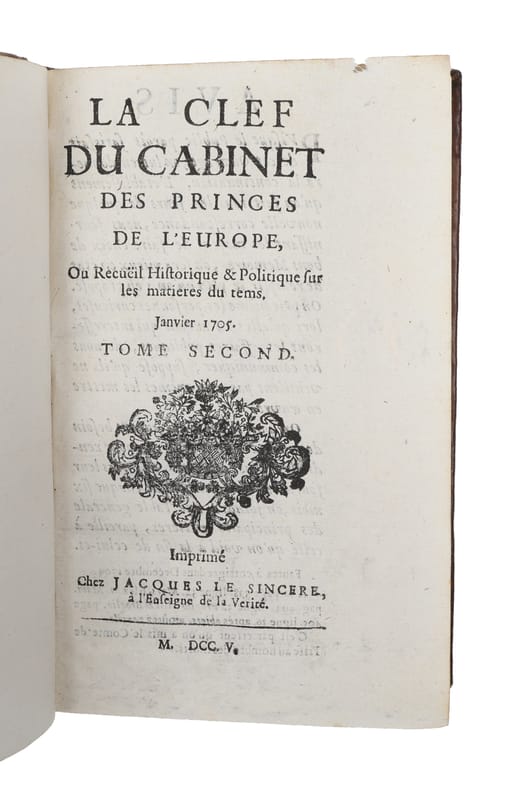
172361629(Luxembourg), Jacques le Sincere (and later:) Andre Chevalier, 1704 - 1723. 8vo. Bound almost uniformly in 38 contemporary full calf bindings with five raised bands and richly gilt spines. Paper-label pasted on to top of spines and ex-libris pasted on to pasted down front end-papers. Light wear to extremities, boards with scratches, occassionally with loss of leather, and spines with light miscolouring and occassional loss of the gilt ornamentation. Vol. 1-18, 20-30, 32-38 and the 2 supplement volumes (both 1713).
172361629Luxembourg Jacques le Sincere and later: Andre Chevalier 1704 - 1723. 8vo. Bound almost uniformly in 38 contemporary full calf bindings with five raised bands and richly gilt spines. Paper-label pasted on to top of spines and ex-libris pasted on to pasted down front end-papers. Light wear to extremities boards with scratches occassionally with loss of leather and spines with light miscolouring and occassional loss of the gilt ornamentation. Vol. 1-18 20-30 32-38 and the 2 supplement volumes both 1713. <br/><br/><em>The exceedingly rare first edition of Luxembourg’s first newspaper and periodical in general which appeared for the first time in July 1704. It was then published monthly without interruption until July 1794. The early volumes of the journal are rarely found in trade and we have not been able to trace a single multiple-volume set with the supplement included. Behind the newspaper were initially the librarian printer and journalist Claude Jordan born around 1659 from Valence and the printer André Chevalier 1660-1747 a Frenchman from Bourg-en-Bresse who had a printing press in Luxembourg city. Jordan had previously published the Gazettes de Hollande in Leyden and Amsterdam. In 1704 the two joined forces to produce a newspaper from Luxembourg aimed at the Lorraine region which was then independent of France and the French market following the model of the Gazettes de Hollande. </em> hardcover
145461Official NBA Spalding Basketball boldly signed by 13 members of the 1997-98 NBA Champion Chicago Bulls including Hall of Famers Michael Jordan and Scotty Pippen. Additionally accompanied by a James Spence Letter of Authentication. Housed in a custom acrylic case. This extremely rare multi-signed basketball signifies the end of the Chicago Bulls dynasty of the 1990's and marks the conclusion of the legendary Michael Jordan's tenure with the team leaving a significant impact on both the sport and the world. Known for having one of the NBA's greatest dynasties winning six NBA championships between 1991 and 1998 the Chicago Bulls have become a name recognizable in most any household. Founded on January 16 1966 the Chicago Bulls played its very first game in the 1966–67 NBA season beginning the __ . The dominant 1997-98 Chicago Bulls clinched the NBA Championship in six games against the Western Conference Champion Utah Jazz securing Chicago's sixth NBA title within an eight-year period. unknown
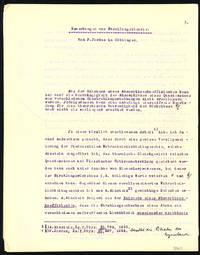
1925509651925. <p>Jordan Pascual 1902-80. Bemerkungen zur Strahlungstheorie. Carbon typescript in German with manuscript additions. 6ff. N.p. n.d. 1925. 286 x 225 mm. Creased horizontally edges a bit crinkled but very good.</p> <p> Apparently Unpublished Paper written in response to Einstein's "Bemerkung zu P. Jordans Abhandlung: 'Zur Theorie der Quantenstrahlung'" Zeitschrift für Physik 31 March 1925: 784-785. We can find no evidence that Jordan's paper appeared in any journal and this typescript copy with formulae and other additions in Jordan's hand may be the only copy in existence.</p> <p> Jordan one of the authors of the famous Dreimännerarbeit on quantum matrix mechanics obtained his doctorate in physics from Göttingen in 1924 with a thesis on the light-quantum problem which was published in the Zeitschrift für Physik under the title "Zur Theorie der Quantenstrahlung" Z. Phys. 30 December 1924: 297-319. At that time Bohr and other quantum physicists had raised a number of objections to Einstein's old conception of light quanta particularly with regard to the Compton effect as they could not find a satisfactory way to integrate Einsteinian light quanta into the current quantum physics. In his thesis Jordan addressed this problem seeking "to propose a compromise between the extreme positions of the light-quantum theory as assumed by Einstein and of the wave theory of radiation as preferred by Niels Bohr on the basis of correspondence arguments. In particular he made an attempt to modify Einstein's theory of the interaction between electrons or atoms and radiation by avoiding an important assumption of the light-quantum theory: namely the assumption that a light-quantum of energy h necessarily imparts a recoil momentum of magnitude h/c to the electron or atom" Mehra & Rechenberg The Historical Development of Quantum Theory 3 p. 51. </p> <p> Jordan's proposal did not convince his fellow physicists particularly Einstein who summarized his objections in the above-referenced "Bemerkung zu P. Jordans Abhandlung: 'Zur Theorie der Quantenstrahlung'" Comment on P. Jordan's paper: "On the theory of quantum radiation". Jordan's reaction to "Einstein's critique can be seen in the present typescript which begins English translation ours:</p> <p> In a recently published work I pointed out that by a certain generalization of the fundamental probability laws introduced by Einstein the thermal equilibrium between quantum atoms and Planckian cavity radiation can also be secured under the assumption of elementary processes in which the radiative recoil can be assigned any values can assume between 0 and h/c. A. Einstein raised serious concerns about these generalized probability laws. A. Einstein concludes from the existence of an absorption coefficient that the radiation extraction of an atom from different incident light beams must be independent of each other. If one has assured oneself in this way of the one-sidedness of the absorption one-sidedness must of course also be concluded for the emission.</p> <p> "It now seems to me that the justification of this point which according to A. Einstein is essential for the proof of the necessity of recoils h/c is not as transparent and reliable as one would like in view of the importance of the matter and it seems to me therefore not superfluous to devote a few more brief considerations to the subject here. . ."</p> <p> We do not know why Jordan chose not to publish this paper but we do know that he did not persist in maintaining his radiation thesis-in his next paper on the subject published the following August he followed Pauli's Einstein's and Ehrenfests's treatments of the processes involved Mehra & Rechenberg p. 52.</p> . unknown
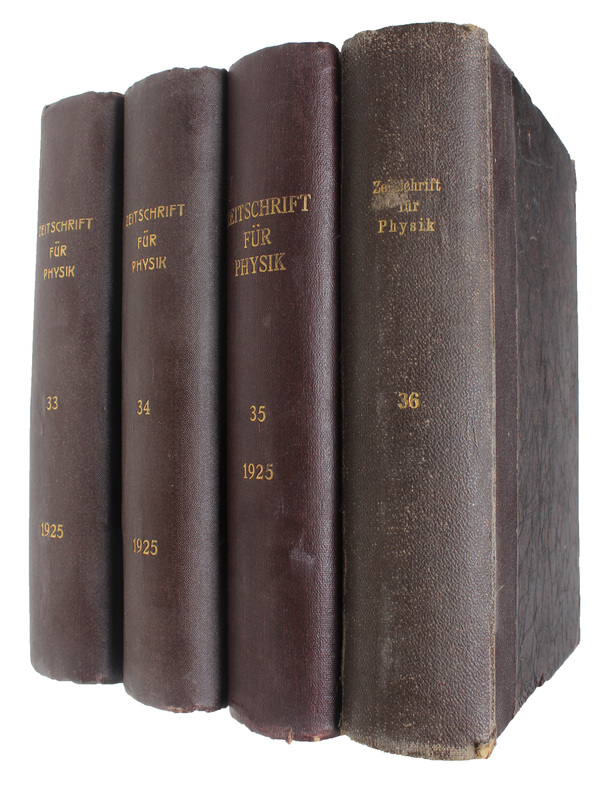
192539170Berlin, Julius Springer, 1925-26. Bound in 4 nearly uniform contemp. hcloth. Edges a little rubbed. Stamp on title-pages. In ""Zeitschrift für Physik. Hrsg. von Karl Scheel"", Vols 33,34,35 and 36. VII,950"VII,953VIII,954"VII,951 pp. The offered papers: pp. 879-893 (vol.33), pp. 858-888 (vol.34), pp.557-615 (vol.35) and pp.336-363 (vol. 36). Internally fine and clean.
192539170Berlin Julius Springer 1925-26. Bound in 4 nearly uniform contemp. hcloth. Edges a little rubbed. Stamp on title-pages. In "Zeitschrift für Physik. Hrsg. von Karl Scheel" Vols 333435 and 36. VII950;VII953;VIII954;VII951 pp. The offered papers: pp. 879-893 vol.33 pp. 858-888 vol.34 pp.557-615 vol.35 and pp.336-363 vol. 36. Internally fine and clean. <br/><br/><em>First printings of these four absolutely fundamental papers which together MARK THE TURNING POINT IN THE FABRICATION OF A NEW PHYSICS Quantum Mechanics also called "Matrix Mechanics"."In May 1925 Heisenberg took on a new and difficult problem the calculation of the line intensities of the hydrogen spectrum. Just as he had done with Kramers and Bohr Heisenberg began with a Fourier analysis of the electron orbits. When the hydrogen orbit proved too difficult he turned to the anharmonic oscillator. With a new multiplication rule relating the amplitudes and frequencies of the Fourier components to observed quantities Heisenberg succeeded in quantizing the equations of motion for this system in close analogy with the classical equations of motion.in June Heisenberg returned to Göttingen where he drafted his fundamental paper the first paper offered which he completed in July. In this paper Heisenberg proclaimed that the quantum mechanics of atoms should contain only relations between experimentally observable quantities. The resulting formalism served as the starting point for the new quantum mechanics based as Heisenberg's multiplication rule implied on the manipulation of ordered sets of data forming a mathematical matrix.Born and his assistant Pascual Jordan quickly developed the mathematical content of Heisenberg's work into a consistent theory with the help of abstract matrix algebra the second paper offered.Their work in collaboration with Heisenberg culminated in their "three-man paper" "Dreimännerarbeit" - the third paper offered that served as the foundation of matrix mechanics. Confident of the correctness of the new theory Heisenberg Pauli Born Dirac and others began applying the difficult mathematical formalism to the solution of lingering problems." DSB.In the last paper offered the Pauli-paper he shows that the hydrogen spectrum can be derived from the new theory. His starting-point constitutes due to Lez a method for integrating the classical equations of motion of a particle in a Coulomb field. Pauli's paper was received on January 17 1926 but the main result must have been obtained before November 3 1925 for on that date Heisenberg writes Pauli: ".Ich brauche Ihnen wohl nicht zu schreiben wie sehr ich mich über die neue Theorie des Wasserstoffs freue." Pauli's paper convinced most physicists that Quantum Mechanics is correct. Van der Waerden. </em> hardcover
140948192New York: Tor 1990. Advance Reading Copy. Near Fine. Advance uncorrected proof issued to reviewers before publication of the first edition. Signed by Robert Jordan on the title page. xii 4 670 pp. Bound in publisher's stiff illustrated wraps. Spine slightly sunned and a touch of soiling to textblock edges else Fine. A beautiful advance reading copy of the first book in the epic Wheel of Time series the basis for the Amazon Prime series of the same name and a major influence on high fantasy published ever since. Tor unknown
1982C86441New York University Press. As New. 1982. Hardcover. 0814741606 . FREE UPGRADE to Courier/Priority Shipping Upon Request - IN STOCK AND IMMEDIATELY AVAILABLE FOR SHIPMENT - AS NEW THE TEXT BLOCK IS PRISTINE CLEAN UNMARKED AND IN EXCELLENT CONDITION - - 576 pages and many illustrations. Catalogue Raisonné Catalogue Raisonne Catalog Raisonnee Complete Works -- with a bonus offer-- - May be EITHER: out of print OOP and extremely rare in this pristine condition; signed by author or contributor; or a first or special edition; inquire for details . New York University Press hardcover
199844544HEYNE WILHELM 1998-99. softcover. Rad der Zeit Das HEYNE, WILHELM paperback