336 résultats
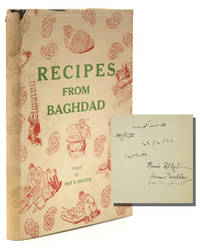
1946313857Baghdad 1946. Six pages in ink on three leaves. 1 vols. 8vo. Letter: small loss from old staple at top of first leaf affecting two letters. Near fine. Book: Black cloth title in green illustration of measuring utensils on pastedowns. Pictorial dust jacket. Binding a bit rubbed spine faded with small loss at head Very good minus. Six pages in ink on three leaves. 1 vols. 8vo. Letter from Baghdad 1946. Fascinating letter from editor May H. Beattie 1908-1997 editor of Recipes from Baghad published for the benefit of the Red Cross and later a widely published author on Persian and oriental carpets. Beattie describes its contemporary reception in cosmopolitan Baghdadi circles noting specific criticisms of contents and illustrations how the barbs affected some of the editors with report of discussions with an editor in the U.K and mention of a possible Arabic edition for local "middle class people". Beattie writes "At the moment rather between ourselves I have a most consuming passion to make a record of Baghdad women - I am finding out all sorts of things about their cosmetics tatooing hair dying & customs in general. I should think it will be almost impossible to extract any information from Baghdad "Society" but I am finding other sources in plenty and a card index is filling rapidly."<br/>Beattie who trained as a microbiologist had come to Baghdad with her husband in 1937; in 1946 they returned to England and so the book on Baghdad women was never completed. Beattie's career as a scholar of carpets began in the 1950s when she saw the shortcomings of earlier research. "Dr. Beattie transferred her scholarly training in one discipline to another" Mackie and assembled facts and "recorded manufacturing methods equipment patterns and functions of carpets."<br/><br/>With: Recipes from Baghdad with an Introduction by Her Majesty the Queen Mother of Iraq. Edited by May H. Beattie B.A. Ph.D. with the assistance of Bedia Afnan Renée Elkab Helen Gaudin and Ann Walter. Caricatures by Suad Salim. Folding table; illustrations in text. 163 2 blank xi pp. 8vo Baghdad: Published by the Indian Red Cross Printed at the Government Press 1946. OCLC: 29816802 7 copies. <br/>Inscribed by the Queen Mother of Iraq on flyleaf in Arabic: ila Miz Gaudin 'Aliya 16/4/46; and signed below by May H. Beattie Renée Elkab Ann Walter and Helen Gaudin.<br/><br/>'Aliya bint 'Ali 1911-1950 Queen Mother of Iraq was granddaughter of King Faisal of the Hejaz and widow of King Ghazi. Her son Faisal II was the last king of Iraq and was killed in the 1958 revolution. For May Beattie see biographical notice by Louise W. Mackie in Oriental Carpet and Textile Studies 3:1 1987 pp. 6-10 unknown books
1948276712Hamburg: Eckardt & Messtorff 1948. II, 290 S. 55 Textbildern und 33 Tafeln, 5 Luftbildaufnahmen und 5 Karten lt. Titelbl. <richtig 1> 4° HLN.
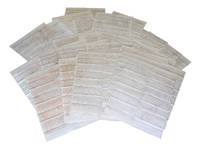
1945191029Baghdad: Iraqi Army Press c.1945. for the benefit of the Arabic language First edition with over 12000 words printed under the auspices of the Lexicon Committee of the Iraqi Ministry of Defence. The first and second world wars were catalysers for the sharp increase in the production of new Arabic glossaries and dictionaries for officers and soldiers stationed in the Middle East. In the early 1940s special attention was paid to technical dictionaries issued by governments and ministries rather than colloquial phrasebooks produced for individuals aiming at translation consistency and standardization. The dictionary was printed "to collect collate and preserve.the words employed by the late Prof. Abdul-Masih Wazir in his numerous translations of English military publications". Wazir was director of the translation department of the Iraqi Ministry of Defence in 1923-43. It also provided "an easy means of reference for the use of the translators of English military writings". The loose-leaf format was designed to facilitate revision. Octavo 160 x 105 mm. Text in Arabic and English. Issued as 21 pamphlets numbered 1-18 and 18A-20 roughly one per alphabet letter. Original brown cloth yellow stamped paper boards bootlace stitching. Extremities a little rubbed small paper loss on lower outer corner of rear cover contents toned but clean: a very good copy. R. Mairs Arabic Dialogues 2025. hardcover
1930276713Berlin: Reimer / Vohsen 1930. VII, 110 S.240 Textbildern und 47 Tafeln. 4° Ln.mS.
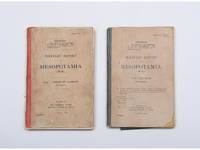
1922173026London: HMSO Press Harrow & Harrison & Sons Ltd 1922 1923 & 1923 1924. Background intelligence on Faisal's Iraq First editions of two regional sitreps issued after the 1920 Iraqi Revolt and Faisal's installation in 1921 prepared for British officials administering the new monarchy. Both are rare - print runs of 1375 likely with fewer distributed - with only five and four institutional copies traced. Each is marked Provisional and Confidential; Area 1 is additionally stamped "secret" in a contemporary hand. The projected 10-volume series was never completed and surviving instalments sometimes titled Military Report on Iraq are scarce. Compiled at short notice on the model of Naval Intelligence Division geographical handbooks the reports provide concise local intelligence: historical and geographical survey then climate resources ethnography tribal structure leading figures communications transport and routes with technical appendices. Area 1 Northern Jazirah covers northern Iraq and adjacent Turkey and Syria stressing weak British influence and the prestige lost through unchecked tribal raiding after 1919. Its core is a detailed tribal analysis supplemented by contemporary intelligence annotations on succession disputes and political loyalties. Area 7 Tigris surveys the settled agricultural belt from Kut to Qurnah and the Shatt al-Arab reflecting greater stability and asserting that firm but protective rule could secure order. Detailed appendices describe estates shaikhs armed retainers and agricultural practice. Together the volumes offer granular evidence of British intelligence gathering during the improvised creation of the Iraqi state in the early 1920s. 2 vols octavo. Area 1 pp. viii 240 with a folding table and numerous tables to the text; Area 7 pp. ii 184 3 folding many to the text. Both in original greyish yellow printed boards cloth backstrips first with reddish orange spine the second greyish green. Both volumes in field service condition and lacking the maps called for spines sunned and chipped some repairs "Mespots" added in white ink boards rubbed and lightly stained hinges occasionally cracked with some repairs and a little play but the internal binding sound; contents toned but generally clean; for such fragile productions both remain surprisingly well preserved very good. hardcover
1920276768Berlin: Reimer / Vohsen 1920. XII, 164 Seiten, mit 44 Abbildungen im Text und 65 Tafeln, davon 4 in Kupfer-, Licht- und Farbendruck. 4° HLdr. *2 Taf gebräunt, unteres Kapital minimal berieben, schönes Expl.* eins von insgeamt 315 Expl.*.
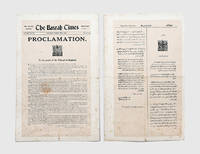
1917178262Basrah: The Basrah Times 1917. Empire and Pan-Arabism Two leaves from the first and only issue of the Basrah Times 20 March 1917 printing Sir Frederick Stanley Maude's appeal to the people of Baghdad province issued nine days after the British capture of the city. The proclamation marks a turning point in the First World War exemplifies imperial rhetoric and foreshadows the tensions between colonial authority and national aspiration that shaped the following decade in Iraq. Although Basrah fell in November 1914 Baghdad was secured only after a further two and a half years of campaigning. Maude drove the advance restoring supply lines and winning successive engagements at Hayy Dahra and Kut before the final assault. The proclamation presents the British not as conquerors but as liberators promising renewal after centuries of foreign rule and invoking the recent success of the Arab Revolt under Sharif Hussein as a model of independence and unity. Yet this balance between nationalist promise and imperial control proved unstable: the post-war Mandate endured only until the revolt of 1920 forced political transition culminating in Faisal's election as king in 1921. Two sheets each approximately 440 x 285 mm laid down on thick card framed and glazed. Text in English and Arabic. Sheets toned and with creases from old folds minor foxing a few short tears one small hole to centre of one sheet affecting one letter: a very good set. unknown
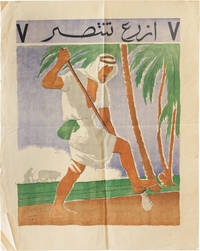
194344248Baghdad: S.i. ca.1943-44. Original illustrated poster offset printed in five colors on beige stock measuring 56.75cm x 72.75cm 22.25" x 28.5". Signed "FAIK H" in plate at lower left corner. Two old folds smoothed out trivial wear to intersection of folds at center with a handful of short marginal tears and attendant creases; unbacked; Very Good. Superb example of this agricultural-themed wartime propaganda poster designed by Iraqi painter Faeq Hassan 1914-1992 widely heralded as "the father of Iraqi modern art." Born poor in Baghdad Hassan showed an early aptitude for art. When he was 12 he visited his uncle a gardener in the royal palace for King Faisal I; when the King saw his drawing of a horse drinking from a river he recognized his talent instantly and offered him a scholarship. Faisal died in 1933 while Hassan was still in high school though his successor King Ghazi carried out his father's will and send him to the École des Beaux-Arts Paris in 1935. After returning from Paris Hassan founded Al-Ruwad The Pioneers Group a group of Iraqi artists who eschewed the traditional studio atmosphere; while engaging with nature and choosing the chronicle the daily realities of Iraqi life through their art the group played a critical role in bridging the gap between heritage and modernity. <br/><br/>Little scholarship exists regarding Hassan's activities or artistic output during World War II though the present example suggests he put his talents to some use creating home front propaganda after the Anglo-Iraqi War. The poster depicts a male laborer in traditional garb digging in a field with a bag of seeds tied at his waist beneath the slogan "If You Plant You Will Win" flanked by twin V's. Despite the traditional Iraqi setting the message is similar in tone to the American propaganda campaign encouraging the populace to plant victory gardens to help the war effort. A notably early work by Hassan and a rare survival with no examples found in the auction record and none found in the holdings of any OCLC member institution. cf."Profile: Faik Hassan." Al Jazeera 30 October 2005. S.i. unknown books
1942L7VCIV4N38L2UK Government: Survey Directorate HQ Tenth Army / Indian Field Survey Co. 1942. 42 chromolithographed topographic maps of parts of Iraq made from aerial photographs during World War II on a scale of 1:100000 and 1:253440 a quarter-inch to a mile. 68 x 50.5 cm & 60 x 47 cm. An impressive collection of Iraq maps compiled from the most current aerial photography and produced by the British Army for use in the Persian theatre of war during World War II. The cities and regions covered include Ain Sifni Aqra Tel Afar Salman Pak BaQuba Sumaika Penjwin Halabja Baghdad Kirkuk Dulaim Erbil and Mosul divisions.Previously folded. Generally well-preserved. Survey Directorate HQ Tenth Army / Indian Field Survey Co., unknown
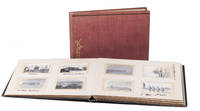
1917ABC_48426Iran and Iraq 1917. Contemporary cloth one album in in red and one in grey with 'Kodak' lettered in gold on the front board and a black classical meander border tooled near the foot. The albums are kept together by a black ribbon. Oblong 8vo ca. 15.5 x 20 cm. With 191 resp. 95 and 96 gelatin silver prints all ca. 4 x 6 cm. 2 volumes. Remarkable set of Kodak photo albums with nearly 200 photographs of military life and the oil industry in Iran and Iraq in the early 20th century. The photographs were most likely taken by the compiler of the albums and show scenes from his daily life. Most of them are captioned. Included are images of Persian oil fields Abu Zenema Sinai coast Port Sudan Bushehr Basra various locations along the Tigris Euphrate and Shatt al-Arab rivers Ashwaz and Shush. The photographs also show locals involved in various activities including races shark hunting and selling wares. The compiler of the album was likely a British soldier who was stationed in Basra and other locations in Iran and Iraq after the First World War.The edges and corners of both albums are slightly scuffed with a few light stains on the back board of the red album. The paper on which the photographs are mounted is slightly browned ten of the photos have either creased corners or a damaged surface some photographs a little loose within their windows missing a photo on the final page of the red album. Otherwise in good condition. hardcover
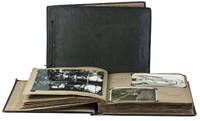
1928I3OEKR47KBBKIraq plus Malta and Egypt 1928. The photos mounted with paper corner-mounts in two contemporary cloth-covered albums the larger with padded boards covered in alligator-skin patterned dark green cloth with the photographs on both sides of 24 dark grey album leaves each leaf with a glassine paper guard-leaf embossed with a spider-web pattern bound in before it; the smaller covered in black cloth with a grey-white bird in a cloud painted on the front board and the word snaps with the photographs on both sides of leaves 2-35 & 51-52 of 54 light brown album leaves. Oblong albums 25 x 34.5 cm & 21.5 x 28.5 cm. Two albums containing about 275 silver halide photographic gelatin prints 6 x 8.5 cm to 16 x 21.5 cm assembled and mostly taken by a British Royal Air Force pilot while stationed in Iraq and then briefly Malta with a visit to Egypt. A collection of about 275 photographs made by an RAF pilot Sergeant William Reynish during his service in Iraq ca. 1928-1933 and Malta 1933 and during a brief visit to Egypt. Most have captions written on the album leaves clearly identifying the scenes. Some photos show scenes of daily life in Iraq Bagdad Hinaidi Mosul and other cities as well as the surrounding countryside with local people shops buildings landscapes ruins monuments etc. Others show the British troops and their activities vehicles airplanes including crashed ones etc. The portraits include an unidentified sheik with a falcon and an Arabic man smoking a hookha water pipe. The Kurdish Sheik Mahmud Barzanji of Sulaimaniyah rebelled against the Iraqi army around June 1930 but the RAF bombed his people's villages from September 1930 to April 1931 when he finally surrendered to Major W.C.F.A. Wilson administrative inspector at Mosul. Several photographs cover the sheik and his surrender.The surviving corner mounts show that three photographs have been removed from the album. A few photographs are slightly blurry or faded but most are very sharp and in very good condition. The inside front hinge of one album has broken but the albums are otherwise in good condition. A wealth of informative images from pre-War Iraq most clearly identified in the captions. hardcover