143 résultats
1987LFA-126728085Un ouvrage de 315 pages, format 140 x 220 mm, illustré de cartes, publié en 1987, Editions Anthropos, bon état
78 pages. Articles: Traffic Traps for Tourists - unjust arrests in many parts of the U.S.; Red Clouds over Olympus - Life in Greek village of Magoula is miserable under the Communists; The Secret Papers of Harry L. Hopkins (part 13) - from Cairo to Teheran - the first meeting with Stalin;.Sunday Dinner - lady in the kitchen; Pot Shots by One Shot Ross - Boxing Manager Wirt Ross; "There Goes Rusty" - one of the world's fastest greyhounds. Fiction: Plenty of Time for Love; The Inspector had a Wife; The Fugitive; The Logger and the Lady; River Crossing; An Affair of State (part 3 of 4). Ads include: Studebaker cars; Vitalis (with Bob Feller); Philco radio-phonographs; Firestone "Super-Balloon" tires; Gillette Blue Blades (2-pages in color); Kaiser-Frazer cars (centerfold); Pllymouth; "Good Sam" movie with Gary Cooper; Schlitz beer; GM Electro-motive division; Coke - shows Coke machine at gas station; Texaco - shows young lady water skiing; Rice-Stix; U.S. Army; Lucky Strike cigarettes (back cover). Unmarked with moderate wear and minor bits of moisture exposure to top and bottom edges. A sound vintage copy. Book
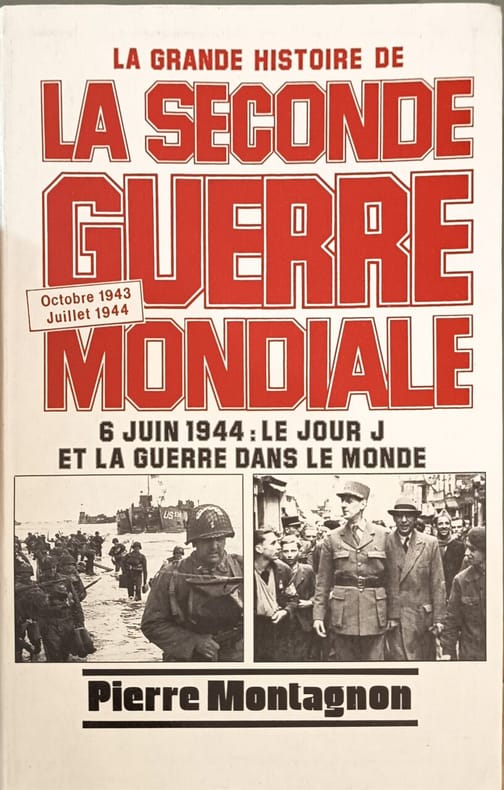
19949674Le grand du mois 1994 319 pages in8. 1994. broché. 319 pages. Ce livre est le sixième tome de la série 'La Grande Histoire de la Seconde Guerre mondiale' de Pierre Montagnon. Il couvre la période cruciale d'octobre 1943 à juillet 1944 en se concentrant sur des événements majeurs comme l'opération Overlord décidée à la conférence de Téhéran le débarquement du 6 juin 1944 en Normandie (le Jour J) l'attentat contre Hitler et la percée décisive d'Avranches. L'ouvrage propose une vision globale et approfondie de ce volet décisif du conflit
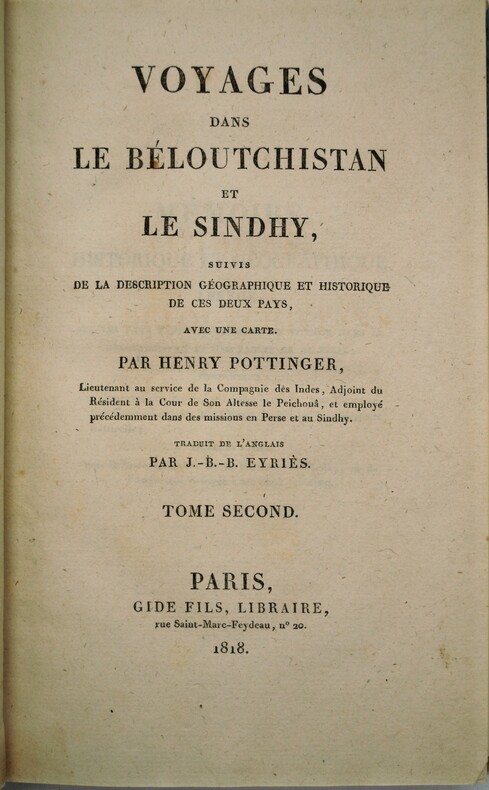
1818PHO-1148Paris, Gide fils, 1818. 2 vol. in-8, demi-veau vert glacé, dos estampé à froid de motifs (lyre, bateau) - Coiffes usagées- VIII, VI, 465, 352 pp. carte dépliante in fine
2601918 May 1917; on letterhead of the Russian Consulate San Francisco California United States. 2pp 4to. 41 lines including postscript in green ink. On aged and brittle air mail paper with chipping and discoloration at the head resulting in some loss to printed letterhead but with text clear and entire. Addressed to ‘Mon cher ami’ and with valediction from ‘Ton très dévoué ami’. The recipient is unidentified but would appear to have been a former colleague at the Russian legation in Tehran Persia. Signed ‘Geo. S. Romanovsky’. He begins by thanking him for his congratulations. The recipient is right: ‘les choses ont changé’. Life has become less complicated: ‘l’âme ne cherche plus de choses extraordinaires la ‘might sic for ‘night’ life’ fatigue. C’est le commencement de la vieillesse nom de Dieu!’ Reference to ‘les Himenes triomphant sic’. Later an intriguing reference: ‘Il y a quelques jours je pensais à une nuit que nous avons passée sic ensemble avec le hashish deux types de dervish et cette canaille autrichienne de Consul rappele toi de lui il est mort à Tauris. Je me rappelais comme c’était drôle toute cette nuit chaude ce “beng†ces poètes cités ses cigarettes fumées . Et le fantôme de l’Orient m’etait venu dans la chambre du “University Club†et les mûrs hyppocrytes sic ont rougi. Je rêve de l’orient encore mais je doute qu’il y aie des possibilités d’y retourner. Il ne faux jamais oublir le proverbe latin “non bis in idem.†’ He continues with a comment on the heart and emotions concluding ‘Les meilleurs roses sont celles que le jardinier a pantées sur du fumier!’ He ends with a conversation urging a ‘longue Conversation’ with the recipient. It will be a pleasure in ‘la tourbillon de la vie nous nous trouverons réuni’. A book will have to be written ‘ainsi que nous partîmes à Tehran’. Postscript signed ‘Geo.’ suggests that he and the recipient should write often. 18 May 1917; on letterhead of the Russian Consulate, San Francisco, California [United States]. unknown
1991LFA-126734736Un ouvrage de 203 pages, format 140 x 210 mm, illustré, relié cartonnage sous jaquette couleurs, publié en 1991, bon état
1991LFA-126745052Un ouvrage de 252 pages, format 150 x 235 mm, illustré, broché couverture couleurs rempliée, publié en 1991, Edition°1 / Editions Michel Lafon, bon état
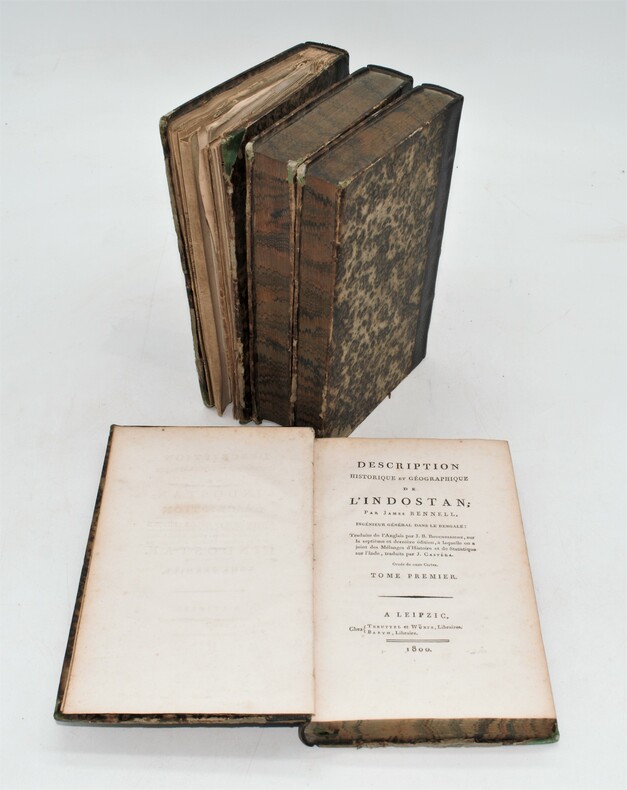
1800P2-8BLeipzic, Treuttel & Wurtz ,1800. 4 volumes in-8 , relié demi basane , dos à nerfs avec auteur , titre et tomaison , tranches et gardes peignées , coupes et coins usés , petites rousseurs . Complet en 3 volumes de texte et 1 volume d’Atlas , de XXXVIII pp., 302 pp. - 2 ff., 410 pp. - 2 ff., 362 pp. - Atlas, 39 pp., 11 cartes dépliantes. Première édition française, traduite par Jean-Baptiste Boucheseiche sur la septième édition anglaise. Elle est illustrée de 11 cartes repliées réunies dans un atlas séparé
1800PHO-1521Paris, imprimerie de Poignée,1800. 3 volumes in-8 (4), relié pleine basane, dos lisse orné avec pièce de titre rouge et tomaison verte titre et tomaison, une coiffe accidentée, petites rousseurs XXXVIII pp., 302 pp. - 2 ff., 410 pp. - 2 ff., 362 pp..
185099923551revue des deux mondes Paris Au Bureau de la Revue des Deux Mondes 1850, In-8 broché, 192 pages. Bon état.
Paris Au Bureau de la Revue des Deux Mondes 1850, In-8 broché, 192 pages. Bon état. LA COUR DE TEHERAN EN 1845 OU NE REVEILLEZ PAS LE CHAT QUI DORT, PROVERBE, par Haçan MEHEMET-KHAN - GUILLAUME III ET LE ROI LOUIS PHILIPPE. 1688 - 1830 par L. LAVERGNE - LES RECITS DE LA MUSE POPULAIRE. LES HUITTIERS ET LES CABANIERS DU MARAIS par Emile SOUVESTRE - PEINTRES ET SCULPTEURS MODERNES DE LA FRANCE. JEAN GOUJON par Gustave PLANCHE - ETUDES SUR LES QUESTIONS POLITIQUES ET SOCIALES. DES MOYENS DE DIMINUER LA MISERE par Michel CHEVALIER - CUBA ET LA PROPAGANDE ANNEXIONISTE - DE LA LEGISLATION MUSULMANE EN ALGERIE Etc...
New Persian Original bdg. HC. Folio. (34 x 24 cm). In Persian with abstracts in English. 392 p., color and b/w ills. Tehran became a major city of Iran after 1554 A.D. during the Safavid period when Shah Tahmasb I, son of Shah Ismail, ordered the implementation of two large-scale public works. The first project was the construction of ramparts and moats surrounding the entire city, which defined the city's perimeters and increased its defense. The rampart consisted of 114 towers, representing the 114 chapters within the Holy Quran and enclosed an area of 4.35 km2. The second project was the establishment of the bazaar, the heart of the industrial and commercial activities of the city, surrounded by numerous holy shrines. However, it was 240 years later in the Spring of 1796 A.D. that Tehran became the national capital of Iran, during Agha Mohammad Khan Qajar's reign. 2016 A.D. actually marks the 220th year since Tehran became the political centre of Iran. The first known map of Tehran (page 18), a Russian spy map, dates back to 1826 A.D. The next Russian map of Tehran (page 24) from 1852 A.D. was translated into Persian and presented as a gift to Naser al-Din Shah Qajar (page 29). After the establishment of the military polytechnic school in 1851 A.D. and the arrival of Europe an military instructors, the importance of accurate topographical maps was recognized by the nation's leaders. The Austrian artillery trainer for cannons, August Karl Krziz, coordinated in 1858 A.D. the preparation of the maps of Tehran (page 39) and its surrounding area (page 35). This was the beginning of scientific cartography in Iran. By 1863 A.D., maps of Tehran Province for the purpose of tax collection (page 58) were being produced by engineer Abdul Rasool Khan. Tehran dramatically expanded after a huge flood in 1867 A.D. destroyed a large portion of the Safavid period ramparts and moats, after which Alexander Bohler, a French military instructor, designed a new and enlarged rampart and moat enclosure. Within four years between 1867 A.D. and 1871 A.D., Tehran grew from 4 .35 km2 to 19.75 km2 with these new constructions. By 1891 A.D., a highly detailed and technical map of Tehran (page 64) had been produced by Abdul Ghafar Najmolmoq. During the reigning years of Mozafar al-Din Shah, Mohammad Ali Shah, and Ahmad Shah, maps for Tehran postal services (page 126) and Tehran provincial delineation (page 127) were produced. During these years, the Russian, British and French prepared several geopolitical maps of the region including Tehran. For example, the map on page 323 reproduces a map prepared in 1892 A.D. by the British Survey of India at the scale of 1:506,880. In 1914 A.D., German publisher Wagner & Debes prepared a touristic map of Tehran (page 134). In 1922 A.D. the Ministry of Culture's Investigation Section prepared a map of schools in Tehran (page 138). During the Pahlavi I period (1925~1941 A.D.), modernization of Tehran became a national priority. By 1930 A.D. a map for street enlargement in Tehran (page 158) had been published. In 1932 A.D., the demolition of the Naser al-Din Shah Qajar period ramparts began simultaneous to further expansion of urbanized Tehran. The 1936 A.D. military map of Tehran (page 169) is testimony to the changes in the urban morphology of this period. The creation of a dedicated military cartographic service in 1935 A.D. marked an important milestone in the history of cartography in Iran. The 1937 A.D. urban development plan of Tehran (page 170) clearly shows the new streets, squares and urban development envisioned. The first known aerial photograph of Tehran dating from 1940 A.D. (page 177) displays the realization of this urban development plan. After the invasions by the Russians, British and Americans in 1941 A.D., cartographic activities in Iran suddenly increased. Sergeant Mohammad Reza Ghaffari privately published maps of Tehran [.] The above mentioned maps are a few representative samples of the over 270 maps
50 pages. Features: Full-page ad for 'Network'; Photo-illustrated interview with Producer-Director Martin Ritt; 'The Seven Percent Solution' - photos; Article on the decline (and fall?) of the Roman (film) Empire; 'Desert of the Tartars' - photos; 'Ashes and Diamonds' - photo-illustrated article on this cult film; 'The Last Tycoon' - photos; Photos of Elia Kazan directing 'The Last Tycoon'; Tehran 1976 (article); 'Rocky' - photos; Reviews - 'The Last Tycoon', 'Victory at Entebbe', 'Next Stop, Greenwich Village', 'Norman... Is That You?', 'The Enforcer', 'The Shootist', 'A Nous Les Petites Anglaises', 'Two-Minute Warning'; 'The Sentinel' - photos; and more. Average wear. Unmarked. A sound vintage copy. Magazine
ria9780323917742_inpPaperback / softback. New. New Book; Fast Shipping from UK; Not signed; Not First Edition; N/A paperback
199321340ABFrankfurt am Main, Fischer-Taschenbuch-Verl., 1993. 18 cm. 172 S. Taschenbuch (Softcover). Dt. Erstausg. Neuwertiges Exemplar. [Fischer-Taschenbücher] ; 11295.
27849Milaan/Wenen, Skira/Kunsthistorisches Museum Wien, 2000 softcover originele kartonnen uitgeversomslag geillustreerd in kleur, 28x24.5 cm., 341 pp., geillustreerd in kleur en z/w. ISBN 9789057790287.
1986LIT21007Weinheim. Beltz & Gelberg. 1986. 249 S. Kartoniert. Nachwort. Glossar. Zeittafel zur Nationalisierung des iranischen Öls von 1950 - 1953. Buchrücken leicht berieben. Kanten leicht bestoßen. Exemplar ohne Stempel oder Anstreichungen. Gut erhalten.
185317061853 Ed. V. Lecou, Paris, 1853. In-12, demi-chagrin, au chiffre de Meissonnier. 382 pages
14529Magic Lantern Iran Collection of 3 Vintage Optical Lantern images of Iran circa 1905. 3 1/4" X 4." The images include the Qajar king palace royal gardens in Tehran and the Khaju Bridge in Isfahan. In the first image we see a Persian man in traditional 19th century clothing strolling in the Qajar royal Palace and gardens. The second image is a very rare aerial view of 19th century Tehran labeled "the Shah's gardens and the new neighborhoods." Since this image predates airplanes it is an extremely rare find probably using an aerial balloon. In the final image we see the Khaju Bridge which is one of the most famous bridges in Isfahan Iran. It was built by the Persian Safavid king Shah Abbas II around 1650 C.E. on the foundations of an older bridge. It has 23 arches and is 105 meters long and 14 meters wide. The bridge served as both a bridge and a dam and public meeting place as it links the Khaju quarter on the north bank with the Zoroastrian quarter across the Zayandeh River. <br/><br/>These are positives on a glass lantern Gelatine silver bromure. In 1850 two Daguerreotypists in Philadelphia William and Frederick Langenheim invented a transparent positive image of a photograph in the form of a glass slide that could be projected onto a wall or screen using a Magic Lantern. Magic lanterns also known as optical lanterns provided one of the most popular forms of entertainment during their heyday in the 18th and 19th centuries. Using an artificial light source and a combination of lenses these devices enlarged small transparency images or miniature models and projected them onto a wall or screen. dimensions : The photographer of the first two images Arthur Radiguet died the same year the images were made1905 he worked for the " la Maison Molteni" famous for their lantern images. The third image was produced by T.H. McAllister a very important and famous company based in New York which specialized in magic lantern equipment and images. Scarce and in very good condition. unknown books
14426Vintage Photograph of Teheran from 1905- Optical lantern image of the Qajar king Palace gardens in Tehran. This seems to be a aerial view of the garden with the city in background. Titled "VUE PRISE DU PALAIS DU SHAH-LES NOUVEAUX QUARTIERS DE TEHERAN" Photographer is "Projections Molteni Radiguet & Massiot 15 bd des filles du calvaire-Paris" This is a positive on a glass lantern Gelatine silver bromure. Magic lanterns also known as optical lanterns provided one of the most popular forms of entertainment during their heyday in the 18th and 19th centuries. In 1850 two Daguerreotypists in Philadelphia William and Frederick Langenheim invented a transparent positive image of a photograph in the form of a glass slide that could be projected onto a wall or screen using a Magic Lantern. Using an artificial light source and a combination of lenses these devices enlarged small transparency images or miniature models and projected them onto a wall or screen. dimensions : 85 cm x 10 cm. The photographer Arthur Radiguet died the year of this image in 1905 worked for the " la Maison Molteni" famous for their lantern images. Very rare to find such a aerial view of 1905 iran. In very good condition. unknown books
catalogo della mostra (6 dicembre 1999 - 10 gennaio 2000), pagine a colori, 22,5x22 cm, ottimo stato
A9781848725256Paperback / softback. New. paperback
A9781138146198Hardback. New. hardcover
B203101-2Tihran 1977. 136pp. Lrg. 4to. Wraps. Parallel texts in Persian and English. Tihran, [1977?]. paperback
B90683-3Tihran 1977. 36pp. Prof. illus. 4to. Wraps. Parallel texts in English and Farsi. Tihran, 1977. paperback