15 résultats
156819511Lyon Rovillé 1568 -in-folio Une gravure de l'Edition Originale au burin sur papier vergé, Format à la cuvette : 27 centimètres de haut par 17,5 centimètres de large. Format total : 35 centimètres de haut par 24 centimètres de large, colorée d'époque à la main (couleurs trés fraîches) gravées par L. Danet,deux petits trous et un trés léger manque en bas à droite de la gravure, 1568 Lyon : G. Rovillé Editeur,
156819512Lyon Roville 1568 -in-folio Une gravure de l'Edition Originale au burin sur papier vergé, Format à la cuvette : 27 centimètres de haut par 17,5 centimètres de large. Format total : 35 centimètres de haut par 24 centimètres de large, colorée d'époque à la main (couleurs trés fraîches) gravées par L. Danet, taches brunes à nettoyer) 1568 Lyon : G. Roville Editeur,
156819509Lyon Rovillé 1568 -in-folio Une gravure de l'Edition Originale au burin sur papier vergé, Format à la cuvette : 27 centimètres de haut par 17,5 centimètres de large. Format total : 35 centimètres de haut par 24 centimètres de large, colorée d'époque à la main (couleurs trés fraîches) gravées par L. Danet, 1568 Lyon : G. Rovillé Editeur,
156819505Lyon Roville 1568 -in-folio Une gravure de l'Edition Originale au burin sur papier vergé, Format à la cuvette : 27 centimètres de haut par 17,5 centimètres de large. Format total : 35 centimètres de haut par 24 centimètres de large, colorée d'époque à la main (couleurs trés fraîches) gravées par L. Danet, déchirure ancienne restaurée d'époque, 1568 Lyon : G. Roville Editeur,
156819510Lyon Rovillé 1568 -in-folio Une gravure de l'Edition Originale au burin sur papier vergé , Format à la cuvette : 27 centimètres de haut par 17,5 centimètres de large. Format total : 35 centimètres de haut par 24 centimètres de large, colorée d'époque à la main (couleurs trés fraîches) gravées par L. Danet, 1568 Lyon : G. Rovillé Editeur,
15688993Lyon Rouillé 1568 -in-folio Une gravure de l'Edition Originale au burin sur papier vergé, Format à la cuvette : 27 centimètres de haut par 17,5 centimètres de large. Format total : 35 centimètres de haut par 24 centimètres de large, colorée d'époque à la main (couleurs trés fraîches) gravées par L. Danet, 1568 Lyon : G. Rovillé Editeur,
156827235Lyon Rouillé 1568 Une gravure de l'Edition Originale au burin sur papier vergé, Format à la cuvette : 27 centimètres de haut par 17,5 centimètres de large. Format total : 35 centimètres de haut par 24 centimètres de large, colorée d'époque à la main (couleurs trés fraîches) gravées par L. Danet, 1568 Lyon : G. Rovillé Editeur,
156827236Lyon Rouillé 1568 Une gravure de l'Edition Originale au burin sur papier vergé, Format à la cuvette : 27 centimètres de haut par 17,5 centimètres de large. Format total : 35 centimètres de haut par 24 centimètres de large, colorée d'époque à la main (couleurs trés fraîches) gravées par L. Danet, 1568 Lyon : G. Rovillé Editeur,
15688995lyon rouillé 1568 Une gravure de l'Edition Originale au burin sur papier vergé, Format à la cuvette : 27 centimètres de haut par 17,5 centimètres de large. Format total : 35 centimètres de haut par 24 centimètres de large, colorée d'époque à la main (couleurs trés fraîches) gravées par L. Danet, 1568 Lyon : G. Rovillé Editeur,
156819507Lyon Rovillé 1568 -in-folio Une gravure de l'Edition Originale au burin sur papier vergé, Format à la cuvette : 27 centimètres de haut par 17,5 centimètres de large. Format total : 35 centimètres de haut par 24 centimètres de large, colorée d'époque à la main (couleurs trés fraîches) gravées par L. Danet, 1568 Lyon : G. Rovillé Editeur,
1588PHO-2120Paris, Hierosme de Marnes & la Veuve Guillaume Cavellat, 1588. Petit in-4 (21,6 × 15,5 cm), [12] ff., 468 pp., [1] f. (achevé d’imprimer, marque de l’imprimeur au verso). Basane fauve mouchetée du XVIIe siècle, dos à cinq nerfs orné, titre doré, tranches mouchetées, reliure un peu usée, frottements et épidermures, petit manque au dos, charnière fendillée, très légères rousseurs, infimes trous de vers marginaux.
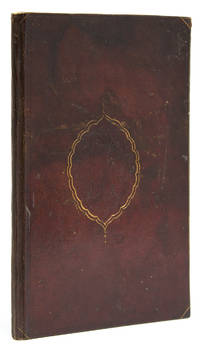
1570311740Istanbul 1570. Text in Ottoman Turkish and Persian mostly in double columns. Ornamental headpiece. Nastaliq in black and red on colored leaves ruled in black and in gold. 39 ff. Dated on last leaf. 1 vols. Large 8vo. Red leather with gilt mandorlas with floral motif tooled in blind. Collectors' stamps on first and last leaves: Hilmi Hassan Tahsin 1306 1888; 'Uthman bin Hassan Tahsin and two others. Some staining. Text in Ottoman Turkish and Persian mostly in double columns. Ornamental headpiece. Nastaliq in black and red on colored leaves ruled in black and in gold. 39 ff. Dated on last leaf. 1 vols. Large 8vo. unknown
1570311740Istanbul 1570. Text in Ottoman Turkish and Persian mostly in double columns. Ornamental headpiece. Nastaliq in black and red on colored leaves ruled in black and in gold. 39 ff. Dated on last leaf. 1 vols. Large 8vo. Red leather with gilt mandorlas with floral motif tooled in blind. Collectors' stamps on first and last leaves: Hilmi Hassan Tahsin 1306 1888; 'Uthman bin Hassan Tahsin and two others. Some staining. Text in Ottoman Turkish and Persian mostly in double columns. Ornamental headpiece. Nastaliq in black and red on colored leaves ruled in black and in gold. 39 ff. Dated on last leaf. 1 vols. Large 8vo. unknown books
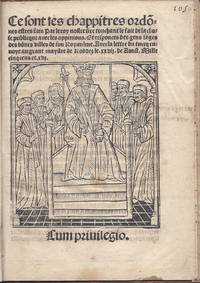
15161704S.l.: s.n. 1516. First edition. Title page with large woodcut illustration showing the King on his throne surrounded by the delegates. In Bastarda type with two floral woodcut initials. In later hard paper. Gilt title vignette on spine damaged. Concise marginal notes and page-numbers in ink by a contemporary hand throughout. Trimming of the leaves slightly affects the glosses with no effect to legibility otherwise the margins are wide. Title page crinkled at the upper right corner with a small tear that only affects the margin. Narrow inkblot to the lower margin throughout. B4 with two light brown stains C1 crinkled at lower corner. Bookplates on the inner front panel G. J. Arvanitidi; Antoine Mouradian. Overall in very good condition. First edition. Title page with large woodcut illustration showing the King on his throne surrounded by the delegates. In Bastarda type with two floral woodcut initials. In later hard paper. Gilt title vignette on spine damaged. 20 p. <p><br /> A bibliographically unrecorded early sixteenth-century French book about royal ordinances regarding the commonwealth along with the French translation of Sultan Selim I's letter of conquest fethname addressed to the Grand Master of Rhodes. <br /> <p><p><br /> The first and major part of the book presents nine concepts of orders of Francis I 1494-1547 King of France from 1515 until his death regarding the commonwealth chose publique. The drafts concern such topics as the commerce of spices and drugs wool cloth and other goods chapter 1-4 the weights and equivalents of coins and the recognized foreign currencies chapter 5 the recognized units of measures chapter 6 the regulation of the extravagance of clothing chapter 7 the inn trade chapter 8 and the money that goes to Rome for obtaining Bulls chapter 9. <br /> <p><p><br /> The second section comprises the responses to the aforementioned concepts of the representatives of the Good Cities Bonnes Villes Provence and Dauphiné who had been previously assembled in Paris by the order of the King in March 1516. In most cases they requested a delay of reply to discuss the matters with those who they were representing.<br /> <p><p><br /> The third section presents the grievances and requests delivered to the King by the delegates regarding the provincial councils conciles provinciaux the prolixity of the trials the tariffs the public officers the superior courts cours souveraines the land taxes tailles and the abuse and plunder by the soldiers crossing the kingdom. <br /> <p><p><br /> These sections were recorded and written down by the court clerk Jean Hesselin Seigneur of Girodon. Hesselin mentions himself twice p. 14 and 17 once by name p. 14 within the text.<br /> <p><p><br /> The final part is the French translation of the Ottoman Sultan Selim I's fethname letter of conquest sent on 27 August 1516 from Aleppo to Fabrizio del Carretto 1455-1521 Grand Master Magnus Magister of the Knights Hospitaller in Rhodes between 1513 and 1521. The fethname accordingly to its genre details Selim's expedition and the conquest and emphasizes the power and grandeur of the Sultan and his army. <br /> <p><p><br /> Selim I 1470-1520 ascended the throne as the Sultan of the Ottoman Empire in 1512. He is remembered for the enormous expansion of the Empire during his reign thus raise the Ottomans to the leaders of the Muslim world. Selim's most notable deed was the conquer of the Mamluk Sultanate which included Levant Hejaz and Egypt in 1516 and 1517 at the Battles of Marj Dabiq and Ridaniya.<br /> <p><p><br /> The Battle of Marj Dabiq near Aleppo took place on August 24 1516 where Selim defeated the Mamluk Sultan Al-Ashraf Qansuh al-Ghuri. This was a decisive victory of the war between the Ottoman Empire and the Mamluk Sultanate which ended in the conquest of much of the Middle East. Such an expansion of the Ottoman territory was a clear threat to Rhodes which was the nearest Christian possession to the coast of Asia halfway between Constantinople and Egypt. At the time the Grand Master in Rhodes was the Italian admiral Fabrizio del Carretto 1455-1521; Grand Master from 1513 to 1521 for a short interlude of a course of fifty-five years of Frenchmen serving as the supreme heads of the Order. Selim announced his victory and forecasted his threat to del Carretto in a fethname presented here in French translation however eventually he did not have the time to conduct the campaign against Rhodes. It was his successor Suleiman I who conquered the island in 1522 thus gained control over the eastern Mediterranean for the next centuries. By the time of the siege the commander of the Order was again a Frenchman Grand Master Philippe Villiers de L'Isle-Adam 1464-1534. Suleiman allowed him and the surviving knights to leave unmolested and eventually the Hospitallers were quartered permanently on Malta in 1530.<br /> <p><p><br /> To the best of our knowledge the original fethname has not survived and we could not trance any other printed version or edition of the French translation. We could find one surviving copy of a Spanish translation of Selim's letter which was addressed to Pope Leo X titled Carta de nuevas grandes buenas y ciertas embiada a nuestro s. padre Leon X de las cosas que han passado en Levante entre el gran turcho y el gran solda Valencia Juan Viñao 1517; Norton 1256 IB 11215 USTC 344377 kept at Cambridge University Library F151.d.8.12.<br /> <p><p><br /> Provenance: Bookplate of Georgios Arvanitidis 1876-1953 a noted Constantinopolitan collector of books on Turkish and Greek history. Bookplate with the motto "On abuse du vrai" of Antoine Mouradian.<br /> <p><p><br /> Ref.: Bibliographically unrecorded.<br /> <p><p><br /> Bibl.: Setton K. M. Hazard H. W. ed.: A History of the Crusades. Vol. 3. Wisconsin: The University of Wisconsin Press 1975. pp. 332-335. Pedani-Fabris M. P.: Ottoman Fetihnames. The Imperial letters announcing a Victory. In: Tarih İncelemeleri Dergisi 13 1998. 181-192. <br /> <p>. [s.n.] unknown
157128345Nuremberg 1571. Engraving printed on two sheets of laid paper joined. Engraver's monogram at the lower left. Early manuscript caption in English in the lower margin. Plate mark: 11 x 16 inches. Sheet size: 14 5/8 x 18 3/8 inches. Tear extending from the right margin closed with small void in excellent facsimile small worm hole within the image. Very rare German news-sheet map depicting the Turkish fleet invasion of Cyprus in 1570.<br/> <br/>Exceptionally scarce engraved German broadside map depicting the Ottoman fleet sailing to Venetian-controlled Cyprus in 1570. The early English manuscript caption in ink just below image reads: "The representation of the Turkish Navall Army in ye year 1570 going forth to meet the Venetian fleet." Cyprus then under Venetian rule was a strategic point for controlling shipping and trade in the Eastern Mediterranean. The Ottomans ruled by Sultan Selim II had long desired the island. Following a series of warnings and demands the Ottoman fleet commanded by Müezzinzade Ali Pasha and Lala Mustafa Pasha sailed for Cyprus in late June 1570. Depicted here the Turkish fleet was composed of an estimated 350-400 ships and upwards of 100000 men. Following sieges and massacres at Nicosia Kyrenia and Famagusta the island was taken by August 1571. Although the invasion was long-heralded the Venetian fleet failed to prevent the invasion or the subsequent fall of Cyprus to the Turks. However they subsequently raised the support of the "Holy League" of the Catholic maritime states in the Mediterranean and defeated the Ottoman fleet at the Battle of Lepanto in October 1571 off the western coast of Greece. The victory of the Holy League prevented the Ottoman Empire expanding further along the European side of the Mediterranean though did not end their possession of Cyprus. Jenichen who signed the map with his monogram 'BI' was the leading German publisher of news-sheet maps. Jenichen and compatriot Matthias Zündt took particular interest in the conflict and produced views and maps of it that equaled and surpassed those of their Italian counterparts. Given their ephemeral nature all are rare and desirable. We can locate only one other example of this engraving appearing at auction in recent times Sotheby's London 29 April 2014 lot 157 £60000.<br/> <br/>Hollstein XL B 128; G.K. Nagler Die Monogrammisten v. 1 p. 818-819; Andresen II Nr. 276; Drugulin II 364; s.a. Meurer Jenichen S. 50. unknown books