[TURQUIE].Livre Rare Book
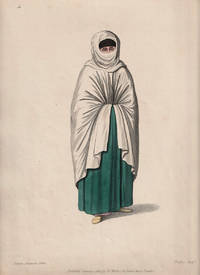
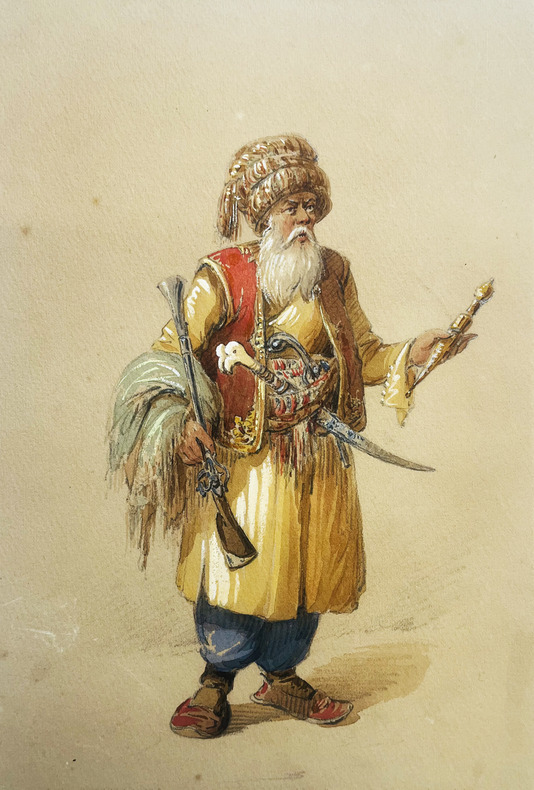
[Costume ottoman].
1860LBW-8737S.l., [vers 1860]. Aquarelle originale avec rehaut de gouache et de blanc (24 x 16 cm) sur papier, contrecollée sur carton.
Librairie Le Bail · Paris, France300,00 €
273 résultats
1839055027Kostantiniyye Constantinople - Istanbul: Takvîm-i Vekâyi. AH 1255 1839. Soft cover. Very Good. Original newspaper taken from a volume. Folio. 425 x 28 cm. In Ottoman script Old Turkish with Arabic letters. 5 p. Extremely rare early issue of this first official newspaper of the Ottoman Empire after the proclamation of Reform Tanzîmât in 1839 informed Daguerre's new and weird invention "photography" as it would be called in the 1850s to the Ottoman peoples and readers. The article reads: "It is the talk of the town steam engines have been able to run on rails in factories in recent years. Meanwhile a man carefully focused on his thoughts so much and the craft turned into a strange art and finally a coquettish mirror surface appeared. This skillful Frenchman named Daguerre drew the lines of objects by reflecting the sunlight with the methods of the different science of art he learned drew the contours of the objects and gave 20 years secretly and openly to the formation of this strange art. Finally he reached the goal and this event won the appreciation and admiration of everyone. This is to say the image of the object in the form of a large or small box free from light is pictured inside by passing through the glass in front of it. In order for the reflected picture to be captured on a surface some chemicals must be prepared. Daguerre has achieved this mix based on his experience. This substance applied on the plate is called iodine. After the plate is kept in the vapor of the iodine for a few minutes it is immediately placed in the dark box and the image passing through the window of the box is pictured for five minutes. Considering that some of the things that should be hidden are captured like this it will be understood what a valuable invention this is.". In the continuation of the article it is written that an Englishman named Talbot Henry Fox Talbot found the same thing with almost the same processes ! but Daguerre had taken pictures before. Takvim-i Vekâyi was the first fully Turkish-language newspaper. It was launched in 1831 by Sultan Mahmud II taking over from the Moniteur ottoman as the Official Gazette of the Ottoman Empire. With the beginning of the Tanzimat reform period Takvim-i Vekayi produced versions in multiple language editions. It ceased publication in 1878 resuming in 1891-2 before being closed again. It resumed in 1908 until around 1922. In the 1831-1878 period it published a total of 2119 issues - an average of slightly less than one a week. <br/> <br/> Takvîm-i Vekâyi., [AH 1255] paperback
1860LBW-8737S.l., [vers 1860]. Aquarelle originale avec rehaut de gouache et de blanc (24 x 16 cm) sur papier, contrecollée sur carton.
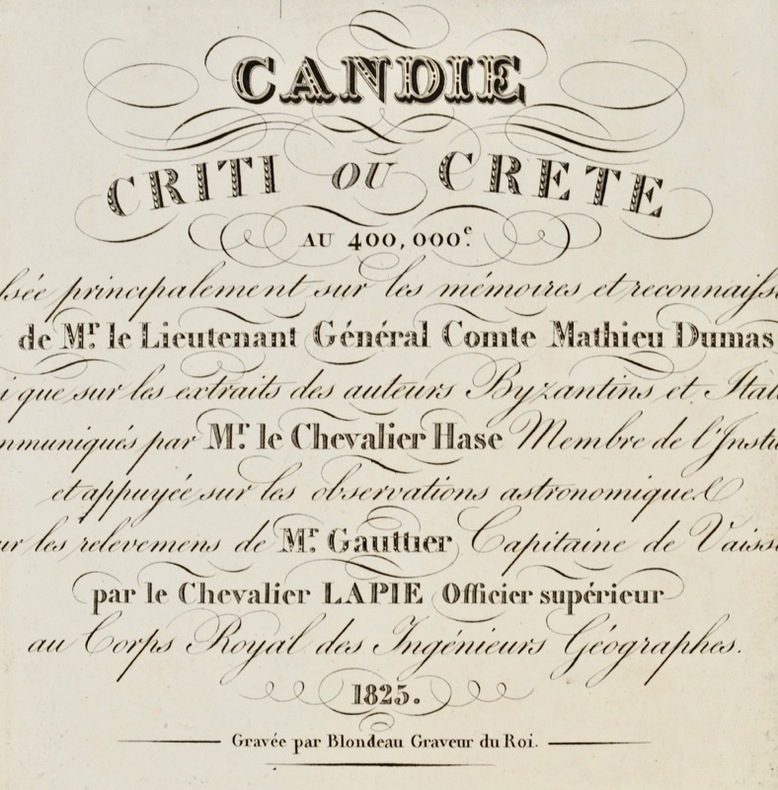
182541623Paris, Picquet, 1825. Plan replié et entoilé de 78 x 50 cm, étiquette "J. Goujon marchand de cartes rue du Bac n°6 à Paris".
189342499S.l.n.d., , (vers 1893). Manuscrit in-4 à 25 lignes sur belle page de 132 ff. (16 x 20 cm) montés en 1 album, demi-vélin ivoire à coins, titre enluminé sur le dos (reliure de l'époque).
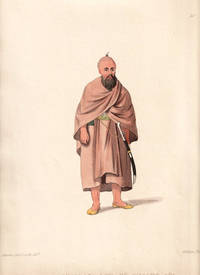
1802219553London.: W. Miller. 1802. Hand-coloured engraving 34.7 x 25.9 cms sheet including plate-mark edge toning but in very good condition. Attractive large image of a Dervise or Dervish prepared as Plate XXX for Dalvimart's work "The Costume of Turkey". <br>"Dalvimart's is one of the basic works on Turkish costume which has provided the prototypes for numerous other illustrative material. It is known that Dalvimart travelled in Turkey and Greece in 1797-8" Atabey. . W. Miller. unknown
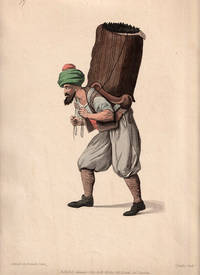
1802219551London.: W. Miller. 1802. Hand-coloured engraving 34.7 x 25.8 cms sheet including plate-mark edge toning but in very good condition. Attractive large image prepared as plate 17 for Dalvimart's work "The Costume of Turkey". <br>"Dalvimart's is one of the basic works on Turkish costume which has provided the prototypes for numerous other illustrative material. It is known that Dalvimart travelled in Turkey and Greece in 1797-8" Atabey. . W. Miller. unknown
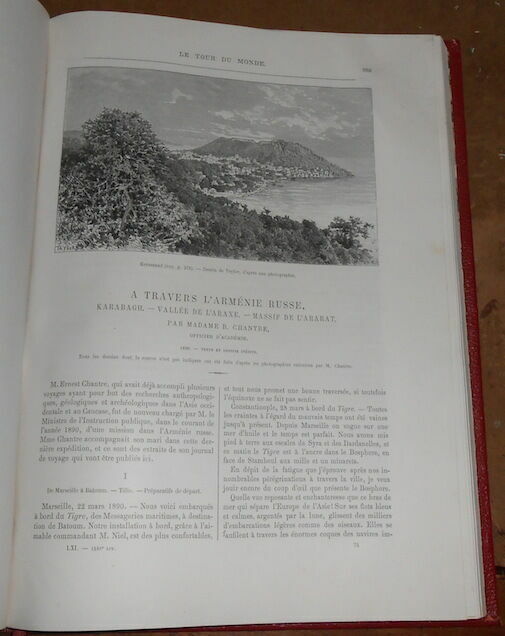
1890164281890. Paris Librairie Hachette « Le Tour du Monde » 1890 - Cartonnage moderne 23 cm x 31 5 cm 192 pages (pagination non continue) 139 ills noir album factice réalisé à partir des tomes LXI LXII LXIII et LXIV du « Tour du Monde »
1802219552London.: W. Miller. 1802. Hand-coloured engraving 34.7 x 26 cms sheet including plate-mark edge toning but in very good condition. Attractive large image prepared as Plate IV for Dalvimart's work "The Costume of Turkey". <br>"Dalvimart's is one of the basic works on Turkish costume which has provided the prototypes for numerous other illustrative material. It is known that Dalvimart travelled in Turkey and Greece in 1797-8" Atabey. . W. Miller. unknown
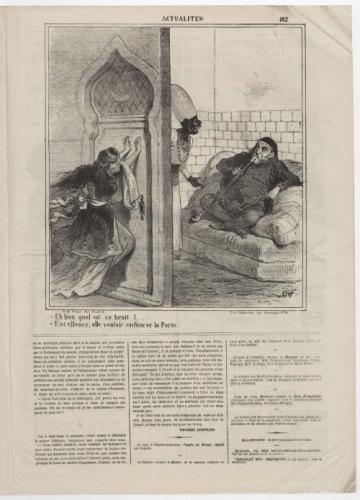
1866254311866 Le Charivari, trente-cinquième année, jeudi 20 septembre 1866- Hauteur: 43.8cmx Largeur: 31cm - Trait carré :Hauteur: 25.8cmx Largeur: 23.3cm1 feuillet ; illustration page 3. - Au-dessus de l'image, au centre : "ACTUALITÉS", et à droite : "182" ; signé dans l'image en bas à droite : "STOP", sous l'image à gauche : "A.de Vresse, Rue Rivoli, 55." et à droite : "Lith Destouches Rue Paradis Pre 28" ; au-dessous, au centre : "_Eh bien quel est ce bruit ?... / _Excellence, elle vouloir enfoncer la Porte.",texte imprime au dos,bon etat
1863X79953Paris, Firmin Didot 1863 530pp.+ 32 planches hors-texte & 4 cartes dépliantes, dans la série "L'univers pittoresque. Histoire et description de tous les peuples" volume 11, texte sur 2 colonnes, reliure cart. (plats marbrés, dos en toile avec titre doré), 21cm., peu de rousseurs, bon état, X79953
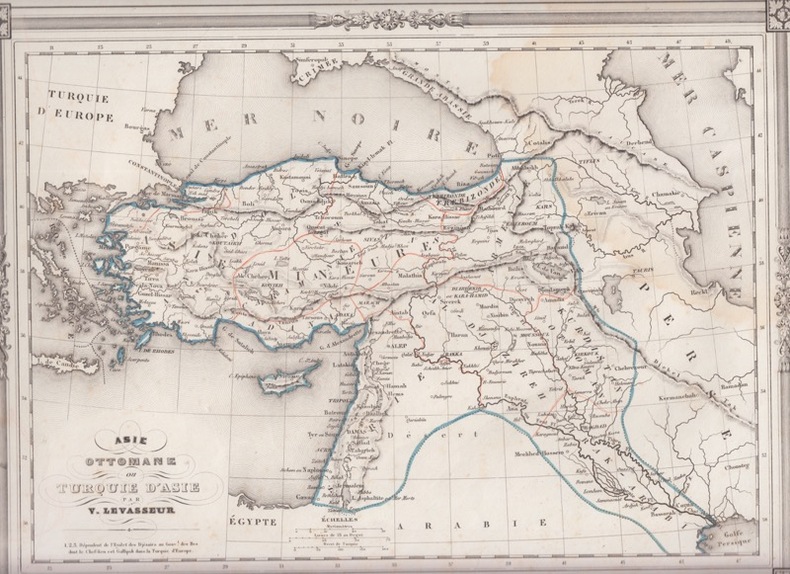
1842262441842 Maison Basset, Paris, 1842. hand-coloured map, by George and Smith, BARBIE DU BOCAGE, , image size approximately 22,5 x 30 cm old original print / originale Druckgrafik
1863195651863. Paris Éditions Firmin-Didot coll. « L'Univers Pittoresque » 1863 - Reliure éditeur demi-basane filets et motifs dorés au dos 14 cm x 21 5 cm 530 pages+ 32 gravures hors-texte + 4 cartes dépliantes hors-texte - Texte de Ph. Le Bas terminé par M. Chéron - Rousseurs sinon bon état
188732224Paris, Maison Quantin, 1887. Un fort vol. au format in-4 (283 x 193 mm) de 3 ff. n.fol., 1 frontispice n.fol. et 453 pp. Reliure de l'époque de demi-chagrin maroquiné cerise, filet vertical gras à froid porté sur les plats, dos à nerfs orné de filets gras à froid, larges fleurons dorés, titre doré, tête dorée.
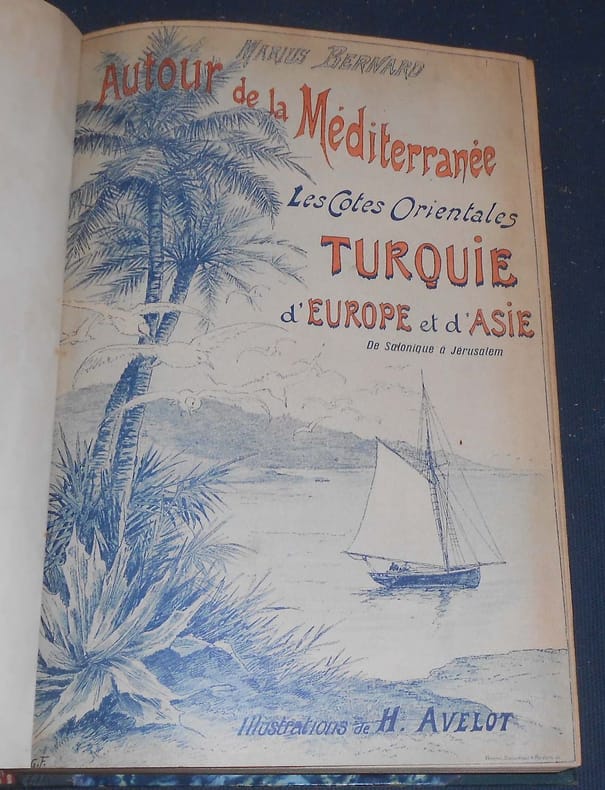
1899100074616Paris. 20 cm x 28 cm. 1899. Relié. 382 pages. Paris Éditions Laurens 1899. Relié demi basane dos à nerfs couverture conservée 20 cm x 280 cm 382 pages 120 illustrations in et hors-texte 1 carte hors-texte. Texte de Marius Bernard illustrations in et hors-texte de H. Avelot et de Le Pan de Ligny. Bon état
190018257P., L. Boulanger, (vers 1900) in-4 broché, format à l'italienne (24 X 32 cm) couverture vert amande décoré sur le premier plat d'un titre stylisé.
1849052077Edirne - Adrianople: AH: 1265 1849. No Binding. Very Good. Original autograph manuscript letter sent to Haci Giray family for condolences on Haci Giray's death. 38x21 cm. On a special paper with 'ahar'. Sealed. 1 p. Has six lines. With a legible script and fine calligraphic style. It starts with 'huve'. He was a Turkish statesman governor and member of state council according to Sicill-i Osmânî by Süreya and Türkischer Biographischer Index. The House of Giray Crimean Tatar: Geraylar Turkish: Âl-i Cengiz also Girays were the Genghisid/Turkic dynasty that reigned in the Khanate of Crimea from its formation in 1427 until its downfall in 1783. The dynasty also supplied several khans of Kazan and Astrakhan between 1521 and 1550. Apart from the royal Girays there was also a lateral branch the Choban Girays Çoban Geraylar. Before reaching the age of majority young Girays were brought up in one of the Circassian tribes where they were instructed in the arts of war. The Giray khans were elected by other Crimean Tatar dynasts called myrzas mirzalar. They also elected an heir apparent called the qalgha sultan qalga sultan. In later centuries the Ottoman Sultan obtained the right of installing and deposing the khans at his will. Giray family settled in Adrianople Edirne city in 17th century. <br/> <br/> AH: [12]65 unknown
1878052130Washington: Epeude Vradeus Letterhead 1878. No Binding. Very Good. Original manuscript handwritten letter ALS signed as a Turkish / Ottoman minister in Washington addressed 'Cher Monsiuer' evidently taking in hand the arrangements for his correspondent's visit to Constantinople. 18x11 cm. In French. 3 p. Washington 25 January 1878. Folds lightly toned some mnor blemmishes. Embossed crest with Greek inscription 'Epeude Vradeus'. Gregory "Ligor" Aristarchis also known as Aristarchi Bey was an Ottoman diplomat of Phanariote Greek ethnicity compiler of a corpus of Ottoman legislation. Originally a provincial jurist he became the director of foreign correspondence of Crete beginning in 1861 and then from 1867 the Smyrna Izmir directeur politique "political director" and vice-governor. He served as Ottoman Minister in Washington from 1873 to 1883 with Alexandros Mavrogenis. The Ottoman government dismissed him from his post. Sinan Kuneralp the author of "Ottoman Diplomatic and Consular Personnel in the United States of America 1867-1917" argued that his relationship with Midhat Pasha was the "more likely" reason why he was fired while the official accusation was that Aristarchis misused money from a weapons deal. After 1883 he lived in Paris where he worked as an advisor to Alfred Nobel. After the fall of Abdul Hamid II he served as an Ottoman envoy to the Netherlands where he died. He composed one of the first collections of the Ottoman law in 7 volumes in the French language: "egislation ottomane ou Recueil des lois reglements ordonnances traités capitulations et autres documents officiels de l'Émpire Ottoman" Constantinople: Imprimerie Frères Nicolaides. <br/> <br/> Epeude Vradeus Letterhead unknown
1867052131Ellenborough House Roehampton 1867. No Binding. Very Good. Original manuscript handwritten letter ALS signed as an Turkish / Ottoman ambassador in the UK addressed 'Mrs. Darby Griffith' wife of Christopher Darby Griffith M.P. who was a British politician and a Member of the Parliament of the United Kingdom for Devizes 1857-1868. 18x12 cm. In English. 2 p. Deep black borders the Ambassador's personal seal in black wax transferred from an envelope to the first page. With the separate engraved visiting - business card of l'Ambassador de Turquie. Ellenborough House Roehampton 31 August 1867. Konstantinos Mousouros also known as Kostaki Musurus Pasha was an Ottoman Greek diplomatic official of the Ottoman Empire who served as ambassador to Greece Austria Great Britain Belgium and the Netherlands. He was born in 1807 in Constantinople Istanbul to a distinguished Phanariote family. His brother Pavlos Mousouros also became a diplomat. Mousouros became the first ambassador of the Ottoman Empire to the newly independent Kingdom of Greece in 1840 a position he kept until 1848. In 1847-48 he was a central figure in the events known as Mousourika which led to his temporary recall and the breakdown of relations between the two states. On his return to Athens he survived an assassination attempt leading to his transfer to Vienna. In 1850 he took up the post of Ottoman ambassador to the Great Britain and Ireland which he kept for 35 consecutive years until his retirement in 1885. During the same period he also served as ambassador to the Netherlands 1861-77 and Belgium 1861-75. In 1876-78 he was ex officio a member of the short-lived Senate of the Ottoman Empire. Well educated in 1883 Mousouros translated Dante's Divine Comedy into ancient Greek. He was married and had a son Stephanos Mousouros who later became Prince of Samos. <br/> <br/> unknown
1877050824Paris - Istanbul: H.: 1293 1877. No Binding. Very Good. Original handwritten autograph letter signed 'Refet' sent to his brother 'Mahmud Fehim Bey' who was the Second Secretary of the Turkish Embassy in Paris like it's written on envelope as bilingual in French and Ottoman Turkish: 'Paris Sefâret-i Seniyyesi Ikinci Serkâtinbi = Seconde Secrétaire de l'Ambassade de Turquie en ParisSeconde Secrétaire de l'Ambassade de Turquie Paris'. Folded in its original envelope. Letter open size: 20x25 cm; envelope size: 11x14 cm. In Ottoman script. 3 p. full. Dated Hegira 27 Ramazan 1293 = Gregorian: 1877. They were sons of Bastirmali Sadrazam -Ottoman Grand Vizier- Mehmed Esad Safved Pasha 1814-1883 and one of the signatories of the Treaty of Ayastefanos -Treaty of San Stefano-. Mehmed Refet Bey was 'Hariciyye Mektubçusu' which was an important part of foreign relations of Ottoman diplomacy and their duty was dealing with legal cases between Ottoman citizens and foreigners. <br/> <br/> [H.: 1293] unknown
1885051539Istanbul: Bâb-i Fetva Daire-i Seyhülislâm. H.: 1301 1885. No Binding. Very Good. 8vo - over 7¾ - 9¾" tall. Original manuscript handwritten letter ALS signed 'Ahmed Es'ad'. Oblong: 19x24 cm. In Ottoman script. Letterhead of 'Bâb-i Fetva Daire-i Seyhülislâm'. AH: 1301 = AD: 1885. With elqab includes three lines. Written on salary increase of 'Imam-i Sânî Rasid Efendi hazretleri'. Folded. In elqab it starts with 'Faziletlü efendim hazretleri' after 'Hüve'. Uryânîzâde Ahmed Esad Efendi was 117th sheikh al-islam of the Ottoman Empire in the period of Sultan Abdulhamid 2. He was son of Mehmed Said who was one of qadis judge of Sultan Mahmud II. He was descend from Osman el-Uryânî who was a Kilis city-born. <br/> <br/> Bâb-i Fetva Daire-i Seyhülislâm., [H.: 1301] unknown
1898055584Istanbul: Mahmud Bey Matbaasi. AH 1315 1898. 1st Edition . Leather. Very Good. 8vo - over 7¾ - 9¾" tall. In contemporary handsome 1/3 leather bdg. Raised five bands to the spine. The third and fourth compartments have a lettered gilt title and a personal name Fikri in Ottoman script. Other ones have decorated gilts. Cr. 8vo. 20 x 14 cm. In Ottoman script Old Turkish with Arabic letters. 359 p. First and only edition of Süleyman Tevfik's eyewitness travel account to Thessaly who participated in the Turco-Greco War in 1897 as a war correspondent in the Thessaly Front between April 27 - May 20 1897. The Greco-Turkish War of 1897 or the Ottoman-Greek War of 1897 also called the Thirty Days' War and known in Greece as the Black '97. It was a war fought between the Kingdom of Greece and the Ottoman Empire. Its immediate cause was the question over the status of the Ottoman province of Crete whose Greek majority had long desired union with Greece. Despite the Ottoman victory on the field an autonomous Cretan State under Ottoman suzerainty was established the following year because of the intervention of the Great Powers after the war with Prince George of Greece and Denmark as its first High Commissioner. This was the first war effort in which the military and political personnel of Greece were put to test in an official open war since the Greek War of Independence in 1821. For the Ottoman Empire this was also the first war effort in which the reorganized military personnel were put to the test. The Ottoman army was under the guidance of a German military mission led by Colmar Freiherr von der Goltz who had reorganized it after the defeat in the Russo-Turkish War 1877-1878. In Thessalian Front war was declared on 18 April when the Ottoman ambassador in Athens Asim Bey met with the Greek foreign minister announcing the cutting of diplomatic ties. Heavy fighting occurred between the 21-22 April outside the town of Tyrnavos but when the overwhelming Ottoman forces converged and pushed together the Greek general staff ordered a general withdrawal spreading panic among soldiers and civilians alike. Larissa fell on 27 April while the Greek front was being reorganized behind the strategic lines of Velestino in Farsala. Nevertheless a division was ordered to head for Velestino thus cutting Greek forces in two 60 km apart. Between 27 and 30 April under the command of Col. Konstantinos Smolenskis Greek forces checked and halted the Ottoman advance. On 5 May three Ottoman divisions attacked Farsala forcing an orderly withdrawal of Greek forces to Domokos while on the eve of those events Smolenskis withdrew from newly recaptured Velestino to Almyros. Volos fell into Ottoman hands on 8 May. At Domokos the Greeks assembled 40000 men in a strong defensive position joined by about 2000 Italian "Redshirt" volunteers under the command of Ricciotti Garibaldi son of Giuseppe Garibaldi. The Ottoman Empire had a total of about 70000 troops of whom about 45000 were directly engaged in the battle. On 16 May the attackers sent part of their army around the flank of the Greeks to cut off their line of retreat but it failed to arrive in time. The next day the rest of their army made a frontal assault. Both sides fought ferociously. The Ottomans were held at bay by the fire of the defending infantry until their left flank defeated the Greek right. The Ottoman formation broke through forcing a renewed withdrawal. Smolenskis was ordered to stand his ground at the Thermopylae passage but on 20 May a ceasefire went into effect. Özege 20762.; OCLC 65794449 / 775132812. <br/> <br/> Mahmud Bey Matbaasi., [AH 1315] hardcover
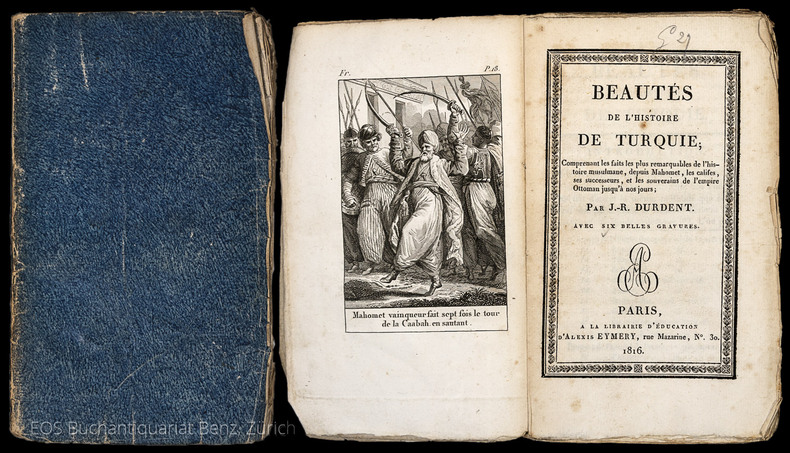
18167185CBParis, Eymery, 1816. 8°. 415 S. Mit Kupfertafeln. Broschur der Zeit.
18167185CBParis, Eymery, 1816. 8°. 415 S. Mit Kupfertafeln. Broschur der Zeit. + Wichtig: Für unsere Kunden in der EU erfolgt der Versand alle 14 Tage verzollt ab Deutschland / Postbank-Konto in Deutschland vorhanden +, A
1844111505Milan, chez Charles Turati, 1844, in-8°, 576 pp, reliure demi-veau glacé prune, dos lisse, titres et roulettes dorées, tranches mouchetées (rel. de l'époque), dos uniformément passé, plats et coupes frottés, bon état. Rare