British Mandatory PalestineBiblio.com
131 résultats
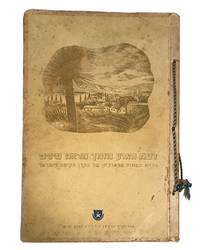
1940228911940. An early Zionist cigarette card photo album during the British Mandate period documenting Jewish paramilitary forces settlement defense athletics and infrastructure development in Mandatory Palestine likely produced in the 1930s-1940s as an educational and propaganda tool. The images illustrate the development of defense forces collective agricultural settlements and youth training movements that formed the institutional foundation of Jewish state building in the region.<br /> <br /> British Mandatory Palestine c. 1940s. 200 black-and-white silver gelatin photographic cigarette cards mounted in original printed album with Hebrew captions and descriptions. Folio. Original illustrated stiff wraps featuring a soldier in a sun helmet scanning the horizon rifle slung over his shoulder. A rare Zionist cigarette card photo album documenting the military security and athletic institutions of the Yishuv the Jewish community in pre-state Palestine during the British Mandate period. The album serves as both propaganda and educational material designed to instill national pride and discipline among the Jewish population particularly youth involved in the Haganah the Palmach and other proto-military defense organizations. The imagery and text emphasize the dual ethos of physical preparedness and self-defense alongside agricultural labor and nation-building. The album consists of photographic cigarette cards depicting key aspects of Zionist security forces settlement defense and sporting achievements in Mandate Palestine. The first sections focus on military training featuring members of the Jewish Settlement Police Notrim Jewish auxiliary police under the British and early paramilitary forces. Uniformed men in sun helmets keffiyehs or British-style caps are shown patrolling rural roads manning watchtowers practicing marksmanship and training in hand-to-hand combat. The inclusion of women in certain images suggests their role in auxiliary units foreshadowing the integration of women in the Israeli military. Several images capture women in agricultural labor construction and fishing industries highlighting their integral role in building and sustaining early Jewish settlements particularly within the kibbutz movement. Additionally photographs of women in aviation training including piloting gliders showcase early efforts to integrate them into technical and military fields.<br /> <br /> A later section transitions into the "Wall and Tower" Homa U'Migdal settlements-strategically built fortified agricultural outposts constructed overnight to establish a Jewish presence in contested areas. Photographs show men and women erecting wooden watchtowers carrying supplies and working cooperatively to secure land under hostile conditions. These images capture the pioneering spirit of the Yishuv where defense and agriculture were inseparable components of state-building. The final third of the album focuses on athletics reflecting the Zionist ideal of the "New Jew"-physically strong self-sufficient and ready to defend the homeland. Included are images of Jewish sports leagues fencing boxing wrestling weightlifting and track and field with a notable photograph of a female athlete wearing a "Ramah" Maccabi shirt symbolizing Jewish participation in international sports and the Maccabiah Games. The album also features aviation imagery including early Jewish pilots training in gliders an essential precursor to the formation of the Israeli Air Force.<br /> <br /> Covers show mild wear with minor foxing and wear to spine. Interior pages exhibit mild creasing to margins pages and photographs clean. Some cigarette cards are slightly lifting at the edges but all appear present. Overall very good condition. A visually rich artifact of Zionist history this cigarette card album offers rare photographic documentation of Jewish military organization settlement defense and athletic prowess during a crucial period leading to Israeli statehood. Complete or near-complete examples of such albums are scarce and highly sought after. unknown
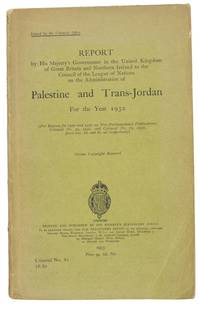
1933LBEG60X1NJ1QLondon: His Majesty's Stationary Office 1933. Original publisher's printed wrappers. 4to in 16s. With two folding maps showing parts of the Palestine territory that had been surveyed in detail. Detailed report to the Mandates Commission of the League of Nations regarding the British controlled Mandate of Palestine. After the collapse of the Ottoman Empire after World War I the Empires territories in the Middle East were divided between Great-Britain and France with the exception of the newly created Kingdom of Saudi Arabia and ruled as mandates on behalf of the League of Nations. The Mandate of Palestine was one of the territories governed by Great-Britain on behalf of the League of Nations and the British government had to produce an annual report of the territorys government for the League of Nations. The first proper report was produced in 1924 and they were produced every year thereafter until 1938. The reports contain extensive information on the region at that specific period describing the economy politics judicial system public health technological works and religious matters. The growing unrest in the Arab population and its strife for independence which would lead to the 1936-1939 revolt against British rule is already clearly visible in the report.In very good condition. Binding slightly worn and with a few folds.l National voices in Jordan: the street and the state p. 247. His Majesty's Stationary Office, unknown
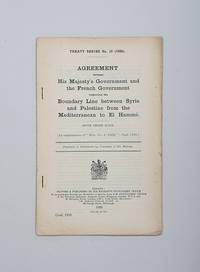
1923181603London: His Majesty's Stationery Office 1923 but 1924. Lines in the sand First trade edition one of 250 copies of the text of the Paulet-Newcombe Agreement including three maps delineating the newly agreed Palestine-Syrian border. The agreement was signed in March 1923 a few months before the Britain's Palestine mandate came into force. Whitehall was represented in the Anglo-French negotiations by Lieutenant-Colonel Stewart Francis Newcombe 1878-1956 a close wartime associate of Lawrence of Arabia who is cited frequently in Seven Pillars of Wisdom. Newcombe was commissioned into the Royal Engineers in 1898 and transferred into the Egyptian Army in 1901. Shortly before the outbreak of war he travelled to southern Palestine in the company of Lawrence and Leonard Woolley to complete a secret survey for the British government - "this initial encounter with Lawrence set up a lifelong friendship between the professional soldier and the young scholar-archaeologist. Newcombe's extraordinary exploits and courage coupled with an inexhaustible supply of energy made him a legend in the desert causing the Arabs to complain that 'Newcombe is like fire he burns friend and enemy'" ODNB. In 1935 he was one of the six pallbearers at Lawrence's funeral. According to the printer's slug the agreement was first published in July 1923 in the Parliamentary Papers series. Octavo pp. 16. With 3 folding colour maps. Text in English and French. Original printed self-wrappers. Wrappers and maps repaired with archival tape rear cover chipped: very good. Khalidi & Khadduri 1648. unknown
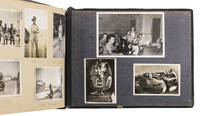
1940ABC_484251940. Contemporary embossed brown calf with flowers on the front and back board and an aluminium view of David's Tower and Jerusalem's old city wall embedded in the front board. Oblong album 30 x 20 cm. With 128 gelatin silver prints most ca. 6.5 x 9.5 cm. Beautiful album with 128 photographs of Egypt and Palestine present day Israel and the West Bank during the British Mandate. It was likely compiled by a British soldier who was stationed in the Middle East during the 1940s. Some of the photographs are numbered in the negative and may have been made by important photographers active in the area at the time like G. Eric Matson and his wife Edith the founders of the Matson Photo Service. The images show Cairo and various locations in Palestine including Jerusalem Bethlehem Nazareth Tiberias Sea of Galilee Nathanya Tel Aviv the Jordan river Haifa Beirut and the Dead Sea. Other than important locations like churches and gates the photographs also show many locals including for example street barbers in Cairo shepherds and farmers in Palestine and beautifully dressed women in Haifa. In the back of the work a few dried leaves from local plants have been mounted namely orange lemon fig eucalyptus grapevine and mulberry. The eucalyptus leaf still retains some of its scent.The edges and vorners of the boards are somewhat scuffed with some loss of material at the head and foot of the spine and around the edges of the embedded aluminium plate. The photographs mounted on the inside of the front board are slightly stained the fig leaf mounted on one of the final pages is damaged and the cyprus leaf is missing. Otherwise in good condition. unknown
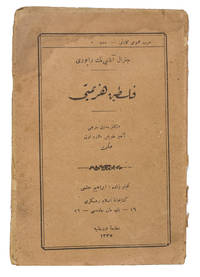
1919ABC_47443Istanbul: Matbaa-yi Orhaniye 1919. Original publisher's orange printed paper wrappers. 8vo ca. 18.5 x 12.5 cm. With the Turkish text printed using Arabic script. First and only edition of a report about the Sinai and Palestine campaign 1915-1918 in Ottoman Turkish translation. This second half of this campaign was led by General Edmund Henry Hynman Allenby 1st Viscount Allenby 1861-1936. He commanded the Egyptian Expeditionary Force EEF then part of the British army against the Ottoman Empire in the conquest of Palestine in 1917-1918. The EEF succeeded in capturing Beersheba Jaffa and Jerusalem in late 1917 as well as the Jordan valley and Northern Palestine in 1918. The present work is a translation of Allenby's reports which cover the period between December 1917 when the British entered Jerusalem and September 1918 when General Allenby started a new campaign resulting in the capture of Damascus and Aleppo. The report begins with operations to make Jaffa and Jerusalem safe against Turkish counterattacks and continues with Allenby's succesful attacks on Jericho the Jordan Valley and As-Salt. The EEF won numerous other battles in the region before the Armistice of Mudros ended the campaign in October 1918. Allenby then became the High Commisioner in Egypt and Sudan from 1919-1925.With an inscription on the title page and on the back wrapper. With a water stain on the head margin throughout including the wrappers the spine is somewhat torn but the wrappers are still connected. Somewhat browned throughout the edges of the leaves are frayed the leaves are folded and loose in the wrappers as issued. Otherwise in good condition.l WorldCat 777059280 3 copies; Özege 5787; cf. The campaign in Palestine: General Allenby's official report of the fighting north of Jerusalem up to September 18 1818. In: Current history 1916-1940 vol. 9 1 part 2 1919 pp. 167-172. Matbaa-yi Orhaniye, unknown
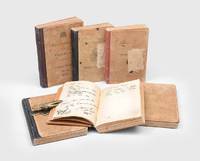
19231784971923-31. Policing Palestine An absorbing day-to-day record of British policing in Mandatory Palestine these diaries chart the volatile years from 1920 to the early 1930s offering a granular view of religious and social tensions and of Britain's often self-serving pursuit of "law and order". Major Laurence Harrington joined the Palestine Police at its inception in July 1920 rose rapidly and served mainly in Jerusalem and Jaffa. He witnessed the 1929 disturbances and later gave evidence to the Shaw Commission. His diaries consist of brief functional entries kept for official purposes with gaps when volumes were sent for inspection and frequent references to named officers and local figures. Religious violence dominates the record. Harrington repeatedly investigates killings framed explicitly in religious terms orders precautionary deployments and manages flashpoints such as Labour Day nationalist demonstrations anniversaries strikes and boycotts. He records crowd control operations armed patrols prison break-outs manhunts with shoot-to-kill authority and the tense aftermath of the 1929 riots including censorship confiscations and plain-clothes operations to suppress unrest. Alongside this the diaries document routine but hazardous police work - drug-smuggling busts raids on suspected agitators and the exposure of corrupt informants - as well as Harrington's ceremonial duties escorting senior British officials and visiting dignitaries. His proximity to power brings an active social life offset by football as a constant release. The final volume anticipates the worsening climate of the 1930s with police on continual alert for political and communal triggers. No other diaries by Harrington are known to survive making this candid administrative record an unusually fortunate and valuable witness to the mandate's daily realities. 6 vols octavo. Original quarter cloth five black one red rebacked boards lettered in black. Bindings rubbed covers with splash stains and tidemarks and labels torn away internally some foxing and finger soiling. Overall in condition commensurate with maintaining a diary on active duty: well preserved. hardcover