128 résultats
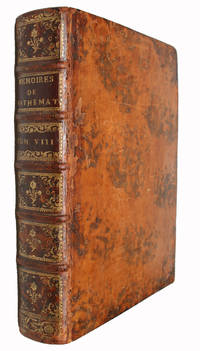
178044929Paris Moutard Panckoucke 1780. 4to. Contemp. full sprinckled calf with 5 raised bands on spine. Richly gilt compartments title-and tomelabels with gilt lettering. "Mémoires fe Mathematique et de Physique Présentés à l'Academie des Sciences par divers Savans" Tome VIII. XXIV624 pp. 8 engraved plates a. 52 folded tables. Entire volume offered. Van Swinden's work: pp. 1-576 3 folded engraved plates and 52 folded tables. <br/><br/><em>First edition of Van Swinden's large work on magnetism and the function of the compass and the variability of magnetic needles. It also explained the diurnal variation of the earth's magnetic force.In 1767 van Swinden obtained the chair of philosophy logic and metaphysics at Franekar University. He studied all the popular scientific topics of the period especially magnetism electricity meteorolgy and chemistry and corresponded with many leading scientists including Bonnet Euler Deluc J. C. Wilcke Bertholon and Lalande. His Tentamen de magnete 1772 dealt with his mathematical theory of magnetism and in 1777 he and Coulomb shared the gold medal of the Paris Academy of Sciences for a very detailed prize essay on magnetism Recherches sur les aiguilles aimantées. the essay offered.Poggendorff II 1057 </em> hardcover
1893163107No place of publication.: 天眞堂. Tenshindō. Meiji 26 1893. A beautifully illustrated colour manuscript Meiji period "house geomancy" 家相 plan folded scale 1:50. On heavy good quality Japanese paper. Pop-up walls gate and some buildings turnable geomantic compass. Some creasing light soiling or browning but generally very good. 179 x 95cm. House divination originated in ancient China and became popular in Japan from the 19th century on. The idea of the house divination remains popular in Japan to this day. <br> <br>This beautiful sheet gives a detailed floor plan of a traditional Japanese house designed for a person of high status. This house was possibly on the grounds of Tenshindō in Yamanashi near Tokyoas Tenshindō is mentioned in the text. The 24 red lines which represent 24 hexagrams diverge from the central movable paper geomantic compass indicating 24 directions. The geomantic compass its range taking in the entire plan enables the planner to be certain that rooms and objects will be placed in such a way as to benefit the residents. By the same token the compass serves to make sure that planning does not work to the detriment of the residents. . [天眞堂]. [Tenshindō] unknown
Folio (320 x 215mm). (16) ll, including frontispiece, 618 pp, (14) ll. Engraved frontispiece, title in red and black with large engraved vignette, numerous engraved illustrations including large-format ones, and numerous woodcut illustrations, headpieces and initials, with final blank. Contemporary vellum, manuscript title on spine. Somewhat browned and with a small defect in the engraved title-page, but still in good condition, binding slightly bowed.

