56 résultats
1933HALL510224Hardback. 1933. 32 to 116pp plates & maps card covers London 1933-1965. Very good ex-library copies. . hardcover
3013New York: The Company by Tubbs Nesmith & Teall Printers 1854. . 8vo buff wrappers front printed Sabin 32767 New York: [The Company] by Tubbs, Nesmith & Teall, Printers, 1854. unknown
2989London: The Company by Truebner & Co. 1857. . 8vo pale-green printed wrappers London: [The Company] by Truebner & Co., 1857. unknown
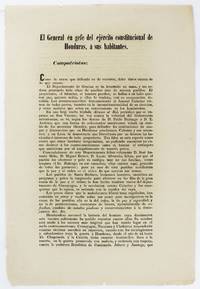
18535732Guatemala: December 31 1853. About very good. Broadsheet approximately 13 x 8.5 inches. Two very short closed tears at upper left margin. Light tanning and dust soiling faint foxing. A scarce anti-Cabañas screed penned by his political rival in Honduras José Santos Guardiola. José Trinidad Cabañas was at this time president of the country and attempting to reunite the states of Central America in a new federation. Here Guardiola accuses him of trying to "enthrone himself" as the ruler of Central America through the negotiations and of selling the country by the "atrocious act" of allowing Anglo-Americans to build an "imaginary and impossible" trans-isthmian railroad. Guardiola became president in 1860 after Cabañas was overthrown; he served six years before being assassinated by his own guard. OCLC locates four copies at Berkeley Kansas the Huntington and Boston Public. December 31 unknown
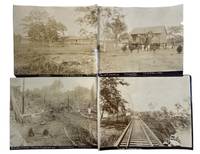
1922221591922. Group of Honduras plantation photographs early twentieth century by Wolfe photographer documenting agricultural development and infrastructure expansion at Toloa Plantation in northern Honduras. The images illustrate a system of export-oriented plantation agriculture revealing how land clearing transportation infrastructure and administrative spaces were organized to support large-scale fruit production and providing primary-source visual evidence for the study of U.S.-backed economic expansion in Central America. The photographs show the mechanisms by which plantation economies functioned including the integration of rail transport controlled landscapes and built environments within a system tied to foreign corporate investment.<br /> Wolfe. Toloa Plantation Honduras. Four large albumen prints each approximately 8.5 x 11 inches with black-lettered captions in the negatives identifying location. Images include a cleared agricultural field showing tree stumps and early planting rows indicating recent land conversion; a straight railroad track extending through dense tropical vegetation suggesting transport routes for agricultural goods; and two views of a wooden plantation building or administrative residence one with multiple figures posed in front likely workers or managerial staff. The photographs emphasize spatial organization including cleared land linear rail corridors and landscaped residential or operational structures with visual focus on the relationship between natural terrain and imposed infrastructure.<br /> These photographs document the expansion of plantation economies in Honduras during a period when U.S.-based companies such as the United Fruit Company and Cuyamel Fruit Company established extensive agricultural and transportation networks in the region. The presence of rail infrastructure and controlled landscapes reflects systems of land concession export production and foreign capital investment that shaped regional economies and governance. As visual records the images align with broader practices of documenting and promoting agricultural development to support commercial and political interests. Minor edge wear; overall very good condition. A focused photographic record of plantation systems and infrastructure in early twentieth-century Honduras. unknown
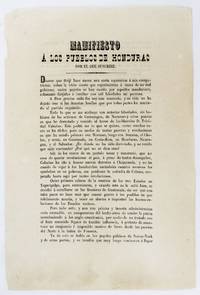
18555736Gracias Honduras 1855. Very good. Broadsheet approximately 12.5 x 8.5 inches. A few small chips and short closed tears at edges. Light even tanning. Scarce appeal by the conservative Honduran military leader Juan Lopez directed to the country's citizens to throw off the rule of liberal president José Trinidad Cabañas. A few months after this broadsheet was issued in July 1855 Guatemalan forces and its president Rafael Carrera crossed the border to support Lopez and together they forced Cabañas into exile. The present work calls the initial election of Cabañas unconstitutional and harps on the various misfortunes and violence that have befallen Honduras since his ascension to the presidency. The address concludes with an appeal to the citizenry to join Lopez in his efforts to bring peace and stability to the country. Not in OCLC. unknown