813 résultats
194579889Roma: Editrice Cultura Moderna Collana del Girasole 1945. Brossura wrappers. Molto buono Very Good. Riproduzione di un disegno di Van Gogh. Traduzione di Guglielmo Santangelo. 16mo. pp. 164. Molto buono Very Good. Dorso riparato Repaired spine. Prima edizione italiana di 1000 L es. numerati. Editrice Cultura Moderna, Collana del Girasole unknown
1928ROD0034904Charpentier et Fasquelle. 1928. In-12. Broché. Bon état, Couv. défraîchie, Dos frotté, Intérieur bon état. 228p. + Carte dépliante des peuples anciens de l'Amérique et de leur principales citées. Dos décoloré. Plat orné.. . . . Classification Dewey : 986-Colombie, Panama, Equateur
18512009AG1851. London & New York J & F. Tallis 1851. Original steel engraving / Vintage map. Drawn and engraved by John Rapkin. Partly hand-coloured. Plate Size: 33.2 cm x 24.6 cm. Sheet Size: 37.5 cm x 27.3 cm. Vintage 19th century map in very good condition. John Tallis 7 November 1817 3 June 1876 was an English cartographic publisher. His company John Tallis and Company published views maps and atlases in London from roughly 1838 to 1851. Tallis set up as a publisher with Frederick Tallis in Cripplegate in 1842; the business moved to Smithfield in 1846 and was dissolved in 1849. From 1851 to 1854 Tallis operated as John Tallis and Company. He started The illustrated news of the world and national portrait gallery of eminent personages in 1858 selling it for £1370 in 1861; it folded in 1863. Wikipedia The most important project John Tallis undertook was the 'Illustrated Atlas' from 1851. The original map we offer here was part of this exceptional Atlas and all the maps it contained are still today considered as the last reminder of an era of lavish map production. Tallis worked the project together with John Rapkin 1815-1876 and it was Rapkin's style and talent that we have to thank for when we marvel at these maps today. What makes these maps so special is the detail of engraved vignettes that surround the map and often show indigenous scenes people in their environment and even more so historical buildings or historical views of towns and cities architecture and landscape. The project of 'The Illustrated Atlas' was designed to be finished just in time for the anxiously awaited "Great Exhibition of the Works of Industry of All Nations" or The Great Exhibition sometimes referred to as the Crystal Palace Exhibition in reference to the temporary structure in which it was held was an international exhibition that took place in Hyde Park London from 1 May to 11 October 1851. It was the first in a series of World's Fairs exhibitions of culture and industry that became popular in the 19th century and it was a much anticipated event. The Great Exhibition was organized by Henry Cole and Prince Albert husband of the reigning monarch Queen Victoria. It was attended by numerous notable figures of the time including Charles Darwin Samuel Colt members of the Orléanist Royal Family and the writers Charlotte Brontë Charles Dickens Lewis Carroll George Eliot and Alfred Tennyson. Music for the opening was under the direction of Sir George Thomas Smart and the continuous music from the exhibited organs for the Queen's procession was "under the superintendence of William Sterndale Bennett". Wikipedia unknown
Coimbra, França Amado, Editor, 1905. 4to.; XV-254 pp. Ejemplar con envío autógrafo de Fortunato de Almeida. Cubiertas originales.
16277Broché - 12 x 18,5 - 286 pp - année 1931 Collection Le Sphinx - Editions de la Nouvelle Revue Critique -
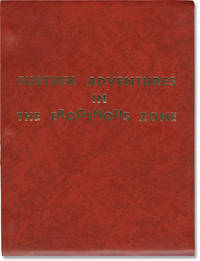
1973141520N.p.: N.p. 1973. Draft script for an unproduced film. <br /> <br /> A young woman is torn between her estranged ex-husband a rich man who is attempting to win her back and the man she has been seeing ever since she and her husband split up who also happens to be his lawyer. She will not commit to him but subsequently will not let her ex back into her life. <br /> <br /> Set in New York City. <br /> <br /> Red titled wrappers. Title page present dated April 4 1973 with credits for screenwriters Norman Panama and Albert E. Lewin. 122 leaves with last page of text numbered 120. Mimeograph duplication. Pages Near Fine wrapper Near Fine bound internally with three gold brads. N.p. unknown
1977LFA-126729530Un ouvrage de 263 pages, format 150 x 240 mm, broché couverture couleurs, publié en 1977, Flammarion, collection "Grands Feuilletons", bon état
1956150115Los Angeles: Paramount Pictures 1956. Vintage promotional reference photograph of Al Capp from the 1956 film. "Culver Pictures Inc." and "131242" stamps and two later date "Culver Pictures Inc." labels on verso.<br/><br/>Based on the 1954 Broadway play "King of Hearts" by Jean Kerr.<br/><br/>Al Capp famed cartoonist for his long-running satirical comic strip "Li'l Abner" portrays himself in a cameo role as well as providing promotional art for the film.<br/><br/>Divorced comic strip cartoonist Francis X. Dignan Bob Hope is hired as a ghost-writer for the pompous fiance George Sanders of his ex-wife Eva Marie Saint. <br/><br/>Set in Port Huron Michigan and New York City. <br/><br/>8 x 10.25 inches. Very Good with creasing primarily to margin. <br/><br/>Complete collation details available on request. Paramount Pictures unknown books
1956150115Los Angeles: Paramount Pictures 1956. Vintage promotional reference photograph of Al Capp from the 1956 film. "Culver Pictures Inc." and "131242" stamps and two later date "Culver Pictures Inc." labels on verso.<br /> <br /> Based on the 1954 Broadway play "King of Hearts" by Jean Kerr.<br /> <br /> Al Capp famed cartoonist for his long-running satirical comic strip "Li'l Abner" portrays himself in a cameo role as well as providing promotional art for the film.<br /> <br /> Divorced comic strip cartoonist Francis X. Dignan Bob Hope is hired as a ghost-writer for the pompous fiance George Sanders of his ex-wife Eva Marie Saint. <br /> <br /> Set in Port Huron Michigan and New York City. <br /> <br /> 8 x 10.25 inches. Very Good with creasing primarily to margin. Paramount Pictures unknown
413 p. + 16 color plates showing water-color paintings by E. J. Read and Gordon Grant + Advertisements + Folding color map as frontis. 'Profusely illustrated by over 600 unique and attractive photographs taken expressly for this book by our special staff.' Small folio (9 x 12"). Original full red cloth binding with a color picture of a painting mounted to the front cover. One corner bumped. **PRICE JUST REDUCED! NW31
(Canale di Panamà - Centro America) In 4° piccolo (cm 29,5 x 22,5), bella legatura editoriale in piena tela rossa con titoli e ricche impressioni figurate policrome, pp. (2),414,(2), con una carta geografica ripiegata a colori (Panama Canal and Canal zone) in antiporta, 600 illustrazioni fotografiche in bianco e nero nel testo e 16 tavole fuori testo con disegni a colori di E. J. Read. Ottimo stato di conservazione.
Mm 300x405 Fascicolo in folio di pp. 8 con prima carta illustrate in bianco e nero, illustrazioni in nero nel testo. In buono stato. SPEDIZIONE IN 24 ORE DALLA CONFERMA DELL'ORDINE.
Mm 300x405 Fascicolo in folio di pp. 8 con prima carta illustrate in bianco e nero, illustrazioni in nero nel testo. In buono stato. SPEDIZIONE IN 24 ORE DALLA CONFERMA DELL'ORDINE.
1964LFA-126728723Revue mensuelle de 72 pages, format 140 x 210 mm, illustrée, brochée, Impr. de Sceaux, bon état
187946867London The Economist Office 1879. Small folio. Bound in comtemporary half cloth. Entire volume 37 July - December 1879 of The Economist. Minor wear to extremities and a few repairs to a few leaves otherwise fine and clean. Pp. 761-1504. <br/><br/><em>Original printing of The Economist - the most important and influential economic journal worldwide - from the year 1879. The initial planning of the Panama Canal began in 1879. The enormous endeavor of digging the Canal was reflected in The Economist: "The canal proposed by M. de Lesseps and intended to pierce the Isthmus of Panama is in many respects a bolder enterprise even than the Suez Canal. The engineering difficulties are far greater the climate is a much more serious obstacle to labour and especially to that of Europeans and finally the possibility of a rival plan being carried out is much greater." </em> hardcover
1893806821893 Paris, Charles, 1893, in 12 broché, 186 pages.
1943LFA-126735002Une revue de 56 pages, format 165 x 245 mm, illustrée, brochée couverture couleurs, bon état
9779Annales de l'Extrême-Orient et de l'Afrique, n° 123. Paris, Challamel, septembre 1888. In-4, broché.
1370392Paris: Musée de l'Homme, Museum National d'Histoire Naturelle, 1970 in-4, 72 pages, nombreuses illustrations. Broché, bon état, cachet. Sommaire: Philip FRY: ESSAI SUR LA STATUAIRE MUMUYE. - Alain ICHON: Vases funéraires d'El Indio (District de Tonosi, Panama). - Monique ROUSSEL DE FONTANES: "Roumanie 69", Monette RIBEYROL: Une collecte de pains rituels en Bulgarie. - Henri LHOTE: Mission au Tassili (mai-juin 1969) - Jacques MILLOT: Une précieuse donation turque. - Jacqueline DELANGE et Philip FRY: L'exposition "Oeuvres africaines nouvelles".
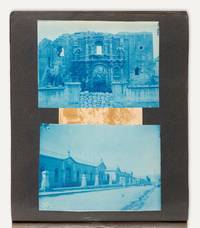
1918List2982Peru and Panama 1918. Approximately 364 photos; album and unmounted photos silver prints cyanotypes and printing-out-paper prints. Photos measure 3 x 4 to 8 x 10 inches with about half measuring 3 x 5 ½ inches. Some with photographer’s hand-stamp or credit in pencil; others with manuscript notations verso or recto; some captions to album pages. Offered in partnership with Daniel / Oliver.<br /> <br /> Rich and extensive photographic archive of Walton T. Burres of Stockton California showing his time in Peru c. 1904 as an amateur explorer and doctor for the Inca Mining and Rubber Company and his later work in Panama c. 1918 with the Rockefeller Foundation’s International Health Division.The collection consists of a large number of loose photos acquired by the gallery in 2021 and a recently discovered photo album showing some of the same subjects and containing a few duplicate images some printed in different sizes or formats as well as hundreds of previously unseen prints. Together this material makes up the largest extant archive of Burres’s photographic work. Though his work was published at the time both in Peruvian and American publications much of it was lost when he dropped it in a river that he was attempting to ford.<br /> <br /> Burres was educated at California’s Cooper Medical College the first school of medicine on the West Coast and was a prominent member of the Stockton community before sojourning to Peru around 1900 to help the Inca Mining and Rubber Company address the deadly diseases endemic to the region such as malaria and yellow fever. To encourage economic infrastructure in remote areas the Peruvian government began granting land concessions to any company that would build roads bridges or river ports. As a result the Inca Mining Company an American outfit based in Tirapata purchased the rights to mine gold along the upper Inambari River in 1896 and soon became the richest gold producer in Peru.<br /> <br /> A large portion of Burres’s Peruvian images document his 1903–1904 excursion from Arequipa 150 miles into “rubber country.†The journeys were well-recounted in U.S. papers and a number of the anecdotes described in print are seen in the present images.<br /> <br /> There are many dynamic views of Burres and his party trekking through the dense jungle and summiting the high mountains as well as shots of flora fauna and native Peruvians. Burres’s travel companions for this trip included the famed adventurer Harriet Chalmers Adams later dubbed “America’s greatest woman explorer†by the New York Times. Adams and her husband Frank both fellow Stocktonians joined up with Burres during their own multi-year expedition through South America. There are a number of portraits of a woman who bears a striking resemblance to Adams though it is possibly another person.<br /> <br /> Other Peruvian material includes numerous views of Cusco Arequipa and the surrounding environs including a beautiful interior of a chapel a Martin Chambi-esque detail shot of a stone wall and portraits of local townspeople some identified as Quechua people. There are a number of lush large-format cyanotypes rich printing-out-paper views and many handsome small-format panoramas. These were printed on Inca Mining Company surplus stationary which speaks to the makeshift nature of photo-development under the circumstances. One particularly striking image shows the top of Misti volcano barely visible above the clouds. This image was reproduced in Burres's account of his travels published in 1909 in Outing magazine.<br /> <br /> The photographs from Burres’s time in Panama document his more serious work as a virologist and health administrator in the area. One interesting photo shows a pair of recently-shot iguanas with a caption noting that “blood of these reptiles was found infected with Haemogregarina.†Another image is that of a new style of privy built from concrete and wire-mesh designed to better keep out rain water. There are also keenly-shot views of main streets and local culture in Los Santos Chiriquà and elsewhere including a number of humanistic group portraits taken at a girl’s school. unknown
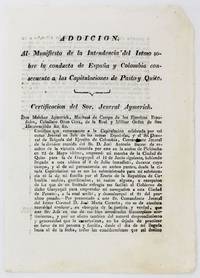
18235754Panama: Jose Maria Goytia 1823. Very good plus. Broadsheet handbill 8.5 x 6 inches. Minor creasing. Faint dampstaining at right edge. An extremely rare statement by Spanish general Melchor Aymerich following his final defeat in Ecuador by Antonio José Sucre and subsequent flight to Panama in 1822. Aymerich the "Mariscal de Campo de los Ejercitos Españoles" and "Jeneral en Jefe de las Armas Españolas" states that he and his family traveled lodged and ate at their own expense following his defeat at Pichincha by Sucre and subsequent capitulation. No money or provision of any kind was provided to them by the Republic of Gran Colombia. He continues to declare that they traveled from Quito to Guayaquil and thence to Panama and would soon be departing for Havana. While in Panama he was the guest of the Commandant of the Isthmus Colonel José Maria Carreno and he thanks the Colonel and his family for their generosity and assistance. Although the caption title of this broadsheet states that it is an "Addicion" to a lengthier "Manifiesto" this prior work does not seem to have survived.<br /> <br /> The present handbill is a very early Panamanian imprint. There is no evidence of there having been printing in Panama during its colonial period and exactly when the first press was introduced there is unclear. OCLC locates a single copy of a call for independence in New Spain published by the present printer José Maria Goytia in 1821 and vanishingly few issues of two newspapers established in 1822. Medina traces an 1822 sermon as printed in Panama and we locate a smattering of other imprints from this period including the present handbill of which OCLC notes a single copy at the John Carter Brown Library; we know of one other at the New York Public Library. Jose Maria Goytia unknown
191463524Boston: The Page Company 1914. Thick 8vo. xv 1 559 1 pp. Frontisp. colour map of the Republic of Panama & profile of the Canal 1 large folding map of Central America numerous plates engravings maps. Dark green pictorial publisher’s cloth white blue gilt & red illustration front cover gilt lettering & ruling t.e.g. minor light uniform interior toning occasional edgewear rubbing to fore-edges slight scuffing still VG bright copy. Second edition of this excellent history of Central America and promotion of Panama upon the completion of the Canal and in conjunction with Page Company incorporating this title into the “See America First†series issued for over two decades. Not only has author presented a concise history of the Spanish exploration and exploitation of the West Indies and Central America but also included specific sections on privateers such as Sir Francis Drake as well as pirates in the Caribbean including the account of the sack of Old Panama City by Henry Morgan. The Page Company, hardcover
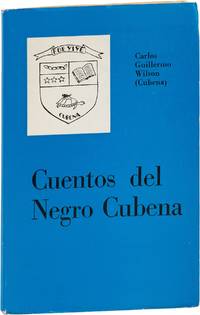
197785023Guatemala: Editorial Landívar 1977. First Edition. First Impression. Octavo 21.75cm; pictorial card wrappers; 67-942pp; text is entirely in Spanish. This copy is from the library of to Puerto Rican editor translator and literary critic Roberto Marquez inscribed to him by the author signing off with his pseudonym "Cubena" on the title page: "para la profesora Roberto Marquez / Paz Amor Justicia / Cubena / 77/ Los Angeles." Some wear to extremities a few creases to corners; contents clean; Very Good. <br /> <br /> Collection of a dozen short stories by the Afro-Panamanian author and scholar Carlos Guillermo Wilson 1941-2016 whose work written chiefly under the pseudonym "Cubena" was centered around the lives and struggles of Afro-Panamanians. Uncommon in commerce especially inscribed. Editorial Landívar unknown
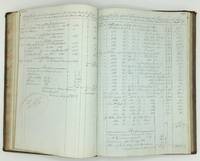
18521338Original manuscript. 1852-1854. Folio 38 x 27cm. Full contemporary reverse calf with gilt morocco titles labels to the spine "Rough Sales Book / S & L / B". Marbling to page edges. Marbled endpapers with engraved label for "Baily Brothers Booksellers Stationers Account Book Manufacturers" London to the front pastedown. 172pp. of manuscript text in ink on red-ruled laid paper watermarked "W. King / 1850" followed by c.160pp. blank with a handful of pages torn out following the conclusion of the manuscript text section and another within the text. The majority of entries are in English with some in Spanish mostly written in the same hand. Condition is very good the binding firm with marking to the boards chipping to the head of the spine and a little wear to the extremities. The contents with a 3cm tear to the head of the first text page and two pages partially cut/torn away at the bottom are otherwise in good order. The ledger of a British sales agents operating in Panama during the mid-nineteenth century detailing the importation and sale of a wide variety European and South American goods into the country.</p><p>The manuscript meticulously records the origin city/country importer ship the goods received and sold and the charges entailed for each shipment. A typical entry for example records the arrival of "gunpowder received per "Alexander" and sold on behalf of the Kames Gunpowder Company Glasgow" followed by details of the subsequent purchasers "J. D. Cordova" etc. and the charges/commissions taken by the agent including fees for landing expenses and "carriage to arsenal". </p><p>Many of the entries describe large diverse cargoes combining both essential and luxury goods including: alpacas; chocolate pots; "41 cases of pickles and mustard"; lavender water; rocking chairs; a "copying machine"; cinnamon; scissors razors; bone buttons; horse brushes; compasses; gin; hatchets; bedsteads; looking glasses; children's toys; cloves; muslins; kegs of shot; cups and saucers; tobacco; machetes; claret; playing cards rat traps; "Aqua de Colonia" cologne; silk gloves; saddles; blunderbusses; padlocks; lace; pantaloons; "Jamaica rum"; almonds; vinegar; bonnets; sausages; gold frames; water closets; wash stands; champagne; mosquito nets; and much else besides.</p><p>The origin ports include major European trade centres such as Liverpool and Glasgow but also include many South American ports such as Guayaquil Equador carrying beans cocoa coffee sugar and quinoa amongst other things; Buenaventura Colombia; Callao Peru carrying candlesticks coffee mills and bayonets; Lima Peru "bottled fruits" and cherry cordial; and Valparaiso Chile; as well as San Francisco and New York to the north. The importers themselves are also a mixture of British and Panamanian companies.</p><p>A fascinating detailed insight into Panama's transatlantic and South American trade during the mid-nineteenth century. [Original manuscript]. hardcover
1911100851Souvenir pamphlet 8vo colored printed pictorial wrappers illustrated 16 pp. Folded and creased down the middle with a little wear at the fold some minor rubbing to wrappers normal aging; otherwise very good. This is a scarce piece of ephemera commemorating the 1911 groundbreaking ceremony by President William H. Taft for the exhibition in the Golden Gate Park. While the purpose of the exhibition was to celebrate the completion of the Panama Canal it seemed to function more as a worlds fair held in San Francisco. It took over three years to construct and the exhibition ran from February through December 1915. There are a number of black and white photographs in the booklet including a double page panoramic view of the city of San Francisco. The activities of the ceremony are recorded in this pamphlet which feature speakers songs marches and what they had for dinner Blair-Murdock Co.,