12 résultats
1878z015741Liverpool: Panama Railroad Company/ Royal Mail Steam Packet Company/ Pacific Mail Steam Ship Co 1878. Very Good. Letter of transmittal from a Panama Railroad Company/ Royal Mail Steam Packet Company/ Pacific Mail Steam Ship Co. agent to James M. Lincoln of the Pacific Mail Steamship Co. New York. Measures 8 by 10 inches recto only. Very good. Stain and paper repair to top corner letter creased else clean and unmarked. Panama Railroad Company/ Royal Mail Steam Packet Company/ Pacific Mail Steam Ship Co unknown
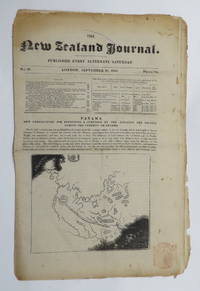
184323353London: Printed and Published by D. M. Aird. Good with no dust jacket. 1843. First Edition. Softcover. Some foxing. Some small tears and chips to margins of some leaves. Stamp on first page: "New Zealand Journal / Newspaper / One Penny". ; Single issue of this newspaper. 241-252 pages. 12 pages in total. Page dimensions: 338 x 210mm. Text in double columns. This issue has a long article about the proposal for a Panama Canal on page 241-244. The article includes a wood-cut map showing "Course of projected Canal". The map measures 151 x 124mm. Contents: Panama; Emigration versus Charity; Systematic Preparation; Resume of Instructions fo Gathering and Packing Seeds in New Zealaad; Summery; Wellington; Nelson; New Plymouth; Auckland; Home News; The Middle Island; Advertisements. "In February 1840 under the influence of E. G. Wakefield Henry Samuel Chapman began publishing the 'New Zealand Journa'l as proprietor-editor. The newspaper was the unofficial organ of the New Zealand Company which subsidised it. It was published fortnightly for the next three years." - entry on Henry Samuel Chapman Dictionary of New Zealand Biography. . Printed and Published by D. M. Aird paperback
182624048Washington: Printed at the Office of the United States' Telegraph 1826. First edition. 23 pp. 1 vols. 8vo. Disbound some spotting at front and back else a very good copy. First edition. 23 pp. 1 vols. 8vo. This related to the question of the mission to the Panama Congress. Simon Bolivar had called the Congress and in 1825 the United States had been included among the invitees. President Adams believed that the U. S. should be represented but it was later revealed that there was some plan among the Latin America republics to unite against Spain or other unfriendly nations and to establish an assembly with full war powers. Adams decided to send two delegates and to limit the U. S. participation. There was serious debates in Congress and in the end the U. S. was not represented but due to the death of one of the Representatives Ricahard C. Anderson and John Sergeant was only as far as Mexico City when the Congress adjourned. Sabin 34755. Panama Congress Mission. Sabin 34755 <br/><br/> Printed at the Office of the United States' Telegraph unknown
183956498Washington: 1839. 8vo. In later half cloth with gilt lettering to spine. Library labels pasted on to front and back board. Library stamp to to pasted down front end-paper and library label pasted on to pasted down back end-paper. Reapirs to last 5 leaves of "Potomac Aqueduct" with some loss of text. 81 1 167 pp. 6 folded plates. hardcover
18512009AG1851. London & New York J & F. Tallis 1851. Original steel engraving / Vintage map. Drawn and engraved by John Rapkin. Partly hand-coloured. Plate Size: 33.2 cm x 24.6 cm. Sheet Size: 37.5 cm x 27.3 cm. Vintage 19th century map in very good condition. John Tallis 7 November 1817 3 June 1876 was an English cartographic publisher. His company John Tallis and Company published views maps and atlases in London from roughly 1838 to 1851. Tallis set up as a publisher with Frederick Tallis in Cripplegate in 1842; the business moved to Smithfield in 1846 and was dissolved in 1849. From 1851 to 1854 Tallis operated as John Tallis and Company. He started The illustrated news of the world and national portrait gallery of eminent personages in 1858 selling it for £1370 in 1861; it folded in 1863. Wikipedia The most important project John Tallis undertook was the 'Illustrated Atlas' from 1851. The original map we offer here was part of this exceptional Atlas and all the maps it contained are still today considered as the last reminder of an era of lavish map production. Tallis worked the project together with John Rapkin 1815-1876 and it was Rapkin's style and talent that we have to thank for when we marvel at these maps today. What makes these maps so special is the detail of engraved vignettes that surround the map and often show indigenous scenes people in their environment and even more so historical buildings or historical views of towns and cities architecture and landscape. The project of 'The Illustrated Atlas' was designed to be finished just in time for the anxiously awaited "Great Exhibition of the Works of Industry of All Nations" or The Great Exhibition sometimes referred to as the Crystal Palace Exhibition in reference to the temporary structure in which it was held was an international exhibition that took place in Hyde Park London from 1 May to 11 October 1851. It was the first in a series of World's Fairs exhibitions of culture and industry that became popular in the 19th century and it was a much anticipated event. The Great Exhibition was organized by Henry Cole and Prince Albert husband of the reigning monarch Queen Victoria. It was attended by numerous notable figures of the time including Charles Darwin Samuel Colt members of the Orléanist Royal Family and the writers Charlotte Brontë Charles Dickens Lewis Carroll George Eliot and Alfred Tennyson. Music for the opening was under the direction of Sir George Thomas Smart and the continuous music from the exhibited organs for the Queen's procession was "under the superintendence of William Sterndale Bennett". Wikipedia unknown
190099653<p>Panama circa early 1900s. 1900s. Good. - Fourteen original silver print photographs of the Canal Zone each measuring 3-1/4 inches high by 5-1/2 inches wide. The images include scenes of workers on and debarking from ships people strolling along village or town streets with horse drawn carriages what is likely an official residence and 5 images of construction work on what would later become the Panama Canal. One of the photos depicting construction work is a duplicate. The photographs are slightly curled with creases to the corners of a very few photos and minor chips to the edges of 4 of these. Very good.</p> [Panama], circa early [1900s].
187946867London The Economist Office 1879. Small folio. Bound in comtemporary half cloth. Entire volume 37 July - December 1879 of The Economist. Minor wear to extremities and a few repairs to a few leaves otherwise fine and clean. Pp. 761-1504. <br/><br/><em>Original printing of The Economist - the most important and influential economic journal worldwide - from the year 1879. The initial planning of the Panama Canal began in 1879. The enormous endeavor of digging the Canal was reflected in The Economist: "The canal proposed by M. de Lesseps and intended to pierce the Isthmus of Panama is in many respects a bolder enterprise even than the Suez Canal. The engineering difficulties are far greater the climate is a much more serious obstacle to labour and especially to that of Europeans and finally the possibility of a rival plan being carried out is much greater." </em> hardcover
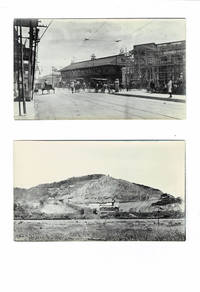
1900225611900. Latin America Panama City and the Canal Zone at the beginning of the 20th century photo archive featuring a range of architectural infrastructural and cultural subjects reflecting the western urbanization and colonial history of the area. Archive of 15 sepia toned real photo postcards. Each 3.5" x 5.5". The archive documents the transformation of Panama during the era of U.S. construction and administration of the Panama Canal and the subsequent urban growth of the capital. Many are captioned at the bottom in the negative.<br /> <br /> The collection includes multiple views of the Panama Canal itself such as "Opening Gates Pedro Miguel Locks" "Miraflores Locks Panama Canal" and a wide-angle vista from the Pacific side capturing the engineering marvel that reshaped global commerce. Urban scenes emphasize both civic life and colonial remnants: the "American Cabaret" façade crowded with pedestrians the Panama City railway station with carriages at its entrance and the Cathedral Plaza shown both from street-level and aerial perspectives. Religious heritage appears in the richly photographed "Golden Altar of San José" a baroque altar famously saved from pirate depredation by being painted black. Other views include the Old Spanish Fort tower ruins panoramic shots of the city grid ships moored in Balboa harbor and even the bullfighting ring situating Panama as both modernizing and deeply layered with colonial past. Minor handling wear and faint edge toning to some images remain crisp and clean. Overall very good condition. This archive offers a rich visual record of Panama at a pivotal historical moment combining imagery of U.S. imperial engineering with local cultural life and colonial heritage making it a valuable resource for scholars of Latin American history U.S.-Panama relations and the history of global infrastructure. unknown
1825368803Burdeos Bordeaux: en casa de Lawalle Jóven y Sobrino 1825. 155pp. 12mo. Modern red morocco and cloth front cover off original printed wrappers bound in. 155pp. 12mo. Bolivar propose the Congress which took place in 1826. en casa de Lawalle Jóven y Sobrino unknown
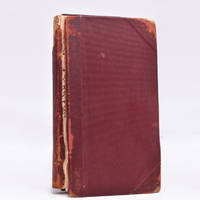
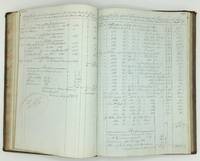
18521338Original manuscript. 1852-1854. Folio 38 x 27cm. Full contemporary reverse calf with gilt morocco titles labels to the spine "Rough Sales Book / S & L / B". Marbling to page edges. Marbled endpapers with engraved label for "Baily Brothers Booksellers Stationers Account Book Manufacturers" London to the front pastedown. 172pp. of manuscript text in ink on red-ruled laid paper watermarked "W. King / 1850" followed by c.160pp. blank with a handful of pages torn out following the conclusion of the manuscript text section and another within the text. The majority of entries are in English with some in Spanish mostly written in the same hand. Condition is very good the binding firm with marking to the boards chipping to the head of the spine and a little wear to the extremities. The contents with a 3cm tear to the head of the first text page and two pages partially cut/torn away at the bottom are otherwise in good order. The ledger of a British sales agents operating in Panama during the mid-nineteenth century detailing the importation and sale of a wide variety European and South American goods into the country.</p><p>The manuscript meticulously records the origin city/country importer ship the goods received and sold and the charges entailed for each shipment. A typical entry for example records the arrival of "gunpowder received per "Alexander" and sold on behalf of the Kames Gunpowder Company Glasgow" followed by details of the subsequent purchasers "J. D. Cordova" etc. and the charges/commissions taken by the agent including fees for landing expenses and "carriage to arsenal". </p><p>Many of the entries describe large diverse cargoes combining both essential and luxury goods including: alpacas; chocolate pots; "41 cases of pickles and mustard"; lavender water; rocking chairs; a "copying machine"; cinnamon; scissors razors; bone buttons; horse brushes; compasses; gin; hatchets; bedsteads; looking glasses; children's toys; cloves; muslins; kegs of shot; cups and saucers; tobacco; machetes; claret; playing cards rat traps; "Aqua de Colonia" cologne; silk gloves; saddles; blunderbusses; padlocks; lace; pantaloons; "Jamaica rum"; almonds; vinegar; bonnets; sausages; gold frames; water closets; wash stands; champagne; mosquito nets; and much else besides.</p><p>The origin ports include major European trade centres such as Liverpool and Glasgow but also include many South American ports such as Guayaquil Equador carrying beans cocoa coffee sugar and quinoa amongst other things; Buenaventura Colombia; Callao Peru carrying candlesticks coffee mills and bayonets; Lima Peru "bottled fruits" and cherry cordial; and Valparaiso Chile; as well as San Francisco and New York to the north. The importers themselves are also a mixture of British and Panamanian companies.</p><p>A fascinating detailed insight into Panama's transatlantic and South American trade during the mid-nineteenth century. [Original manuscript]. hardcover
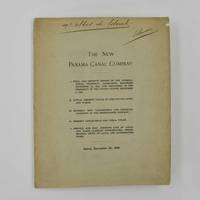
189821219591898. New York The Evening Post Job Printing House. Dated December 26 1898. 4to. Original printed wrappers; pp. 38 20 plates after photographs large folding sections in red and black large folding map in red and black; spine with few restorations small marginal flaw to front wrappers wire-stitched as issued with oxidization to wire-stitching; a very good copy of a great rarity presented to one Albert de Colomb with ink inscription to front wrapper.Very rare first edition. The first attempt to build the canal started under the leadership of Ferdinand de Lesseps proved to be a failure and the company collapsed in 1889. 'Although the company reorganized in 1894 it virtually ceased to function by 1898. Any possibility of completing the canal across Panama was gone; its sole hope lay in holding together an enterprise that could be offered for sale' Enyclopaedia Britannica. This rare document was compiled the by the International Technical Commission and assesses the possibility of resuming work which finally after difficult diplomatic negotiations and under the pressure of the United Stated and mainly supported by Roosevelt could be completed in 1914. An estimated 20000 lives were lost during the construction but the canal changed international shipping trade and the flow of goods for ever. unknown
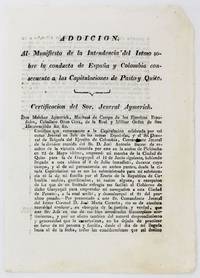
18235754Panama: Jose Maria Goytia 1823. Very good plus. Broadsheet handbill 8.5 x 6 inches. Minor creasing. Faint dampstaining at right edge. An extremely rare statement by Spanish general Melchor Aymerich following his final defeat in Ecuador by Antonio José Sucre and subsequent flight to Panama in 1822. Aymerich the "Mariscal de Campo de los Ejercitos Españoles" and "Jeneral en Jefe de las Armas Españolas" states that he and his family traveled lodged and ate at their own expense following his defeat at Pichincha by Sucre and subsequent capitulation. No money or provision of any kind was provided to them by the Republic of Gran Colombia. He continues to declare that they traveled from Quito to Guayaquil and thence to Panama and would soon be departing for Havana. While in Panama he was the guest of the Commandant of the Isthmus Colonel José Maria Carreno and he thanks the Colonel and his family for their generosity and assistance. Although the caption title of this broadsheet states that it is an "Addicion" to a lengthier "Manifiesto" this prior work does not seem to have survived.<br /> <br /> The present handbill is a very early Panamanian imprint. There is no evidence of there having been printing in Panama during its colonial period and exactly when the first press was introduced there is unclear. OCLC locates a single copy of a call for independence in New Spain published by the present printer José Maria Goytia in 1821 and vanishingly few issues of two newspapers established in 1822. Medina traces an 1822 sermon as printed in Panama and we locate a smattering of other imprints from this period including the present handbill of which OCLC notes a single copy at the John Carter Brown Library; we know of one other at the New York Public Library. Jose Maria Goytia unknown