171 résultats
1956150115Los Angeles: Paramount Pictures 1956. Vintage promotional reference photograph of Al Capp from the 1956 film. "Culver Pictures Inc." and "131242" stamps and two later date "Culver Pictures Inc." labels on verso.<br /> <br /> Based on the 1954 Broadway play "King of Hearts" by Jean Kerr.<br /> <br /> Al Capp famed cartoonist for his long-running satirical comic strip "Li'l Abner" portrays himself in a cameo role as well as providing promotional art for the film.<br /> <br /> Divorced comic strip cartoonist Francis X. Dignan Bob Hope is hired as a ghost-writer for the pompous fiance George Sanders of his ex-wife Eva Marie Saint. <br /> <br /> Set in Port Huron Michigan and New York City. <br /> <br /> 8 x 10.25 inches. Very Good with creasing primarily to margin. Paramount Pictures unknown
1942221221942. Latin America Panama Life in both urban Panama and the rural town of Chepo during the 1940s photo archive with most prints dated to 1942. Archive of 17 items 16 silver gelatin photographs measure 3.5" x 2.5" with one panoramic photo mounted on cardstock measuring 2.25" x 11". This archive offers a visually rich record of everyday life across class racial and geographic boundaries. Multiple photographs feature captions in ink on the verso providing locations and dates. The archive is split between two geographic zones: the modest rural community of Chepo and a more metropolitan center-likely Panama City-showing large buildings post offices police headquarters cantinas and well-trafficked intersections. In one striking rural image captioned "Dorein sic Indian Mother and Child" a white American tourist likely one of the photo owners stands beside an Indigenous woman and her child on a stilted wooden platform. The Darien likely of either the Emberá Wounaan or Kuna tribes woman wears only a sarong while a toddler stands nude at her feet highlighting the tension between Western spectatorship and traditional village life. In another photo local children gather in front of a wooden building marked "Cantina La Favorita de Chepo" while boys play barefoot on an unpaved road. Women in housedresses stand along porches and Indigenous women in linen skirts and little else are seen emerging from thatched or wooded homes. An image marked "Cantina at Chepo - 3-29-42" shows two white men and a white woman smiling at a table in a roofed structure made of rough wooden beams likely serving as a makeshift bar during their travels. The photos from urban Panama offer a sharp contrast. A modern cantilevered government building identified as the "Police Headquarters" is captioned en verso "Building now has many bullet holes on the sides" possibly a reference to political unrest or postwar violence. Another image shows a broad intersection labeled "6th & 8th St" filled with pedestrians in Western clothing including men in white suits and hats women in modern dresses and a cyclist passing beneath a neocolonial archway connecting civic buildings. Other rural images feature homes elevated on stilts a forested footpath with American visitors walking alongside locals and a panoramic view mounted to board showing a wide aerial view of one of the region's larger towns. Minor wear to edges. Overall very good condition. A rare and intimate archive documenting contrasting experiences of daily life in Panama across rural Indigenous communities and modernizing urban zones in the early 1940s with strong documentary value in the areas of colonial tourism race and hemispheric wartime movement. unknown
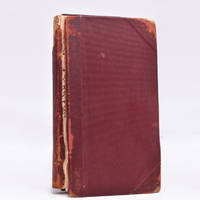
187946867London The Economist Office 1879. Small folio. Bound in comtemporary half cloth. Entire volume 37 July - December 1879 of The Economist. Minor wear to extremities and a few repairs to a few leaves otherwise fine and clean. Pp. 761-1504. <br/><br/><em>Original printing of The Economist - the most important and influential economic journal worldwide - from the year 1879. The initial planning of the Panama Canal began in 1879. The enormous endeavor of digging the Canal was reflected in The Economist: "The canal proposed by M. de Lesseps and intended to pierce the Isthmus of Panama is in many respects a bolder enterprise even than the Suez Canal. The engineering difficulties are far greater the climate is a much more serious obstacle to labour and especially to that of Europeans and finally the possibility of a rival plan being carried out is much greater." </em> hardcover
1911100851Souvenir pamphlet 8vo colored printed pictorial wrappers illustrated 16 pp. Folded and creased down the middle with a little wear at the fold some minor rubbing to wrappers normal aging; otherwise very good. This is a scarce piece of ephemera commemorating the 1911 groundbreaking ceremony by President William H. Taft for the exhibition in the Golden Gate Park. While the purpose of the exhibition was to celebrate the completion of the Panama Canal it seemed to function more as a worlds fair held in San Francisco. It took over three years to construct and the exhibition ran from February through December 1915. There are a number of black and white photographs in the booklet including a double page panoramic view of the city of San Francisco. The activities of the ceremony are recorded in this pamphlet which feature speakers songs marches and what they had for dinner Blair-Murdock Co.,
1967332687Morocco: Gnaoua Press 1967. First edition. 20 pp. viii. 8vo. Staple bound illustrated wrappers some sunning to spine and stain from price sticker else near fine. First edition. 20 pp. viii. 8vo. Panama Rose was the pen name of Rosalind Schwartz whose partner at the time was poet underground filmmaker publisher and photographer Ira Cohen. From around 1961-1965 they lived together in Tangier Morocco where they spent time with other ex-pats Paul Bowles William S. Burroughs and Brion Gysin and worked on music and publications. Schwartz wrote The Hashish Cookbook at the suggestion of Brion Gysin who years earlier had given Alice B. Toklas the hashish fudge recipe that appears in The Alice B. Toklas Cook Book. Often The Hashish Cookbook is wrongly attributed as being written by Cohen himself though he did publish it when he returned to New York in 1966. 10000 copies were printed and sold within six weeks. Cohen later sold the rights to a British publisher for a percentage of sales and subsequent reprints were made and some bootlegs are known to exist. Gnaoua Press unknown
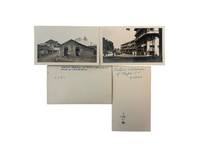
1900225611900. Latin America Panama City and the Canal Zone at the beginning of the 20th century photo archive featuring a range of architectural infrastructural and cultural subjects reflecting the western urbanization and colonial history of the area. Archive of 15 sepia toned real photo postcards. Each 3.5" x 5.5". The archive documents the transformation of Panama during the era of U.S. construction and administration of the Panama Canal and the subsequent urban growth of the capital. Many are captioned at the bottom in the negative.<br /> <br /> The collection includes multiple views of the Panama Canal itself such as "Opening Gates Pedro Miguel Locks" "Miraflores Locks Panama Canal" and a wide-angle vista from the Pacific side capturing the engineering marvel that reshaped global commerce. Urban scenes emphasize both civic life and colonial remnants: the "American Cabaret" façade crowded with pedestrians the Panama City railway station with carriages at its entrance and the Cathedral Plaza shown both from street-level and aerial perspectives. Religious heritage appears in the richly photographed "Golden Altar of San José" a baroque altar famously saved from pirate depredation by being painted black. Other views include the Old Spanish Fort tower ruins panoramic shots of the city grid ships moored in Balboa harbor and even the bullfighting ring situating Panama as both modernizing and deeply layered with colonial past. Minor handling wear and faint edge toning to some images remain crisp and clean. Overall very good condition. This archive offers a rich visual record of Panama at a pivotal historical moment combining imagery of U.S. imperial engineering with local cultural life and colonial heritage making it a valuable resource for scholars of Latin American history U.S.-Panama relations and the history of global infrastructure. unknown
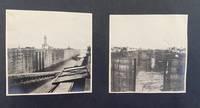
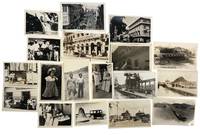
1910226891910. Unknown photographers early twentieth-century Panama photo archive circa 1910s to 1920s documents Panama during the decades surrounding the completion and early operation of the Panama Canal supporting research into U.S. engineering influence urban modernization Indigenous representation tourism waterfront labor and the transformation of Panama City and Colón into canal-era commercial spaces. The Panama Canal was completed and opened in 1914 linking the Atlantic and Pacific through one of the period's most consequential engineered waterways and the Gatun Locks formed part of the lock system that lifted vessels to Gatun Lake before lowering them at the opposite end of the route. These photographs record not only canal machinery and civic streets but also the human geography around the canal: tourists workers traders children waterfront activity ruins and leisure businesses appear together in a visual record of Panama's modernization under strong American commercial and infrastructural presence.<br /> <br /> Fifteen pieces comprising fourteen silver gelatin photographs and real photo postcards with one printed business advertisement card Panama circa 1910s to 1920s measuring approximately 2½ x 3¾ inches to 4 x 6 inches. The canal views include "Operating Emergency Dam Gatun Locks Panama Canal" and a view captioned "Gatun Locks" showing massive steel gates and early twentieth-century bridgework. Urban scenes include "Street Scene Panama City on Southern Cruise 1923" with American tourists Model T automobiles and colonial façades and "The Plaza Panama City" showing palm trees streetcar tracks and civic space. Local and historical subjects include a real photo postcard captioned "Circular Stairway in Old Panama ruins of Old Panama standing at the foot and looking directly up" documenting Panama Viejo the site of the original Panama City founded in 1519 and later recognized as part of a UNESCO World Heritage site. Other images include "Panama Water Front at High Tide" with fishing boats and market activity; dockworkers and traders near the canal's edge; and "Children in San Blas Panama" foregrounding Indigenous presence during the Canal era. The San Blas Islands are associated with the Guna an Indigenous people of Panama and Colombia whose communities are strongly identified with Guna Yala and the San Blas archipelago. <br /> <br /> The advertisement card reading "When in Colon Visit the Café Hollywood" places the photographic group within the leisure and service economy that grew around canal traffic tourism and foreign presence. Together the images clarify the different but connected worlds of early twentieth-century Panama: the engineered landscape of Gatun Locks the colonial and modern streets of Panama City the ruins of Old Panama the working waterfront Indigenous children in San Blas and the commercial culture of Colón. Minor corner wear and toning; images sharp and well preserved very good overall. Cohesive Panama Canal era archive documenting the intersection of American engineering urban transformation Indigenous life waterfront labor and tourist commerce in the early decades of the Canal Zone. unknown
1920217831920. Archive of photographs documenting the Panama Canal and Indigenous communities in Panama in the early twentieth century ranging from the industrial landscape of the canal's construction and operation to the daily lives of Indigenous Panamanian peoples. The photographs reflect two intertwined yet often contrasting aspects of Panamanian history: the rise of industrial imperialism and the endurance of Indigenous culture. Archive of 33 silver gelatin photographs. Each measure between 4.5" x 2.5" to 3.5" x 2.25". <br /> <br /> The series prominently features engineering achievements along the canal route. Images include multiple angles of locks and lift bridges such as the Miraflores Pedro Miguel and Gatun Locks as well as steamships and freighters navigating through the canal and moored along its edges. Several views capture drawbridges in operation mechanical infrastructures like lock control houses and long rail-lined chambers used to elevate ships across Panama's central isthmus. A few aerial or elevated shots emphasize the canal's monumental scale revealing vast water channels and industrial zones carved through jungle terrain. A second subset of photographs focuses on the Welland Ship Canal in Ontario Canada suggesting a comparative or thematic link between North American waterway engineering and the Panama Canal project-possibly compiled by a traveler engineer or canal enthusiast.<br /> <br /> In contrast the ethnographic photographs document Indigenous Panamanian groups-most likely Guna Kuna and Emberá-Wounaan peoples-living in thatched-roof villages dressed in traditional textiles body paint and adornments. Several portraits show children and adults standing in front of woven bamboo huts while others portray groups in ceremonial or communal settings. The camera's perspective suggests a Western possibly touristic or anthropological gaze reflecting the era's colonial attitudes toward Indigenous populations. The Panama Canal completed in 1914 under U.S. control after a failed French attempt was one of the most ambitious engineering projects of the 20th century. It transformed global maritime trade by connecting the Atlantic and Pacific Oceans through Central America. The canal's construction required the displacement of communities massive deforestation and the recruitment of tens of thousands of laborers primarily from the Caribbean who worked under harsh and segregated conditions.<br /> <br /> Indigenous populations in the canal zone and surrounding regions were deeply affected by this transformation. Their lands were often appropriated for canal infrastructure military zones or settler expansion. Cultural disruptions ecological degradation and restricted access to traditional territories became ongoing challenges. At the same time Indigenous communities-especially the Guna-resisted assimilation and maintained distinct cultural practices leading to moments of organized resistance like the 1925 Guna Revolution which asserted political autonomy in the face of Panamanian and U.S. pressures. This archive preserves a multifaceted visual history of Panama at a time of profound transition. The industrial photographs document the ambitions and outcomes of a modern imperial project while the ethnographic images capture Indigenous identities that persisted despite external pressures. Together they offer insight into the tensions between modernization and tradition progress and displacement-narratives that continue to shape Panama's national story today. unknown
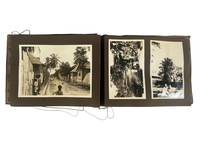
1904182051904. Photograph album circa 1904-1914 documenting maritime activity canal construction and social life in Panama during the period of American engineering control of the Panama Canal project. The images center on a group of American men traveling aboard a small yacht identified in several photographs by the presence of the American yacht ensign indicating a private pleasure vessel rather than a military or commercial ship. Several photographs appear to show large-scale excavation and infrastructure consistent with canal construction situating the album within the decade of intensive labor and engineering that culminated in the canal's completion in 1914. Alongside these scenes are numerous images of local life including Indigenous children and adults along coastal and riverine environments as well as built landscapes featuring plantation-style houses adapted to tropical climates. The album provides visual evidence of the intersection of American presence large-scale infrastructure development and local communities in early twentieth-century Panama.<br /> <br /> Photograph album containing images mounted on black pages within a black leather-bound volume measuring approximately 10 x 7 inches and comprising 86 pages. The photographs depict shipboard life including crew members steering and managing vessels group portraits of men in bathing attire and social gatherings such as shared meals. Additional images show coastal scenes with canoes swimmers and shoreline activity as well as occasional figures in military dress. The composition of the album reflects both travel documentation and informal social photography capturing a range of maritime domestic and environmental subjects.<br /> <br /> 86-page album with photographs mounted throughout; one page partially clipped and one page removed with small tears to several pages not affecting images. Light sunning to some photographs; overall very good condition. A cohesive visual record of American maritime travel and canal-era activity in Panama documenting both infrastructure development and everyday life in the region. unknown
1915224481915. Unknown photographer Panama Canal Zone and local life photo archive 1915 documents Panama during the first year after the canal's opening to traffic and supports research into U.S. imperial administration Canal Zone settlement travel photography military protection of infrastructure and the visual ordering of colonial space. The Panama Canal opened to traffic on August 15 1914 after U.S. construction created a strategic interoceanic route administered through the Canal Zone and Balboa Heights became a key administrative and residential center for the U.S.-controlled canal system. These photographs capture the built and natural environment through which American authority was made visible: locks river landscapes official buildings hilltop housing city views and naval practice appear together as evidence of a recently completed engineering project becoming an occupied administrative territory.<br /> <br /> Twenty-four original silver gelatin photographs including two real photo postcards dated 1915 with some undated images several with handwritten inscriptions in English on versos and some with printed captions on rectos. Photographs measure approximately 3½ x 5 inches to 5½ x 7 inches. The archive includes views of the Chagres River the largest river in the Panama Canal drainage basin and a major part of the canal water system together with photographs of the Gatun Locks canal gates aerial views of Panama City the main city plaza a bull ring and Balboa Heights. The Balboa Heights images show American-style bungalows arranged along curving terraced roads with broad verandas raised foundations and landscaped grounds visual evidence of the residential hierarchy attached to U.S. canal administration. Additional images show the Administration Building at Balboa Heights completed in 1914 and positioned above the town as a central administrative landmark while a real photo postcard captioned "Ready to Fire-Division Practice" shows U.S. naval boats in formation off the coast connecting sightseeing views to the military protection of the newly opened canal.<br /> <br /> The archive's research value lies in its combination of personal travel documentation official-looking captioned views urban and infrastructural scenes and military imagery from the early Canal Zone era. Its views of Balboa Heights are especially significant because U.S. canal society was organized through racialized and occupational distinctions including the "gold roll" and "silver roll" labor categories that separated white American workers from largely Black Caribbean and Latin American workers and shaped housing pay and privilege within the zone. Light edge wear legible inscriptions and preserved image surfaces very good overall. Cohesive Panama Canal Zone photo archive documenting the immediate post-opening landscape of U.S. power in Panama through canal infrastructure river systems segregated administrative space urban views and naval readiness. unknown
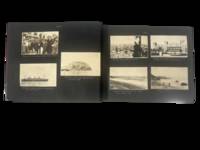
1930224461930. Caribbean and Panama travel photograph album. circa early 1930s. This album documents interwar travel through the Panama Canal Zone and Jamaica recording maritime transit canal infrastructure and rural Caribbean life as observed by Western travelers. The photographs provide primary visual evidence of the Panama Canal as a site of industrial activity and international movement alongside scenes of Jamaican village life and landscape establishing a contrast between engineered environments and colonial rural settings. The material is particularly strong in its depiction of canal operations and the presence of local populations within these spaces.<br /> <br /> Album containing 29 silver gelatin photographs mounted on black leaves with individual prints measuring approximately 3.5 x 4.5 to 5 x 7 inches housed in a string-bound album measuring approximately 7 x 9.5 inches. The opening sequence shows passengers aboard a steamship with men and women posed along deck rails and views of ships navigating canal locks and docking areas. Additional images depict cranes drawbridges canal cuts and small boats in the water along with dock workers and uniformed personnel visible among travelers. Architectural and infrastructural views include colonial-style buildings and mechanical equipment associated with canal operation concluding with a monument identified as that of Vasco Núñez de Balboa in Panama City. The Jamaica sequence includes landscape views of hillsides and gardens along with images of Black Jamaican residents posed in village settings. One photograph bears the caption "Kingston Jamaica 10 -- S.S. 'Reliance' West Indies Cruise" showing children and adults gathered along a dirt road lined with wooden and metal-roofed structures. Other images show groups assembled beneath trees and within rural surroundings.<br /> <br /> Produced during a period when the Panama Canal served as a major conduit for global shipping under U.S. administration and Caribbean travel formed part of organized cruise itineraries the album reflects established routes of interwar tourism. The juxtaposition of canal engineering and Jamaican village scenes situates the photographs within broader patterns of travel that linked industrial infrastructure with colonial landscapes. Minor water rippling to pages and photographs; images remain clear; overall very good. A coherent travel album documenting canal operations and Caribbean life in the early twentieth century. unknown
1825368803Burdeos Bordeaux: en casa de Lawalle Jóven y Sobrino 1825. 155pp. 12mo. Modern red morocco and cloth front cover off original printed wrappers bound in. 155pp. 12mo. Bolivar propose the Congress which took place in 1826. en casa de Lawalle Jóven y Sobrino unknown
1920230431920. Panama City photograph archive ca. 1920s documenting the urban environment of the Panamanian capital and the infrastructure of the Panama Canal during the decades following the canal's opening in 1914. The photographs record the interconnected worlds of canal engineering international commerce tourism and everyday street life that developed as Panama City became a strategic hub of global shipping and American geopolitical influence in the Caribbean basin. Urban scenes depict commercial storefronts streetcars automobiles and pedestrian activity along central avenues while other photographs capture the canal's mechanical landscape of locks spillways and industrial structures. Together the images illustrate the transformation of Panama City into a cosmopolitan port city shaped by canal traffic international trade and the presence of the U.S. Canal Zone administration.<br /> <br /> Archive of eighteen original silver gelatin photographs depicting Panama City and surrounding canal infrastructure. Each measure approximately 3.5 x 5.5 inches. Several images show major canal engineering features including a photograph captioned "Purifying Plant and Spillway - Panama Canal" as well as views of lock systems and canal transport routes where cargo vessels pass through the waterway. Urban photographs record commercial and entertainment districts including a façade marked "American Cabaret" a busy street labeled "Street Scene - Panama City" and a view of the Hotel Central along a principal thoroughfare lined with automobiles and electric streetcars. One photograph bears the caption "264 - President's Palace on day of Riot Panama 2-28-." showing crowds gathered along balconies and streets near the presidential residence during a moment of public unrest. Additional photographs document daily life and local commerce including outdoor market scenes pedestrians and vendors workers posing near canal machinery and residents standing beside storefront displays. Landscapes and travel images appear as well including a waterfall and rural roadside scenes with automobiles indicating the expansion of modern transportation and tourism into the Panamanian countryside during the early twentieth century.<br /> <br /> The photographs collectively capture the layered social and industrial landscape that emerged in Panama after the completion of the Panama Canal when the city became a focal point of hemispheric trade and international transit. The canal drastically shortened maritime routes between the Atlantic and Pacific Oceans and reshaped the economy of the Caribbean and Pacific coasts of the Americas. Panama City consequently developed a complex urban culture combining local Panamanian communities canal workers foreign merchants travelers and U.S. officials connected to canal administration. Light surface wear and minor edge handling visible on several prints overall very good condition. These images document that environment through views of transportation infrastructure entertainment venues commercial streets and civic spaces offering a visual record of Panama City during the formative decades of the canal era. Photographs measure approximately postcard size. unknown
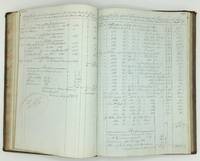
18521338Original manuscript. 1852-1854. Folio 38 x 27cm. Full contemporary reverse calf with gilt morocco titles labels to the spine "Rough Sales Book / S & L / B". Marbling to page edges. Marbled endpapers with engraved label for "Baily Brothers Booksellers Stationers Account Book Manufacturers" London to the front pastedown. 172pp. of manuscript text in ink on red-ruled laid paper watermarked "W. King / 1850" followed by c.160pp. blank with a handful of pages torn out following the conclusion of the manuscript text section and another within the text. The majority of entries are in English with some in Spanish mostly written in the same hand. Condition is very good the binding firm with marking to the boards chipping to the head of the spine and a little wear to the extremities. The contents with a 3cm tear to the head of the first text page and two pages partially cut/torn away at the bottom are otherwise in good order. The ledger of a British sales agents operating in Panama during the mid-nineteenth century detailing the importation and sale of a wide variety European and South American goods into the country.</p><p>The manuscript meticulously records the origin city/country importer ship the goods received and sold and the charges entailed for each shipment. A typical entry for example records the arrival of "gunpowder received per "Alexander" and sold on behalf of the Kames Gunpowder Company Glasgow" followed by details of the subsequent purchasers "J. D. Cordova" etc. and the charges/commissions taken by the agent including fees for landing expenses and "carriage to arsenal". </p><p>Many of the entries describe large diverse cargoes combining both essential and luxury goods including: alpacas; chocolate pots; "41 cases of pickles and mustard"; lavender water; rocking chairs; a "copying machine"; cinnamon; scissors razors; bone buttons; horse brushes; compasses; gin; hatchets; bedsteads; looking glasses; children's toys; cloves; muslins; kegs of shot; cups and saucers; tobacco; machetes; claret; playing cards rat traps; "Aqua de Colonia" cologne; silk gloves; saddles; blunderbusses; padlocks; lace; pantaloons; "Jamaica rum"; almonds; vinegar; bonnets; sausages; gold frames; water closets; wash stands; champagne; mosquito nets; and much else besides.</p><p>The origin ports include major European trade centres such as Liverpool and Glasgow but also include many South American ports such as Guayaquil Equador carrying beans cocoa coffee sugar and quinoa amongst other things; Buenaventura Colombia; Callao Peru carrying candlesticks coffee mills and bayonets; Lima Peru "bottled fruits" and cherry cordial; and Valparaiso Chile; as well as San Francisco and New York to the north. The importers themselves are also a mixture of British and Panamanian companies.</p><p>A fascinating detailed insight into Panama's transatlantic and South American trade during the mid-nineteenth century. [Original manuscript]. hardcover
191438258New York: Wittenberg Coal Company 1914. 8vo. 8 11/16 x 5 15/16 inches. 36pp. Early cloth backed boards original wrappers bound in.<br/> <br/> Provenance: Marinens Bibliotek old inked stamps; deaccessioned by the Garnisions Bibliotek in 2017<br/> <br/> Among the earliest directions for sailing through the Panama Canal.<br/> <br/> The Panama Canal opened to shipping traffic on August 15 1914. This work issued as a promotional piece by an American coal company prints Wilson's July 9 1914 Executive Order number 1990 which detailed the rules and regulations for ships passing through the canal. Unrecorded in OCLC. Wittenberg Coal Company unknown
1925227551925. Latin America SS Resolute voyage photograph album 1925 documenting a steamship journey through Central and South America during the interwar expansion of international maritime tourism following the opening of the Panama Canal in 1914. The photographs record port cities landscapes and civic landmarks encountered along the Pacific and Atlantic coasts of Latin America during a period when luxury liners increasingly connected North American travelers with destinations across the hemisphere. By the 1920s transisthmian canal travel had reshaped global shipping and passenger routes allowing cruise itineraries to combine Caribbean Pacific and South American destinations within a single voyage. The album preserves visual evidence of these emerging travel circuits while also documenting major urban and cultural centers of the region during a period of modernization and expanding hemispheric exchange.<br /> <br /> Photo album compiled during the 1925 voyage of the steamship SS Resolute containing approximately 150 original silver gelatin photographs mounted to black album leaves and captioned in white ink. Contemporary red leatherette album titled "Photographs" in gilt and bound with red cord. Photographs measure approximately 3 x 4 inches to 4 x 6 inches. The photographs document the vessel's route through Panama and the Canal Zone before continuing along the Pacific coast of South America and returning through the Atlantic basin. Numerous photographs depict Panama City and the Panama Canal including views of the Culebra Cut and Gold Hill major engineering features of the canal project completed little more than a decade earlier. Other sections of the album record urban and harbor scenes in Cartagena Colombia including colonial architecture and waterfront activity. Photographs from Peru show Lima's Plaza de Armas the bullring at Miraflores and rural Andean valleys near Arequipa with terraced agricultural landscapes and local communities. Images from Chile capture the steep hills and harbor districts of Valparaíso along with coastal plazas and naval vessels near El Morro. Additional photographs from Argentina depict major civic spaces in Buenos Aires including Plaza San Martín and Plaza de Mayo documenting the monumental architecture and modernizing urban landscape of the city during the 1920s.<br /> <br /> The steamship SS Resolute operated as a passenger liner serving long distance routes during the interwar expansion of luxury cruising and international tourism. Voyages such as the one recorded in this album reflected the growing accessibility of transcontinental travel made possible by the Panama Canal and by the increasingly global network of commercial steamship lines linking the Americas. Mild toning consistent with age; mounts and binding well preserved. Overall very good condition. The photographs collectively document a hemispheric itinerary connecting canal infrastructure colonial port cities Andean landscapes and rapidly modernizing capitals offering a visual record of the cultural and geographic environments encountered by travelers during the height of the steamship era. unknown
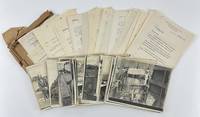
19365953Balboa Panama Canal Zone 1936. Very good. Eighty-four black-and-white or sepia-toned photographs each about 8 x 10 inches many with typed or manuscript captions on verso plus thirty-two typed documents some signed. Moderate edge wear occasional minor marginal chipping to photographs. Mostly minor wear to documents. A striking collection of photographs picturing construction of the Panama Canal during the years of the First World War. Many of the photographs are dated between 1914 and 1916 and almost all capture construction of the Panama Canal mainly around Dry Dock #1 at the Balboa and Pacific Terminals. Many of the photographs are captioned either typed or in manuscript on the verso providing valuable information on the settings of these images. Most of the images were taken from an elevated viewpoint from area towers offering unusual detail of the construction sites in the Balboa area "before flooding" of the canal with some images showing the canal "ready to be flooded;" the images taken at ground level also exhibit the sheer size and depth of the project with human figures dwarfed by the canal walls.<br /> <br /> A healthy number of images feature local workers of African descent engaged in manual labor on the walls and in the flat bottom of the canal. These workers are managed by a coterie of white subjects. In fact one of the more striking images speaks volumes about the literal separation between the managers and laborers in the Canal Zone. The photograph is a group shot featuring seventeen white managers standing in the foreground in front of a group of twenty-two Black workers.<br /> <br /> A sampling of the settings and activity revealed in the captions for the photographs include "Dy Dock #1 -- Entrance" "Placing granite in the hollow quoin -- Dry Dock No. 1 Balboa" "General view of Dry Dock #1 -- from the boom of Unloader Tower" "Progress of concrete in south wall as of Oct. 20 1914" "Head wall of Dry Dock #1" "Reinforcing around the suction chamber Dry Dock #1" "Dry Dock looking from the head wall west towards the sea" "D.D. excavation looking eastward toward headwall of the dock from the Coffer Dam" "Reinforcement in and around cross culverts at the west and end of Dry Dock #1" "Dry Dock #1 one month after commencing concrete work in the south wall" "Dry Dock No. 1 Pumping Plant -- Erecting 54-inch Check Valves -- Looking west" "General view of construction progress around pump well and discharge culvert -- Dry Dock" "Dry Dock Gate -- South Leaf -- Heel casting after wedges have been placed and rivets driven" "Reinforced concrete pontoons -- Preparing to pour concrete in No. 2 pontoon" and "Placing the last girder on dock gate Dry Dock No. 1 Balboa."<br /> <br /> The photographs are accompanied by a group of more than thirty military documents relating to the service of Major William C. Foote in the mid-1930s. Most of the documents concern Major Foote's assignment to the Coast Artillery Corps at Fort Amador in the Canal Zone in Balboa. Both the photographs and documents were found in a large envelope marked "Personal File Major William C. Foote." Finding the Panama Canal photographs along with Major Foote's later paperwork indicate that he probably acquired the photographs while serving in the Canal Zone and the material stayed together all these years. unknown
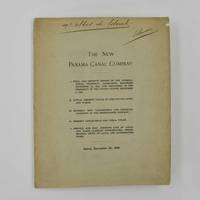
189821219591898. New York The Evening Post Job Printing House. Dated December 26 1898. 4to. Original printed wrappers; pp. 38 20 plates after photographs large folding sections in red and black large folding map in red and black; spine with few restorations small marginal flaw to front wrappers wire-stitched as issued with oxidization to wire-stitching; a very good copy of a great rarity presented to one Albert de Colomb with ink inscription to front wrapper.Very rare first edition. The first attempt to build the canal started under the leadership of Ferdinand de Lesseps proved to be a failure and the company collapsed in 1889. 'Although the company reorganized in 1894 it virtually ceased to function by 1898. Any possibility of completing the canal across Panama was gone; its sole hope lay in holding together an enterprise that could be offered for sale' Enyclopaedia Britannica. This rare document was compiled the by the International Technical Commission and assesses the possibility of resuming work which finally after difficult diplomatic negotiations and under the pressure of the United Stated and mainly supported by Roosevelt could be completed in 1914. An estimated 20000 lives were lost during the construction but the canal changed international shipping trade and the flow of goods for ever. unknown
1938158618N.p.: N.p. 1938. Archive of 64 vintage photographs including 53 matte-finish and eleven glossies documenting reconstruction of the Panama Canal's Dock 15 in Balboa. Most photographs with technical captions and dates from the negative on the rectos. Additionally included with the photographs is a collection of four booklets dated between 1919 and 1943 discussing various aspects of the canal's construction and improvements during that time as well as an original shipping envelope addressed from the Panama Canal Metal Trades Council. <br /> <br /> With Europe on the verge of war in the early 1930s the US government became increasingly concerned about its ability to move naval warships between oceans. The canal locks would be susceptible to bombing in the event of war the canal defenses were deemed inadequate and the locks already had difficulty accommodating large US battleships. As a result Congress passed a resolution on May 1 1936 authorizing a study of and subsequent improvements to the canal's defenses existing structure and vessel capacity. <br /> <br /> Originally constructed in 1911 Dock 15 was weakened by gradual earth movement necessitating its replacement. With the exception of the construction of the Madden Dam between 1930 and 1936 the $1220000 reconstruction of Dock 15 was one of the largest canal projects after the close of the construction era. <br /> <br /> Photographs: 61 photographs 10 x 8 inches 3 photographs 5 x 4 inches. Very Good plus lightly creased overall. <br /> <br /> Pamphlets: From 8 x 10.5 inches to 9 x 12 inches. Generally Very Good plus to Near Fine some with scattered foxing and edgewear. N.p. unknown
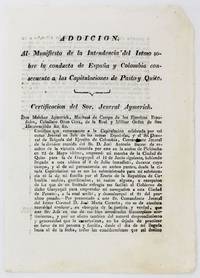
18235754Panama: Jose Maria Goytia 1823. Very good plus. Broadsheet handbill 8.5 x 6 inches. Minor creasing. Faint dampstaining at right edge. An extremely rare statement by Spanish general Melchor Aymerich following his final defeat in Ecuador by Antonio José Sucre and subsequent flight to Panama in 1822. Aymerich the "Mariscal de Campo de los Ejercitos Españoles" and "Jeneral en Jefe de las Armas Españolas" states that he and his family traveled lodged and ate at their own expense following his defeat at Pichincha by Sucre and subsequent capitulation. No money or provision of any kind was provided to them by the Republic of Gran Colombia. He continues to declare that they traveled from Quito to Guayaquil and thence to Panama and would soon be departing for Havana. While in Panama he was the guest of the Commandant of the Isthmus Colonel José Maria Carreno and he thanks the Colonel and his family for their generosity and assistance. Although the caption title of this broadsheet states that it is an "Addicion" to a lengthier "Manifiesto" this prior work does not seem to have survived.<br /> <br /> The present handbill is a very early Panamanian imprint. There is no evidence of there having been printing in Panama during its colonial period and exactly when the first press was introduced there is unclear. OCLC locates a single copy of a call for independence in New Spain published by the present printer José Maria Goytia in 1821 and vanishingly few issues of two newspapers established in 1822. Medina traces an 1822 sermon as printed in Panama and we locate a smattering of other imprints from this period including the present handbill of which OCLC notes a single copy at the John Carter Brown Library; we know of one other at the New York Public Library. Jose Maria Goytia unknown
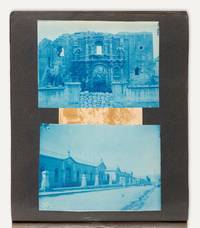
1918List2982Peru and Panama 1918. Approximately 364 photos; album and unmounted photos silver prints cyanotypes and printing-out-paper prints. Photos measure 3 x 4 to 8 x 10 inches with about half measuring 3 x 5 ½ inches. Some with photographer’s hand-stamp or credit in pencil; others with manuscript notations verso or recto; some captions to album pages. Offered in partnership with Daniel / Oliver.<br /> <br /> Rich and extensive photographic archive of Walton T. Burres of Stockton California showing his time in Peru c. 1904 as an amateur explorer and doctor for the Inca Mining and Rubber Company and his later work in Panama c. 1918 with the Rockefeller Foundation’s International Health Division.The collection consists of a large number of loose photos acquired by the gallery in 2021 and a recently discovered photo album showing some of the same subjects and containing a few duplicate images some printed in different sizes or formats as well as hundreds of previously unseen prints. Together this material makes up the largest extant archive of Burres’s photographic work. Though his work was published at the time both in Peruvian and American publications much of it was lost when he dropped it in a river that he was attempting to ford.<br /> <br /> Burres was educated at California’s Cooper Medical College the first school of medicine on the West Coast and was a prominent member of the Stockton community before sojourning to Peru around 1900 to help the Inca Mining and Rubber Company address the deadly diseases endemic to the region such as malaria and yellow fever. To encourage economic infrastructure in remote areas the Peruvian government began granting land concessions to any company that would build roads bridges or river ports. As a result the Inca Mining Company an American outfit based in Tirapata purchased the rights to mine gold along the upper Inambari River in 1896 and soon became the richest gold producer in Peru.<br /> <br /> A large portion of Burres’s Peruvian images document his 1903–1904 excursion from Arequipa 150 miles into “rubber country.†The journeys were well-recounted in U.S. papers and a number of the anecdotes described in print are seen in the present images.<br /> <br /> There are many dynamic views of Burres and his party trekking through the dense jungle and summiting the high mountains as well as shots of flora fauna and native Peruvians. Burres’s travel companions for this trip included the famed adventurer Harriet Chalmers Adams later dubbed “America’s greatest woman explorer†by the New York Times. Adams and her husband Frank both fellow Stocktonians joined up with Burres during their own multi-year expedition through South America. There are a number of portraits of a woman who bears a striking resemblance to Adams though it is possibly another person.<br /> <br /> Other Peruvian material includes numerous views of Cusco Arequipa and the surrounding environs including a beautiful interior of a chapel a Martin Chambi-esque detail shot of a stone wall and portraits of local townspeople some identified as Quechua people. There are a number of lush large-format cyanotypes rich printing-out-paper views and many handsome small-format panoramas. These were printed on Inca Mining Company surplus stationary which speaks to the makeshift nature of photo-development under the circumstances. One particularly striking image shows the top of Misti volcano barely visible above the clouds. This image was reproduced in Burres's account of his travels published in 1909 in Outing magazine.<br /> <br /> The photographs from Burres’s time in Panama document his more serious work as a virologist and health administrator in the area. One interesting photo shows a pair of recently-shot iguanas with a caption noting that “blood of these reptiles was found infected with Haemogregarina.†Another image is that of a new style of privy built from concrete and wire-mesh designed to better keep out rain water. There are also keenly-shot views of main streets and local culture in Los Santos Chiriquà and elsewhere including a number of humanistic group portraits taken at a girl’s school. unknown