171 résultats
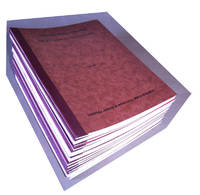
193851354Panama Canal: Hotel Tivoli & Hotel Washington 1938. 4to. 12 pp unpaginated. Printed in green & red throughout numerous green-tinted photos large double-page centerfold map of the Panama Canal showing the locations of the Hotels on the Caribbean and Pacific sides a couple smaller maps. Self-printed illustrated softcovers slight soiling very minor center creasing from fold still VG copy. First edition early printing of this scarce work extolling the virtues of vacationing at the famed Hotels Tivoli & Washington by the Panama Canal in the 1930s. The Hotel Washington was constructed and opened in 1913 and operated by the Panama Railroad Company by order of the Secretary of War to be operated for the Government. Built of concrete and cement blocks it was constructed in a modified Spanish Mission style that made it very comfortable and had a very large pool. The Tivoli Hotel was opened in November 1906 and served as the centerpiece of Canal Zone society until it closed in 1971 and President Roosevelt is considered the first person to have “officially†stayed at the Tivoli. Hotel Tivoli & Hotel Washington, paperback
1944455027.Gpaperback. Good. Access codes and supplements are not guaranteed with used items. May be an ex-library book. paperback
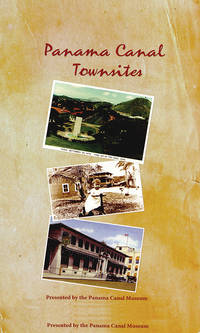
17090Panama Canal Company. 1975. Paperback. Very good. 8 x 10.5 inches with stiff cardboard covers manuals mostly about "Locks Division" canal repairs with frequent pictures. "Strut Arm Assembly Replacement Proceedure Chamber Caissons Installation And Removal Procedures Center Wall Culvert Inlet/Outlet Bulkheads Installation & Removal Procedures Installation Operation And Removal Of Culvert Dewatering Pumps Miter Gate Crank Gear Re0placement Procedures Center Wall Culvert Elevators Split Bevel Gear Assembly Center Wall Bulkheads In Side Wall Culvert Intake Screen slots Side Wall Culvert Intake Screens Chamber Dewatering And Filling Procedures Gatun Locks Installation And Removal Of Lateral Culvert Plugs and Side Wall Adit Drainage Culvert And T-Culvert Bulkheads. Panama Canal Company paperback
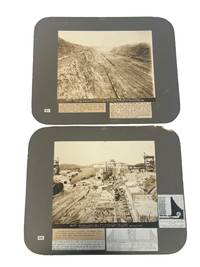
1912201831912. Panama Canal Early Photography Two large albumen photographs of the construction of the Panama Canal 1912. Photographs are pasted down to grey cardstock with captions and articles describing the imagery below. Photos measure 11" x 14". The building of the Panama Canal was not met with ease as the former French owned project was abandoned due to lack of investment and a high worker mortality rate and the grappling of territory between Panama Columbia and the United States. In 1903 Panama gained it's independence and as the United States recognized this Roosevelt used buying power to his advantage to funnel millions of dollars towards Panama and the funding of this project. These two photographs are early large scale displays of the massive amounts of land and infrastructure that went into this long awaited project. One photograph shows the Culebra Cut in June 1912. The article pasted to the front states that "To remove the 105000000 cubicyards of earth from the backbone of the Americas required about 6000000 pounds of high-grade dynamite each year to break up the material.in which time some 19000000 pounds were exploded in Culebra Cut only eight men were killed." The second photograph dated January 1912 shows the Miraflores Upper Locks with a diagram of what the final construction would look like. The photograph shows a partially built sill multiple tracks for hauling material heavy duty cranes and other industrial equipment. Thousands of local men were hired for this dangerous and underpaying job over the course of a decade. These Caribbean workers endured poor working conditions low wages and unbearable temperatures for a government that was not theirs over 5000 becoming casualties. By it's opening ceremony in 1914 The Panama Canal was the most expensive project in US history estimated at $350000000. These early photographs show only a portion of what went into this costly construction. Minor wear to edges of board upper right corner of one is chipped. Images are crisp and clear overall very good condition. unknown
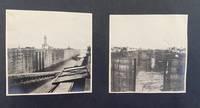
1920217831920. Archive of photographs documenting the Panama Canal and Indigenous communities in Panama in the early twentieth century ranging from the industrial landscape of the canal's construction and operation to the daily lives of Indigenous Panamanian peoples. The photographs reflect two intertwined yet often contrasting aspects of Panamanian history: the rise of industrial imperialism and the endurance of Indigenous culture. Archive of 33 silver gelatin photographs. Each measure between 4.5" x 2.5" to 3.5" x 2.25". <br /> <br /> The series prominently features engineering achievements along the canal route. Images include multiple angles of locks and lift bridges such as the Miraflores Pedro Miguel and Gatun Locks as well as steamships and freighters navigating through the canal and moored along its edges. Several views capture drawbridges in operation mechanical infrastructures like lock control houses and long rail-lined chambers used to elevate ships across Panama's central isthmus. A few aerial or elevated shots emphasize the canal's monumental scale revealing vast water channels and industrial zones carved through jungle terrain. A second subset of photographs focuses on the Welland Ship Canal in Ontario Canada suggesting a comparative or thematic link between North American waterway engineering and the Panama Canal project-possibly compiled by a traveler engineer or canal enthusiast.<br /> <br /> In contrast the ethnographic photographs document Indigenous Panamanian groups-most likely Guna Kuna and Emberá-Wounaan peoples-living in thatched-roof villages dressed in traditional textiles body paint and adornments. Several portraits show children and adults standing in front of woven bamboo huts while others portray groups in ceremonial or communal settings. The camera's perspective suggests a Western possibly touristic or anthropological gaze reflecting the era's colonial attitudes toward Indigenous populations. The Panama Canal completed in 1914 under U.S. control after a failed French attempt was one of the most ambitious engineering projects of the 20th century. It transformed global maritime trade by connecting the Atlantic and Pacific Oceans through Central America. The canal's construction required the displacement of communities massive deforestation and the recruitment of tens of thousands of laborers primarily from the Caribbean who worked under harsh and segregated conditions.<br /> <br /> Indigenous populations in the canal zone and surrounding regions were deeply affected by this transformation. Their lands were often appropriated for canal infrastructure military zones or settler expansion. Cultural disruptions ecological degradation and restricted access to traditional territories became ongoing challenges. At the same time Indigenous communities-especially the Guna-resisted assimilation and maintained distinct cultural practices leading to moments of organized resistance like the 1925 Guna Revolution which asserted political autonomy in the face of Panamanian and U.S. pressures. This archive preserves a multifaceted visual history of Panama at a time of profound transition. The industrial photographs document the ambitions and outcomes of a modern imperial project while the ethnographic images capture Indigenous identities that persisted despite external pressures. Together they offer insight into the tensions between modernization and tradition progress and displacement-narratives that continue to shape Panama's national story today. unknown
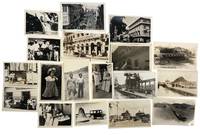
1900225611900. Latin America Panama City and the Canal Zone at the beginning of the 20th century photo archive featuring a range of architectural infrastructural and cultural subjects reflecting the western urbanization and colonial history of the area. Archive of 15 sepia toned real photo postcards. Each 3.5" x 5.5". The archive documents the transformation of Panama during the era of U.S. construction and administration of the Panama Canal and the subsequent urban growth of the capital. Many are captioned at the bottom in the negative.<br /> <br /> The collection includes multiple views of the Panama Canal itself such as "Opening Gates Pedro Miguel Locks" "Miraflores Locks Panama Canal" and a wide-angle vista from the Pacific side capturing the engineering marvel that reshaped global commerce. Urban scenes emphasize both civic life and colonial remnants: the "American Cabaret" façade crowded with pedestrians the Panama City railway station with carriages at its entrance and the Cathedral Plaza shown both from street-level and aerial perspectives. Religious heritage appears in the richly photographed "Golden Altar of San José" a baroque altar famously saved from pirate depredation by being painted black. Other views include the Old Spanish Fort tower ruins panoramic shots of the city grid ships moored in Balboa harbor and even the bullfighting ring situating Panama as both modernizing and deeply layered with colonial past. Minor handling wear and faint edge toning to some images remain crisp and clean. Overall very good condition. This archive offers a rich visual record of Panama at a pivotal historical moment combining imagery of U.S. imperial engineering with local cultural life and colonial heritage making it a valuable resource for scholars of Latin American history U.S.-Panama relations and the history of global infrastructure. unknown
1910226891910. Unknown photographers early twentieth-century Panama photo archive circa 1910s to 1920s documents Panama during the decades surrounding the completion and early operation of the Panama Canal supporting research into U.S. engineering influence urban modernization Indigenous representation tourism waterfront labor and the transformation of Panama City and Colón into canal-era commercial spaces. The Panama Canal was completed and opened in 1914 linking the Atlantic and Pacific through one of the period's most consequential engineered waterways and the Gatun Locks formed part of the lock system that lifted vessels to Gatun Lake before lowering them at the opposite end of the route. These photographs record not only canal machinery and civic streets but also the human geography around the canal: tourists workers traders children waterfront activity ruins and leisure businesses appear together in a visual record of Panama's modernization under strong American commercial and infrastructural presence.<br /> <br /> Fifteen pieces comprising fourteen silver gelatin photographs and real photo postcards with one printed business advertisement card Panama circa 1910s to 1920s measuring approximately 2½ x 3¾ inches to 4 x 6 inches. The canal views include "Operating Emergency Dam Gatun Locks Panama Canal" and a view captioned "Gatun Locks" showing massive steel gates and early twentieth-century bridgework. Urban scenes include "Street Scene Panama City on Southern Cruise 1923" with American tourists Model T automobiles and colonial façades and "The Plaza Panama City" showing palm trees streetcar tracks and civic space. Local and historical subjects include a real photo postcard captioned "Circular Stairway in Old Panama ruins of Old Panama standing at the foot and looking directly up" documenting Panama Viejo the site of the original Panama City founded in 1519 and later recognized as part of a UNESCO World Heritage site. Other images include "Panama Water Front at High Tide" with fishing boats and market activity; dockworkers and traders near the canal's edge; and "Children in San Blas Panama" foregrounding Indigenous presence during the Canal era. The San Blas Islands are associated with the Guna an Indigenous people of Panama and Colombia whose communities are strongly identified with Guna Yala and the San Blas archipelago. <br /> <br /> The advertisement card reading "When in Colon Visit the Café Hollywood" places the photographic group within the leisure and service economy that grew around canal traffic tourism and foreign presence. Together the images clarify the different but connected worlds of early twentieth-century Panama: the engineered landscape of Gatun Locks the colonial and modern streets of Panama City the ruins of Old Panama the working waterfront Indigenous children in San Blas and the commercial culture of Colón. Minor corner wear and toning; images sharp and well preserved very good overall. Cohesive Panama Canal era archive documenting the intersection of American engineering urban transformation Indigenous life waterfront labor and tourist commerce in the early decades of the Canal Zone. unknown
1920230431920. Panama City photograph archive ca. 1920s documenting the urban environment of the Panamanian capital and the infrastructure of the Panama Canal during the decades following the canal's opening in 1914. The photographs record the interconnected worlds of canal engineering international commerce tourism and everyday street life that developed as Panama City became a strategic hub of global shipping and American geopolitical influence in the Caribbean basin. Urban scenes depict commercial storefronts streetcars automobiles and pedestrian activity along central avenues while other photographs capture the canal's mechanical landscape of locks spillways and industrial structures. Together the images illustrate the transformation of Panama City into a cosmopolitan port city shaped by canal traffic international trade and the presence of the U.S. Canal Zone administration.<br /> <br /> Archive of eighteen original silver gelatin photographs depicting Panama City and surrounding canal infrastructure. Each measure approximately 3.5 x 5.5 inches. Several images show major canal engineering features including a photograph captioned "Purifying Plant and Spillway - Panama Canal" as well as views of lock systems and canal transport routes where cargo vessels pass through the waterway. Urban photographs record commercial and entertainment districts including a façade marked "American Cabaret" a busy street labeled "Street Scene - Panama City" and a view of the Hotel Central along a principal thoroughfare lined with automobiles and electric streetcars. One photograph bears the caption "264 - President's Palace on day of Riot Panama 2-28-." showing crowds gathered along balconies and streets near the presidential residence during a moment of public unrest. Additional photographs document daily life and local commerce including outdoor market scenes pedestrians and vendors workers posing near canal machinery and residents standing beside storefront displays. Landscapes and travel images appear as well including a waterfall and rural roadside scenes with automobiles indicating the expansion of modern transportation and tourism into the Panamanian countryside during the early twentieth century.<br /> <br /> The photographs collectively capture the layered social and industrial landscape that emerged in Panama after the completion of the Panama Canal when the city became a focal point of hemispheric trade and international transit. The canal drastically shortened maritime routes between the Atlantic and Pacific Oceans and reshaped the economy of the Caribbean and Pacific coasts of the Americas. Panama City consequently developed a complex urban culture combining local Panamanian communities canal workers foreign merchants travelers and U.S. officials connected to canal administration. Light surface wear and minor edge handling visible on several prints overall very good condition. These images document that environment through views of transportation infrastructure entertainment venues commercial streets and civic spaces offering a visual record of Panama City during the formative decades of the canal era. Photographs measure approximately postcard size. unknown
1904182051904. Photograph album circa 1904-1914 documenting maritime activity canal construction and social life in Panama during the period of American engineering control of the Panama Canal project. The images center on a group of American men traveling aboard a small yacht identified in several photographs by the presence of the American yacht ensign indicating a private pleasure vessel rather than a military or commercial ship. Several photographs appear to show large-scale excavation and infrastructure consistent with canal construction situating the album within the decade of intensive labor and engineering that culminated in the canal's completion in 1914. Alongside these scenes are numerous images of local life including Indigenous children and adults along coastal and riverine environments as well as built landscapes featuring plantation-style houses adapted to tropical climates. The album provides visual evidence of the intersection of American presence large-scale infrastructure development and local communities in early twentieth-century Panama.<br /> <br /> Photograph album containing images mounted on black pages within a black leather-bound volume measuring approximately 10 x 7 inches and comprising 86 pages. The photographs depict shipboard life including crew members steering and managing vessels group portraits of men in bathing attire and social gatherings such as shared meals. Additional images show coastal scenes with canoes swimmers and shoreline activity as well as occasional figures in military dress. The composition of the album reflects both travel documentation and informal social photography capturing a range of maritime domestic and environmental subjects.<br /> <br /> 86-page album with photographs mounted throughout; one page partially clipped and one page removed with small tears to several pages not affecting images. Light sunning to some photographs; overall very good condition. A cohesive visual record of American maritime travel and canal-era activity in Panama documenting both infrastructure development and everyday life in the region. unknown
1915224481915. Unknown photographer Panama Canal Zone and local life photo archive 1915 documents Panama during the first year after the canal's opening to traffic and supports research into U.S. imperial administration Canal Zone settlement travel photography military protection of infrastructure and the visual ordering of colonial space. The Panama Canal opened to traffic on August 15 1914 after U.S. construction created a strategic interoceanic route administered through the Canal Zone and Balboa Heights became a key administrative and residential center for the U.S.-controlled canal system. These photographs capture the built and natural environment through which American authority was made visible: locks river landscapes official buildings hilltop housing city views and naval practice appear together as evidence of a recently completed engineering project becoming an occupied administrative territory.<br /> <br /> Twenty-four original silver gelatin photographs including two real photo postcards dated 1915 with some undated images several with handwritten inscriptions in English on versos and some with printed captions on rectos. Photographs measure approximately 3½ x 5 inches to 5½ x 7 inches. The archive includes views of the Chagres River the largest river in the Panama Canal drainage basin and a major part of the canal water system together with photographs of the Gatun Locks canal gates aerial views of Panama City the main city plaza a bull ring and Balboa Heights. The Balboa Heights images show American-style bungalows arranged along curving terraced roads with broad verandas raised foundations and landscaped grounds visual evidence of the residential hierarchy attached to U.S. canal administration. Additional images show the Administration Building at Balboa Heights completed in 1914 and positioned above the town as a central administrative landmark while a real photo postcard captioned "Ready to Fire-Division Practice" shows U.S. naval boats in formation off the coast connecting sightseeing views to the military protection of the newly opened canal.<br /> <br /> The archive's research value lies in its combination of personal travel documentation official-looking captioned views urban and infrastructural scenes and military imagery from the early Canal Zone era. Its views of Balboa Heights are especially significant because U.S. canal society was organized through racialized and occupational distinctions including the "gold roll" and "silver roll" labor categories that separated white American workers from largely Black Caribbean and Latin American workers and shaped housing pay and privilege within the zone. Light edge wear legible inscriptions and preserved image surfaces very good overall. Cohesive Panama Canal Zone photo archive documenting the immediate post-opening landscape of U.S. power in Panama through canal infrastructure river systems segregated administrative space urban views and naval readiness. unknown
192328406Mount Hope CZ: Panama Canal Press 1923. First edition. Stapled paper wrappers. A very good copy some sunning to the wrappers small tear along the fore edge of back wrapper and a few leaves. 12 pp. 8vo. A note states: "This information is provided for a handy reference and style guide for machine operators proof readers and reviewers employed at the Panama Canal Press." Includes ship names dimensions tonage etc. Scarce. OCLC shows no copies. Panama Canal Press unknown
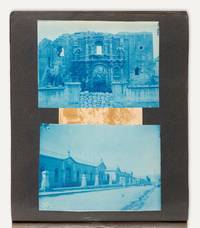
1918List2982Peru and Panama 1918. Approximately 364 photos; album and unmounted photos silver prints cyanotypes and printing-out-paper prints. Photos measure 3 x 4 to 8 x 10 inches with about half measuring 3 x 5 ½ inches. Some with photographer’s hand-stamp or credit in pencil; others with manuscript notations verso or recto; some captions to album pages. Offered in partnership with Daniel / Oliver.<br /> <br /> Rich and extensive photographic archive of Walton T. Burres of Stockton California showing his time in Peru c. 1904 as an amateur explorer and doctor for the Inca Mining and Rubber Company and his later work in Panama c. 1918 with the Rockefeller Foundation’s International Health Division.The collection consists of a large number of loose photos acquired by the gallery in 2021 and a recently discovered photo album showing some of the same subjects and containing a few duplicate images some printed in different sizes or formats as well as hundreds of previously unseen prints. Together this material makes up the largest extant archive of Burres’s photographic work. Though his work was published at the time both in Peruvian and American publications much of it was lost when he dropped it in a river that he was attempting to ford.<br /> <br /> Burres was educated at California’s Cooper Medical College the first school of medicine on the West Coast and was a prominent member of the Stockton community before sojourning to Peru around 1900 to help the Inca Mining and Rubber Company address the deadly diseases endemic to the region such as malaria and yellow fever. To encourage economic infrastructure in remote areas the Peruvian government began granting land concessions to any company that would build roads bridges or river ports. As a result the Inca Mining Company an American outfit based in Tirapata purchased the rights to mine gold along the upper Inambari River in 1896 and soon became the richest gold producer in Peru.<br /> <br /> A large portion of Burres’s Peruvian images document his 1903–1904 excursion from Arequipa 150 miles into “rubber country.†The journeys were well-recounted in U.S. papers and a number of the anecdotes described in print are seen in the present images.<br /> <br /> There are many dynamic views of Burres and his party trekking through the dense jungle and summiting the high mountains as well as shots of flora fauna and native Peruvians. Burres’s travel companions for this trip included the famed adventurer Harriet Chalmers Adams later dubbed “America’s greatest woman explorer†by the New York Times. Adams and her husband Frank both fellow Stocktonians joined up with Burres during their own multi-year expedition through South America. There are a number of portraits of a woman who bears a striking resemblance to Adams though it is possibly another person.<br /> <br /> Other Peruvian material includes numerous views of Cusco Arequipa and the surrounding environs including a beautiful interior of a chapel a Martin Chambi-esque detail shot of a stone wall and portraits of local townspeople some identified as Quechua people. There are a number of lush large-format cyanotypes rich printing-out-paper views and many handsome small-format panoramas. These were printed on Inca Mining Company surplus stationary which speaks to the makeshift nature of photo-development under the circumstances. One particularly striking image shows the top of Misti volcano barely visible above the clouds. This image was reproduced in Burres's account of his travels published in 1909 in Outing magazine.<br /> <br /> The photographs from Burres’s time in Panama document his more serious work as a virologist and health administrator in the area. One interesting photo shows a pair of recently-shot iguanas with a caption noting that “blood of these reptiles was found infected with Haemogregarina.†Another image is that of a new style of privy built from concrete and wire-mesh designed to better keep out rain water. There are also keenly-shot views of main streets and local culture in Los Santos Chiriquà and elsewhere including a number of humanistic group portraits taken at a girl’s school. unknown
19602090202120412948Not Available 1960. Soft Cover. Fine. Number of books: 1 Not Available paperback
183956498Washington: 1839. 8vo. In later half cloth with gilt lettering to spine. Library labels pasted on to front and back board. Library stamp to to pasted down front end-paper and library label pasted on to pasted down back end-paper. Reapirs to last 5 leaves of "Potomac Aqueduct" with some loss of text. 81 1 167 pp. 6 folded plates. hardcover
1528540611.Gpaperback. Good. Access codes and supplements are not guaranteed with used items. May be an ex-library book. paperback
1993265010PN. New. 1993. Soft Cover. Date is original print. This is a reprint edition . PN paperback
191326706Tegicigalpa: Tipografia Nacional 1913. Wraps. Good. 26 pages. Printed yellow wrappers. 7 3/4 x 11 inches. Browned paper uncut and unopened. Dampstaining near spine in several places throughout. A scarce publication. Wraps. Rough english translation: "Regulation of the Honduras Section at the Panama-Pacific International Exposition San Francisco California 1915: approved by supreme agreement of May 28 1913 . followed by the Regulations and Rules for Reporting and Guidance of Those Who Claim to Participate in she dictated by the President of The Expresada Exposicon And Corrected And Approved By The Same Tipografia Nacional unknown
1010939556.Gpaperback. Good. Access codes and supplements are not guaranteed with used items. May be an ex-library book. paperback
1275448984.Gpaperback. Good. Access codes and supplements are not guaranteed with used items. May be an ex-library book. paperback
0243221606.Gpaperback. Good. Access codes and supplements are not guaranteed with used items. May be an ex-library book. paperback
0656457686.Ghardcover. Good. Access codes and supplements are not guaranteed with used items. May be an ex-library book. hardcover
a658891961-1962. 4 issue of this monthly bulletin. In Spanish. 4to. about 15 leaves rectos only per issues stapled wraps. Goodsome wear; lightly toned. . paperback
1990231067PN. New. 1990. Soft Cover. Date is original print. This is a reprint edition . PN paperback
190324029no place: Panama Railroad Company Panama Railroad Steamship Line 1903. Original edition. Hardcover. Near fine. 30 pp. 4.5 x 6.75 inches original brown cloth. <br/><br/>Explicit rules of conduct and protocols for employees of the Panama Railroad Company. Scarce. Panama Railroad Company, Panama Railroad Steamship Line hardcover
192531179PRIMERA EDICION.- Madrid: Ed. Marineda Libr. de Alejandro Pueyo 1925.- 206 p. 1 h.; 8º 19 cm.; Intonso con todas sus barbas; Rústica Ed. pintada a todo color por "Quesada Hoyo".- Importante autor panameño que nos narra en este libro su viaje desde Cuba rumbo a El Havre. Es libro ameno plagado de interesantes reflexiones algunas de ellas referentes a la MASONERIA con la que simpatiza sin ningún disimulo. Incluye el libro un verso traducido del francés que según el autor es una ORACION DEL MASON. RARO. LITERATURA ESTUDIOS LITERARIOS FILOSOFÃA Y PENSAMIENTO IBEROAMERICANO EN GENERAL Libro en español Ed. Marineda paperback