[Border War]. [Oregon]Biblio.com

193 résultats
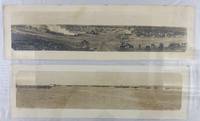
19163738N.p. probably Portland 1916. Near fine. 36pp. plus two multi-panel folding panoramic photographic plates. Original tan wrappers printed in brown accompanied by original printed mailing envelope reading "A Souvenir of The Third Oregon Infantry on the Mexican Border." Very light wear. A scarce work featuring the officers staff and soldiers of the Third Oregon Infantry while stationed on the Mexican border near San Diego during the conflict with Mexico just before World War I. The work includes field and staff lists rosters organized by company and a list of "men who have enlisted at Clackamas since the Regiment left" in the summer of 1916. The work is profusely illustrated with photographs of each company within the text usually on the recto facing the roster lists. Each inside cover includes a folding panoramic photographic plate - the first titled "First Battalion at San Diego Exposition July 9 1916" and the second featuring the "Third Battalion on the Border - Mexico in the Background." Both panoramic images were produced from photographs by O.A. Tunnell. unknown
19162445Brownsville 1916. Very good. Panoramic photograph approximately 7.5 x 39.5 inches. Mounted on card manuscript identifications along foot. Light wear minor soiling. A large formal portrait of Troop C of the 1st Virginia Cavalry in camp at Fort Brown Brownsville Texas. National guard units were called up in 1916 to guard the border while General Pershing made his incursions into Mexico against revolutionary and regular military units involved in the Mexican revolution and civil war of the 1910s. The image depicts the entire troop mounted in a single file with the commissioned officers at far left sixty-six men in all. Although the photographer does not identify himself each man in the unit is named in clear manuscript along the foot of the photograph making the present image a valuable record of the Virginia Cavalry's service in Texas during the Border War. unknown
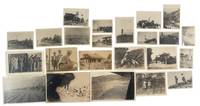
1910218961910. Large photograph archive circa 1910s-1930s documenting U.S. and Mexican military presence along the Rio Grande border and in Sinaloa during a period of revolution intervention and military modernization. The photographs depict soldiers fortifications and daily military activity across multiple locations providing primary-source visual evidence for the study of U.S.-Mexico border tensions the Mexican Revolution and interwar military development. One photograph identified en verso as taken at the "United States Immigration Station on the Rio Grande River - Border Service - 1916" situates the archive within the period of the Mexican Revolution and the U.S. Punitive Expedition while other images extend into the 1920s and 1930s reflecting continued military presence and surveillance.<br /> <br /> Archive comprises 22 vernacular silver gelatin photographs ranging from approximately 3.25 x 5.5 inches to 4.5 x 6.5 inches several with manuscript annotations en versos and studio stamps including "Laboratorio Vega Mazatlán Sin." and "La Foto Madero 42." Images include U.S. soldiers positioned atop sandbag fortifications with rifles standing at border outposts and posing beside military vehicles including an early Dodge touring car. Mexican Army scenes depict officers and enlisted men in varied uniforms including kepis and high-collared tunics assembled in formations occupying trenches and constructing earthen defenses. A photograph inscribed "12º Rgto. Mazatlán Sin. Marzo 1929" identifies the 12th Infantry Regiment during a coastal inspection. Additional images show cavalry units riding in formation across fields soldiers resting near agave plants and encampments along beaches with troops engaged in labor or recreation. One aerial photograph taken from a biplane captures a valley settlement while another image shows a rural structure marked "U.S. 19" on its roof suggesting identification or surveillance use. Across the archive soldiers appear in both formal and informal groupings sometimes posed in relaxed settings with visible gestures of camaraderie.<br /> <br /> These photographs document a period of sustained militarization along the U.S.-Mexico border and within northern Mexico following the upheaval of the Mexican Revolution and subsequent stabilization efforts. The presence of both U.S. Border Service personnel and Mexican Army units illustrates parallel and overlapping military activities including patrol construction and occupation of strategic terrain. The imagery of trenches transport and aerial observation reflects evolving military practices in the early twentieth century while the combination of formal and informal scenes provides insight into daily life within these environments. Surface wear to several prints; overall very good condition. A concentrated visual record of binational military activity and borderland conditions during a formative period of regional conflict and modernization. unknown
19912082702114611734Sada Sanman En Shinjin Oraisha Heisei 3-5 1991. Soft Cover. Fine. The book is in fine condition. Sada Sanman En Shinjin Oraisha Heisei 3-5 paperback
19163127El Paso Tx: J.W. Medley & I. Shulman 1916. Good plus. About 9.5 x 51.25 inches. Backed on board. Some tanning to board. Minor spotting along edges minor staining and some surface lift along top left edge left edge and left bottom edge from being previously framed. One of a group of panoramic photographs depicting Camp Stewart at El Paso during the Mexican Revolution 1910-1919 known here as the Mexican Border War or Pershing's Punitive Expedition. The camp was set up in 1916 and the goal of the conflict was to stop Pancho Villa's military actions on the United States side of the border. American and Mexican forces pursued Villa for months and managed to quash the rebellion but Pancho Villa himself was never captured. This photograph provides a good view of the tents and small building erected in this dry Texas landscape. The photographers J. Urban Medley and Isaac Shulman of El Paso Texas were prolific chroniclers of the American Southwest and Mexican borderlands with a studio at 1709 Montana. A striking panoramic image of a large camp near El Paso during the Texas Border War. J.W. Medley & I. Shulman unknown
19163373McAllen: Photo. by Murff & Robinson 1916. Very good. Two panoramic photographs measuring 8 x 28 and 8 x 26.5 inches. Rolled. A couple of short closed tears and small perforations otherwise minor wear and soiling. Two detailed panoramic photographs that depict the First Cavalry Regiment of the New York National Guard one unit of the 15000 guardsmen from the state that were sent to garrison the Rio Grande in South Texas during the Border War with Mexican revolutionaries and Pershing's Punitive Expedition against Pancho Villa. The New Yorkers were stationed at inadequate parched camps in Mission McAllen and Pharr. The slightly larger of the two images here shows the camp of the First Cavalry at McAllen with field tents and temporary camp buildings on the left and the regiment's allotment of horses tethered together at right. The second images shows the unit on parade being reviewed by General Frederick Funston the commander of the border garrisons. The photos are each captioned in the negative and dated August 28 1916 and October 1 1916 respectively. Scarce images of New York's encampment in Texas during the Border War. Photo. by Murff & Robinson unknown
19522082702114611533Yamaguchi Prefecture Agricultural Group History Compilation Committee 1952. Soft Cover. Fine. Number of books: 1 Yamaguchi Prefecture Agricultural Group History Compilation Committee paperback
19362082702114600105Kobakuzan Manpuku-ji Temple Edition 1936. Soft Cover. Fine. Number of books: 1 Kobakuzan Manpuku-ji Temple Edition paperback
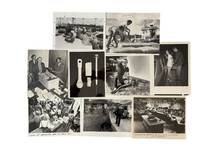
1970216021970. African American Latino History Criminal Justice Photography Unidentified press photographers War on Drugs photographs 1974 to 1992 document law enforcement operations arrests and media coverage of drug enforcement in Texas during the expansion of federal and local anti narcotics campaigns. Produced for newspaper circulation by the Houston Chronicle and the Associated Press the images provide direct evidence of policing practices surveillance and public presentation of drug enforcement activities across multiple decades. The archive supports research into racial disparities in policing the growth of coordinated federal and local enforcement systems and the role of press photography in shaping public understanding of crime and punishment during the late twentieth century.<br /> <br /> Texas primarily Houston and El Paso 1974 to 1992. Archive of 9 original silver gelatin press photographs with printed and typed captions on versos. Images include a 1974 photograph of Drug Enforcement Administration agents seizing a large marijuana cache from a tugboat; a 1975 Associated Press image displaying cocaine and heroin paraphernalia accompanied by a caption describing drug use in social settings; a 1979 photograph of the El Paso Intelligence Center identified as the control center of federal drug enforcement operations; and multiple photographs from the 1980s and early 1990s depicting arrests raids and evidence seizures. One image labeled "Operation Crackdown" shows a group of detainees with hands restrained behind their backs gathered at a temporary booking site surrounded by officers and paperwork processing tables. Another photograph captures an undercover officer restraining a young Black man outside an apartment complex during an arrest. A photograph dated April 27 1992 shows officers recovering firearms and suspected narcotics from a vehicle in a dealership parking lot accompanied by an assignment sheet describing a police chase and subsequent arrest. Additional images include a 1990 multi agency raid involving federal and local authorities using a trained detection dog identified as "Magnum" with annotations indicating restrictions on identifying agents.<br /> <br /> The archive situates drug enforcement within the broader expansion of the War on Drugs a policy framework that intensified policing surveillance and incarceration beginning in the 1970s and continuing through the end of the twentieth century. These photographs document the coordination between agencies such as the Drug Enforcement Administration U.S. Customs and the Federal Bureau of Investigation as well as the increasing visibility of enforcement through media distribution. The repeated depiction of arrests and controlled displays of seized materials underscores the public facing dimension of these operations while the imagery of detainees and targeted enforcement reflects documented disparities in how drug laws were applied across racial and socioeconomic groups. Light handling wear with minor surface marks typical of press photographs; captions remain legible. Overall very good condition. A concentrated visual record of law enforcement practice media representation and the social impact of drug policy in late twentieth century Texas. unknown
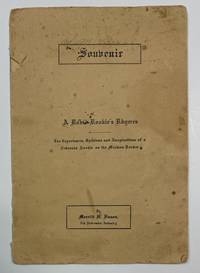
19164822N.p. possibly Brownsville Tx 1916. Very good. 111pp. Original tan printed wrappers stapled. Wrappers soiled partially split along spine penciled ownership signature on front cover. Light creasing occasional minor foxing to text. An unrecorded collection of poetry by First Sergeant Merritt H. Fuson of the 5th Nebraska Infantry capturing military life during the U.S.-Mexico Border War in 1916-1917. Sergeant Fuson's poems begin with "A Rookie's Prayer" and generally describe the incessant drilling and preparations for battle in southern Texas. One of the poems was given to Fuson before he left home and one other poem is credited to a "Minnesota artilleryman name unknown" but the remainder of the poems appear to be authored by Fuson himself. Fuson's poem "War Is Hell" particularly encapsulates the difficulties of military camp life during his service but does not capture the horrors of war which Fuson apparently never experienced. Fuson does express his desire to return home to Nebraska in at least two poems and his homesickness comes through in others in passages such as "Sing a song of Texas Drill and sweat and dig One Nebraska soldier Dirty as a pig." The 5th Nebraska Infantry had a short and uneventful stay in Llano Grande outside Mercedes in the McAllen-Brownsville region of south Texas. They arrived in July 1916 and drilled and camped until returning to Nebraska in February 1917. An interesting collection of wartime poetry by a young Nebraska man serving in the Texas-Mexico borderlands. No copies in OCLC auction records or any other sources we consulted. unknown
191612895Des Moines IA: Hebard-Showers Company September 1916. Panoramic photograph 8 x 37.5 inches with numerous captions in the negative. Rolled tightly. A few soft creases minor wear at bottom right corner. Very good. An unusually informative panorama of Brownsville and Matamoros taken from the American side of the Rio Grande during the heat of the Mexican Revolution. The photograph was produced by the form of Hebard-Showers here spelled Hedard-Showers likely scratched backwards in the negative of Des Moines Iowa. The image captures the scene along the Red River from a portion of Fort Brown in the east west to Brownsville's Union Station with the International Bridge visible downriver. Directly across the river from Brownsville is labeled "Santa Cruz Mexico" with Matamoros a bit further south. Other landmarks identified on the Brownsville side include the aforementioned Union Station and the International Bridge as well as Fort Brown a river landing the customs house and various locations for American state guard units. Near the landing is the Brownsville Transfer Company's building.<br /> <br /> More pertinent to the Mexican Revolution are some of the captions identifying locations on the Mexican side. These include "Casa Mata Fort or place of execution" "Blanco's Battlefield June 3rd 1913" and "Villa's Battlefield March 27 - Apr. 13 1915. 100 Killed." Also identified on the Mexican side are a Mexican bull ring the "Bone yard" and a river landing. Interestingly a small rowboat containing a few people can be seen approaching the Mexican side on the Rio Grande.<br /> <br /> Naturally Hebard-Showers Company mainly documented Des Moines and its surrounding areas but they shot a handful of Brownsville border views over several years at least between the present example and about 1921. SMU holds an example of the later panorama; comparisons between the present example and SMU's does reveal some changes in the area over the course of those five years and the present example includes many more detailed captions in the negative. Hebard-Showers Company, September unknown
1998303046New York: Alfred A. Knopf 1998. First editions of the Border Trilogy. 3 vols. 8vo. All in quarter black cloth and black boards. Fine in fine unclipped pictorial dust-jackets designed by Chip Kidd. First editions of the Border Trilogy. 3 vols. 8vo. Alfred A. Knopf unknown books
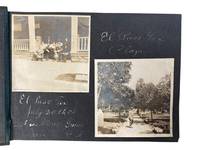
1905231541905. Texas HistoryBorderlands U.S.-Mexico borderlands photograph album 1905-1906 centered on El Paso and Juárez with additional views in New Mexico Arizona California Oregon and Alaska. The album documents an early twentieth-century traveler's movement through the southern border of the U.S. when El Paso and Ciudad Juárez were being promoted through rail travel tourism and cross-border entertainment and when American visitors regularly treated Mexican religious sites plazas bullrings and street life as part of a border excursion circuit. Its strongest historical value lies in the concentration of images tied to the Texas-Mexico border including Juárez bullfight and cockfight scenes street and church views and domestic group portraits in El Paso alongside a labeled photograph of a Santo Domingo Pueblo corn dance likely Kewa Pueblo north of Albuquerque showing non-Native travelers recording Indigenous life in the Southwest.<br /> <br /> Photograph album containing 81 original photographs most measuring approximately 2 x 3 to 4 x 5 inches mounted on thick black paper leaves in a cloth-bound album. Contemporary manuscript captions identify numerous locations and subjects including "El Paso Tex" "Juarez Mex" "Bull Fight" "Cock Fight" "Near Albuquerque 1906" "1906 New Mexico" "New Mexico 1905" "Juarez Mex Church over 350 years old" and "Corn Dance. Santo Domingo." Visible subjects include family and social group portraits posed on porches and in front of residences; women in white dresses and men in coats hats and ties; a tree-lined park path in El Paso; religious architecture and church interiors in Juárez; a fountain identified as Robinson Park in Albuquerque; river and landscape views labeled Rio Grande; a saguaro cactus study; a donkey; a seated elderly woman in a doorway; and multiple arena photographs showing matadors horses attendants spectators and ring action in Juárez. Several photographs bear later ink inscriptions including one later image of five men captioned "Alaska" en recto and with names on verso including "Mayor Goldstein" a prominent Jewish businessman and six time Juneau Mayor Isadore Goldstein.<br /> <br /> The album records border travel encompassing scenes of domestic life in El Paso tourism in Juárez and excursions into New Mexico and the wider West. The Juárez images are especially strong preserving direct vernacular views of public spectacle in the bullring and cockfight pit as well as church architecture and urban settings seen from the perspective of a visiting American observer. Photographs mounted throughout; some images faded or silvered with scattered surface wear corner wear occasional discoloration and a few later annotations or tape remnants visible. Overall very good condition. unknown
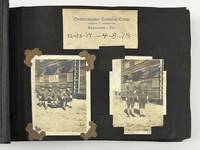
19182322Various locations in Texas 1918. Very good. Fifteen leaves illustrated with fifty-five mounted photographs and a few ephemeral clippings identifying locations. Oblong octavo. Contemporary black cloth string-tied. Light soiling to covers. Minor wear to some photographs but overall a handsome selection. A unique collection of vernacular photographs collected by a soldier in the 8th U.S. Cavalry identified simply as D. Watson serving in southwest Texas during the Mexican Border War. The first two pictures emanate from Quartermaster Training Camp in Jacksonville Florida. This is followed by one photo from Barron Field in Everman Texas. The remaining photographs document Watson's time in Ruidosa Texas an unincorporated Texas-Mexico border town in Presidio County about a hundred miles from Terlingua. Here Watson includes photographs of himself and other soldiers and their horses posed in front of old stone structures in orange groves amongst canyons in front of an automobile and more with images of Mexican adobes a wagon advertising an "electric light company" the cavalry preparing their horses scenes of the wilds of southwest Texas and the E.H. Carlton company store. E.H. Carlton was also a principal in the Carlton Van Loan Company an oil speculation firm active in the 1920s. An eclectic and intriguing selection of Texas-Mexico border images from an important period in history. unknown
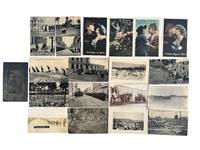
1916225131916. Mexico Border Wars United States and Mexican Border War photograph archive circa 1914-1916 documents military operations and occupation scenes produced during the period of armed confrontation between the United States and revolutionary Mexico in the years surrounding the Mexican Revolution. Created during the escalation of cross border conflict that followed the Tampico Affair and the subsequent United States occupation of Veracruz in April 1914 the photographs record American and Mexican troops engaged in urban combat military drills occupation ceremonies and field movements along the Gulf Coast and northern borderlands. The images provide visual documentation of the military campaign ordered by President Woodrow Wilson during a decade of instability in Mexico when revolutionary conflict cross border raids and American intervention shaped relations between the two nations.<br /> <br /> Archive of nineteen photographs created between approximately 1914 and 1916 primarily real photo postcards with one tintype portrait. Most photographs measure approximately 3.5 × 5.5 inches and several retain contemporary captions identifying locations and military activity. Scenes documenting the United States occupation of Veracruz include captions such as "The 5th Brigade U.S. Army Commanded by General Funston taking Possession of Vera Cruz April 30th 1914" and "Federal Mexican Soldiers Firing from Street Corner First Day of Battle April 21st." Additional images depict United States troops in training or formation including "U.S. Soldiers Hiking in the Sand Hills around Vera Cruz Mexico" "U.S. Army at Vera Cruz Mexico" and "Nebraska's Battalion." Mexican federal troops appear in photographs captioned "Serving Machine Guns" and assembled "for Grand Review Vera Cruz Mex." A dramatic real photo postcard titled "Firing Squad Mexico" depicts six riflemen firing upon a condemned prisoner kneeling at the water's edge. Another image captioned "Adobe House Destroyed by Artillery in Mexico" shows a bullet scarred building façade with mounted troops nearby. Panoramic troop movements appear in photographs captioned "Mexican Infantry entering Juárez Mex." and "Scene at Vera Cruz Mexico during Battle of April 21st and 22nd" the latter showing soldiers lying prone in firing positions. The archive also includes four hand colored patriotic "sweetheart" postcards sent by soldiers to loved ones bearing sentimental captions such as "Don't Forget the One You Left Behind." The tintype depicts an American soldier wearing a campaign hat and service uniform standing before a canvas tent. One postcard bears a lengthy manuscript letter written from McAllen Texas dated September 27 1916 in which the writer reports: "Still here! & it's hot! but I have a nice job and plenty to do. I love it and I'm sure you would enjoy it. It is a splendid experience and I am proud of the N.G. The flag is O.K. in our hands."<br /> <br /> These photographs emerge from the years of heightened tension along the United States Mexico border between 1910 and 1919 when revolutionary upheaval within Mexico and armed incursions across the frontier led to repeated military mobilization by the United States. The occupation of Veracruz in 1914 marked one of the most significant American interventions of the period and produced several days of street fighting between United States Marines Army units and Mexican defenders. Light handling wear to several cards with occasional corner creasing and one example with minor margin loss. Tintype shows light surface spotting but retains clear detail. Overall very good condition. The photographs collectively record both the violence of the conflict and the symbolic displays of military presence that accompanied the occupation including troop drills reviews and staged patriotic imagery circulated through postcards. unknown
19460001566PRESIDIO TEXAS WEST TEXAS TX. Good. 1946. On offer is a very interesting archive of two 2 manuscript relics of mid-20th Century border problems of illegal immigration being note pads of a West Texas border patrol agent detailing his daily activities during work hours. They start in May 1st 1946 through September 30th 1951. He worked West Texas around Presidio and does a super job detailing his work life from the mundane: shoeing his own horse and the names of other patrol agents he worked with to the exciting: hunting and catching aliens hauling them off to jail naming the ranches he patrolled and much more. All pages in both booklets are written on. The binding is loose in the books but all pages intact and overall G.; 24mo - over 5" - 5¾" tall; KEYWORDS: HISTORY OF WEST TEXAS PRESIDIO BORDER PATROL AGENT ILLEGAL IMMIGRATION IRREGULAR IMMIGRATION UNAUTHORIZED IMMIGRATION UNDOCUMENTED IMMIGRATION ILLEGAL ALIEN ILLEGAL IMMIGRANT CLANDESTINE WORKERS SANS PAPIERS WITHOUT PAPERS UNAUTHORIZED ENTRY BORDER CROSSING HUMAN TRAFFICKING HUMAN SMUGGLING SOUTH WESTERN TEXAS AMERICANA HANDWRITTEN MANUSCRIPT DOCUMENT LETTER AUTOGRAPH DIARY JOURNAL LOG KEEPSAKE WRITER HAND WRITTEN DOCUMENTS SIGNED LETTERS MANUSCRIPTS HISTORICAL HOLOGRAPH WRITERS DIARIES JOURNALS LOGS AUTOGRAPHS PERSONAL MEMOIR MEMORIAL PERSONAL HISTORYantiquité contrat vélin document manuscrit papier Antike Brief Pergament Dokument Manuskript Papier oggetto d'antiquariato atto velina documento manoscritto carta antigüedad hecho vitela documento manuscrito papel. . unknown
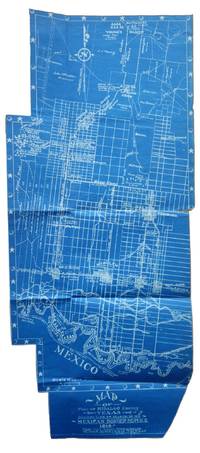
1917List2530VP 1917. Scrapbook measuring 15 ½ x 10 ½ inches. With forty leaves most with newspaper clippings and varied ephemera attached. Boards detached contents generally fine. Laid in is a blueprint map entitled Map of Part of Hidalgo County Texas Showing Line of March in my Mexican Border Service 1916. Made from Survey Notes taken on the march by Corp. C.A. Rice 74 Inf. N.G.U.S. Buffalo N.Y. Armory. Map measuring 33 ½ x 14 ¾ inches irregularly shaped and apparently complete. Very Good. A scrapbook documenting the military service of 1st Sergeant Samuel Gaffney of the 74th National Guard New York in the Mexican Border Service. Gaffney documents the campaign in great detail through printed matter - with each of the forty leaves containing material affixed including panoramic photographs advertisements from local businesses along the routes programs from entertainment offered to the troops military orders and official correspondence and many affixed newspaper articles and photographs. <br /> <br /> The scrapbook is most notable for the inclusion of an unrecorded map by Charles A. Rice the Buffalo native who would eventually map the campaign in larger fashion in a map entitled Map Showing Lines and March and Border Patrols in my Mexican Border Service 1916-1917. The map here just showing the route through Hidalgo County is unrecorded. The larger map - which was produced as souvenirs for the other members of the 74th - is quite scarce as well with five copies known to exist per OCLC with two different numbers. This blueprint map which appears to be complete cartographically and missing only the ornamental border on one portion shows the route taken early in the campaign in 1916. The Buffalo native Rice 1885-1931 who would eventually settle in Texas after the conflict also wrote a history of the 74th during the campaign. Rice published the maps and memoir himself. The map shows the route in great detail showing the location of wells farms roads and identifying landowners. Water quality and abundance is understandably a common theme in Rice’s notes. Some notes show the location of bandits smugglers and the like. We find no other examples of blueprint maps by Rice. <br /> <br /> Other highlights from the scrapbook include seven panoramic photographs of the 74th encamped at Pharr; a broadside advertisement for the shop of Agustin Acevedo in Pharr listing prices of goods; a handbill advertising the 74th’s Minstrels and Great Entertainment show on September 16 1916; an advertisement for a production entitled Glorious Liberty at the National Theatre in Pharr; two circulars instructing troop movement issued by Headquarters Brownsville District; several postcards with songs about the campaign; several snapshots; a mounted albumen photograph of troops at rest with the notation “Corp Frederick Paid†verso; a typed poem entitled “Home Again†and a notebook page describing his activities from January 1917 onward; and a thanksgiving menu for 1916 for the holiday spent at Pharr. The remainder of the scrapbook is composed of affixed newspaper clippings which provide extensive information on the 74th collected in a single volume. <br /> <br /> Overall a significant scrapbook with much information to glean for students of the 74th’s activities with the map providing a unique cartographic reference of the early days of the campaign. unknown
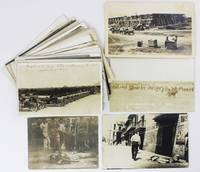
19216158Various places in Mexico Texas and Arizona 1921. Overall about very good. 106 real photo postcards including six duplicates. Varying sizes but most approximately 3.5 x 5.5 inches. Scattered contemporary and later manuscript annotations. Light wear at edges occasionally a bit heavier. Some scattered damp and dust soiling. A substantial collection of over 100 real photo postcards that depict scenes from the Mexican Revolution and the related border war interventions of the United States Army. The images included here some quite violent in nature are dated from 1913 to 1922; most are captioned in the negative. They show ruined buildings military encampments injured soldiers and corpses on both sides of the U.S.-Mexican border and in Veracruz. Also included are identified portraits of individuals such as Francisco Madero Pancho Villa on his deathbed and American General John Pershing. Many of the images are by El Paso photographer W.H. Horne who was one of the most prominent photographers of Border War incidents captured the Columbus Raid in New Mexico and photographed skirmishes near his home in El Paso. Also present are a short series of images by Cal Osborn who documented border incidents near Douglass Arizona and a group by William Hadsell William Hadsell an American resident of Veracruz who ran a Kodak store and was a prolific recorder of events there. Several Mexican photographers are represented as well. Many of the photos are quite gruesome in nature and show corpses in various states of decomposition as well as the aftermath of battles and executions but in all provide an arresting visual document of the interventions by the United States in Mexico during the 1910s. Powerful images of the Mexican Revolution and the resulting upheaval there and along the border with the United States. unknown