Antiquariat.de

539 résultats
160017001Venedig, Valegio, um 1600. Ca. 8,5 cm x 13 cm.
Ilustraciones "Faros y Costas" de Eduardo Sanz. Del índice: "DOS FRAGMENTOS DE LA COSTUMBRE DE VIVIR", por J.M. Caballero Bonald. "LA LUCIDEZ Y EL ÓXIDO", por Luis García Montero. "UN POEMA", por Francisco Brines. "ENTREVISTA: ABDELKRIM TABBAL, EL POETA DE XAUEN". "JEAN COCTEAU: LA AVENTURA ESPAÑOLA", por Juan Lamillar.
Sin lugar a dudas es este un nuevo acto de aproximación entre dos sectores, el científico y el industrial.
S.l., s.n.t., s.d. (anni '10 del sec. XX), in-16, cartoncino edit. con dorso e cop. post. fittizi, pp. 15, (1).
lettere senza frontieremedici senza frontiere testimonianze operatori umanitari
185026013MADRID: Por Aguado Impresor de Cámara 1850. 4º.- Cartoné de época.- 101 páginas. El texto es de Felice Romani y la música del mallorquín Francisco Frontera de Valldemosa. Por Aguado, Impresor de Cámara unknown
19762110502150415400Hanashinotokushu 1976. Soft Cover. Fine. Volume: 1 Hanashinotokushu paperback
19772082702114603147Mainichi Shimbun Co. Ltd. 2000 yen 1977. Soft Cover. Fine. Number of books: 1 Mainichi Shimbun Co., Ltd. 2,000 yen paperback
19882082702114610955JICC Publishing Bureau 1988. Soft Cover. Fine. Number of books: 1 JICC Publishing Bureau paperback
19752082702114605540Princess Road SL Club 1975. Soft Cover. Fine. Number of books: 1 Princess Road SL Club paperback
18932082702114607139Kinko-do 1893. Soft Cover. Fine. Number of books: 1 Kinko-do paperback
20052090502113717143Not Available 2005. Soft Cover. Fine. The book is in fine condition. Not Available paperback
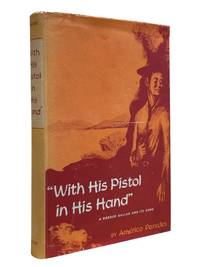
19589869Austin: The University of Texas Press 1958. First edition. Hardcover in illustrated jacket uncredited 282pp. Inscribed by Paredes to the former owner on the half title. Texas Folklore Society bookplate to front pastedown old tape residue to rear boards where jacket protector had been attached. Colorful jacket toned but with minimal edge wear. A nicely preserved very good copy. <br /> <br /> Scarce inscribed copy of this book on the Mexican border bandit Gregorio Cortez Lira. <br /> <br /> Six-Guns 1675. The University of Texas Press hardcover
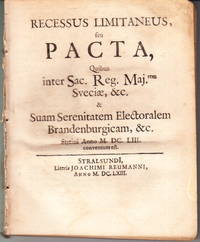
89737Stralsund Joachimi Reumanni 1663. 4to. 176 pp. Disbound. VD17 14:001661R with only 42 Bl. Warmholtz 8693. A treaty between Sweden and Brandenburg that defines the borders of Pomerania which according to the Westphalian peace treaty was divided between Sweden and Brandenburg. The treaty also contains the succession rights for Brandenburg to the Swedish parts of Pomerania etc. unknown
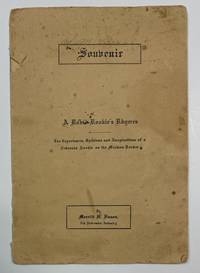
19164822N.p. possibly Brownsville Tx 1916. Very good. 111pp. Original tan printed wrappers stapled. Wrappers soiled partially split along spine penciled ownership signature on front cover. Light creasing occasional minor foxing to text. An unrecorded collection of poetry by First Sergeant Merritt H. Fuson of the 5th Nebraska Infantry capturing military life during the U.S.-Mexico Border War in 1916-1917. Sergeant Fuson's poems begin with "A Rookie's Prayer" and generally describe the incessant drilling and preparations for battle in southern Texas. One of the poems was given to Fuson before he left home and one other poem is credited to a "Minnesota artilleryman name unknown" but the remainder of the poems appear to be authored by Fuson himself. Fuson's poem "War Is Hell" particularly encapsulates the difficulties of military camp life during his service but does not capture the horrors of war which Fuson apparently never experienced. Fuson does express his desire to return home to Nebraska in at least two poems and his homesickness comes through in others in passages such as "Sing a song of Texas Drill and sweat and dig One Nebraska soldier Dirty as a pig." The 5th Nebraska Infantry had a short and uneventful stay in Llano Grande outside Mercedes in the McAllen-Brownsville region of south Texas. They arrived in July 1916 and drilled and camped until returning to Nebraska in February 1917. An interesting collection of wartime poetry by a young Nebraska man serving in the Texas-Mexico borderlands. No copies in OCLC auction records or any other sources we consulted. unknown
19163738N.p. probably Portland 1916. Near fine. 36pp. plus two multi-panel folding panoramic photographic plates. Original tan wrappers printed in brown accompanied by original printed mailing envelope reading "A Souvenir of The Third Oregon Infantry on the Mexican Border." Very light wear. A scarce work featuring the officers staff and soldiers of the Third Oregon Infantry while stationed on the Mexican border near San Diego during the conflict with Mexico just before World War I. The work includes field and staff lists rosters organized by company and a list of "men who have enlisted at Clackamas since the Regiment left" in the summer of 1916. The work is profusely illustrated with photographs of each company within the text usually on the recto facing the roster lists. Each inside cover includes a folding panoramic photographic plate - the first titled "First Battalion at San Diego Exposition July 9 1916" and the second featuring the "Third Battalion on the Border - Mexico in the Background." Both panoramic images were produced from photographs by O.A. Tunnell. unknown
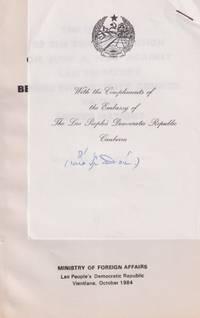
1984215696Vientiane.: Ministry of Foreign Affairs Lao People's Democratic Republic. October1984. iv 64pp. Signed compliments slip from the Lao Embassy in Canberra stapled to upper wrapper staple little rusted otherwise a very good copy. 21.5 x 14cm. A collection of transcripts from addresses given by Lao and Thai delegates to the UN General Assembly Non-Aligned Movement and UN Security Council regarding a series of armed skirmishes along the Lao-Thai border. . Ministry of Foreign Affairs, Lao People's Democratic Republic. unknown
191084196San Antonio: Dahrooge & Co n.d. ca. 1910. A small tan card folding chemise containing a concertina style pull out of 20 monochrome images titled to the front panel with space for an address for postal use with an advertisment for the Dahrooge Co. to the rear panel. A little wear and toning to the edges of the chemise otherwise a very good clean example. <br /> <br /> A souvenir collection of images depicting US soldiers performing drills queuing at chow hall dragging artillery etc. interspersed with images of local Mexican people a horrifying jury-rigged armored vehicle Mexican artillery preparing to engage and a variety of scenery shots. Dahrooge & Co unknown
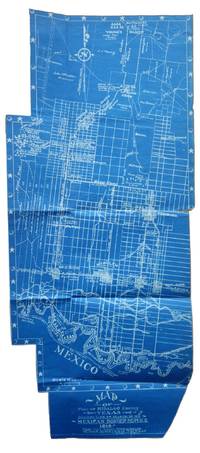
1917List2530VP 1917. Scrapbook measuring 15 ½ x 10 ½ inches. With forty leaves most with newspaper clippings and varied ephemera attached. Boards detached contents generally fine. Laid in is a blueprint map entitled Map of Part of Hidalgo County Texas Showing Line of March in my Mexican Border Service 1916. Made from Survey Notes taken on the march by Corp. C.A. Rice 74 Inf. N.G.U.S. Buffalo N.Y. Armory. Map measuring 33 ½ x 14 ¾ inches irregularly shaped and apparently complete. Very Good. A scrapbook documenting the military service of 1st Sergeant Samuel Gaffney of the 74th National Guard New York in the Mexican Border Service. Gaffney documents the campaign in great detail through printed matter - with each of the forty leaves containing material affixed including panoramic photographs advertisements from local businesses along the routes programs from entertainment offered to the troops military orders and official correspondence and many affixed newspaper articles and photographs. <br /> <br /> The scrapbook is most notable for the inclusion of an unrecorded map by Charles A. Rice the Buffalo native who would eventually map the campaign in larger fashion in a map entitled Map Showing Lines and March and Border Patrols in my Mexican Border Service 1916-1917. The map here just showing the route through Hidalgo County is unrecorded. The larger map - which was produced as souvenirs for the other members of the 74th - is quite scarce as well with five copies known to exist per OCLC with two different numbers. This blueprint map which appears to be complete cartographically and missing only the ornamental border on one portion shows the route taken early in the campaign in 1916. The Buffalo native Rice 1885-1931 who would eventually settle in Texas after the conflict also wrote a history of the 74th during the campaign. Rice published the maps and memoir himself. The map shows the route in great detail showing the location of wells farms roads and identifying landowners. Water quality and abundance is understandably a common theme in Rice’s notes. Some notes show the location of bandits smugglers and the like. We find no other examples of blueprint maps by Rice. <br /> <br /> Other highlights from the scrapbook include seven panoramic photographs of the 74th encamped at Pharr; a broadside advertisement for the shop of Agustin Acevedo in Pharr listing prices of goods; a handbill advertising the 74th’s Minstrels and Great Entertainment show on September 16 1916; an advertisement for a production entitled Glorious Liberty at the National Theatre in Pharr; two circulars instructing troop movement issued by Headquarters Brownsville District; several postcards with songs about the campaign; several snapshots; a mounted albumen photograph of troops at rest with the notation “Corp Frederick Paid†verso; a typed poem entitled “Home Again†and a notebook page describing his activities from January 1917 onward; and a thanksgiving menu for 1916 for the holiday spent at Pharr. The remainder of the scrapbook is composed of affixed newspaper clippings which provide extensive information on the 74th collected in a single volume. <br /> <br /> Overall a significant scrapbook with much information to glean for students of the 74th’s activities with the map providing a unique cartographic reference of the early days of the campaign. unknown
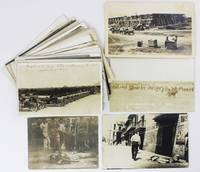
47618Various publishers & dates. Extensive photographic archive documenting events on both sides of the U.S.-Mexico Border during the Mexican Revolution focused primarily on the Border Wars in Texas and the Veracruz Incident of 1914 comprised entirely of contemporary images all but a few of which are original vintage prints. The collection includes: <br /> <br /> • Sixty-one commercially-produced real-photo postcards ca. 14cm x 9cm or the reverse; <br /> • Six commercially-printed postcards using non-photographic processes same dimensions;<br /> • Three carte-de-visite portraits ca 9cm x 6cm mounted to cards;<br /> • Eight small-format photographs ranging from 14cm x 8cm to 11cm x 16cm of which three appear to be commercial images; <br /> • Three 8x10 20cm x 25cm photographic prints printed at some later date from original plates but apparently not contemporary; <br /> • One vintage 4x6 10cm x 16cm photograph mounted on board. <br /> <br /> All but a dozen or so images are captioned in the negative and most are additionally captioned in pencil in a later hand on verso. Approximately half the images include no photo credit; of those that do we have identified the following photographers: W.H. Horne D.W. Hoffman Walter P. Hadsell Van Zile & Chalk and L.O. She. <br /> <br /> Condition is generally Very Good. Two of the photo postcards are damaged with abrasions to significant portions of image area; the remainder show various degrees of edge wear aging and creasing but by and large image quality remains excellent. None of the postcards are postally used though a few include brief contemporary notes on verso. The refusal of Mexican President Porfirio Dîaz to cede power to his rival Francisco Madero in the elections of 1910 resulted in a violent large-scale revolt by campesinos and leftists setting off the thirty-year long Mexican Revolution. American involvement in the conflict began in 1911 when President William H. Taft under the guise of heightening border security moved to back Díaz against the rebels. The resulting mobilization - Taft sent more than 20000 American troops nearly a quarter of all American forces to the Mexican border with especially heavy concentrations in Texas and New Mexico - was to that date the largest mobilization of American military forces in peacetime. At the same time many Americans whose sympathies were not aligned with the Díaz dictatorship including anarchists wobblies Native Americans and more than a few soldiers of fortune went south to fight on the side of the rebels. The resulting border conflict which took place over nearly a decade occasionally pitting American insurrectos against American Federal troops resulted in thousands of Mexican and hundreds of American deaths. <br /> <br /> The Border Wars reached their climax around the period 1912-1914 which happened to coincide with a near-hysterical vogue for postcards among the American public. The result is that the Mexican Revolution is perhaps the first major armed conflict to have been extensively photo-documented in real time and certainly the first to have had a significant mass audience for that documentation. At least three hundred commercial photographers have been identified in association with the Mexican Revolution and they produced tens of thousands of images ranging from the relatively innocuous e.g. peaceful street and harbor scenes in Veracruz to the horrific lynchings and sidewalk cremations. <br /> <br /> This entire range of content is represented in the current collection along with portraits of most of the key players on the Mexican side including El Presidente Porfirio Díaz; his primary rival and successor Francisco Madero; Madero's successor by coup Victoriano Huerta; and various military figures including General Juan Navarro Felipe Angeles Ramírez and numerous others. Many of these semi-professional images though produced with commercial intent "professional" remains a guarded term in the context of what was essentially battlefield exploitation photography are valuable for their almost off-hand depictions of violent day-to-day life on the contested border including the casual destruction and acceptance of death from both sides that seemed to define this conflict. Of particular note are numerous of photographs of African-American troops the so-called "Buffalo Soldiers" as well as at least one image depicting Native American soldiers in uniform. Locales represented include Camp Grossmont in California; El Paso and Laredo in Texas and their cross-border sister cities Juarez and Nuevo Laredo; Veracruz site of the American incursion of 1914 known as the "Veracruz Incident"; and various unidentified encampments and battle sites in both Texas and Mexico. <br /> <br /> A wide-ranging and compelling photographic collection documenting not only a key period in U.S. military diplomacy - one which for better or worse set the tone for American-Mexican relations for the succeeding century - but also a tangible manifestation of the first widespread public incarnation in America of the picture-postcard as a vehicle for both propaganda and photojournalism. unknown
19216158Various places in Mexico Texas and Arizona 1921. Overall about very good. 106 real photo postcards including six duplicates. Varying sizes but most approximately 3.5 x 5.5 inches. Scattered contemporary and later manuscript annotations. Light wear at edges occasionally a bit heavier. Some scattered damp and dust soiling. A substantial collection of over 100 real photo postcards that depict scenes from the Mexican Revolution and the related border war interventions of the United States Army. The images included here some quite violent in nature are dated from 1913 to 1922; most are captioned in the negative. They show ruined buildings military encampments injured soldiers and corpses on both sides of the U.S.-Mexican border and in Veracruz. Also included are identified portraits of individuals such as Francisco Madero Pancho Villa on his deathbed and American General John Pershing. Many of the images are by El Paso photographer W.H. Horne who was one of the most prominent photographers of Border War incidents captured the Columbus Raid in New Mexico and photographed skirmishes near his home in El Paso. Also present are a short series of images by Cal Osborn who documented border incidents near Douglass Arizona and a group by William Hadsell William Hadsell an American resident of Veracruz who ran a Kodak store and was a prolific recorder of events there. Several Mexican photographers are represented as well. Many of the photos are quite gruesome in nature and show corpses in various states of decomposition as well as the aftermath of battles and executions but in all provide an arresting visual document of the interventions by the United States in Mexico during the 1910s. Powerful images of the Mexican Revolution and the resulting upheaval there and along the border with the United States. unknown
191435285n.p.: n.p. 1914. Photograph. Good. Photograph. Approx. 10" x 8". Photograph is in good condition with light amount of spotting to the image. No other information known about the image other than what is written at the bottom of the picture "Mexican Border 1914 Raymond Thompson." View shows three men up front on horses. One soldier on a white horse is carrying the American Flag. The view also shows other soldiers and tents in the background. From wikipedia: <br /> <br /> The Mexican Border War13 or the Border Campaign14 refers to the military engagements which took place in the Mexico–United States border region of North America during the Mexican Revolution. The war's time period encompassed World War I during which Germany attempted to have Mexico attack the United States and engaged in hostilities against American forces there itself. The Border War was the fifth and latest major conflict fought on American soil where its predecessors were the American Revolutionary War War of 1812 Mexican–American War 1846–1848 and the American Civil War. The end of the Mexican Revolution on 1 December 1920 marked the close of the American Frontier. The Bandit War15 in Texas was part of the Border War. From the beginning of the Mexican Revolution in 1910 the United States Army was stationed in force along the border and on several occasions fought with Mexican rebels or federals. The height of the conflict came in 1916 when revolutionary Pancho Villa attacked the American border town of Columbus New Mexico. In response the United States Army under the direction of General John J. Pershing launched an expedition into northern Mexico to find and capture Villa. Although Villa was not captured the US Army found and engaged the Villista rebels killing Villa's two top lieutenants. The revolutionary himself escaped and the American army returned to the United States in January 1917. Conflict at the border continued however and the United States launched several additional though smaller operations into Mexican territory until after the American victory in the Battle of Ambos Nogales in August 1918 leading to the establishment of a permanent border wall.16 Conflict was not only subject to Villistas and Americans; Maderistas Carrancistas Constitutionalistas and Germans also engaged in battle with American forces during this period. n.p. unknown
191612895Des Moines IA: Hebard-Showers Company September 1916. Panoramic photograph 8 x 37.5 inches with numerous captions in the negative. Rolled tightly. A few soft creases minor wear at bottom right corner. Very good. An unusually informative panorama of Brownsville and Matamoros taken from the American side of the Rio Grande during the heat of the Mexican Revolution. The photograph was produced by the form of Hebard-Showers here spelled Hedard-Showers likely scratched backwards in the negative of Des Moines Iowa. The image captures the scene along the Red River from a portion of Fort Brown in the east west to Brownsville's Union Station with the International Bridge visible downriver. Directly across the river from Brownsville is labeled "Santa Cruz Mexico" with Matamoros a bit further south. Other landmarks identified on the Brownsville side include the aforementioned Union Station and the International Bridge as well as Fort Brown a river landing the customs house and various locations for American state guard units. Near the landing is the Brownsville Transfer Company's building.<br /> <br /> More pertinent to the Mexican Revolution are some of the captions identifying locations on the Mexican side. These include "Casa Mata Fort or place of execution" "Blanco's Battlefield June 3rd 1913" and "Villa's Battlefield March 27 - Apr. 13 1915. 100 Killed." Also identified on the Mexican side are a Mexican bull ring the "Bone yard" and a river landing. Interestingly a small rowboat containing a few people can be seen approaching the Mexican side on the Rio Grande.<br /> <br /> Naturally Hebard-Showers Company mainly documented Des Moines and its surrounding areas but they shot a handful of Brownsville border views over several years at least between the present example and about 1921. SMU holds an example of the later panorama; comparisons between the present example and SMU's does reveal some changes in the area over the course of those five years and the present example includes many more detailed captions in the negative. Hebard-Showers Company, September unknown
19163127El Paso Tx: J.W. Medley & I. Shulman 1916. Good plus. About 9.5 x 51.25 inches. Backed on board. Some tanning to board. Minor spotting along edges minor staining and some surface lift along top left edge left edge and left bottom edge from being previously framed. One of a group of panoramic photographs depicting Camp Stewart at El Paso during the Mexican Revolution 1910-1919 known here as the Mexican Border War or Pershing's Punitive Expedition. The camp was set up in 1916 and the goal of the conflict was to stop Pancho Villa's military actions on the United States side of the border. American and Mexican forces pursued Villa for months and managed to quash the rebellion but Pancho Villa himself was never captured. This photograph provides a good view of the tents and small building erected in this dry Texas landscape. The photographers J. Urban Medley and Isaac Shulman of El Paso Texas were prolific chroniclers of the American Southwest and Mexican borderlands with a studio at 1709 Montana. A striking panoramic image of a large camp near El Paso during the Texas Border War. J.W. Medley & I. Shulman unknown
19162445Brownsville 1916. Very good. Panoramic photograph approximately 7.5 x 39.5 inches. Mounted on card manuscript identifications along foot. Light wear minor soiling. A large formal portrait of Troop C of the 1st Virginia Cavalry in camp at Fort Brown Brownsville Texas. National guard units were called up in 1916 to guard the border while General Pershing made his incursions into Mexico against revolutionary and regular military units involved in the Mexican revolution and civil war of the 1910s. The image depicts the entire troop mounted in a single file with the commissioned officers at far left sixty-six men in all. Although the photographer does not identify himself each man in the unit is named in clear manuscript along the foot of the photograph making the present image a valuable record of the Virginia Cavalry's service in Texas during the Border War. unknown