5 résultats
1588211031588. Orig.-Kupferstich in der Größe von ca. 20 x 48 cm. Oberrand mit 2 Wasserflecken
16002104411(Leipzig: Henning Große) 1600. 996 (statt 998) unpaginierte Seiten. Erstes Blatt der Vorrede (Lagensign. A2) fehlend! Zweispaltendruck. Mit einer allegorischen Druckermarke auf dem Titel. Kl. 8° (17 x 10 cm). Pergamentband der Zeit mit durchgezogenen Bünden, abgeschrägten Deckelkanten und neuerem handschriftlichem Rückentitel sowie rotgefärbtem Schnitt.
151976364Calcutta: His Highness the Nizam's Government 1915-1932. First editions of the first ten publications from this now defunct Indian principality. Quarto. Each paper separately paginated and all with plates at the rear. Original printed green wrappers. Recently bound in attractive and tactile black cloth and with red and black morocco gilt spine labels. Number 1 with perforated stamp to lower blank margin of front wrapper and with same stamp in ink on the half-title all with small paper labels on bottom inner margin of front wrappers rear wrappers not bound in but for the last issue front wrapper of first volume with a couple of small wrinkles. An attractive presentation of the scarce first ten publications of this famed archaeological series from the puppet state of Nizam in India.Originally a vassal state of the Mughal government. the state of Hyderabad fell on hard times in the eighteenth century. The Mughal emperor granted the princely state of Hyderabad to Nizam-ul-Mulk the first of a series of Asaf Jahs. A largely autonomous state the Nizams ruled Hyderabad from 1724 to 1947. Late in the eighteenth century the Nizams allied themselves to the British. There were left alone by the British providing they allow the Raj to dictate their foreign policy and provided the Nizams provided soldiers for actions the British took in India. The Nizam’s kingdom was remarkable for its religious tolerance and it secular-orientated rule in general. While the ruling dynasty was Muslim the majority of the population was Hindu. The state adopted a secular administration thereby discouraging religious tensions. Indeed the Nizams built and maintained both Hindu and Muslim temples and facilities. The Kingdom was around the size of France and it was enormously wealthy. Mir Osman Ali Khan the last ruling Nizam of Hyderabad was arguably the richest man on earth in the early 20th century. It all came to an end in 1947 when the newly formed Indian government sent its military to squash the independent state. The state ruled by the Nizam previously called "Hyderabad State" is now primarily part of the Indian state of Telangana. All ten publications are complete and the titles are as follows;1 The New Asokan Edict of Maski. 1915. 2 The Daulatabad Plates of Jagadekamalla A.D. 1017. 19173 Inscriptions at Palampet and Uparpalli. 19194 Pakhal Inscription of the Reign of the Kakatiya Ganapatideva. 19195 Munirabad Stone Inscription of the 13th year of Tribhuvanamala Vikramaditya VI. 1922.6 The Kotagiri Plates of the Reign of the Kakatiya Queen Rudramamba A.D. 1275. 19257 Bodhan Stone Inscription of the Reign of Trailokyamalla Somesvara A.D. 1056. 19258 The Inscriptions of Nagai. 1928.9 Shitab Khan of Warangal by Dr. Hirananda Sastri. 1932.10 The Gavimath and Palkigundu Inscriptions of Asoka. Edited by R. L. Turner. 1932.OCLC records two complete files but no individual titles dating this early. No copies ever at auction. The Nizam spared no expense on this publication using high quality paper and enabling fine photographic illustrations. The first nine numbers were printed at the Baptist Mission Press in Calcutta and the last issue at the Oxford University Press. The Archaeological Department of the Government of the Nizam of Hyderabad restored the Ajanta paintings in the 1920's. His Highness the Nizam's Government hardcover
15785129484Lipsiae, Iohannes Rhamba excudebat (Leipzig: Johannes Rhamba) 1578. Titel, (64), 559, (1 weiße) Seiten. Kl.-4° (18,5 x 15,5 cm). Halbpergamentband des 18. Jahrhunderts mit durchgezogenen Bünden, Pergamentecken und neuerem handschriftlichem Rückentitel.
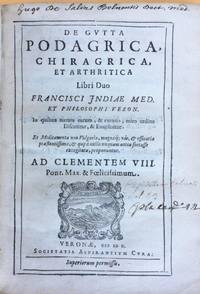
1600M13168Verona: Societatis Aspirantium cura 1600. 1600. Two parts in 1. Small 4to. xxiv 118 1 pp. Printer's woodcut device 5 snakes over landscape woodcut initials and tailpiece rear errata & colophon; old ink marginalia p.36 underlining pp. 97-99. Original vellum; lacks ties. Ownership inscription on title: Hugo De Salins Belnensis Doct. Med. d.1659 and another signature obscured. Bookplate of Château de Montrevost Cuisery France. EARLY SEVENTEENTH CENTURY WORK ON GOUT & RHEUMATOID ARTHRITIS: : HUGUES DE SALINS' COPY. First edition of this rare work on the nature cause and treatment of rheumatoid arthritis and gout. The status of gout in the late sixteenth century was such that gout was said by Turberville to be found in "horses capons and falcons." p. 64. John Gerard's Herball 1597 stated that Gout-wort or Herba Gerardi was a native herb that could be used with some benefit supported further by Culpeper. According to Copeman Thomas Sydenham 1624-1689 suffered from gout and wrote the classic description of the disease and was the first to be able to differentiate between rheumatoid arthritis and gout. The present work was written decades earlier. Francesco India cites Galen Chap. 1 Ambroise Pare Chap. 12 and Jean Fernel Chapters 5 7 8. India makes two 15-page tables of causes which he uses to organize his data. <br /><br /> PROVENANCE: Hugues de Salins: The British Library catalogue lists a "Hugues de Salins; see: Jean Baptiste de Salins Defense du vin de Bourgogne 1704." This may be a descendent. See: Societe d'Histoire d'Archeologie et de Litterature de l'arrondissement de Beaune Memoires annee 1890 Volumes 15-16 Beaune 1891 pp. 75 177. Mentions the wife of Hugues de Salins as buried in 1626 and Hugues de Salins buried in 1659. <br /><br /> Francisci Indiae an Italian philosopher and physician who is little known wrote the present work and two others: Hygiphylus: sive de febre maligna dialogus 1593. Hygiophilvs Tertivs Vel De Symptomatvm Febri Malignae Svper 1599. See: Frederic Paulhan Catalogue des legs Gide & Teissier-Rolland 1892 p. 212. Showing a copy of Strabo's Strabonis rerum geographicarum libri XVII 1571 with the same provenance inscription is this book. This inscription must date prior to 1892. <br /><br /> Copeman W.S.C. A Short History of the Gout and the Rheumatics Diseases pp. 53 64. Locations: British Library; Edinburgh University; Middle Temple Library; Wellcome Library. Societatis Aspirantium cura, 1600. hardcover books