Colonial British IndiaBiblio.com
2 832 résultats
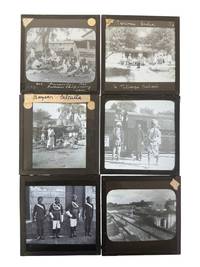
1900232871900. India glass lantern slide archive documenting class hierarchy dichotomy in British India with scenes of village labor bazaar exchange railway movement industrialization Sikhs and colonial cavalry circa 1900-20. Images clearly depict the class divid and Cast system; villagers and laborers are shown seated on bare ground in carpentry work men and goats occupy an unpaved settlement space Sikh men stand beside a railway carriage tied to imperial transport networks a factory scene introduces mechanized industry and a formal portrait of turbaned cavalry soldiers.<br /> Photo archive of 8 glass lantern slides 3.25" x 3.25" India circa 1900 to 1920. Several slides retain manuscript captions on the mounts including "Central India" "Village School" "Bazaar Calcutta" and "MV. parannis an Indian carpentry clas." "Parannis" is probably a misspelling or misreading of "Pariahs" a historical caste/community term used in colonial-era descriptions of South Indi The British largely preserved formalized and exploited the Indian caste system rather than dismantling it. Their relationship with caste was pragmatic: caste became a tool for administration taxation labor control military recruitment and social organization across British India. The "Village School" slide shows a line of children and adults posed before a low building under dense tree cover with one figure standing forward in the open yard. The carpentry slide shows a large group of Indian boys outdoors beneath a tree seated or crouched on the ground around planks and hand tools with timber laid across the foreground and simple structures behind. The Calcutta bazaar scene places vendors baskets and goods in an open market setting under palms while the village scene presents men in loose garments in what seems to be a cattle farm setting. One slide shows Sikh men beside a railway carriage one barefoot in the foreground and others gathered near the rail car doors linking Indian bodies to the movement of goods troops and passengers through the colonial rail system. Another slide presents four uniformed soldiers in turbans possibly the Madras cavalry posed formally with boots sashes and weapons before a masonry wall. The factory view shows smoking industrial works with long roofs tracks and an extended production yard further cementing colonial industrialization within the archive.<br /> <br /> British rule in India relied on linked systems of extraction transport discipline and military force and these slides place those systems beside the people who bore their unequal social effects. Railways expanded under colonial finance and administration to move troops raw materials and commercial goods; industrial sites grew beside older economies of hand labor and bazaar trade; Indian soldiers and cavalry units served within an army organized to secure imperial control; and rural schools workshops and village scenes expose the local social world that existed under those pressures rather than outside them. Light edge wear some mount loss to several slides; no cracks or chips. Overall very good condition. British colonialism widened India's class divide by concentrating wealth transport and military power in imperial systems while leaving many Indians in village labor and low paid market work. unknown
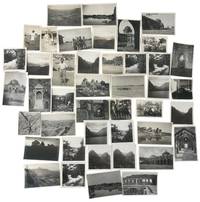
1940232161940. British India photo archive following an unidentified man likely a serviceman in Mhow and Mandu during World War II 1942-1943 preserving a localized record of colonial wartime life through mess scenes sport staff bungalows named companions imposed colonial social frameworks and visits to the major Islamic monuments of Mandu. The captions place the central figure in the company of "Carroll Sahib" Ken Davis and other men in uniform-style dress while repeated references to the "mess" weapon training staff and cantonment-like grounds situate the photographs within a British colonial wartime environment in central India. The group shows one participant moving between military or officer-adjacent daily life and the monumental landscape of Mandu at a moment when India remained a crucial base of Allied wartime activity.<br /> <br /> Photo archive of 43 silver gelatin photographs ranging from 2 x 3.5 to 2.5 x 2.5 inches Mhow and Mandu India 1942-1943. Most photographs bear substantial contemporary handwritten inscriptions on the versos often dated. Identifiable scenes include two men with tennis rackets outside a bungalow captioned as taken after tennis; a portrait inscribed "Me the Carroll Sahib & Ken Davis outside the Mess 25/12/42"; a group of eight men captioned "two scotsmen our four weapon training instructors the Carroll Sahib me outside the W/T staff bungalow 25/12/42"; men wearing garlands outside the mess; a sports or gymkhana ground with riders or runners in formation; tented grounds beside a large building; and a portrait of a man identified as "Machdo our bearer." The architectural and landscape views are closely tied to Mandu with captions naming the Jami Masjid Jahaz Mahal Rupmati's Pavilion Baz Bahadur's Palace mosque interiors courtyards pools lake views ravines and elevated plateaus. Several photographs show men posed on open parade or sports grounds in light uniform-style dress including group portraits outside the mess and the W/T staff bungalow with tennis rackets bicycles garlands and temporary tent lines indicating a social world organized around exercise communal dining and station routine. Other images turn to Mandu's built landscape in much greater detail with framed views of domed pavilions arcaded courtyards carved entrances long interior corridors water tanks and palace ruins seen from terraces lakesides and elevated lookouts. The landscape scenes broaden that record further including steep ravines river and waterfall views and plateau panoramas that place the serviceman's movements within the wider terrain of central India.<br /> <br /> During World War II Mhow remained an important cantonment in British India and these photographs place one serviceman within the daily social world of that station where tennis communal dining staff housing local attendants and holiday gatherings existed alongside travel to nearby historic sites. The Mandu views record the same hand moving through one of central India's best-known Sultanate monument complexes with captions naming the Jami Masjid Jahaz Mahal Rupmati's Pavilion Baz Bahadur's Palace and associated interiors courtyards pools and landscape features. Light general wear occasional silvering and minor handling marks; inscriptions strong and legible on most versos. The dense captioning and photographic record show British colonial India during World War II through the the personal lens colonial rank and language staff organization sport and leisure during wartime Indian attendants and movement through one of central India's historic architectural landscapes. unknown
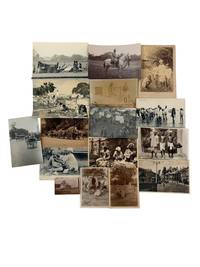
1890234981890. Colonial Indian labor photo archive depicting street work informal commerce transport labor and social hierarchy under British rule circa 1890s-1920s. British India depended on low-paid manual labor to move people goods food and raw materials through cities ports hill stations and military cantonments. The group contrasts workers seated on the ground with baskets tools tents carts and roadside goods against riders on horseback and passengers carried by rickshaw carriage and bullock cart. <br /> <br /> Photo archive of 16 silver gelatin photographs and black-and-white real photo postcards various sizes India circa 1890s-1920s. Marketplace sellers sit among baskets cloth tents and on the ground goods; families and workers gather beside tents and rough encampments; men pull or guide rickshaws carriages and ox-drawn carts through colonial streets. A mounted man sits formally on a white horse while views of Simla show pedestrians commercial buildings and hill-station streets associated with British administration and seasonal elite life. Additional scenes show an outdoor "Hindu barber" "Indian coolies" carrying large baskets men seated by stonework near a Gothic-style building children posed in white garments some hand written captions en verso identify locations or tasks.<br /> The archive records the everyday labor that supported colonial India before independence when caste landlessness debt and imperial wage economies shaped who carried cleaned hauled shaved sold and served. Ligh toning handling and edge wear; overall in very good condition. A late colonial documentation of Indian labor and social separation grounded in street work transport marketplace survival and the visible privileges of those being carried or served. unknown
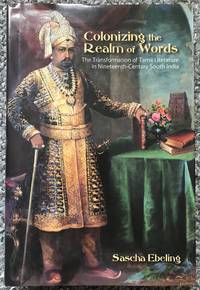
2010001950Albany: State University of New York 2010. First edition. Hardcover. Very Good/very good . 8vo. xxiv 356 pp. Bound in black boards in illustrated dust jacket. Includes several black and white illustrations references and index. Very Good stain to top edge of text block otherwise clean and tight in Very Good dust jacket with small stain to verso of front cover. <br/><br/> State University of New York hardcover
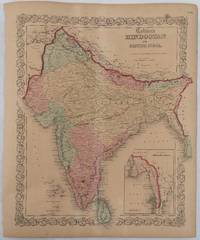
1859224156New York.: J. H. Colton. 1859. Hand-coloured map 40 x 33 cms inset map "Continuation of British India" 12 x 9.3 cms showing Burma elaborate decorative burst border a few spots sheet age-toned inner margin a little chipped not affecting the map and small split in the outer margin no loss text "Farther India or Indo-China" from Colton's atlas on the verso an attractive map in good condition. Attractively hand-coloured map showing different districts presidencies and independent kingdoms with contrasting pastel pinks yellows greens and blues. Major Presidencies Bengal Bombay and Madras are shown alongside extensive detail on river networks the Himalayan range roads and early railway lines connecting major trading hubs. Published a year after the East India Company was stripped of its governing powers following the tumultuous events of the 1857 Indian Rebellion Sepoy Mutiny. This 1859 map is one of the very first American atlas sheets printed to reflect the formal establishment of direct British Crown rule the Raj. It illustrates a subcontinent transitioning from a corporate-held trade monopoly into the crown jewel of Queen Victoria's empire neatly delineating newly pacified administrative boundaries. . J. H. Colton unknown
1455121770.GaudioCD. Good. Access codes and supplements are not guaranteed with used items. May be an ex-library book. unknown
1455121827.Gpreloaded_digital_audio_player. Good. Access codes and supplements are not guaranteed with used items. May be an ex-library book. unknown
449936Penguin Books Ltd. Hardcover. Good. THERE ARE NO TARIFFS OR CUSTOMS DUTIES ON BOOKS. It's December 23rd and Clara is running around Oxford Street buying presents. She wants to make Christmas perfect: it's a lifelong ambition and a challenging one at best even without taking her loved ones and their varying degrees of social disfunction into account. Meanwhile something weird has happened to her marriage.A bleakly funny tender dissection of the meaning of love.SIGNED by the author. Hardback in dust jacket; book and dust jacket unmarked and in generally very good condition Copyright © Penguin Books Ltd Penguin Books Ltd hardcover
453050Penguin Books Ltd. Paperback. Good. THERE ARE NO TARIFFS OR CUSTOMS DUTIES ON BOOKS. Bestselling writer India Knight explores the inevitable panic that family and Christmas bring in her third novel Comfort and Joy. 'I'd say Christmas was about hope. Yeah. Hope. And optimism. It's like the fairy tales in the window: for families every Christmas is a new opportunity for Happy Ever After. No pressure then.'Oxford Street two shopping days left to Christmas and wife and mum Clara Dunphy is desperately madly trying to make everything not perfect but just right for her extended family on the greatest day of the year. But then she gets distracted. . . 'Will make you laugh maybe make you cry and keep you reading past bedtime' Penguin Books Ltd paperback
1455121797.Gmp3_cd. Good. Access codes and supplements are not guaranteed with used items. May be an ex-library book. unknown
2011Q-0143119818Penguin Books 2011-09-27. Paperback. New. New. In shrink wrap. Looks like an interesting title! Penguin Books paperback
1455121789.GaudioCD. Good. Access codes and supplements are not guaranteed with used items. May be an ex-library book. unknown
B9781017410099Hardback. New. hardcover
2026x-1032614420Taylor & Francis Ltd 2026. Paperback. New. 170 pages. 6.14x0.39x9.21 inches. Taylor & Francis Ltd paperback
0366151428.Ghardcover. Good. Access codes and supplements are not guaranteed with used items. May be an ex-library book. hardcover
0366151371.Gpaperback. Good. Access codes and supplements are not guaranteed with used items. May be an ex-library book. paperback
0656635428.Ghardcover. Good. Access codes and supplements are not guaranteed with used items. May be an ex-library book. hardcover
0260775622.Ghardcover. Good. Access codes and supplements are not guaranteed with used items. May be an ex-library book. hardcover
0332116999.Ghardcover. Good. Access codes and supplements are not guaranteed with used items. May be an ex-library book. hardcover
0656529059.Ghardcover. Good. Access codes and supplements are not guaranteed with used items. May be an ex-library book. hardcover
0265772060.Gpaperback. Good. Access codes and supplements are not guaranteed with used items. May be an ex-library book. paperback
0118804227.Ghardcover. Good. Access codes and supplements are not guaranteed with used items. May be an ex-library book. hardcover
C--25164Brand New. Brand New! Fast Delivery US Edition and ship within 24-48 hours. Deliver by FedEx UPS & USPS and we do not accept APO and PO BOX Addresses. Order can be delivered worldwide within 7-12 days and we do have flat rate for up to 2LB. Extra shipping charges will be requested if the Book weight is more than 5 LB. This Item May be shipped from India. unknown
2025x-1032557494Taylor & Francis Ltd 2025. Paperback. New. 208 pages. 9.18x6.12x9.21 inches. Taylor & Francis Ltd paperback
53312093like new. unknown