JUSTEL (Henri)Livre Rare Book
6 résultats
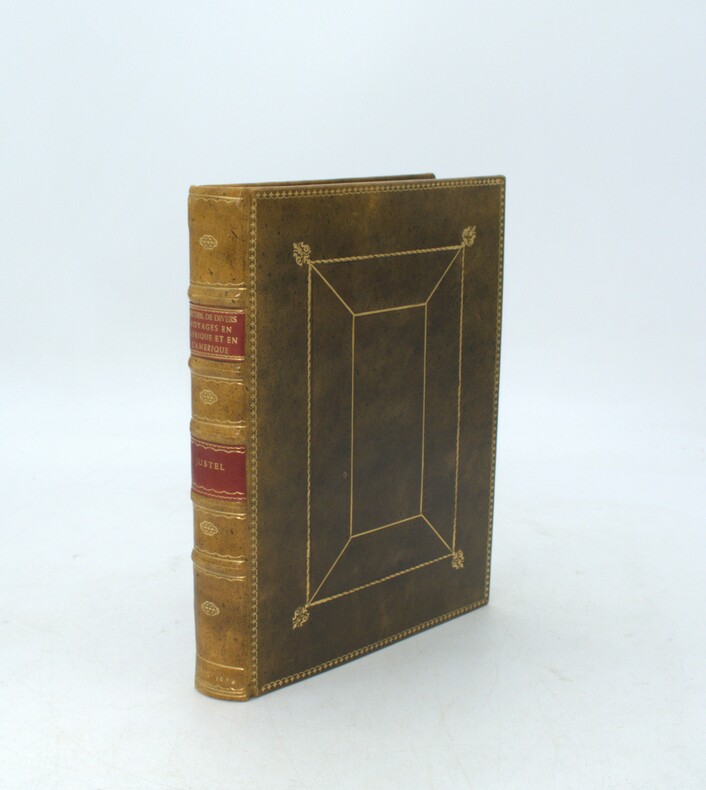
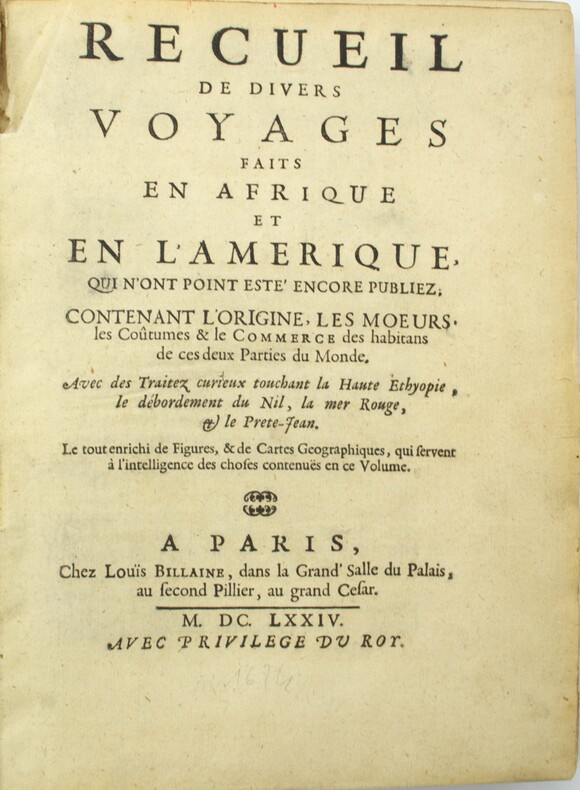
1674PHO-2243Paris, Louis Billaine, 1674, in-4 (228x164), basane postérieure (19eme), dos à nerfs avec titre, lieu et date, tranches marbrées, réparations au dos et aux coins, petite réparation au pli de la carte des Barbades, intérieur frais, illustré de 12 planches (13) et trois cartes dépliantes (Barbades, Jamaïque et Virginie, Maryland et la Nouvelle-Angleterre) manque la carte du Nil comme souvent et un faux titre
1674PHO-2032Paris, Louis Billaine, 1674. in-4 (228x164) , relié plein veau , filets sur les plats , dos à nerfs orné avec titre , auteur et date (reliure pastiche),tranches rouge. L'ouvrage est illustré de 12 planches hors texte, une carte de l'Éthiopie dans le texte, trois cartes dépliantes (Barbades, Jamaïque et Virginie, Maryland et la Nouvelle-Angleterre) manque la carte du Nil, mouillures, déchirure et réparation au pli (carte des Barbardes)
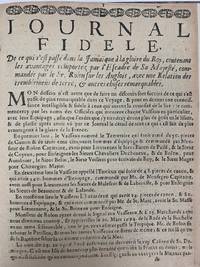
169560184to. 227 x 170 mm. 8 pp. Bound in marbled paper over boards. Margins short cropping page numbers on 2 leaves and just touching but not obscuring the top of some letters of text. Generally very good. <br /><br /><p>Very rare with one recorded copy in Bordeaux of a detailed and lively account of this French expedition against Jamaica during the Nine Years War comprising a string of brutal attacks over the summer of 1694 led by Jean-Baptiste Du Casse. Appointed Governor of Saint-Domingue in 1691 Du Casse had earlier in his career been involved with the slave-trading Compagnie du Senegal and had served throughout the Atlantic world in various capacities including as admiral and privateer. Very familiar with the Caribbean and the ways of the filibusterers and buccaneers operating there he was the best candidate for the difficult job of rallying competing interests to align with those of <i>la France d'outre-mer </i>at a time when funding from France was scarce with Louis XIV distracted by the War of the League of Augsburg closer to home. </p><p>In brief 3 French warships accompanied by numerous transport ships under the command of Captain Rollon were sent to Saint Dominique to provide support to the colonists against the Spanish in neighboring Hispaniola. Soon after their arrival they were reassigned by Du Casse to cruise off Jamaica in early April 1694 where they eventually landed at Port Morant on the eastern coast of the island. Over a period of six to seven weeks they ravaged plantations destroyed over 50 sugar-works and kidnapped hundreds of slaves along with killing and torturing numerous English colonists. Soon to follow Du Casse assembling a small fleet of colonial brigantines and sloops embarked from Saint Dominique with 1500 men for Jamaica. He set sail down the southern coast to Carlisle Bay en route to Spanish Town which he planned to plunder. However a militia company of planters and slaves successfully defended their ground and Du Casse withdrew to St. Dominque but not before destroying Carlisle Bay. "The expeditions richest prize was undoubtedly the 1300 to 3000 captured slaves who proved crucial to the immediate future prosperity of the French colony" Pritchard p. 318 where our narrator points out they could be sold for 60 to 120 piastres each.</p><p>Narrated chronologically the eye-witness account gives vivid testimony to the preparations execution and aftermath of the expedition against Jamaica over the spring and summer months and into the fall of 1694 touching on the internal state of martial affairs between the Spanish and French on the divided island they occupied together. The narrator's lively digressions and personal reflections leave no doubt that he was on the spot when he comments on the disease probably Yellow Fever which ravaged the crews the tremors under foot which incited fear of another earthquake like the one which flattened Port Royal two years before the unexpected collateral encounters and skirmishes with the English in the area related through colorful anecdotes and the general atmosphere of depravation of the crews and the weakness of the Saint Dominique defenses against incursion by the Spanish as a result in large part to the lack of sufficient material support coming from France. </p><p>"If Du Casse could declare the attack on Jamaica a success the same conclusion could not be made by the navy. By August sickness was swiftly reducing crew numbers. <i>Le Solide</i> which had been long in the Islands was immediately sent back to France her crew being too diminished for further use. <i>Le Téméraire</i> had lost 50 of her best sailors and the captain of the English prize now called <i>Le Faucon</i> had died. By September <i>L'Envieux</i> had lost 100 men including her captain and disease claimed Captain du Rollon of Le <i>Téméraire</i>. The four warships including <i>Le Hazardeux</i> departed Cap Francais in early October but further disaster awaited them in the Atlantic" Pritchard p.318– storms capture by the English starvation fire shipwreck disappearance and death. Of the 350 men who departed France at the beginning of the year only 130 returned by year's end. </p><p>Collated against the copy at the Collection de la ville de Bordeaux Bibliotheque municipale see https://issuu.com/scduag/docs/bbx17016 a copy with numerous printer's creases significantly obscuring text; Pritchard <i>In Search of Empire: The French in the Americas 1670-1730</i> Cambridge 2004; Charlevoix <i>Histoire de l'Isle Espagnole ou de S. Domingue</i> 1731 vol. 2 p. 261. Not in Landis.</p> hardcover
169560184to. 227 x 170 mm. 8 pp. Bound in marbled paper over boards. Margins short cropping page numbers on 2 leaves and just touching but not obscuring the top of some letters of text. Generally very good. <br /><br /><p>Very rare with one recorded copy in Bordeaux of a detailed and lively account of this French expedition against Jamaica during the Nine Years War comprising a string of brutal attacks over the summer of 1694 led by Jean-Baptiste Du Casse. Appointed Governor of Saint-Domingue in 1691 Du Casse had earlier in his career been involved with the slave-trading Compagnie du Senegal and had served throughout the Atlantic world in various capacities including as admiral and privateer. Very familiar with the Caribbean and the ways of the filibusterers and buccaneers operating there he was the best candidate for the difficult job of rallying competing interests to align with those of <i>la France d'outre-mer </i>at a time when funding from France was scarce with Louis XIV distracted by the War of the League of Augsburg closer to home. </p><p>In brief 3 French warships accompanied by numerous transport ships under the command of Captain Rollon were sent to Saint Dominique to provide support to the colonists against the Spanish in neighboring Hispaniola. Soon after their arrival they were reassigned by Du Casse to cruise off Jamaica in early April 1694 where they eventually landed at Port Morant on the eastern coast of the island. Over a period of six to seven weeks they ravaged plantations destroyed over 50 sugar-works and kidnapped hundreds of slaves along with killing and torturing numerous English colonists. Soon to follow Du Casse assembling a small fleet of colonial brigantines and sloops embarked from Saint Dominique with 1500 men for Jamaica. He set sail down the southern coast to Carlisle Bay en route to Spanish Town which he planned to plunder. However a militia company of planters and slaves successfully defended their ground and Du Casse withdrew to St. Dominque but not before destroying Carlisle Bay. "The expeditions richest prize was undoubtedly the 1300 to 3000 captured slaves who proved crucial to the immediate future prosperity of the French colony" Pritchard p. 318 where our narrator points out they could be sold for 60 to 120 piastres each.</p><p>Narrated chronologically the eye-witness account gives vivid testimony to the preparations execution and aftermath of the expedition against Jamaica over the spring and summer months and into the fall of 1694 touching on the internal state of martial affairs between the Spanish and French on the divided island they occupied together. The narrator's lively digressions and personal reflections leave no doubt that he was on the spot when he comments on the disease probably Yellow Fever which ravaged the crews the tremors under foot which incited fear of another earthquake like the one which flattened Port Royal two years before the unexpected collateral encounters and skirmishes with the English in the area related through colorful anecdotes and the general atmosphere of depravation of the crews and the weakness of the Saint Dominique defenses against incursion by the Spanish as a result in large part to the lack of sufficient material support coming from France. </p><p>"If Du Casse could declare the attack on Jamaica a success the same conclusion could not be made by the navy. By August sickness was swiftly reducing crew numbers. <i>Le Solide</i> which had been long in the Islands was immediately sent back to France her crew being too diminished for further use. <i>Le Téméraire</i> had lost 50 of her best sailors and the captain of the English prize now called <i>Le Faucon</i> had died. By September <i>L'Envieux</i> had lost 100 men including her captain and disease claimed Captain du Rollon of Le <i>Téméraire</i>. The four warships including <i>Le Hazardeux</i> departed Cap Francais in early October but further disaster awaited them in the Atlantic" Pritchard p.318– storms capture by the English starvation fire shipwreck disappearance and death. Of the 350 men who departed France at the beginning of the year only 130 returned by year's end. </p><p>Collated against the copy at the Collection de la ville de Bordeaux Bibliotheque municipale see https://issuu.com/scduag/docs/bbx17016 a copy with numerous printer's creases significantly obscuring text; Pritchard <i>In Search of Empire: The French in the Americas 1670-1730</i> Cambridge 2004; Charlevoix <i>Histoire de l'Isle Espagnole ou de S. Domingue</i> 1731 vol. 2 p. 261. Not in Landis.</p> hardcover books
1662250234Southampton House England 1662. 1 bifolium 11-3/4 x 8-1/4 in. accomplished entirely in manuscript. Docketed verso: "Sr Tho. Whetstones warrant for £100 out of the privy seals dormant. indistinct initials follow.". 1 vols. 4to. Former fold lines per usual; some surface soil to recto of document; heavy surface soil to verso of integral cognate; small perimeter chips and light distress. 1 bifolium 11-3/4 x 8-1/4 in. accomplished entirely in manuscript. Docketed verso: "Sr Tho. Whetstones warrant for £100 out of the privy seals dormant. indistinct initials follow.". 1 vols. 4to. According to David F. Marley's Pirates of the Americas Sir Thomas Whetstone 1630/31-1668 was a nephew of Oliver Cromwell "reduced from a Commonwealth naval Commodore into an impoverished West Indian rover before dying in Spanish hands." <br /> Whetstone is described by ODNB as a naval officer and adventurer and a son of the favorite sister of the protectorate. Through nepotism per the protector's "misplaced patronage" Whetsone quickly rose through the naval ranks. He ascended from a volunteer on Penn's flagship in the 1654 expedition to Hispaniola was given command of a ship on the return voyage home and eventually commanded a squadron cruising the waters between Malta and Crete.<br /> Whetstone soon became a man of questionable integrity. He flouted orders sold grain seriously needed to sustain the fleet for his own profit quarreled with officers and in general showed high levels of insolence incompetence and dallied onshore avoiding naval duties. <br /> Cromwell's death changed Whetstone's fortunes. When it became apparent to political forces that his usefulness as a pawn to control the naval fleet was insignificant Whetsone returned to England at the restoration impoverished and spent. By 1661 he was in a debtor's jail in Marshalsea where he became a royal nuisance by "bombarding" the government for employment and begging relatives for money. Finally to put this embarrassment out of harm's way the King agreed in April 1662 to give Whetstone £100 and to establish him as a Jamaican planter. The money was considered "royal bounty for his encouragement in settling a plantation in the Isle of Jamaica." Additionally Whetsone was given twelve indentured men to help him establish a foothold in the New World. <br /> Here then is the material evidence that propels Whetstone towards his destiny in the West Indies. The document is signed "T. Southampton" by Sir Lawrence Tanfield Earl of Southampton Keeper of the Privy Seal. Addressed to and directing Sir Robert Pye auditor of the exchequer and indicating that he is to give Sir Thomas Whetstone £100 ". as of his Majesty's free gift for his incouragement sic in settling a plantation in the Island of Jamaica." With this document a new chapter in Whetstone's life opened upon his arrival in Jamaica in 1662.<br /> As Marley notes Whetstone's first actions in the West Indies was not to become a sedentary planter but to be a privateer. With an Indian crew he began operating and raiding off the Cuban coast. Then personally providing recent intelligence to the infamous Sir Christopher Myngs 1625-1666 an English admiral and pirate whose riotous atrocities with his buccaneers were legendary Whetstone joined in Myngs' 1662 sacking of Santiago de Cuba. Myngs was hated by the Spanish and famed for his unbridled cruelty. His atrocities next year in 1663 with pirates Henry Morgan and Abraham Blauvelt would alarm and forced King Charles II to call for a moratorium on further attacks. In the same year Whetstone was likewise endeavoring: on record as commander of a 7-gun Spanish prize manned by sixty souls and noted as one of the "private ships of war belonging to Jamaica."<br /> In addition to his exploits at sea Whetsone was heavily involved with the arrest and deposal of the Jamaican Speaker of Assembly Samuel Long on charges of treason in 1664. By 1666 Whetsone himself became Speaker of the Jamaica House of Assembly. Circa this period he was captured by the Spanish on Providencia Island carried as a prisoner to Portobelo and then force-marched to Panama City where he was tossed in the dungeon. So angry were the Spanish at Whetstone's piratical depredations the Governor Juan Perez de Guzman wrote to Madrid blaming the man for planning "all the damage done on these coasts." Whetsone died in Spanish captivity in 1667. See ODNB; Marley Pirates of the Americas pp. 399-405 unknown
1662250234Southampton House England 1662. 1 bifolium 11-3/4 x 8-1/4 in. accomplished entirely in manuscript. Docketed verso: "Sr Tho. Whetstones warrant for £100 out of the privy seals dormant. indistinct initials follow.". 1 vols. 4to. Former fold lines per usual; some surface soil to recto of document; heavy surface soil to verso of integral cognate; small perimeter chips and light distress. 1 bifolium 11-3/4 x 8-1/4 in. accomplished entirely in manuscript. Docketed verso: "Sr Tho. Whetstones warrant for £100 out of the privy seals dormant. indistinct initials follow.". 1 vols. 4to. According to David F. Marley's Pirates of the Americas Sir Thomas Whetstone 1630/31-1668 was a nephew of Oliver Cromwell "reduced from a Commonwealth naval Commodore into an impoverished West Indian rover before dying in Spanish hands." <br/>Whetstone is described by ODNB as a naval officer and adventurer and a son of the favorite sister of the protectorate. Through nepotism per the protector's "misplaced patronage" Whetsone quickly rose through the naval ranks. He ascended from a volunteer on Penn's flagship in the 1654 expedition to Hispaniola was given command of a ship on the return voyage home and eventually commanded a squadron cruising the waters between Malta and Crete.<br/>Whetstone soon became a man of questionable integrity. He flouted orders sold grain seriously needed to sustain the fleet for his own profit quarreled with officers and in general showed high levels of insolence incompetence and dallied onshore avoiding naval duties. <br/>Cromwell's death changed Whetstone's fortunes. When it became apparent to political forces that his usefulness as a pawn to control the naval fleet was insignificant Whetsone returned to England at the restoration impoverished and spent. By 1661 he was in a debtor's jail in Marshalsea where he became a royal nuisance by "bombarding" the government for employment and begging relatives for money. Finally to put this embarrassment out of harm's way the King agreed in April 1662 to give Whetstone £100 and to establish him as a Jamaican planter. The money was considered "royal bounty for his encouragement in settling a plantation in the Isle of Jamaica." Additionally Whetsone was given twelve indentured men to help him establish a foothold in the New World. <br/>Here then is the material evidence that propels Whetstone towards his destiny in the West Indies. The document is signed "T. Southampton" by Sir Lawrence Tanfield Earl of Southampton Keeper of the Privy Seal. Addressed to and directing Sir Robert Pye auditor of the exchequer and indicating that he is to give Sir Thomas Whetstone £100 ". as of his Majesty's free gift for his incouragement sic in settling a plantation in the Island of Jamaica." With this document a new chapter in Whetstone's life opened upon his arrival in Jamaica in 1662.<br/>As Marley notes Whetstone's first actions in the West Indies was not to become a sedentary planter but to be a privateer. With an Indian crew he began operating and raiding off the Cuban coast. Then personally providing recent intelligence to the infamous Sir Christopher Myngs 1625-1666 an English admiral and pirate whose riotous atrocities with his buccaneers were legendary Whetstone joined in Myngs' 1662 sacking of Santiago de Cuba. Myngs was hated by the Spanish and famed for his unbridled cruelty. His atrocities next year in 1663 with pirates Henry Morgan and Abraham Blauvelt would alarm and forced King Charles II to call for a moratorium on further attacks. In the same year Whetstone was likewise endeavoring: on record as commander of a 7-gun Spanish prize manned by sixty souls and noted as one of the "private ships of war belonging to Jamaica."<br/>In addition to his exploits at sea Whetsone was heavily involved with the arrest and deposal of the Jamaican Speaker of Assembly Samuel Long on charges of treason in 1664. By 1666 Whetsone himself became Speaker of the Jamaica House of Assembly. Circa this period he was captured by the Spanish on Providencia Island carried as a prisoner to Portobelo and then force-marched to Panama City where he was tossed in the dungeon. So angry were the Spanish at Whetstone's piratical depredations the Governor Juan Perez de Guzman wrote to Madrid blaming the man for planning "all the damage done on these coasts." Whetsone died in Spanish captivity in 1667. See ODNB; Marley Pirates of the Americas pp. 399-405 unknown books