84 résultats
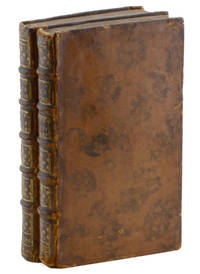
175119420Londres i.e. Paris: Chez Nourse 1751. First edition in French. Joints rather rubbed but sound; some light wear and foxing; a very good copy. 2 vols 12mo contemporary calf leather labels gilt spines 4 285 1; 2 248 pages. 6 folding plates signed N. B. de Poilly. Dans ce tems l‡ le fameux Edouard Teach communÈment appellÈ Barbe noire infestoit les Mers de l'Amerique. On ne vit guËres d'homme plus sanguinaire. Sa cruautÈ alloit jusqu'‡ barbarie. Son nom devint la terreur gÈnÈrale & quelques Gouverneurs ayant nÈgligÈ de le pousuivre il suspendit presque entierement le commerce de certaines Colonies du Nord. It Ètoit nÈ ‡ la Jamaique de fort honnÃtes parens. Sa mere y vit encoutre. . . . Il fut tuÈ & sa tÃte portÈe ‡ la Virginie o˘ elle fut attachÈe au bout d'une perche." Often called a translation of an abridgement of Hans Sloane but quite clearly on comparison of texts a translation of Charles Leslie's New and Exact Account of Jamaica Edinburgh 1739 this translation attributed supposedly to Joseph Raulin. Whether Leslie drew on Sloane is unclear though Leslie appears in fact to have been a Jamaica resident who had met family members of that notorious local figure Blackbeard. Chez Nourse, unknown books
1825WRCAM55730London: Printed by Harvey and Darton 1825. 3-15pp. Lacks half title. Recent half black morocco and grey cloth boards title stamped in blue on front board. Bookplate on front pastedown Stephen Hopwood Jamaican binder's ticket on rear pastedown newspaper article bound in at rear. Front hinge just starting slight soiling to titlepage light tanning. Very good. First edition of this account of the "wanton cold-blooded" hunting of runaway slaves in Jamaica. The "shooting excursion" in the title refers to the 1824 "attack made by a party of islanders upon a long-established camp of runaway slaves who had lived peaceably for years in a forest settlement" Ragatz. The pamphlet includes summaries of the attack from the MONTEGO BAY GAZETTE CORNWALL COURIER and CORNWALL GAZETTE as well as an illustration of the camp showing the route of the attackers. The author explains that "the barbarous excursions which have been described did not owe their origin to any insurrection of the Negroes in consequence of any discussions in the British Parliament nor in consequence of any stir made by the British people in their behalf. They were as the account itself testifies wanton cold-blooded excursions on the part of the white inhabitants of Trelawny to root up a runaway settlement which had subsisted eleven years without offense or molestation to the neighbourhood" p.6. The author of the text is unknown signed only at the end in print as "Alfred." <br> <br> This copy was bound at the Verona Bindery in Kingston Jamaica and includes a newspaper article mounted and bound in at rear from THE JAMAICA WEEKLY GLEANER February 8 1982 recounting the attacks. RAGATZ p.409. OCLC 12003173. SABIN 35556. Printed by Harvey and Darton hardcover books
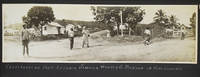
1908316262Jamaica 1908. Mounted recto and verso to loose black paper album leaves captioned in white each monogrammed DKM 1908 within image. Oblong 8vo images measure 3-1/2 x 11-3/4 inches. Some chipping to album leaves with occasional wear to corners of images. Mounted recto and verso to loose black paper album leaves captioned in white each monogrammed DKM 1908 within image. Oblong 8vo images measure 3-1/2 x 11-3/4 inches. Locatons include Port Antonio and Hotel Tichfield Kingston including evidence of destruction from the 1907 earthquake Saint Ann's Bay Cuba as seen from a boat and Castleton Gardens. unknown books
1895WRCAM55994Kingston and other locations in Jamaica 1895. Forty-six sepia-tone photographs either 4 x 6 inches or 6 x 8 inches mounted in an album. Oblong quarto. Contemporary three-quarter calf and pebbled brown cloth front board gilt. Spine perished front board detached cloth soiled and discolored. A few mounts detached mounts toned with occasional soiling and foxing. A few photographs with minor abrasions. Good condition overall. An attractive album of Caribbean images containing almost fifty original photographs showing views of Kingston Jamaica and its environs during the last decade of the 19th century. The album comprises a wide range of settings in and around Kingston including numerous shoreline and harbor views some showing people in sailboats or rowboats a number of street views a handful of images of fruit groves notable residences and other buildings rural views a scene of several people and their horse-drawn carriage outside a barn churches a railroad depot and more. The photographs are present in two distinct sizes; one of the larger-format pictures is titled in pencil on the verso "Palmetto Ave. Kingston." One of the smaller-format photographs is noted as "Bakers Grove." <br> <br> The compiler of the album is unknown though he or she was most likely American; the photograph album was manufactured in New York by Felix Reifschnelder with his label on the inside rear board. <br> <br> A handsome group of photographs featuring the people and places of Kingston Jamaica at the end of the 19th century. hardcover books
1786WRCAM36081Kingston Jamaica: Printed for James Jones Esq. by Lewis and Eberall 1786. v3114-424; 440pp. Quarto. Modern polished calf gilt leather label. Contemporary ownership inscription on titlepage of ACTS.: "George Harrison Lincolns Inn 1791." Titlepage worn and soiled repairs in top and bottom margin with no loss of text. Occasional minor foxing last two leaves dampstained. Small hole in leaf F with loss of a few letters. First four leaves and last four leaves of AN ABRIDGMENT. dampstained leaf aa repaired no loss of text final leaf supplied in facsimile. These exceptions noted very clean internally. A very good copy. First editions of two rare 18th-century Jamaican legal imprints. The volume was previously owned by legal author Sir George Harrison the son of Thomas Harrison who served as attorney-general and advocate- general of Jamaica. The elder Harrison's name is included in the list of subscribers for the ACTS. and father or son have made minor manuscript additions on a half dozen pages in the text. <br> <br> The volume records both public and private acts organized chronologically for 1770 through 1783. The ABRIDGMENT. published as a separate work with separate titlepage clearly supplements the ACTS. by listing the acts by subject and providing an index. There are numerous acts regarding slaves which provide much insight into that institution on the island including legislation regarding runaways "Free- Negroes" "Negro towns" and maroons firearms holidays and even drumming. Other acts cover a wide range of laws and activities including those related to land roads cattle gaming hawkers and pedlars the militia settlers ships and smuggling. <br> <br> All 18th-century Caribbean imprints are rare most are extremely so and these laws are no exception. Furthermore the majority of Caribbean printing is often ephemeral and fairly slight rather than a substantial volume such as this one. The first British colony south of Maryland to have a press printing began in Jamaica in 1718. Except for several items printed in Havana by a press briefly established there this was the first press in the Caribbean; however only a handful of fugitive pieces survive from the 1770s. In that period the economic importance of Jamaica was supplemented by an influx of Loyalists who seems to have invigorated the cultural and publishing life of the colony while the British government liberalized its colonial policy to avoid a repetition of the problems of the American Revolution. In this social and political climate these retrospective laws of the local colonial government were printed. <br> <br> A very good copy of two rare 18th-century Jamaican imprints with provenance related to the island and British legal history. SABIN 35617 ACTS. and ABRIDGMENT. CUNDALL SUPPLEMENT 446 447. GOLDSMITHS 13208. ESTC T140415. OCLC 28209638 30304147 31220784. DNB IX p.32. Printed for James Jones, Esq. by Lewis and Eberall hardcover books
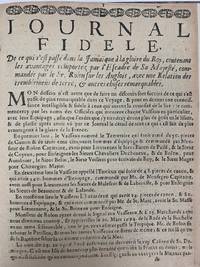
169560184to. 227 x 170 mm. 8 pp. Bound in marbled paper over boards. Margins short cropping page numbers on 2 leaves and just touching but not obscuring the top of some letters of text. Generally very good. <br /><br /><p>Very rare with one recorded copy in Bordeaux of a detailed and lively account of this French expedition against Jamaica during the Nine Years War comprising a string of brutal attacks over the summer of 1694 led by Jean-Baptiste Du Casse. Appointed Governor of Saint-Domingue in 1691 Du Casse had earlier in his career been involved with the slave-trading Compagnie du Senegal and had served throughout the Atlantic world in various capacities including as admiral and privateer. Very familiar with the Caribbean and the ways of the filibusterers and buccaneers operating there he was the best candidate for the difficult job of rallying competing interests to align with those of <i>la France d'outre-mer </i>at a time when funding from France was scarce with Louis XIV distracted by the War of the League of Augsburg closer to home. </p><p>In brief 3 French warships accompanied by numerous transport ships under the command of Captain Rollon were sent to Saint Dominique to provide support to the colonists against the Spanish in neighboring Hispaniola. Soon after their arrival they were reassigned by Du Casse to cruise off Jamaica in early April 1694 where they eventually landed at Port Morant on the eastern coast of the island. Over a period of six to seven weeks they ravaged plantations destroyed over 50 sugar-works and kidnapped hundreds of slaves along with killing and torturing numerous English colonists. Soon to follow Du Casse assembling a small fleet of colonial brigantines and sloops embarked from Saint Dominique with 1500 men for Jamaica. He set sail down the southern coast to Carlisle Bay en route to Spanish Town which he planned to plunder. However a militia company of planters and slaves successfully defended their ground and Du Casse withdrew to St. Dominque but not before destroying Carlisle Bay. "The expeditions richest prize was undoubtedly the 1300 to 3000 captured slaves who proved crucial to the immediate future prosperity of the French colony" Pritchard p. 318 where our narrator points out they could be sold for 60 to 120 piastres each.</p><p>Narrated chronologically the eye-witness account gives vivid testimony to the preparations execution and aftermath of the expedition against Jamaica over the spring and summer months and into the fall of 1694 touching on the internal state of martial affairs between the Spanish and French on the divided island they occupied together. The narrator's lively digressions and personal reflections leave no doubt that he was on the spot when he comments on the disease probably Yellow Fever which ravaged the crews the tremors under foot which incited fear of another earthquake like the one which flattened Port Royal two years before the unexpected collateral encounters and skirmishes with the English in the area related through colorful anecdotes and the general atmosphere of depravation of the crews and the weakness of the Saint Dominique defenses against incursion by the Spanish as a result in large part to the lack of sufficient material support coming from France. </p><p>"If Du Casse could declare the attack on Jamaica a success the same conclusion could not be made by the navy. By August sickness was swiftly reducing crew numbers. <i>Le Solide</i> which had been long in the Islands was immediately sent back to France her crew being too diminished for further use. <i>Le Téméraire</i> had lost 50 of her best sailors and the captain of the English prize now called <i>Le Faucon</i> had died. By September <i>L'Envieux</i> had lost 100 men including her captain and disease claimed Captain du Rollon of Le <i>Téméraire</i>. The four warships including <i>Le Hazardeux</i> departed Cap Francais in early October but further disaster awaited them in the Atlantic" Pritchard p.318– storms capture by the English starvation fire shipwreck disappearance and death. Of the 350 men who departed France at the beginning of the year only 130 returned by year's end. </p><p>Collated against the copy at the Collection de la ville de Bordeaux Bibliotheque municipale see https://issuu.com/scduag/docs/bbx17016 a copy with numerous printer's creases significantly obscuring text; Pritchard <i>In Search of Empire: The French in the Americas 1670-1730</i> Cambridge 2004; Charlevoix <i>Histoire de l'Isle Espagnole ou de S. Domingue</i> 1731 vol. 2 p. 261. Not in Landis.</p> hardcover books
1662250234Southampton House England 1662. 1 bifolium 11-3/4 x 8-1/4 in. accomplished entirely in manuscript. Docketed verso: "Sr Tho. Whetstones warrant for £100 out of the privy seals dormant. indistinct initials follow.". 1 vols. 4to. Former fold lines per usual; some surface soil to recto of document; heavy surface soil to verso of integral cognate; small perimeter chips and light distress. 1 bifolium 11-3/4 x 8-1/4 in. accomplished entirely in manuscript. Docketed verso: "Sr Tho. Whetstones warrant for £100 out of the privy seals dormant. indistinct initials follow.". 1 vols. 4to. According to David F. Marley's Pirates of the Americas Sir Thomas Whetstone 1630/31-1668 was a nephew of Oliver Cromwell "reduced from a Commonwealth naval Commodore into an impoverished West Indian rover before dying in Spanish hands." <br/>Whetstone is described by ODNB as a naval officer and adventurer and a son of the favorite sister of the protectorate. Through nepotism per the protector's "misplaced patronage" Whetsone quickly rose through the naval ranks. He ascended from a volunteer on Penn's flagship in the 1654 expedition to Hispaniola was given command of a ship on the return voyage home and eventually commanded a squadron cruising the waters between Malta and Crete.<br/>Whetstone soon became a man of questionable integrity. He flouted orders sold grain seriously needed to sustain the fleet for his own profit quarreled with officers and in general showed high levels of insolence incompetence and dallied onshore avoiding naval duties. <br/>Cromwell's death changed Whetstone's fortunes. When it became apparent to political forces that his usefulness as a pawn to control the naval fleet was insignificant Whetsone returned to England at the restoration impoverished and spent. By 1661 he was in a debtor's jail in Marshalsea where he became a royal nuisance by "bombarding" the government for employment and begging relatives for money. Finally to put this embarrassment out of harm's way the King agreed in April 1662 to give Whetstone £100 and to establish him as a Jamaican planter. The money was considered "royal bounty for his encouragement in settling a plantation in the Isle of Jamaica." Additionally Whetsone was given twelve indentured men to help him establish a foothold in the New World. <br/>Here then is the material evidence that propels Whetstone towards his destiny in the West Indies. The document is signed "T. Southampton" by Sir Lawrence Tanfield Earl of Southampton Keeper of the Privy Seal. Addressed to and directing Sir Robert Pye auditor of the exchequer and indicating that he is to give Sir Thomas Whetstone £100 ". as of his Majesty's free gift for his incouragement sic in settling a plantation in the Island of Jamaica." With this document a new chapter in Whetstone's life opened upon his arrival in Jamaica in 1662.<br/>As Marley notes Whetstone's first actions in the West Indies was not to become a sedentary planter but to be a privateer. With an Indian crew he began operating and raiding off the Cuban coast. Then personally providing recent intelligence to the infamous Sir Christopher Myngs 1625-1666 an English admiral and pirate whose riotous atrocities with his buccaneers were legendary Whetstone joined in Myngs' 1662 sacking of Santiago de Cuba. Myngs was hated by the Spanish and famed for his unbridled cruelty. His atrocities next year in 1663 with pirates Henry Morgan and Abraham Blauvelt would alarm and forced King Charles II to call for a moratorium on further attacks. In the same year Whetstone was likewise endeavoring: on record as commander of a 7-gun Spanish prize manned by sixty souls and noted as one of the "private ships of war belonging to Jamaica."<br/>In addition to his exploits at sea Whetsone was heavily involved with the arrest and deposal of the Jamaican Speaker of Assembly Samuel Long on charges of treason in 1664. By 1666 Whetsone himself became Speaker of the Jamaica House of Assembly. Circa this period he was captured by the Spanish on Providencia Island carried as a prisoner to Portobelo and then force-marched to Panama City where he was tossed in the dungeon. So angry were the Spanish at Whetstone's piratical depredations the Governor Juan Perez de Guzman wrote to Madrid blaming the man for planning "all the damage done on these coasts." Whetsone died in Spanish captivity in 1667. See ODNB; Marley Pirates of the Americas pp. 399-405 unknown books
1789227355London: Sold by B. White and Son 1789. Third edition first edition was 1756. 49 copper-engraved plates by George Dionysius Ehret. viii 503 646 Index pp. 1 vols. Folio. Bound in contemporary diced calf rebacked. Bookplate of Clarence Dillon Dunwalke Library and with a note that it comes from the Library of Owen D. Young Esq. Third edition first edition was 1756. 49 copper-engraved plates by George Dionysius Ehret. viii 503 646 Index pp. 1 vols. Folio. Browne was an Irish physician who lived for several years in the West Indies and settled in Jamaica in 1746. This is his major work particularly valuable for its contribution to botany. Sabin 8671; Nissen BBl 255; Cundal Bibliographia Jamaicensis 416 Sold by B. White and Son unknown books
1787WRCAM13337Kingston Jamaica: Printed by Alexander Aikman 1787. Two volumes bound in one. 231262221582pp. bound with: AN ABRIDGEMENT OF THE LAWS OF JAMAICA IN MANNER OF AN INDEX. Kingston: Aikman 1787. 429pp. bound with: APPENDIX: CONTAINING LAWS RESPECTING SLAVES. Kingston: Aikman 1787. 4325pp. Large folio. Old calf rebacked. Internally near fine. with: ACTS OF ASSEMBLY PASSED IN THE ISLAND OF JAMAICA; FROM 1770 TO 1783 INCLUSIVE. Kingston: Printed for James Johnes Esq. by Lewis and Eberall 1786. v313-424pp. bound with: AN ABRIDGEMENT OF THE LAWS OF JAMAICA. Kingston: Lewis and Eberall 1786. 440pp. Quarto. Old calf rebacked. Fine. with: ACTS OF ASSEMBLY PASSED IN THE ISLAND OF JAMAICA FROM THE YEAR 1784 TO THE YEAR 1788 INCLUSIVE. Kingston: Printed by Alexander Aikman 1789. xvi300iv423pp. Quarto. Old calf rebacked. Near fine. All together an extraordinary collection of 18th-century Jamaican printing combining six separate imprints one of them consisting of two volumes in three bound volumes all printed between 1786 and 1789 by two different printers in Kingston Jamaica. The texts retrospectively cover the Acts of the Assembly from its beginning in 1681 up to date with the last printing in 1788. Also included are two separate publications containing abridgements of the various acts and a further separate publication combining all of the slave statutes in one place. <br> <br> As anyone who has sought them knows well all 18th-century Caribbean imprints are rare most extremely so and these laws are no exception. Furthermore most Caribbean printing is fairly slight not substantial volumes such as these. Printing began in Jamaica in 1718. It was the first British colony south of Maryland to have a printing press and except for several items printed in Havana by a press briefly established there this was the first press in the Caribbean; however only a handful of fugitive pieces survive from the 1770s. In that period the economic importance of Jamaica was supplemented by an influx of Loyalists including printer Alexander Aikman who seems to have invigorated the cultural and publishing life of the colony while the British government liberalized its colonial policy to avoid a repetition of the problems of the American Revolution. In that climate these retrospective and current laws of the local colonial government were printed. Of all early Caribbean printing that of Jamaica is best documented through the early and thorough work of Frank Cundall. His bibliographies illustrate both the rich variety of material printed on Jamaica and its rarity. <br> <br> Following are the NUC locations and citations of the laws offered herein: <br> <br> 1 ACTS OF ASSEMBLY 1681-1769. Kingston 1787. Not in the NUC. CUNDALL p.52. <br> <br> 2 ABRIDGEMENT OF LAWS. Kingston 1787. Not in the NUC or Cundall. <br> <br> 3 LAWS RESPECTING SLAVES. Kingston 1787. Not in the NUC or Cundall. <br> <br> 4 ACTS OF ASSEMBLY 1770-83. Kingston 1786. The NUC locates DLC MH RPJCB MChB NN. CUNDALL p.52. SABIN 35617. <br> <br> 5 ABRIDGEMENT OF LAWS. Kingston 1786. The NUC locates NN. Not in Cundall. SABIN 35617. <br> <br> 6 ACTS OF ASSEMBLY 1784-88. Kingston 1789. The NUC locates DLC RPJCB. CUNDALL p.53. <br> <br> In all a remarkable assemblage of Caribbean printing. Printed by Alexander Aikman unknown books