DU CANGE (Charles Du Fresne, sieur)Livre Rare Book
837 résultats
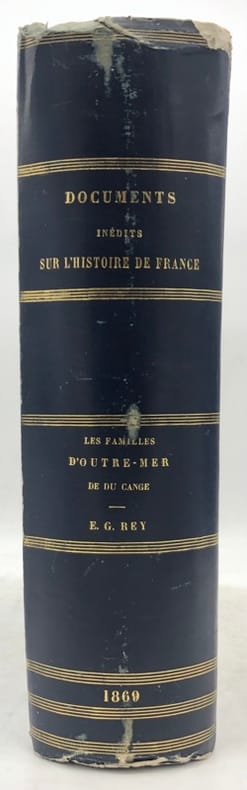
146841Collection Documents Inédits sur l'Histoire de FranceParis, Imprimerie Impériale, 1869 in-4, IV-998 pp., index, cartonnage papier bleu, filets dorés au dos et sur les plats (rel. de l'éditeur). Petites usures aux coiffes, mors supérieur abîmé en tête. Cachet de bibliothèque annulé.
1791P1-2EParis, Belin, 1791. 2 tomes reliés en un in-8 (20x13 cm) plein veau époque, dos à 5 nerfs, pièce de titre et de tomaison rouge, tranches rouges. viii-327 pp.- 4 ff.- 410pp. Avec une description sur 44 pp. de Vins Chypriotes. Le tome premier contient la plus complète description de l’île de Chypre que l’on eût alors. Le second concerne la Syrie. L’auteur avait séjourné au Levant de 1760 à 1768. Mariti, who was an official of the Imperial and Tuscan consulates, gives an excellent account of the condition of Cyprus during the third quarter of the eightieth century, which is based mainly on his own observations. Volume 1 deals with Cyprus and contains, besides the most complete description of Cyprus then available 5 chapters on Cypriot wines. Mariti travelled the Levant from 1760 to 1768 and spoke both Turkish and Arabic fluently.
1544257046Paris: Carolam Guilliar 1544. 12 392 i.e. 397 19 pP. Folio. Bound in contemporary dark brown blind-stamped calf over beech boards spine perished significant peeling and loss to leather on covers vellum wastepaper end-sheets contemporary marginalia internally very good. 12 392 i.e. 397 19 pP. Folio. Adams E250 Carolam Guilliar unknown
1544257046Paris: Carolam Guilliar 1544. 12 392 i.e. 397 19 pP. Folio. Bound in contemporary dark brown blind-stamped calf over beech boards spine perished significant peeling and loss to leather on covers vellum wastepaper end-sheets contemporary marginalia internally very good. 12 392 i.e. 397 19 pP. Folio. Adams E250 Carolam Guilliar unknown books
L3 box619 cVery rare book. paperback
417 pages. Index. Appendices. Footnotes. List of sixty black and white illustrations. A rare surviving copy of this important reference, made all the more engaging by today's environment of competing fiat currency devaluations. "Hitherto Numismatists when stydying the Origines of Coinage had confined themselves to the materials presented to them in the earliest money of Lydia, Greece and Italy, and on the other hand the Metrologists had almost completely limited their range of observation to the systems of Babylon, Egypt, Greece and Rome. As the Comparative Method has yielded such excellent results in the study of other human institutions, I have endeavoured by its aid to get some new principles which may throw some fresh light on the first beginnings of monetary and weight systems." - from Preface. Attractive gilt decoration upon green front board. Legible gilt lettering upon backstrip. Average external soiling and wear. Several chips from and lengthy openings along backstrip which has become brittle with age. Narrow opening along most of front hinge. Back hinge open. Bookplate discretely removed inside front board. Unmarked. A tender but worthy copy. Book
PHO-1698S.l.n.d. (ca 1629 ou 1630), in-folio de [12 ff. y compris le titre] ; 140 pp. (livres I, II et III ). Demi-vélin ivoire du temps. Frontispice baroque gravé en taille douce par Jean Blanchin et répété aux seconde (manquant pour la seconde partie) et troisième parties, 56 portraits en médaillon dans le texte et une croix, (2 répétés), plans de Jérusalem, La Valette et Ptolémaïde. Ouvrage incomplet des feuillets E 2 et E3, (pp. 51 à 54, ici en copie), rousseurs, mouillures dans la marge intérieure au bas de l'ouvrage, petites restaurations marginales, premier titre frontispice court en tête.
Very Good Turkish, Ottoman (1500-1928) Original manuscript paper. 40x28 cm. In Ottoman script. 2 p. Mehmed Emin Rauf Pasha was an Ottoman industrialist and statesman, who was Grand Vizier of the Ottoman Empire twice under Mahmud II (reign 1808-1839) and three times under Abdülmecit I (reign 1839-1861) during the Tanzimat period of reformation. He was one of the most prominent figures in funding the Crimean War. According to Shaw and Shaw, Mehmed Emin Rauf Pasha and his predecessor, Mustafa Resit Pasha, "acted mainly as mediators" for Mahmud II, "attempting to balance conflicting interests while participating in the factional activities and disputes endemic in Ottoman governmental life.". Buyuruldu (or Buyrultu, Buyurildi, Buyurdu etc.) is the order of an Ottoman grand vizier, vizier, beglerbegi , defterdâr , or other high officials to a subordinate. The term is derived from the word 'buyuruldi', it has been ordered, in which the order usually ends and which gradually developed into a conventional sign. Buyuruldus are of two main types: a) decisions written in the margin (der kenâr) of an incoming petition or report, often ordering that a fermân (firman) (or berât , etc.) be issued to a certain effect... (Brill, Encyclopedia of Islam). "Menzils" were early post organizations in the Ottoman Empire before the Reform period. In the Ottoman Empire, every 35 kilometers - the distance one could travel in a day - on the main roads, there were buildings called "menzil" or "menzilhane" (destination, post station). Surrounded by walls, these yards had a hostelry, barn, market, bath, and restaurant. Hosted at the complex for free, travelers shopped, took baths and fed their animals, and continued their journeys the following day. At the complex, officials - registered and paid by the state - served the guests. Within time, menzils turned into bazaars where locals sold their products. Then, villages and towns started to pop up around them. Commodities needed by the army for expeditions were preserved at menzils and soldiers were accommodated at these facilities if needed during expeditions. Mailmen operating between two faraway destinations changed their horses with those waiting at menzils and went on their route without losing time. (Source: Ekrem Bugra Ekinci). It's written on paper with 'ahar'. Used black ink only. It includes approx. 63 lines on front and verso of the paper and two buyuruldus. Different calligraphic "riq'a" styles by different bureaucrats and Grand Vizier and owner of a petition (Bende, Osman). Grand vizier's handwriting is in 'diwanî' script. An extremely rare autograph manuscript is a good example of the Ottoman state organization in the early 19th century.
187610671Paris Emile Deyrolle 1876 Un volume in-8 broché, couverture bleue, étiquette manuscrite collée au dos, xiv et 108 pages. Rousseurs, petites déchirures, sans manque, sur les bords de la couverture.
S6964<p>In Greek. Eighteen 18 volumes > 15000 pages.</p><p>Τα <em>Άπαντα</em> του ΑÏχιεπισκόπου ΜακαÏίου Γ΄ καλÏπτουν την πεÏίοδο 1948-1977 Η αφετηÏία συμπίπτει με την εκλογή του ΜακαÏίου στο αξίωμα του ΜητÏοπολίτη Κιτίου ενώ το Ï„Îλος με τον θάνατό του. Βάσει των εξελίξεων στο ΚυπÏιακό zήτημα στα διαδοχικά στάδιά του και της σχετικής δÏάσης του ΜακαÏίου</p><p>Α΄: Î Ïοσπάθειες για διεθνοποίηση του ΚυπÏÎ¹Î±ÎºÎ¿Ï Î–Î·Ï„Î®Î¼Î±Ï„Î¿Ï‚ και εξεÏÏεση λÏσης μÎσω του ΟÏÎ³Î±Î½Î¹ÏƒÎ¼Î¿Ï Î—Î½Ï‰Î¼Îνων Εθνών.</p><p>Β΄-Δ΄: ΑπελευθεÏωτικός Αγώνας της Ε.Ο.Κ.Α. και ίδÏυση της ΚυπÏιακής ΔημοκÏατίας.</p><p>Ε΄-Ζ΄: Τα Ï€Ïώτα βήματα της ΚυπÏιακής ΔημοκÏατίας και οι δικοινοτικÎÏ‚ ταÏαχÎÏ‚.</p><p>Η΄-ΙΒ΄: ΣχÎδια λÏσης του ΚυπÏιακοÏ. ΧοÏντα των Αθηνών. Εθνικό ÎœÎτωπο.</p><p>ΙΓ΄-ΙΕ΄: Ε.Ο.Κ.Α. Β΄. Î Ïαξικόπημα. ΤουÏκική Εισβολή.</p><p>ΙΣΤ΄-ΙΗ΄: ΕπαναλειτουÏγία του κÏάτους και Ï€ÏοσωÏινή αποκατάσταση των εκτοπισθÎντων. Î ÏοσφυγÎÏ‚ στον ΟÏγανισμό ΗνωμÎνων Εθνών. Συμφωνία ΚοÏυφής ΜακαÏίου και Îτενκτάς. Θάνατος του ΜακαÏίου.</p><p><strong>Additional shipping cost applies.</strong></p> Archbishop Macarios III Foundation hardcover
Very Good Turkish, Ottoman (1500-1928) Original manuscript paper. Double elephant folio. (79 x 58 cm). In Ottoman script. Hegira: [1]233-[1]234 = Gregorian: 1818. Burdurlu Dervish Mehmed Pasha, who was grand vizier held office under Mahmud II between the years of 1818-1820. Dervis Mehmed Pasa had gained a reputation among the 'vüzerâ' (Grand-viziers) would be the grand vizier as previously planned by Sultan Mahmud II according the 19th-century historian of Sânîzâde. He dealt with like cases the Aleppo revolution, confusions in Diyarbekir and Çildir, conquest of the Castle of Dir'iye, the center of the Wahhabis by Ibrahim Pasha, the son of Kavalali Mehmed Ali Pasha, the governor of Egypt and confusions in Sivas city. (Türkiye Diyanet Vakfi Islâm Ansiklopedisi). Buyuruldu (or Buyrultu, Buyurildi, Buyurdu etc.) is the order of an Ottoman grand vizier, vizier, beglerbegi , defterdâr , or other high official to a subordinate. The term is derived from the word 'buyuruldi', it has been ordered, in which the order usually ends and which gradually developed into a conventional sign. Buyuruldus are of two main types: a) decisions written in the margin (der kenâr) of an incoming petition or report, often ordering that a fermân (firman) (or berât , etc.) be issued to a certain effect... (Brill, Encyclopedia of Islam). "Menzils" were early post organization in the Ottoman Empire before Reform period. In the Ottoman Empire, every 35 kilometers - the distance one could travel in a day - on the main roads, there were buildings called "menzil" or "menzilhane" (destination, post station). Surrounded by walls, these yards had a hostelry, barn, market, bath and restaurant. Hosted at the complex for free, travelers shopped, took baths and fed their animals and continued their journeys the following day. At the complex, officials - registered and paid by the state - served the guests. Within time, menzils turned into bazaars where locals sold their products. Then, villages and towns started pop up around them. Commodities needed by the army for expeditions were preserved at menzils and soldiers were accommodated at these facilities if needed during expeditions. Mailmen operating between two faraway destinations changed their horses with those waiting at menzils and went on their route without losing time. (Source: Ekrem Bugra Ekinci). This huge sized budget paper (defter) written on paper with 'ahar'. Used black and red inks. It's written from Harmancik qaza (district) in Bursa vilayet (city) and sent to court of Istanbul for grand vizier confirmation. It's a budget defter of Harmancik 'menzil'. Apprx. 250-300 articles (registers) in notes as expenses like Tatar postmans, horses, Kütahya beglerbegi (beylerbeyi), qadis (judges) and other ones. At the end of registers, there is qadi signature (seal), qadi's name is Mehmed es-Seyyid Samed (?). He was probably Turkish judge in its period in that menzil of Bursa, Harmancik. Budget registers start as '[1]233 senesi Saban-i Muazzama'nin gurresinden [1]234 senesinin Saban-i Serif'inin menzil kuyudu'. Registers had been sent to the Ottoman court for approval from Bursa to Istanbul. Grand vizier's hand writing is in 'diwanî' script. An extremely rare autograph manuscript about the earliest postal history as well.
In -Folio, piena pergamena con titolo manoscritto al dorso; (8), 448, 4 tavv.