Puerto RicoBiblio.com
163 résultats
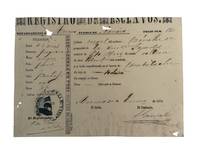
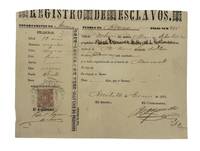
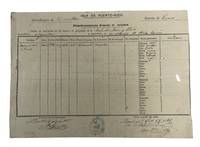
1867208151867. Slave registry document titled "Empadronamiento General de esclavos" from Quebradillas Puerto Rico. 1867. Measuring 6.25" x 8.5". This document was registered by a "Balentin Perez y Pena" and lists a 23 year old enslaved person named "Manuel" documented on the receipt. Document bears official signatures from the local authorities as well as a green stamp from Quebradillas. The enslaved person is listed by their age stature "color" hair color beard eyes nose and mouth. The "color" this individual is listed as "mulato". The name of this person's mother is listed as "Martina". En verso is the printed instructions on how to fill the form as well as the articles on the law of slave trafficking. In Puerto Rico slavery would be abolished in 1873. However the act that outlawed the practice did not emancipate slaves instead phasing it out while also indebting slaves to their masters. Slaves would have to work for a term of three years for their former masters the state or other employers to be released from slavery in addition to having to pay back the master a portion of the 35 million pesetas that he was to be compensated for each former slave. Some minor wormholes and occasional spotting. Overall good condition. unknown
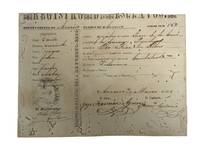
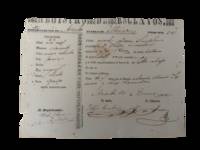
1872208261872. Slave registry document titled "Empadronamiento General de esclavos" from Arecibo Puerto Rico. 1872. Measuring 6.25" x 8.5". This document was registered by a person registering their slave. Document bears official signatures from the local authorities as well as a green stamp. The enslaved person is listed by their age stature "color" hair color beard eyes nose and mouth. The person is listed as 29 years old and the "color" of this individual is listed as "negro". En verso is the printed instructions on how to fill the form as well as the articles on the law of slave trafficking. In Puerto Rico slavery would be abolished in 1873. However the act that outlawed the practice did not emancipate slaves instead phasing it out while also indebting slaves to their masters. Slaves would have to work for a term of three years for their former masters the state or other employers to be released from slavery in addition to having to pay back the master a portion of the 35 million pesetas that he was to be compensated for each former slave. Some minor wormholes and occasional spotting. Overall good condition. unknown
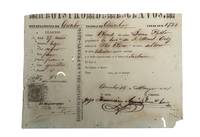
1871208111871. Slave registry document titled "Empadronamiento General de esclavos" from Cambalache Arecibo Puerto Rico. 1871. Measuring 6.25" x 8.5". This document was registered by a person with the surname "Tejada" and lists an enslaved 6 year old boy by the name of "Juan de la Cruz" documented on the receipt. Document bears official signatures from the local authorities. The enslaved child is listed by their age stature "color" hair color beard eyes nose and mouth. The "color" of Juan is listed as "negro". His mother's name is listed as "Victoriana". In Puerto Rico slavery would be abolished in 1873. However the act that outlawed the practice did not emancipate slaves instead phasing it out while also indebting slaves to their masters. Slaves would have to work for a term of three years for their former masters the state or other employers to be released from slavery in addition to having to pay back the master a portion of the 35 million pesetas that he was to be compensated for each former slave. Some wormholing and occasional spotting heading partially cut and back reinforced by notepaper. Overall good condition. unknown
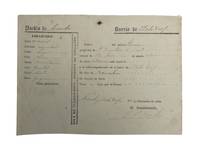
1871208131871. Slave registry document titled "Empadronamiento General de esclavos" from Santana Arecibo Puerto Rico. 1871. Measuring 6.25" x 8.5". This document was registered by a person with the surname "Ortiz" and lists an enslaved 37 year old male by the name of "Juan Pablo" documented on the receipt. Document bears official signatures from the local authorities as well as a grey postage stamp. The enslaved person is listed by their age stature "color" hair color beard eyes nose and mouth. The "color" of this individual is listed as "negro". In Puerto Rico slavery would be abolished in 1873. However the act that outlawed the practice did not emancipate slaves instead phasing it out while also indebting slaves to their masters. Slaves would have to work for a term of three years for their former masters the state or other employers to be released from slavery in addition to having to pay back the master a portion of the 35 million pesetas that he was to be compensated for each former slave. Some wormholing and occasional spotting and heading partially cut. Overall good condition. unknown
1868208271868. Slave registry document titled "Empadronamiento General de esclavos" from Arecibo Puerto Rico. 1868. Measuring 6.25" x 8.5". This document was registered by a person registering their slave. Document bears official signatures from the local authorities. The enslaved person is listed by their age stature "color" hair color beard eyes nose and mouth. The person is listed as 30 years old and the "color" of this individual is listed as "negro". En verso is the printed instructions on how to fill the form as well as the articles on the law of slave trafficking. In Puerto Rico slavery would be abolished in 1873. However the act that outlawed the practice did not emancipate slaves instead phasing it out while also indebting slaves to their masters. Slaves would have to work for a term of three years for their former masters the state or other employers to be released from slavery in addition to having to pay back the master a portion of the 35 million pesetas that he was to be compensated for each former slave. Some minor wormholes and occasional spotting. Overall good condition. unknown
1870207971870. Slave registry document titled "Empadronamiento General de esclavos" from Arecibo Puerto Rico. 1870. Measuring 6.25" x 8.5". This document was registered by a Puerto Rican born person and lists an enslaved 19 year old male by the name of "Maurice" documented on the receipt. Document bears official signatures from the local authorities as well as a red postage stamp. The enslaved person is listed by their age stature "color" hair color beard eyes nose and mouth. The "color" of this individual is listed as "negro". In Puerto Rico slavery would be abolished in 1873. However the act that outlawed the practice did not emancipate slaves instead phasing it out while also indebting slaves to their masters. Slaves would have to work for a term of three years for their former masters the state or other employers to be released from slavery in addition to having to pay back the master a portion of the 35 million pesetas that he was to be compensated for each former slave. Some minor wormholes and occasional spotting heading partially cut and back reinforced by notepaper. Overall very good condition. unknown
1871208121871. Slave registry document titled "Empadronamiento General de esclavos" from Cambalache Arecibo Puerto Rico. 1871. Measuring 6.25" x 8.5". This document was registered by a person with the surname "Tejada" and lists an enslaved 36 year old male by the name of "Lucas" documented on the receipt. Document bears official signatures from the local authorities as well as a grey postage stamp. The enslaved person is listed by their age stature "color" hair color beard eyes nose and mouth. The "color" of this individual is listed as "negro" with a "regular" beard. In Puerto Rico slavery would be abolished in 1873. However the act that outlawed the practice did not emancipate slaves instead phasing it out while also indebting slaves to their masters. Slaves would have to work for a term of three years for their former masters the state or other employers to be released from slavery in addition to having to pay back the master a portion of the 35 million pesetas that he was to be compensated for each former slave. Some wormholing and occasional spotting heading partially cut and back reinforced by notepaper. Overall good condition. unknown
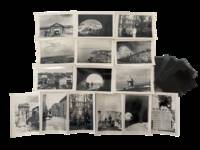
1930231151930. uerto Rico photo archive circa 1930s documenting tourism colonial architecture and coastal urban space in Puerto Rico during the U.S. territorial period. More than simple travel photographs the images preserve how Puerto Rico was visually presented to mainland visitors through fortified Spanish colonial structures harbor overlooks narrow streets landscaped grounds and carefully framed scenic viewpoints. The presence of tourists moving through these spaces reflects the growing role of tourism within Puerto Rico's economy and public image as transportation hospitality and urban modernization increasingly tied the island to expanding American commercial and cultural networks.<br /> <br /> Puerto Rico photo archive of 15 silver gelatin photographs plus 8 sheets of negatives corresponding to the printed images each photograph measuring approximately 3" x 4.5". The photographs center on tourists posed at historic and scenic locations alongside views of masonry fortifications arched passageways lookout platforms coastal bastions harbor panoramas waterfront districts and narrow paved streets lined with colonial architecture. Several images show travelers standing beside defensive walls or within landscaped gardens and hotel-adjacent grounds while others focus outward toward the sea harbor traffic and the built environment of San Juan and surrounding areas. The accompanying negatives preserve the archive as an active travel photography group rather than a surviving set of isolated prints.<br /> <br /> During the 1930s Puerto Rico occupied a distinct position within American imperial commercial and transportation systems and tourism became an increasingly important part of how the island was marketed to mainland visitors. These photographs document that transition by placing travelers within restored colonial sites coastal overlooks and urban spaces where Spanish imperial architecture and modern tourism infrastructure converged. The archive preserves both the physical landscape of Puerto Rico and the broader growth of Caribbean travel culture under U.S. administration showing how photography leisure and colonial urban space worked together in shaping the island's public image. Minor curling and edgewear; overall very good condition. A cohesive documentary archive linking tourism colonial architecture and American-era travel culture in Puerto Rico. unknown
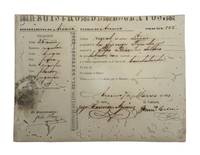
1871231181871. Slavery Black Labor Puerto Rico This official Puerto Rican slave registry document issued in Arecibo in 1871 under Spanish colonial administration represents the bureaucratic infrastructure of slavery in the Caribbean at the precise moment preceding abolition. Titled within the printed form as part of the "Registro de Esclavos - Isla de Puerto Rico" the document records the forced legal identity of an identified enslaved man. <br /> <br /> Single sheet slave registry document "Empadronamiento General de esclavos" from Arecibo Puerto Rico dated 20 de Enero de 1871. Measuring 6.25" x 8.5". This document was registered by a person registering their slave. Document bears official signatures from the local authorities. The enslaved person is listed by their age stature "color" hair color beard eyes nose and mouth. The person is listed as 22 years old and the "color" of this individual is listed as "negro". The physical list of classifications functioned as mechanisms of surveillance control and verification within the colonial slave system. Inclusion of official signatures from both the "dueño" and "comisario" along with a stamped fiscal seal en verso.<br /> <br /> Produced just two years prior to the 1873 abolition of slavery in Puerto Rico the document reflects the transitional legal environment in which enslaved individuals were increasingly catalogued in anticipation of emancipation policies that would in practice impose systems of forced apprenticeship and indemnification to former enslavers.<br /> Some minor wormholes and occasional spotting. Overall good condition. The document stands as evidence of how emancipation in Spanish territories was mediated through administrative control prolonging coercive labor conditions even as slavery was formally dismantled. unknown
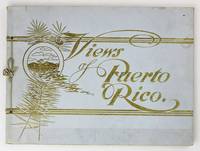
18996319San Juan: Hardie Bros 1899. Very good. 72pp. Oblong octavo. Original card wrappers front cover printed in gilt string-tied at gutter. Minor soiling and edge wear to wrappers. Light toning otherwise internally clean. A rare photo-illustrated promotional pamphlet that details the people places and activities of Puerto Rico in 1899 the year after it became a United States territory as a result of the Spanish-American War. These "Views of Puerto Rico" begins with a brief one-page history of the island followed by seventy pages of captioned photographs picturing a variety of settings and activities. The images are mostly full-page but also include several photo collages. The work opens with a few image that document the U.S. takeover of the island followed by numerous images of Puerto Rican buildings street scenes monuments city and rural views and even a cockfight. The image feature a healthy number of local men women and children engaged in everyday life on the island. OCLC locates copes of this scarce work at only four U.S. institutions Delaware UCLA Tulane and the Buffalo & Erie County Public Library New York. Hardie Bros unknown
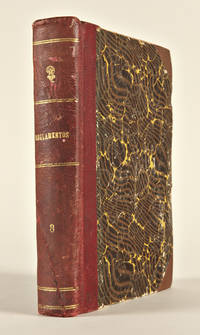
1932WRCAM55116San Juan 1932. Nine separate titles bound together. Individual details of each imprint are provided below. Half contemporary red calf and marbled boards brown calf corners spine gilt. Boards and spine worn corners bumped edges chipped. All pamphlets have front wrapper but lack rear wrapper. Most pamphlets have evidence of previous center folds. Some foxing and tanning but usually due to offsetting from wrappers. Overall very good. A well-preserved collection of pamphlets covering a variety of Puerto Rican legal issues. In the early twentieth century Puerto Rico was in the process of transitioning from U.S. military rule to civilian government albeit limited popular at first following the passage of the Foraker Act or Organic Act in 1900. The United States created a House of Representatives appointed a governor and resident commissioner a non-voting member of the U.S. House and established a Supreme Court to bring Puerto Rico into alignment with the American judicial system. It was not until 1917 with the passage of the Jones- Shafroth Act that Puerto Ricans were granted American citizenship. Jones-Shafroth also established the Puerto Rican Senate a bill of rights and authorized election of the resident commissioner by popular vote. These pamphlets effectively capture part of the history of Puerto Rican officials creating their own government. Notably the earliest pamphlet deals with educating and accrediting lawyers; the others address medicine public education workers' compensation public utilities and banking. The banking pamphlets are from 1931-32 when Puerto Rico along with the rest of the world was in the midst of the Great Depression. The pamphlets in this volume in the order in which they are bound are as follow: <br> <br> 1 Asociación Protectora de Préstamos Sobre Hogares de Puerto Rico: LEY PARA CREAR BANCOS FEDERALES DE PRÉSTAMOS SOBRE HOGARES. San Juan 1932. 21pp. A Spanish translation of the U.S. "Federal Home Loan Bank Act" H.R. 12280 Public No. 304 July 22 1932. <br> <br> 2 Cámara de Representantes: REGLAMENTO DE LA CÃÂMARA DE REPRESENTANTES DE PUERTO RICO 1931. San Juan: Negociado de Materiales Imprenta y Transporte 1932. 21pp. Sets forth the most recent updates to the regulations and bylaws governing Puerto Rico's House of Representatives. <br> <br> 3 REGLAS Y REGLAMENTO DE LA COMISIÓN DE SERVICIO PÚBLICO APROBADO OCTUBRE 27 DE 1917 SEGUN FUE ENMENDADO EN ABRIL 5 DE 1921. San Juan: Negociado de Materiales Imprenta y Transporte 1931. 14pp. Rules and regulations for Puerto Rico's Commission on Public Service one of the oldest regulatory bodies in the territory which oversees utilities and shipping among other territory- wide services. <br> <br> 4 REGLAMENTO PARA EL EXAMEN DE ASPIRANTES AL EJERCICIO DE LA ABOGACÃÂA APROBADO POR EL TRIBUNAL SUPREMO DE PUERTO RICO. PROGRAMAS DEL PRIMERO SEGUNDO Y TERCER CURSOS APROBADO POR EL TRIBUNAL SUPREMO DE PUERTO RICO. San Juan: Bureau of Supplies Printing and Transportation 1914. 149pp. Establishes requirements for individuals aspiring to practice law in Puerto Rico including minimum qualifications to stand for the bar examination and topics to be covered in law school curriculum. Only one copy in OCLC at Universidad Interamericana de Puerto Rico. OCLC 991971626. <br> <br> 5 Board of Medical Examiners: LAW AND REGULATIONS / LEY Y REGLAMENTO OCTOBER 1932. San Juan: Negociado de Materiales Imprenta y Transporte 1932. 64pp. In English and Spanish this pamphlet reprints the Act regulating the practice of medicine in Puerto Rico and sets forth the standards for examination licensing educational requirements etc. <br> <br> 6 A. Andino López compiler. LEYES ESCOLARES DE PUERTO RICO BAJO LA DIRECCIÓN DEL DEPARTAMENTO DE INSTRUCCIÓN OCTUBRE 1927. San Juan: Negociado de Materiales Imprenta y Transporte 1927. 101pp. Sets out current laws governing public education in Puerto Rico including hiring and training of educators salaries for teachers and provisions for alternative learning initiatives. Four copies in OCLC: NYPL Library of Congress Univ. of Cincinnati Universidad de Puerto Rico. OCLC 16162690. <br> <br> 7 Departamento del Trabajo Comision Industrial: REGLAMENTO PARA LA APLICACIÓN DE LA LEY INDEMNIZACIONES POR ACCIDENTES DEL TRABAJO. San Juan: Negociado de Materiales Imprenta y Transporte 1931. 15pp. Explains recent legislation regarding compensation for work-related accidents and injuries. <br> <br> 8 Senado de Puerto Rico: RESOLUCION CONCURRENTE SOBRE ENMIENDAS Y ADICIÓN DE DETERMINADOS ARTÃÂCULOS A LA LEY ORGÃÂNICA EN VIGOR Y OTROS DOCUMENTOS CUYA IMPRESIÓN HA SIDO ACORDADA POR EL SENADO DE PUERTO RICO. San Juan: Negociado de Materiales Imprenta y Transporte 1925. 51pp. Concurrent resolutions comments and other documents approved by the eleventh Asamblea Legislativa and Primer Legislatura Ordinaria related to Jones-Shafroth here also referred to as the Organic Act. Only one copy in OCLC at Universidad de Puerto Rico en Cayey. OCLC 1089551811. <br> <br> 9 Asociación Fondo de Ahorro y Préstamo de los Empleados: INFORME DE LAS ACTIVIDADES DE LA ASOCIACIÓN DURANTE EL AÑO FISCAL 1930-31 COMPILACION DE LAS LEYES 52 DE 1921 96 DE 1925 15 DE 1927 85 DE 1931 Y LA RESOLUCIÓN CONJUNTA NO. 39 DE 1929 SOBRE INTERESES. San Juan: Negociado de Materiales Imprenta y Transporte 1931. 252pp. Fiscal year activity report of the Employee Savings and Loan Fund Association along with reprints of several banking laws. <br> <br> These pamphlets are uncommon; this is the first time we have handled any of these titles. We only found three in OCLC two of them being sole copies. We could find no records of them at auction or in the marketplace. hardcover books
11470Genève, sans nom (probablement Pellet), 1781 ; 10 tomes in-12 et Atlas in-4 (1780) ; demi-basane fauve, dos à faux-nerfs dorés, pièces de titre et de tomaison bleu-canard, tranches jaunes ; ON AJOUTE : Atlas : demi-veau glacé vert-Empire, dos décoré de fleurons dorés, titre doré (reliure début du XIXe siècle) ; XII, 452 ; VIII, 516 ; VIII, 471 ; VIII, 391 ; VIII, 352 ; VIII, 404 ; XII, 471 ; 426 ; VIII, 362 ; IV, 447 ; portrait de Raynal par F.G. Lardy en frontispice du tome Ier et 9 frontispices gravés, un à chaque tome, eux aussi par Lardy ; Atlas : (4), 22 pp., (1) f. blanc, 50 cartes dépliantes (49 + 17 bis).
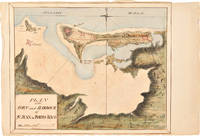
1804WRCAM31595N.p. but probably San Juan 1804. 13 x 9 inches plus two supplementary untitled sketches of the same size. Executed in an exacting hand. Contemporary reds greens blues and browns remain bright and clean. Fine. An attractive Puerto Rican view which shows the town of San Juan its harbor sandbanks islands and fortresses. The plan is marked by a compass rose and rhumb lines. These defenses at San Juan guarded Spanish colonial positions against incursions by the French Dutch and British. The primary plan the only one with its structures labeled runs from Isle de Cabras in the west to Fort St. Antonio in the east. At the center is Moro Castle the six-level masterpiece of Spanish colonial architecture that remains at the heart of present-day San Juan. Construction of the imposing fortress began in 1540 and was completed nearly fifty years later in 1589. Interestingly these plans do not show Fort San Cristobel construction of which began in 1634. Puerto Rico was opened to foreign trade in 1804 and it is possible this plan was composed shortly thereafter to provide either American or British traders with an idea of the island's infrastructure. A wonderful sketch of Puerto Rico's military resources done in brilliant color. Early Puerto Rico material is quite rare. unknown books