709 résultats
1790WRCAM51150Cap Français Saint Domingue 1790. Watercolor 10 1/2 x 16 3/4 inches mounted on 12 3/4 x 18-inch card captioned in manuscript. Some expertly repaired tears and minor soiling. Very good. Matted. A fine perspective view of Place de Montarcher one of the major public spaces in Cap Français modern-day Cap Haïtien with the large Vallière & Montarcher fountain at center surrounded by a lively street scene. Cap Français was by far the richest port city in the colony which helped transform Saint Domingue from a languid outpost into one of France's most profitable and richest colonies by the time of the French Revolution. The image is signed: "Le Cher Largues. pinxit 1790." Original views from 18th-century Haiti are extraordinarily rare in the market. unknown books
1825WRCAM47136Port-au-Prince 1825. Watercolor 6 1/2 x 5 inches. Matted and framed to 10 x 8 inches. A few faint spots of foxing. Colors bright and fresh. Near fine. A handsome watercolor of Haitian general and president Jean-Pierre Boyer 1776-1850 who reigned over Haiti from 1818 to 1843. Boyer a free mulatto was born in Port-au-Prince but educated in France. One of the leaders of the Haitian Revolution he fled to France when Toussaint's uprising turned against the mulattoes as well as the whites returning with LeClerc in 1802. After independence Haiti split into two states north and south and Boyer served as the right hand of Alexandre Petion who established himself as president of the southern state. Boyer was appointed by Petion to be his successor in 1818 while Henri Christophe still ruled in the north. After Christophe committed suicide in 1820 and his young son was killed ten days later Boyer succeeded in reunifying the two states of Haiti. In late 1821 Santo Domingo became independent from Spain and Boyer swiftly moved to invade uniting the island under his rule by early 1822. In 1825 after agreeing to an indemnity he obtained official French recognition of the country for the first time since the revolution. <br> <br> At first Boyer's rule looked like a new start for the war-ravaged country and many free blacks from the United States considered settling there; but Boyer preferred to maintain a semi-feudal government and little was done to improve the situation. He stayed solidly in power until an earthquake was followed by an insurrection in 1843. Santo Domingo rebelled and won its independence back in 1844. Boyer fought back for over a year before fleeing first to Jamaica in 1845 and then to France where he died in 1850. He succeeded in lasting as president longer than any other Haitian ruler just edging out "Papa Doc" Duvalier for the honor. <br> <br> In this portrait which shows Boyer in three- quarter profile facing left he is dressed in his full regalia as general and president wearing a blue military coat trimmed in gold braid and a white cape with a red lining. This likeness closely resembles an engraving by Raban dated 1825 which is probably based on it. He is at the height of his achievements having just solidified his power by obtaining recognition from France. The portrait is signed with the initials "B.C." written in reverse in the bottom corner. An outstanding image of Haiti's fourth president. unknown books
191657435Most Port-au-Prince 1916. 20 items single sheet printed letterhead or partly printed documents accomplished in ink dated and signed with two printed broadsides. 1 vols. Chiefly 4to one broadside folio. Some toning or soiling and marginal chipping large broadside split along fold overall very good. 20 items single sheet printed letterhead or partly printed documents accomplished in ink dated and signed with two printed broadsides. 1 vols. Chiefly 4to one broadside folio. Presidents of the Republic of Haiti - A Collection. An outstanding collection of Haitian material comprising items signed by 11 presidents:<br/>1 ALEXANDRE PETION president of Haiti 1807-1818. Autograph document signed "Pétion" as president 6 April 1812 a laissez passer for Mr Douglass on government business and noting his white horse "which it is forbidden for whomsoever to touch under any pretext."<br/>2 JEAN-PIERRE BOYER president of Haiti 1818-1843. Autograph financial document signed "Boyer" as Commander-in-Chief of Port-au-Prince 30 November 1817 a receipt for 185 gourdes.<br/>3 FABRE GEFFRARD president of Haiti 1859-1867. Manuscript letter signed "Geffrard" as President 3 December 1860 ordering his secretary of state to pay General Simon Sam see no. 7 below the sum of 2165 gourdes.<br/>4 NISSAGE SAGET president of Haiti 1870-1874. Manuscript letter signed "Nissage Saget" as President 11 October 1870 requesting a report on the state of the Arsenal at Cap-Haitien cellophane tape repair to verso at signature.<br/>5 MICHEL DOMINGUE president of Haiti 1874-1878. a Manuscript letter signed "Domingue" as general and provisional commander of the département du Sud 14 September 1868 promoting second lieutenant Hyppolite see no. 6 below to full lieutenant; Partly printed document signed "Domingue" as president of the Etat Meridional d'Haiti 25 January 1869 promoting Prosper Faure to the rank of générale de division; Manuscript letter signed "Domingue" as president of Haiti 11 December 1874 acknowledging receipt of dispatches from the interim secretary of war.<br/>6 FLORVIL HIPPOLYTE president of Haiti 1889-1896. Manuscript letter signed "F Hyppolite" as générale de division 14 July 1875 concerning troop inspections; Manuscript letter signed "F Hyppolite" as president 27 January 1896 concerning an appointment to the local police.<br/>7 TIRESIAS AUGUSTIN SIMON SAM president of Haiti 1896-1902. Manuscript letter signed "T A S Sam" as president 12 August 1898 to the secretary of the interior endorsing a recommendation for a police appointment.<br/>8 FRANÇOIS ANTOINE SIMON president of Haiti 1908-1911. Manuscript letter signed "F.A. Simon" as générale de division honorary aide de camp to the President etc. 16 July 1896 to President Tiresias Augustin Simon Sam concerning a recommendation for Camille Jean-François acting police commissioner in the Cayes district; Typewritten letter Signed "F.A. Simon" as president 15 March 1909 conveying a military commission.<br/>9 CINCINNATUS LECONTE president of Haiti 1911-1912. Manuscript letter Signed "Ctus Leconte" as president 13 June 1912 concerning a request for police officers' uniforms; Printed broadside presidential decree dated 16 August 1911 naming the members of his cabinet.<br/>10 MICHEL ORESTE president of Haiti 1913-1914. Typewritten letter Signed "Michel Oreste" as president 4 July 1913 concerning a commercial license for the representative of the Hamburg America Line.<br/>11 PHILIPPE SUDRE DARTIGUENAVE president of Haiti 1915-1922. Typewritten letter signed "Dartiguenave" as president 1 April 1916 concerning a widow's pension. With four additional Haitian items: Partly printed receipt for import duties paid by Capt Taylor of the American brig Pegasus 6 November 1827 signed Lavartida on letterhead of the National Treasury of Santo-Domingo; Printed broadside with vignette headed "Liberté ou la Mort" decree of the provisional government concerning the rental of properties held by the nation 10 May 1843 following the overthrow of president Boyer; Autograph letter from générale de division Antoine Jeanty 27 November 1880 to the secretary of war; Partly printed consular document Amsterdam 16 December 1929 concerning bills and manifests for a cargo ship.<br/>An impressive and representative collection of Haitian leadership from the earliest years of the Republic's independence through the U.S. invasion of 1915. unknown books
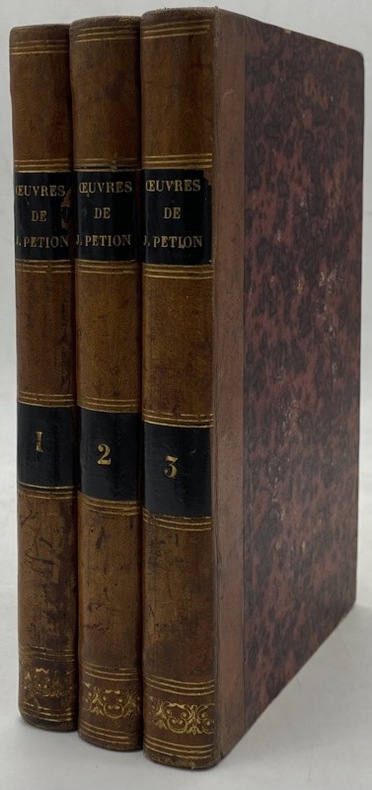
1376012Port-au-Prince: Imprimerie Aug. A. Héraux, 1920-1932-1933 3 vol. in-8, 1) titre, portrait, 1 f. n.ch., 3 p. (préface), XVI p. (introduction), 247 p. 2) 1 f. n. ch., 228 p., 18 ff. n. ch., 3) 239 p. Demi basane noire ("Etienne Camille relieur, rue Roux 336, Port-au-Prince Haïti"), bon état, à signaler : manque angulaire à la page V-VI du tome I avec petite perte de texte sur 5 lignes, mouillure marginale au tome 2. Rarissime édition originale éditée sur 14 ans, habillée par un relieur de Port-au-Prince. L'auteur Horace Pauléus Sannon (1870-1938) est un historien, médecin et diplomate haïtien.
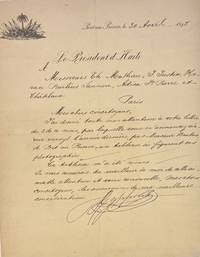
18953632Port-au-Prince 1895. Letter signed “F. Hyppoliteâ€. Single folio sheet ca. 27 × 21 cm. Written in ink on one side folded. Light toning small edge wear old folds. Letter signed “F. Hyppoliteâ€. Single folio sheet ca. 27 × 21 cm. Written in ink on one side folded. <p><br /> Signed letter from Haitian President Florvil Hyppolite to prominent members of the Haitian intellectual diaspora in Paris including future ministers and historian Horace Pauléus Sannon.<br /> <p><p><br /> In this official yet personal letter addressed to Th. Mathieu Joseph Justin Horace Pauléus Sannon Adéca Yn. Pierre and Furcy Châtelain in Paris President Florvil Hyppolite 1828–1896 acknowledges the receipt of a tableau sent the previous year by a group of Haitians living in Paris. The tableau transmitted via Brutus Saint-Victor a prominent figure in Port-au-Prince who himself later served as a cabinet minister contained photographs of the senders. Writing with formal courtesy Hyppolite expresses his gratitude for this thoughtful gesture and conveys his warm appreciation and esteem to his correspondents.<br /> <p><p><br /> The signatories include several figures who would later become prominent in Haiti’s political and intellectual life. Justin Joseph was a jurist and writer who went on to serve briefly as Minister of Foreign Affairs in 1914 and authored significant works on Haitian law and foreign relations. Horace Pauléus Sannon 1870–1938 became one of Haiti’s most important historians and diplomats serving as foreign minister ambassador to France and author of landmark studies on the nation’s revolutionary past. Furcy Châtelain later held high office as both Minister of Justice and Minister of Foreign Affairs during the 1910s. The other two men Th. Mathieu and Adéca Yn. Pierre were likely members of the Haitian expatriate community in Paris though their identities remain less certain.<br /> <p><p><br /> Hyppolite’s presidency lasted from 1889 until his sudden death in 1896. Rising to power after years of internal conflict and foreign interference he worked to stabilize the government modernize the army and strengthen Haiti’s position in international affairs. His rule is often remembered for its emphasis on infrastructure projects including railway and port development and for efforts to maintain a careful balance between Haiti’s internal factions and the increasing influence of foreign powers particularly the United States Germany and France. This letter written near the end of his presidency is a testament to his connections not only with domestic political circles but also with Haitians abroad reflecting the networks of support and exchange that linked the republic to its intellectual and diplomatic communities overseas.<br /> <p>. unknown
1792WRCAM45082Philadelphia 1792. 32pp. Bound with ten other titles detailed below. Contemporary marbled boards neatly rebacked in antique-style half calf gilt leather label. Contemporary manuscript contents list on front pastedown contemporary ownership inscription on fly leaf. Light foxing throughout. Very good. Fourth edition with notes and an appendix extracted from authentic original papers. An important narrative of the Haitian Revolution of 1791 recounting the many violent and brutal events to which the inhabitants were subject. The author writes: "At this time one hundred thousand negroes were in rebellion and all the buildings and plantations of more than half the Northern province appeared only as one general conflagration." <br> <br> This work is bound with ten other early American imprints primarily sermons as detailed below: <br> <br> 1 Aufrer Anthony: THE CANNIBALS' PROGRESS; OR THE DREADFUL HORRORS OF FRENCH INVASION. Newburyport Ma.: Edmund M. Blunt 1798. 351pp. EVANS 33332. <br> <br> 2 Gifford John: A LETTER TO THE HON. THOMAS ERSKINE. Philadelphia. 1797. 128pp. Lacks titlepage and second leaf. EVANS 32191. <br> <br> 3 Tappan David: A DISCOURSE DELIVERED TO THE RELIGIOUS SOCIETY IN BRATTLE-STREET BOSTON. Boston. 1798. 31pp. Half title. Second edition. EVANS 34628. <br> <br> 4 M'Keen Joseph: TWO DISCOURSES DELIVERED AT BEVERLY ON THE DAY OF THE NATIONAL FAST MAY 9 1798. Salem Ma.: Thomas C. Cushing 1798. 31pp. Half title. EVANS 34039. <br> <br> 5 Prince John: A DISCOURSE DELIVERED AT SALEM ON THE DAY OF THE NATIONAL FAST MAY 9 1798. Salem Ma.: Thomas C. Cushing 1798. 44pp. Half title. EVANS 34414. <br> <br> 6 Osgood David: SOME FACTS EVINCIVE OF THE ATHEISTICAL ANARCHICAL AND IN OTHER RESPECTS IMMORAL PRINCIPLES OF THE FRENCH REPUBLIC STATED IN A SERMON DELIVERED ON THE 9th OF MAY 1798. Boston. 1798. 27pp. Half title. EVANS 34284. <br> <br> 7 Thayer John: A DISCOURSE DELIVERED AT THE ROMAN CATHOLIC CHURCH IN BOSTON ON THE 9th OF MAY 1798. Boston. 1798. 31pp. Half title. EVANS 34646. PARSONS 196. WALGREN 417. <br> <br> 8 Tappan David: A DISCOURSE DELIVERED IN THE CHAPEL OF HARVARD COLLEGE JUNE 19 1798. Boston. 1798. 28pp. EVANS 34629. <br> <br> 9 Eckley Joseph: A DISCOURSE DELIVERED ON THE PUBLIC THANKSGIVING DAY NOVEMBER 29 1798. Boston. 1798. 23pp. Half title. EVANS 33664. <br> <br> 10 Morse Jedediah: A SERMON PREACHED AT CHARLESTOWN NOVEMBER 19 1798 ON THE ANNIVERSARY THANKSGIVING IN MASSACHUSETTS. Boston. 1798. 746pp. With the six pages included in the appendix of the second edition printed separately for those who purchased the first edition. EVANS 34151 34152. EVANS 24766. hardcover books
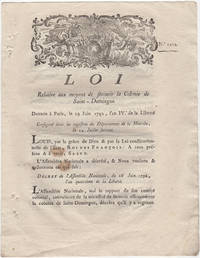
179243209Nancy France: Chez Haener Imprimeur du Départment de la Meurthe 1792. First edition. Self wrappers. A very good copy with pin holes along inner margin two soiled spots signed in ink on last page. 4 pp. Illus. with a woodcut headpiece. Sm. 4to. Signed illegible. Law authorizing negotiation with the United States minister to obtain food and construction materials in the amount of 4000000 livres to be paid by the French Treasury but to be reimbursed by taxes on the colony. The money was much needed as the loan decree dated 26 Juin 1792 came in the midst of unparalleled upheaval in Haiti. The revolution of the year before with its "horrible carnage" had now given way "to strategic military operations tactical maneuvers and new political alliances as the slaves gain territory and stabilize their positions. They raid plantations for military equipment loot the whites' forces after they are repelled and trade with the Spanish for weaponry" Kona Shen History of Haiti The Revolution Builds Brown University. library.brown.edu/haitihistory/6.html. Toussaint Louverture is a rising star Civil Commissions arrive from France free blacks and mulattos in Saint-Domingue are granted equal political rights Spain declares war on England and France and battle ensues for control of Haiti. The U.S. is concerned with conditions on the island and in fact Jefferson writes of his concern to the Marquis de Lafayette 16 June 1792. Rare. OCLC BN France and other European Libraries locate no copies of this issue No. 1412 with additional text concerning the Departement de la Meurthe. A Paris printing No. 1813 can be found at Cornell Univ. Minn. and JCB which also has a Toulouse printing. Manioc Bibliotheque shows a digitized version of the Paris imprint. Chez Haener, Imprimeur du Départment de la Meurthe unknown
179243209Nancy France: Chez Haener Imprimeur du Départment de la Meurthe 1792. First edition. Self wrappers. A very good copy with pin holes along inner margin two soiled spots signed in ink on last page. 4 pp. Illus. with a woodcut headpiece. Sm. 4to. Signed illegible. Law authorizing negotiation with the United States minister to obtain food and construction materials in the amount of 4000000 livres to be paid by the French Treasury but to be reimbursed by taxes on the colony. The money was much needed as the loan decree dated 26 Juin 1792 came in the midst of unparalleled upheaval in Haiti. The revolution of the year before with its "horrible carnage" had now given way "to strategic military operations tactical maneuvers and new political alliances as the slaves gain territory and stabilize their positions. They raid plantations for military equipment loot the whites' forces after they are repelled and trade with the Spanish for weaponry" Kona Shen History of Haiti The Revolution Builds Brown University. library.brown.edu/haitihistory/6.html. Toussaint Louverture is a rising star Civil Commissions arrive from France free blacks and mulattos in Saint-Domingue are granted equal political rights Spain declares war on England and France and battle ensues for control of Haiti. The U.S. is concerned with conditions on the island and in fact Jefferson writes of his concern to the Marquis de Lafayette 16 June 1792. Rare. OCLC BN France and other European Libraries locate no copies of this issue No. 1412 with additional text concerning the Departement de la Meurthe. A Paris printing No. 1813 can be found at Cornell Univ. Minn. and JCB which also has a Toulouse printing. Manioc Bibliotheque shows a digitized version of the Paris imprint. Chez Haener, Imprimeur du Départment de la Meurthe unknown books
1730PHO-2325Paris, Guérin, 1730-1731. 2 volumes in-4 (25,5 × 20 cm). XXVIII, 482 p., 29 ff. ; XIV, 506 p., 30 ff., reliures postérieures en demi-veau, pièces de titre et tomaison, coins et coupes légèrement frottés et émoussés, petits manques aux coiffes. Légèrement bruni, légères galeries de vers et traces d’humidité dans la marge intérieure au début du tome I ; les pages 17-20, 221/222, *19/*20 du tome I ainsi que les plans « Plan de la ville de San-Domingo » (tome I) et « Plan du Cap François » (tome II) sont déreliés ; petit déchirement restauré au pli de la garde de la « Carte de l’Isle de Saint-Domingue » (tome II). Ex-libris Jack Grout.
1792AQ13490London: Printed: and sold by J. Johnson 1792. 32pp. Handsomely bound in recent antique half-calf gilt marbled boards. Occasional mark three small paper flaws at end without loss of sense. A contemporary account of the only successful slave revolt in history which resulted in the foundation of a state ruled by those formerly enslaved on the French Caribbean island of St. Domingue now Haiti. As the inclusion of Coulon's account read to the French National Assembly in this volume suggests the first black insurrection was entwined with the causes and effects of Revolutionary France which despite the 1789 Declaration of the Rights of Man sought albeit unsuccessfully to retake the island from the rebels. ESTC T11240 c/f Sabin 75135. First edition in English. 8vo. Printed: and sold by J. Johnson hardcover
235836Londres, J. Debrett, et se trouve à Paris, Laran, et chez les marchands de nouveautés, s.d. (1797) in-8, [3] ff. n. ch., 100 pp., cartonnage d'attente de papier bouteille, pièce de titre cerise, tranches citron (reliure de l'époque). Rousseurs
239741Paris, chez Arthus Bertrand, 1811 in-8, [4]-494 pp., portr., une vue et une carte dépl., demi-veau fauve, dos lisse, filets dorés (reliure à l'imitation).
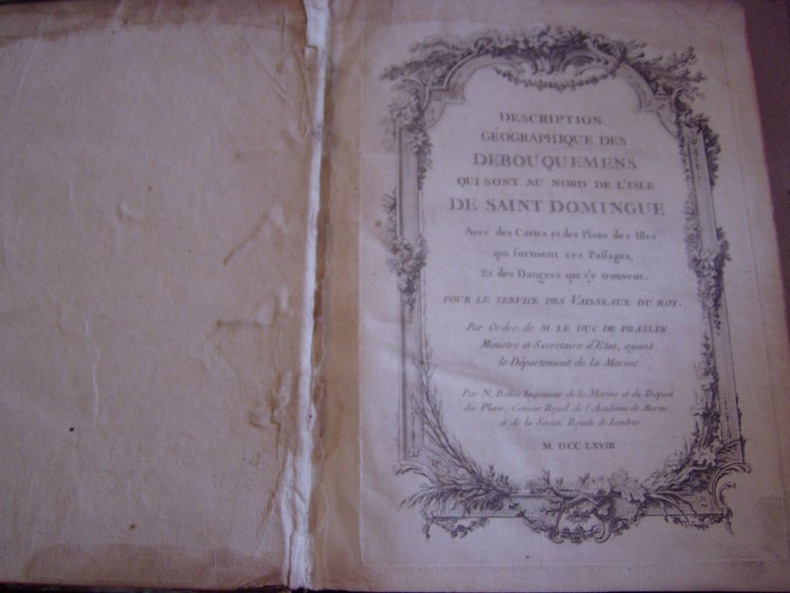
1768203001768 1768 ( A Versailles; Imprimerie du département de la Marine) , 1768. In/4 basane fauve marbrée, dos à nerfs orné d'ancres,152 p., page de titre gravée, page de titre imprimée manquante : 34 planches gravées (cartes) dont 15 rempliées,32 numerotées en continu,la 24 en double,et la carte des Isles Bermudes numerotée T1,N°48. Mouillure generale claire dans la marge superieure sur l’ensemble du volume,page de garde manquante. Armes sur le 2e plat,arrachées ou cachées sur le 1er plat.Coins usés.In-4 carré ( 250 X 195 mm. ) de: [5] ff. ( Titre, Titre gravé, Table des chapitres, Table des cartes et plans ), 152 pages, Joli bandeau allégorique signé Jean CHOFFARD et 34 cartes gravées dont 16 doubles ( 2 dépliantes ) par Nicolas BELLIN. Parmi les 34 cartes qui illustrent louvrage, une carte générale du Nord de St Domingue et de ses cinq débouquements, une du Canal de Bahama représentant le sud du Golfe du Mexique. Rare édition originale de ce routier des Antilles par le premier hydrographe de la Marine royale française, Jacques-Nicolas BELLIN ( 1703-1772 ). ( J. Polak 591 Sabbin, 4552 ).Conforme à l'exemplaire en ligne Gallica - Versailles.
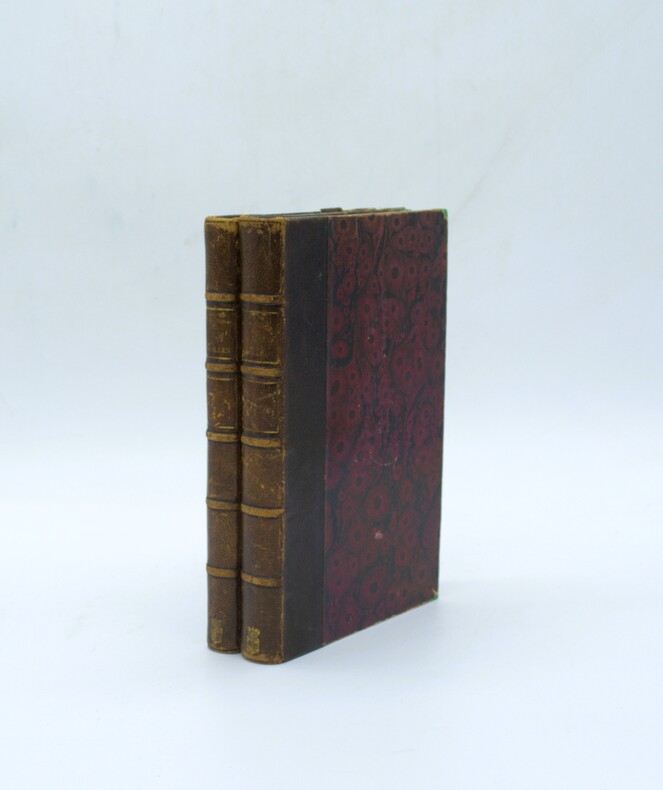
219851Paris, Grangé, 1776-1777 2 vol. in-8, XVI-327 pp. et [4]-IV-368 pp., tableau dépliant, demi-chagrin vert, tranches marbrées (reliure fin XIXe). Coiffes et nerfs frottés, coupes et coins usés. Rousseurs et mouillures au tome II.
1744PHO-2162Trévoux, par la Compagnie, 1744, 3 (4) volumes in-12 (17x10,5cm), (6) ff., 394 pp. ; (1) f., 428 pp. ; 346 pp., illustré de 7 cartes et plans, manque le frontispice au tome 1, veau marbré époque, dos à nerfs ornés avec pièces de titre et de tomaison grenat, tranches rouges, 4 planches détachées, frottements, épidermures plus marquées au tome 2, coiffes arasées au tome 2, petit manque au tome 1, coins usés, coupes usées au tome 2, manque de papier en marge p. 11, sans atteinte au texte.
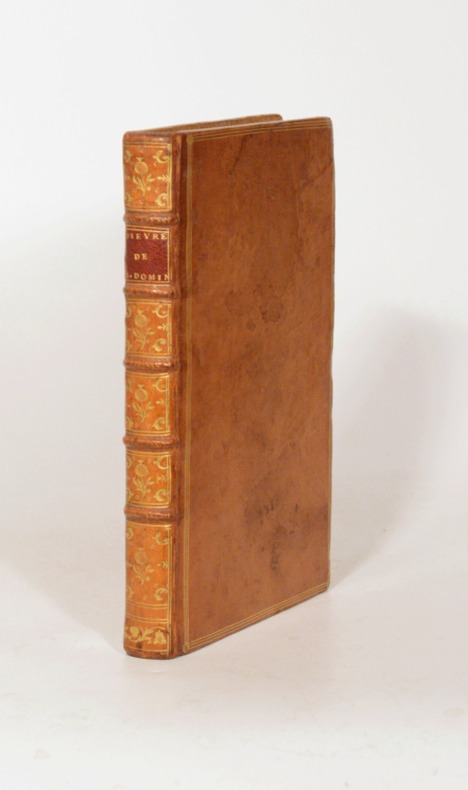
004480Paris, Imprimerie Royale, 1780. In-8 (134 X 204 mm) veau fauve marbré, encadrement de triple filet doré sur les plats, dos cinq nerfs, caissons dorés ornés, pièce de titre maroquin grenat, roulette intérieure, tranches dorées (reliure de l'époque); XVI-312 pages.
384 pages. Extensive index. Notes on bibliography. Illustrated in color and black and white. Map endpapers. "Author served Israel's Ministry of Foreign Affairs in Columbia, Panama and Haiti. In those places, and many others in the Americas to which he traveled, he encountered descendants of Jewish colonists who recalled their religious heritage. Arbell has devoted a good part of his life to uncovering and documenting the elusive story of the Jews who lived in areas of Central and South America at one time ruled by the French, the Dutch, the Danish and the British." - from back board. Clean, bright and unmarked with very light wear. An excellent copy. Book
1796WRCAM52307Port-au-Prince 1796. 4 x 9 1/2 inches completed in manuscript docketed on verso. Minor toning and edge wear. Very good. A rare pay order for supplies made out to Baron Jean-Charles de Montalembert on behalf of the invading British occupation force in Haiti. The document is signed by John Wigglesworth agent to the Commander of the British forces in Haiti and later Britain's envoy to the leader of the Haitian Revolution Touissant Louverture. By early the next century Louverture would become ever so briefly chief of the first free Black Republic in Haiti. The payee Montalembert has docketed the verso with an additional docket in French transferring the funds to Dutilh & Wachsmuth a Philadelphia mercantile house. <br> <br> St. Domingo the French part of Haiti was a highly prosperous sugar coffee and cotton slave-estate island whose produce was described as exceeding that of the whole of the British Leeward and surrounding islands. In 1789 it was said to consist of 10000 white people 24000 free mixed-race people and 455000 negro slaves. Although free local laws decreed that mixed-race individuals could not accept any office or employment other than as planters. As news spread of the revolution this group revolted but were roundly defeated. Part of the white response to the uprising was to create their own local assembly which excluded those of mixed race and resolved to transfer the island's allegiance to Great Britain whereupon France sent Commissioners who according to some reports recruited negroes to fight the whites. <br> <br> Starting in August 1791 the slaves revolted in many towns implementing major massacres and destruction of estates and establishing free communities of their own. They were led by Touissant Louverture an ex-slave who later joined the French army after the country abolished slavery in 1793. Louverture swiftly rose to the rank of Commander in Chief of the French forces in Haiti and proved to be an effective leader. In 1794 the British army under the pretense of the Napoleonic war sent a force from Jamaica that occupied Port-au-Prince and some other towns a welcome development for the remaining white population on the island. This British force was commanded by General Sir Thomas Maitland of the 62 Foot Regiment for whom Wigglesworth was the army agent. <br> <br> In the end the British were not successful. By 1798 the army had been virtually wiped out by yellow fever and in April of that year Maitland withdrew the British forces from Haiti under a guarantee from Louverture that the remaining pro-British whites would be protected. In May 1801 Touissant established St. Domingo as an independent republic. This alarmed the French so badly that they subsequently sent an army of 25000 that recaptured the island within a year and then by a ruse conveyed Louverture to France where he soon after died in prison. <br> <br> Baron de Montalembert had commanded the Legion britaniques de Sainte-Domingue a force of 1200 men composed of white colonials recruits from Europe and possibly some free mixed-race Haitians. Montalembert's Grenadiers were one of the most dependable units fighting for the British until the aforementioned fever along with heavy casualties decimated the unit. They disbanded on June 25 1797. <br> <br> A rare early Haitian document signed by two principal figures in the British occupation during the Haitian Revolution. unknown books
1796WRCAM52305Port-au-Prince 1796. 4 x 9 1/2 inches completed in manuscript docketed on verso. Minor toning and corner wear. Very good. A rare pay order for supplies bought from William Dickson by the invading British occupation force in Haiti. The document is signed by John Wigglesworth agent to the Commander of the British forces in Haiti and later Britain's envoy to the leader of the Haitian Revolution Touissant Louverture. By early the next century Louverture would become ever so briefly chief of the first free Black Republic in Haiti. The payee Dickson has docketed the verso to pay "Mg. de Klegand" with an additional docket in French by de Klegand to pay Dutilh & Wachsmuth a Philadelphia mercantile house. <br> <br> St. Domingo the French part of Haiti was a highly prosperous sugar coffee and cotton slave-estate island whose produce was described as exceeding that of the whole of the British Leeward and surrounding islands. In 1789 it was said to consist of 10000 white people 24000 free mixed-race people and 455000 negro slaves. Although free local laws decreed that mixed-race individuals could not accept any office or employment other than as planters. As news spread of the revolution this group revolted but were roundly defeated. Part of the white response to the uprising was to create their own local assembly which excluded those of mixed race and resolved to transfer the island's allegiance to Great Britain whereupon France sent Commissioners who according to some reports recruited negroes to fight the whites. <br> <br> Starting in August 1791 the slaves revolted in many towns implementing major massacres and destruction of estates and establishing free communities of their own. They were led by Touissant Louverture an ex-slave who later joined the French army after the country abolished slavery in 1793. Louverture swiftly rose to the rank of Commander in Chief of the French forces in Haiti and proved to be an effective leader. In 1794 the British army under the pretense of the Napoleonic war sent a force from Jamaica that occupied Port-au-Prince and some other towns a welcome development for the remaining white population on the island. This British force was commanded by General Sir Thomas Maitland of the 62 Foot Regiment for whom Wigglesworth was the army agent. <br> <br> In the end the British were not successful. By 1798 the British army had been virtually wiped out by yellow fever and in April of that year Maitland withdrew the British forces from Haiti under a guarantee from Louverture that the remaining pro-British whites would be protected. In May 1801 Touissant established St. Domingo as an independent republic. This alarmed the French so badly that they subsequently sent an army of 25000 that recaptured the island within a year and by a ruse conveyed Louverture to France where he soon after died in prison. unknown books
1796WRCAM52308Port-au-Prince 1796. 3 1/2 x 9 3/4 inches completed in manuscript docketed on verso. Minor toning. Very good. A rare pay order for supplies intended for the British occupation force in Haiti made out to M. Juré Ainé. The document is signed by John Wigglesworth agent to the Commander of the British forces in Haiti and later Britain's envoy to the leader of the Haitian Revolution Touissant Louverture. By early the next century Louverture would become ever so briefly chief of the first free Black Republic in Haiti. The payee Jure has docketed the verso in French with an additional docket in French transferring payment to Dutilh & Wachsmuth a Philadelphia mercantile house. <br> <br> St. Domingo the French part of Haiti was a highly prosperous sugar coffee and cotton slave-estate island whose produce was described as exceeding that of the whole of the British Leeward and surrounding islands. In 1789 it was said to consist of 10000 white people 24000 free mixed-race people and 455000 negro slaves. Although free local laws decreed that mixed-race individuals could not accept any office or employment other than as planters. As news spread of the revolution this group revolted but were roundly defeated. Part of the white response to the uprising was to create their own local assembly which excluded those of mixed race and resolved to transfer the island's allegiance to Great Britain whereupon France sent Commissioners who according to some reports recruited negroes to fight the whites. <br> <br> Starting in August 1791 the slaves revolted in many towns implementing major massacres and destruction of estates and establishing free communities of their own. They were led by Touissant Louverture an ex-slave who later joined the French army after the country abolished slavery in 1793. Louverture swiftly rose to the rank of Commander in Chief of the French forces in Haiti and proved to be an effective leader. In 1794 the British army under the pretense of the Napoleonic war sent a force from Jamaica that occupied Port-au-Prince and some other towns a welcome development for the remaining white population on the island. This British force was commanded by General Sir Thomas Maitland of the 62 Foot Regiment for whom Wigglesworth was the army agent. <br> <br> In the end the British were not successful. By 1798 the British army had been virtually wiped out by yellow fever and in April of that year Maitland withdrew the British forces from Haiti under a guarantee from Louverture that the remaining pro-British whites would be protected. In May 1801 Touissant established St. Domingo as an independent republic. This alarmed the French so badly that they subsequently sent an army of 25000 that recaptured the island within a year and by a ruse conveyed Louverture to France where he soon after died in prison. unknown books
1875373911Paris: L. Guerin et Cie 1875. Second edition. 42 engravings and maps. Folio. Bound in quarter contemporary red morocco and cloth. Good only plates with worm holes. Second edition. 42 engravings and maps. Folio. "Collection of views of the main locations of the French colony of Saint Domingue". Sabin 50578 L. Guerin et Cie unknown
WRCAM53510Port-au-Prince: C. Descauriet 1828. 3859-276349-736pp. Thick 16mo. 20th-century patterned calf and marbled boards gilt leather label. A handful of wormholes in binding some edge wear. Haitian library stamp on front free endpaper. Minor toning a number of leaves with fire damage along bottom. A fair copy lacking titlepage last leaf and otherwise incomplete see pagination. Gives the Code Civil Code de Procedure Civile Code de Commerce Code d'Instruction Criminelle Code Penal and Code Rural. A rugged copy at best but an extensive example of early Caribbean printing from a time and place with a very low survival rate of material. C. Descauriet hardcover books
244146Jacmel, Librairie Dame Lamour, 1868 in-8, [2] ff. n. ch., 111 pp., en feuilles, cousu.
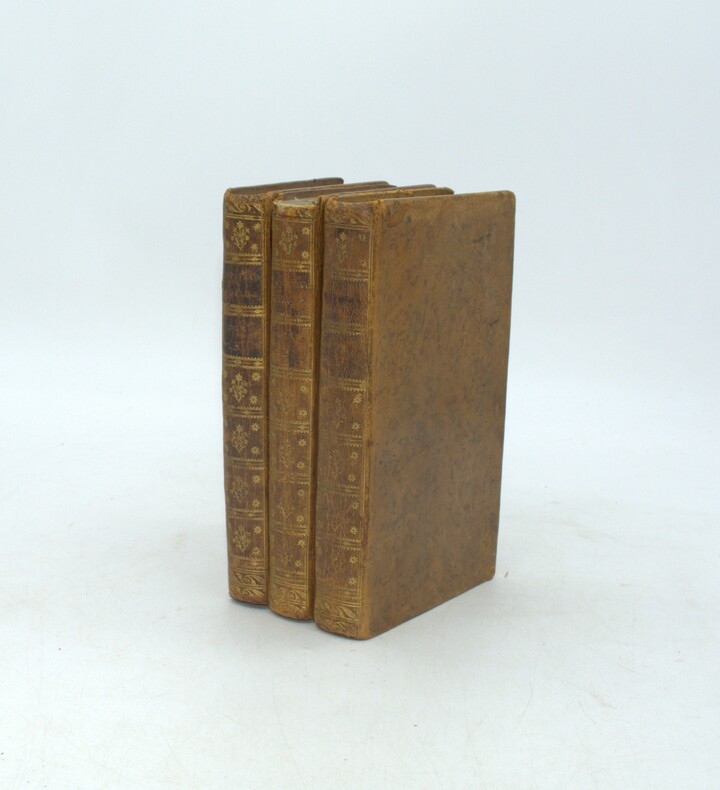
232912Paris, Garnery, an premier de la République (1792-1793) 3 vol. in-8, viij pp., 399 pp. ; [2] ff. n. ch., vj pp., pp. 7-[415] (mal chiffrées 435) ; [2] ff. n. ch., iv pp., pp. 5-436, demi-basane brique, dos lisses ornés de guirlandes et filets dorés, pièces de titre et de tomaison noires, coins en vélin vert, tranches mouchetées (reliure du début du XIXe).
210191Paris, chez Ponthieu, 1826 in-8, (8)-488 pp., demi-basane brune, dos lisse, filets dorés (reliure de l'époque). Début de fente au mors supérieur, mouillure angulaire.