[Cuba]. [Trade]Biblio.com
2 507 résultats
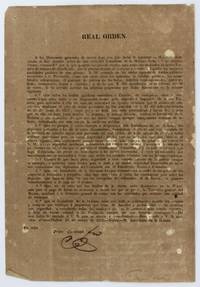
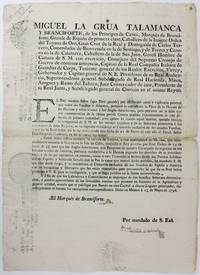
17965074Mexico City: May 13 1796. About very good. Broadside 17 x 12.25 inches. Old fold lines. Slight separation and loss at center fold slightly affecting a few letters. Minor wear else. Proclamation made by the Viceroy of New Spain authorizing trade between Cuba and the United States. The Caribbean was in tumult in the 1790s with Toussaint L'Ouverture overthrowing the French colonial government and outlawing slavery. Likewise in Cuba there was a similar revolt against slavery demanding abolition and equality -- both revolutions were of substantial concern to slaveholders in the American South. Specifically the present decree mentions flour and other vital foodstuffs as a measure against shortages in Cuba intended to prevent further trouble. "Para precaver la escasez de viveres y con especialidad de harinas que verosimilmente causaria la guerra concedio El Rey Permiso por Real Orden de 25 Junio de 93. para que los Anglo-Americanos.pudiesen conducirlos a la Havana pagando los derechos los puertos habilitados de España." The Viceroy at the time was Don Miguel de la Grua Talamanca de Carini y Branciforte First Marques de Branciforte. The Marques was notoriously corrupt even for colonial Spain having gained position through marriage to the Prime Minister's sister. He made sure to make some profit on everything that passed through his hands including taking advantage of the War in Cuba to remove the French from their lands and sell them to his benefit. A rare and interesting decree. We locate a single copy in OCLC at the University of Minnesota. May 13 unknown
18183189Havana 1818. Good. Broadside 11.75 x 8 inches. Heavily tanned. An apparently unrecorded Havana imprint comprising a broadside authorization for increased funding to be extended to the superintendent of Havana so that he can maximize the potential of the island's tobacco plantations. This credit is matched by the superintendent’s promise to use the money "con el preciso destino de comprar y remitir á España las mayores cantidades posibles de este género." The superintendent must also swear to be vigilant and honest in his account-taking reports to Spain and "Avise con toda la anticipacion posible los acopios y compras que verifique à proporcion que tenga de hacerlos y probabilidad en las remesas con seguridad aprovechándo todas las ocasiones que se le presenten para remitir cigarros y hoja de buena calidad á la Peninsula aunque sea con bandera extrangera." Signed in print and rubricated in manuscript by Pedro Carambot a Cuban official of the late 1810s. Not in OCLC. unknown
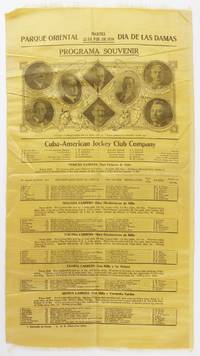
19164158Havana 1916. Very good. Broadside printed on light orange silk approximately 16.25 x 9 inches. Minor edge wear one small tear near bottom right. A seemingly unrecorded silk broadside issued by the Cuba-American Jockey Club Company advertising the lineup of horses and the schedule for a series of five races during Dia de las Damas "Ladies Day" at the Oriental Park racetrack in Marianao Havana in 1916. In addition the top of the broadside is printed with small oval- and diamond-shaped portraits picturing the nine officers of the club who are identified by name and their position within the club. Below these portraits is a listing of fourteen officers of the club. The Oriental Park Racetrack "Parque Oriental" opened in 1915 for winter racing which began in November and lasted into March each year. The racetrack was the only thoroughbred track in Cuba until Fidel Castro practically shut it down after the Cuban Revolution in 1959. The present broadside is a visual reminder of the influx of American business interests in Cuba in the early 20th century. No copies reported in OCLC. unknown
1894106465<p>1894. Pamphlet format 70 pp. Illustrations; map. 14.3x11.8 cm 5½x4½" pictorial wrappers. Some light staining and wear to wrappers spine a little worn very good overall. Rare tourists' guide book produced under the auspices of the Grand Hotel Macotte with much on Havana transportation options sights to see including bull fights prices a Spanish vocabulary etc. with numerous advertisements for Cuban and some Florida businesses and other hotels. One advertisement features cigar maker La Corona. They even include an illustration of Christopher Columbus. OCLC/WorldCat lists only one copy at the California State Library Sutro Branch.</p> J. Carbonell and P. Montero, Proprietors.
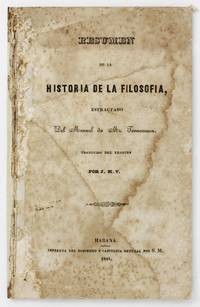
18455307Havana: Imprenta del Gobierno y Capitania General por S.M. 1845. Good. 684pp. Disbound. Some insect damage to gutter of title page ample staining throughout mostly minor foxing. A very rare mid-19th century Cuban imprint translating into Spanish a work by German philosophical historian Wilhelm Gottlieb Tennemann entitled Manual of the History of Philosophy. Tennemann originally published the work in 1812 as a much-abridged history of philosophy after authoring a massive multi-volume work on the subject. According to the translator's note at the beginning of the text the present work was produced in order to provide a text in Spanish for those studying the history of philosophy "at the Royal Academy and in the private schools of the island of Puerto Rico." The translator also notes that the history of philosophy is "one of the subjects.of the general plan of education that must be taught." The work itself is organized as a series of lectures detailing the history of philosophy chronologically from ancient Eastern and Egyptian times through the Greeks Pythagoras Socrates Plato Aristotle and many others concluding with modern thinkers such as Descartes Espinosa Hume Kant Hegel and others. The work ends with an Index and an Errata page.<br /> <br /> "Wilhelm Gottlieb Tennemann 1761–1819 German historian of philosophy was born at Erfurt. Educated at his native town he became lecturer on the history of philosophy at Jena in 1788. Ten years later he became professor at the same university where he remained till 1804. His great work is an eleven-volume history of philosophy which he began at Jena and finished at Marburg where he was professor of philosophy from 1804 till his death. He was one of the numerous German philosophers who accepted the Kantian theory as a revelation. In 1812 he published a shorter history of philosophy which was translated into English in 1852 under the title Manual of the History of Philosophy" - Encyclopedia Britannica. No copies located in the United States. Three copies found in OCLC -- two in Chile and one in Spain. Imprenta del Gobierno y Capitania General por S.M. unknown
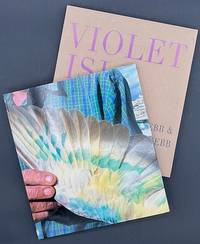
200977690Santa Fe: Radius Books 2009. First edition. 4to. 143 pp. Tiny bump to one lower corner else fine in wrappers in near fine printed cardstock slipcase with a few small spots to the unprinted side. SIGNED by the Webbs on the half-title page. Santa Fe: Radius Books unknown
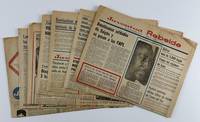
196912628Havana: Union de Jovenas Comunistas 1969. Seven newspapers each between 6 and 8pp. on newsprint. Illustrated. Modest toning some edge wear and closed tears some bumped or dog-eared corners. Overall very good. A small but instant collection of an informative newspaper from Communist Cuba published daily by the youth wing of the Party. The issues are all dated in January 1969 specifically from January 11 15 22 28 29 30 and 31. The issues contain domestic and international reporting along with topics relevant to revolutionary young people. Interestingly one issue contains a translated interview with Hollywood legend Marlon Brando. The paper also prints a legion of photographs cultural event listings classifieds baseball statistics and updates cartoons and more. Union de Jovenas Comunistas unknown
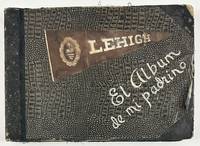
12844Various locations in Cuba and Pennsylvania: contents ca 1973. 25 leaves totaling 40pp. illustrated with thirty black-and-white and sepia-toned photographs with detailed manuscript captions plus seven large clippings from school publications and six additional ephemeral items. Oblong folio. Black cloth with alligator-patterned cloth on front board with manuscript title below a drawn representation of a small pennant for Lehigh University. Covers worn frayed and chipped alligator-style cloth curling a bit along fore edge. A few items loose from adhesive and a few with small tears scattered spotting and soiling. Overall very good condition with fascinating materiality. A lovingly-compiled photograph album and memorial book created by a young woman named Magdalena Sofia Guitart in tribute to her godfather Rafael Genó a Cuban engineer who studied at Lehigh University in Pennsylvania. Juan Rafael Genó Rizo was born in Santiago de Cuba in 1883. A doctoral thesis on Cuban architecture found online deems him one of the premiere Art Deco architects of Santiago and the only one to obtain a degree abroad. Genó graduated with a degree in Civil Engineering from Lehigh in 1909 and from the University of Havana in 1913. He died in Miami Florida in 1973.<br /> <br /> This doting scrapbook was compiled and heavily captioned in Spanish which we hereafter present in translation as a "Memorial which with love and pride I dedicate to my godfather and some of his works; a pale reflection of all the good he has done in his life" by Magdalena Sofia Guitart who was born in 1936 in Santiago and arrived in Miami in 1958. She includes photos of Genó as a baby and a boy of 11 "From a very young age as you can see here my godfather was a little gentleman" as well as in uniform alongside Mexican and Costa Rican comrades at Pennsylvania's Wayne Field. She lauds his "triumphs" and "genius" in "thousands of battles." Genó likely came to the United States following the Spanish-American War during the growth of Cuban immigration resulting from increased American attention of the island country. All of the content in the album is artfully presented within decorative rules or floral borders providing an unusual flair to the presentation. The book displays not only the hand-drawn Lehigh pennant on the cover but also large artistic renditions of the campus and an internal shot of its library clipped from school publications and comparing views from 1873 1909 and 1933 the relevance of Lehigh at the later date is unclear.<br /> <br /> Additional photographs and decorative designs share the story as "our engineer" returns to Cuba and "begins to demonstrate his knowledge" in the mines of Ponupo. Soon "his hard work integrity and honesty led him to be chosen" for other feats of engineering including "la Iglesia church Los Desamparados constructed by my godfather 1932" and a train terminal in Guantánamo. Images and a photographic clipping laud his renovations of "Colegio La Salle" in 1937. There are also six photos and a clipping showing Genó's work on the altar for the Eucharistic Congress held in Santiago in 1936 during which the original statue of Our Lady of Charity of El Cobre Patroness of Cuba was granted a canonical coronation by Pope Pius XI. The album also holds a clipping naming Genó as president of the Board of Directors of Santiago's Urban Property Center an inauguration ribbon and brochure for the Municipal Food Market in 1950 with which he was also involved and photos of the celebrated engineer later in life.<br /> <br /> A captivating and carefully-assembled homage created by a Cuban immigrant to the United States honoring a loved one who was educated in Pennsylvania and then returned to his home country to serve as a noted engineer during the first half of the 20th century. contents ca unknown
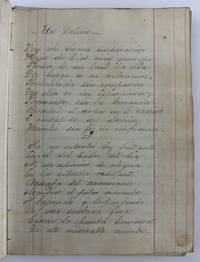
18894403Havana Cuba 1889. Good. 69pp. of manuscript text plus 77pp. of newspaper extracts. Contemporary quarter calf and marbled paper-covered boards. Moderate scuffing and wear to boards and edges spine scuffed. Hinges broken with text block only nominally attached by threads with many leaves detached. Ownership ink stamp on front free endpaper "Manuel F. Barranco" with a gilt insignia affixed below reading "MB." A unique and personal manuscript journal and scrapbook composed and maintained by an important but obscure Cuban-American poet and author Manuel Francisco Barranco y Miranda 1843-1894. Barranco was born in Puerto Principe and lived about half of his life in Cuba before emigrating to Florida in 1875. He married Mercedes Fernández y Fernández-Mora and the couple raised a family in Cuba Florida and New York. Mentions of Barranco are rare in available records but he seems to have been a colleague of famed Cuban revolutionary figure Jose Marti. Barranco and Marti were involved with a Cuban revolutionary emigrant colony in Key West as well as Cuban literary and political societies in Havana and New York such as La Liga. Regarding the latter one of Barranco's poems in the present work composed in eleven parts is titled "Versos recitados en la sesion ordinaria de la Sociedad Literaria Hispano-Americana la noche del 17 de Maya de 1889." The Sociedad Literaria Hispano-Americana or Spanish American Literary Society provides a further connection to Jose Marti as Marti was one of the most prominent members of the club in the 1880s and '90s. Barranco presumably spent the remainder of his life between Cuba and the eastern coast of the United States where he passed away in Tampa Florida in 1894.<br /> <br /> The present material was written and compiled by Barranco over about a thirty year period in the mid-19th century before and after he emigrated to the United States. The chief feature of the present work is contained in almost seventy pages of manuscript poetry by Barranco. The poems which number around a couple dozen compositions include "Un Delirio" written in six parts "Versas improvisados en el Bautiro de mi hija Ana Maria el dia 1 de Enero de 1875" "Versos improvisados en comemora cion del Bautiro de mi hija Ana Maria el dio 1 de Enero del 1876" "Al congreso de la Paz" and various sonnets and other poems dated between 1875 and 1889. Barranco authored a few poems here about his wife Mercedes with titles such as "A Mercedes" "Improvisados a la orrilla del mon - A Mercedes" and "Al contemplar tu retrato." He also composed poems about his mother Ana Maria Sebastiana de Miranda. Several of the later poems from 1888-89 are datelined Havana next to the date of composition indicating Barranco moved back and forth between Cuba and America.<br /> <br /> The manuscript text is supplemented by almost eighty pages of newspaper extracts featuring various articles letters and printed poetry by Barranco published under his own name and a pen name "Leunam." The subject matter of these pieces include education women literature and various family members and other subjects in his own poetry. An example of the latter is a memorial poem for his granddaughter Margarita Barranco who died in Puerto Principe in 1866. Following the manuscript poems themselves is a single handwritten page of contents relating to these newspaper extracts. The extracts very likely come from Cuban newspapers and periodicals since they predate his move to Florida in 1875. A printed note laid into the book reads: "A Bound Journal Containing Published and Unpublished Handwritten Letters and Poems by My Grandfather Manuel Francisco Barranco y Miranda in Habana in the mid-19th Century Probably During the Period 1859-1869." Not much else is easily discovered about Barranco providing an excellent chance for original research into the work of this obscure but important 19th-century Cuban-American poet and writer. unknown
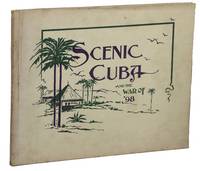
189800009833Chicago: Belford Middlebrook & Co 1898. First edition. Hardcover. Very Good. 4to. Unpaginated. White cloth with decorations in purple and green on the front board. Illustrated with numerous black and white photographs and maps. With introduction and descriptive text. Photographs showcase the beautiful sights of Cuba along with military points of interest and several U.S. Navy ships. A Very Good book with a touch of rubbing to the corners and a bit of soiling to the cloth. Belford, Middlebrook & Co hardcover
1852List2521London 1852. Five groups of documents measuring 13 x 8 inches various paginations see full description below. Fine condition. A scarce set of primary source documents relating to the protection of British territory in the Caribbean in particular along the Mosquito Coast during the period of varied interests in the area in the period following the Anglo-Spanish agreement on the slave trade. Consisting of a series of secretarial copies of reports delivered to Peter McQuhae Commodore of H.M.S. Imauam stationed in Jamaica these dispatches offer an overview of the issues confronting the British Navy in Jamaica during the period and in the Caribbean more broadly. Most of the documents refer to issues with Cuba the most interesting perhaps being a letter warning of an impending filibustering expedition against Cuba by a pro-slavery faction in the American South. <br /> <br /> The group consists of five groups of bound documents some bound out of order and likely bound later. Contents are as follows: <br /> <br /> 1. Addington A.M. Four Page Report Concerning Placing a Ship of War at Grey Town to Discourage Invasions on the Mosquito Coast March 13 1851. <br /> <br /> Henry Addington writes McQuhae to recommend stationing a warship at Grey Town:<br /> <br /> “.it would be sufficient that a Ship of War should from time to time look in grey Town without remaining there at any time long enough to endanger the health of the crew… to provide for the case which is possiblee tho’ not at all likely that during the interval between the visits of a Ship of War some expedition of Nicaraguan or some of the North Americans returning from California might take advantage of the comparatively unprotected state of the lace to take possession of it and that the cruiser on its return to Grey Town might find the place so occupied Lord Palmerston concieves taht in such an event it would seem to be inconsistent with the Honor of this Country that a British Ship of War should acquiesce in such an aggression and it would be right that the intruder should be expelled if the Commander of the Ship of War should find as he probably would that he had the means of doing so without much difficulty and that in case he should repel the intruders and re-establish the authorities of the Mosquito Government demanding the liberation of any British or Mosquito subjects who might have been made Prisoners and holding hostages for their relief if they should have been removed up into the interior of the Country.<br /> <br /> It It is to be hoped however that all questions of dispute in regard to Grey Town will beoon be settled because Her Majesty’s government has through Her Majesty’s Minister at Washington proposed to the Government of the United States that an arrangement should be made by which the Sovereignty of Grey Town… should be transferred to the State of Costa Rica… Lord Palmerston desires me to add that there are at present at Washington a plenipotentiaries both from Nicaragua and Costa Rica for the purpose of conducting this negotiation…â€<br /> <br /> 2. Addington G.M. Single Page Letter in Secretarial Hand Warning of Incoming Ships to Cuba Carrying Enslaved Individuals January 24 1852. <br /> <br /> Addington writes to McQuhae about two incoming vessels carrying enslaved Africans passing on information received at Rio De janeiro by another British vessel:<br /> <br /> “I am directed by Earl GraH.M. Minister at Rio reporting that he had recieved information that two Slavers had sailed from Havana to… the coast of Africa… with the intention of returning with Cargoes of slaves which are to be landed at the Entrade de Cuchillo in Cuba.â€<br /> <br /> 3. Seymour G.F. et al. Four Reports Bound Together on Varied Subjects including the Case of the Creole British Fishing Rights in Spanish Waters off of Cuba and Porto Rico and the Case of a Detained British Vessel in Cuba 1852. <br /> <br /> A series of four reports addressed to McQuhae on various subject as follows:<br /> <br /> A. Report dated May 17 1852 from Seymour discussing the case of the Creole detained in 1851:<br /> <br /> “.enclosing copies of a letter from the Under Secretary of State for Foreign Affairs approving of the course I had pursued with regard to the Creole and of a despatch from the Earl of Malmesbury to Her Majesty’s Minister at Madrid relative to the rights of British Subjects to fish on the coast of Cuba…â€<br /> <br /> B. Letter from Augustus Stafford Apriul 23 1852 discussing the Creole mostly discussing the enclosure of varied reports on the subjects but with little specific information. <br /> <br /> C. Addington A.M. April 21 1852 letter discussing the Creole case and the enclosure of documents. <br /> <br /> D. Earl of Malmesbury April 14 1852 letter discussing the Creole case in more detail:<br /> <br /> “ The Right thus claimed rests on this universally admitted precept of international Law “dominium finitur ubi finitur armorum vis†which in modern practice has been construed to mean “about one marine league from the mainland†and H.M.’s Govt are clearly justified in demanding that the Spanish authorities shall be ordered not to meddle or interfere with British fishermen outside that three mile boundary…â€<br /> <br /> 4. Earl of Malmesbury et al. Series of Three Secretarial Copies of Reports Concerning Impending Filibuster Raids on Cuba Giving Instructions for Assisting Spanish Forces. <br /> <br /> A very interesting series of reports detailing the planned response to pending “Piratical Attacks†showing the extent to which British forces were prepared for an American filibuster attack on the island and the degree to which they intended on assisting the Spanish forces. As follows:<br /> <br /> A. Seymour G.F. Secretarial Copy of Letter Written on May 5 1852 from Cumberland at Bermuda relaying the transmission of a full report of instructions to the British forces regarding an impending filibuster raid:<br /> <br /> “ I hereby enclose for your guidance… orders… relative to the assistance which is to be afforded by Her Majesty’s Ships on the application of the Captain General of Cuba in the Transport of Troops in the event of a Piratical attack being again made on that island by which you will govern your conduct…â€<br /> <br /> B. Earl of Malmesbury. Secretarial Copy of a Letter Dated April 10 1862 discussing piratical attacks:<br /> <br /> “.that in the event of a Piratical Attach being made upon that island… HM’s ships might assist in conveying troops to any poiunt of the Coast of Cuba at which the invading Party might effect a landing…â€<br /> <br /> C. Honley P. Secretarial Copy of an Undated Letter c. 1852 regarding piratical attacks:<br /> <br /> “Her Majesty’s ships might assist in coveying Troops to any point off the Coast of Cubat at which the invading Party might effect a landing… you should be instructed until further ORders that if the Captain General of Cuba should require your assistance for the transport of troops in the manner pointed out in your abovementioned dispatch you should comply with that demand…â€<br /> <br /> 5. Crampton Sir John. Copy of a Letter in Secretarial Hand Relaying the Impending Danger of a Pro-Slavery Filibuster Mission from Florida May 17 1852. <br /> <br /> A fascinating letter relaying information received from M. Calderon de la Barca concerning an impending filibuster mission against Cuba led by a Dr. Wren part of an organization called “The Lone Star Association:â€<br /> <br /> “.it would appear that the government of the United States has also received an intimation that something of the sort is on foot for the President informed M. Calderon that orders had already been sent to the U.S. Authorities at the different Ports of the Union to be prepared to take vigorous measures for the repression of any such attempts… an expedition is in fact meditated by certain parties in the South and that it is intended that it should leave some Port of Florida. The real object of this expedition however as as I am told not Cuba… but San Domingo for the purpose of acting as auxiliaries to the Dominicans against the Haytians… it is by no means impossible that its ultimate aim would be Cuba… the persons I am given to understand engaged in the expedition are a Dr. Wren who is president of a society called “The Lone Star State Association…â€<br /> <br /> The letter is worthy of further study - we find references to a Dr. Wren in newspaper articles from the period but were unable to pinpoint his identity or the history of his organization. An article from a Loudon Tennessee newspaper describes Dr. Wren as a “representative of New Orleans societies†and described a meeting in Loudon in 1852 trying to recruit for the overthrow of the Spanish colonial government of Cuba through an invasion. unknown
202000291Paris, Tallandier, 2008 ; in-12, 220 pp., br. EN BON ÉTAT PLATS DE RELIURE SALIS - Cuba 1837-1842.
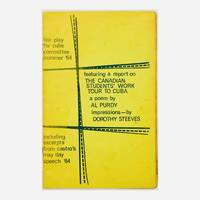
19643764Toronto: Fair Play for Cuba Committee Amis du Peuple Cubain 1964. First Edition First Printing. Card Covers. pp. 36. 12mo. measuring 5.5" x 8.5". Illustrated twice-stapled card covers. No detectable flaws contents remain bright clean and unmarked with tight sound binding; near fine. Contents include: Al Purdy writes on his visit; Unionists visit to Canada; Amigos de Cuba; Hurricaine Relief Fund; Poem to the Sailors on the "Oxford"; Portion of Castro's May Day Speech and much else. Scarce in commerce. <br/><br/>"On June 30th the first group of Canadian students will leave from Eastern Canada for Cuba where they will spend from six to eight weeks working with and talking to Cubans from all walks of life. The second group leaves on July 3rd from points west of Winnipeg and will join up in Mexico City before proceeding to Havana. A total of 45 students will participate in the program and will be led by Captain David Middleton a retired Canadian army officer. The group are representative of Canadian university students from Fredericton and Halifax on the east coast to Victoria on the west coast. Th students represent fifteen campuses in eight provinces and courses in engineering science accountancy medicine political science philosophy liberal arts psychology sociology law school teaching library and theology. Some of the students are in post-graduate studies. The objective of the tour is two-fold: to work as a group on some project or projects alongside Cubans thereby creating a bond of friendship leading to a better understanding between Cubans and Canadians and secondly to provide an opportunity for the group to assess the Cuban experiment in social reconstruction." Fair Play for Cuba Committee, Amis du Peuple Cubain unknown
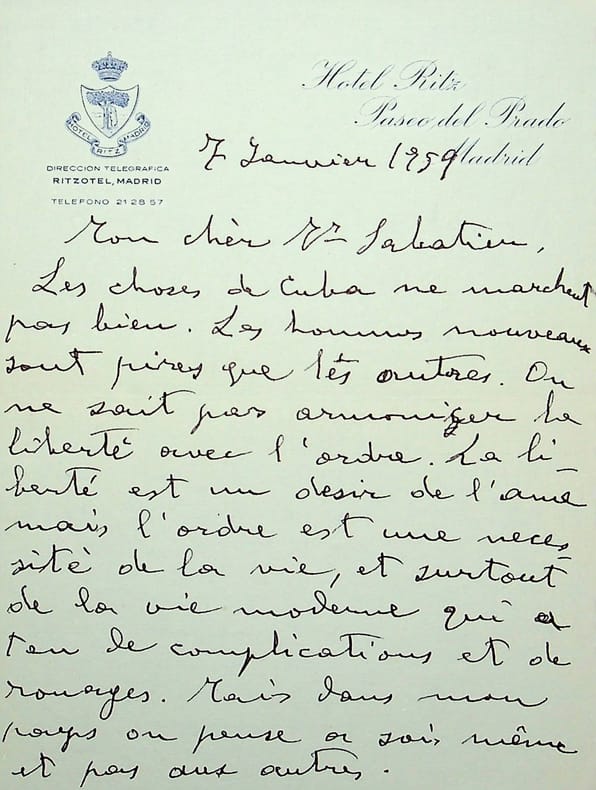
014631[Fidel Castro] Orestes Ferrara (1876-1972), écrivain cubain d'origine italienne, s'étant battu pour l'indépendance de Cuba, et en devint ambassadeur et député. L.A.S., Hôtel Ritz, Madrid, 7 janvier 1959, 2p in-8. A André Sabatier, directeur littéraire chez Albin-Michel. « Mon cher Mr Sabatier, Les choses de Cuba ne marchent pas bien. Les hommes nouveaux sont pires que les autres. On ne sait pas harmoniser la liberté avec l'ordre. La liberté est un désir de l'âme mais l'ordre est une nécessité de la vie, et surtout de la vie moderne qui a tant de complications et de rouages. Mais dans mon pays, on pense à soi-même et pas aux autres. Je ne sais pas si je resterai à l'Unesco. Je n'y tiens pas. Et si je peux me retirer sans apparaître que je démissionne pour des raisons d'ordre politique, je le ferai avec plaisir. Je n'aimais pas les anciens et je n'aime pas les nouveaux. Mon "Felipe II" est en train d'être copié. J'espère l'avoir dans un mois. Si je viens à Paris plus tard, je vous remettrai une copie avec quelque ami. Miomandre m'a félicité pour la nouvelle année. Je ne lui ai pas répondu par ce qu'il a été très mal élevé lorsqu'il m'a parlé par téléphone. Mes respectueuses salutations à madame Sabatier. A vous mon très amical coup de main. Orestes Ferrara ». Rare lettre de ce révolutionnaire devenu cubain qui critique ici l'arrivée au pouvoir de Fidel Castro et ses alliés. Battista a fui le pays le 31 décembre 1958 et dès le 1er janvier, Castro survole le pays avant d'être nommé le 7 janvier, le jour-même de cette lettre. [354]
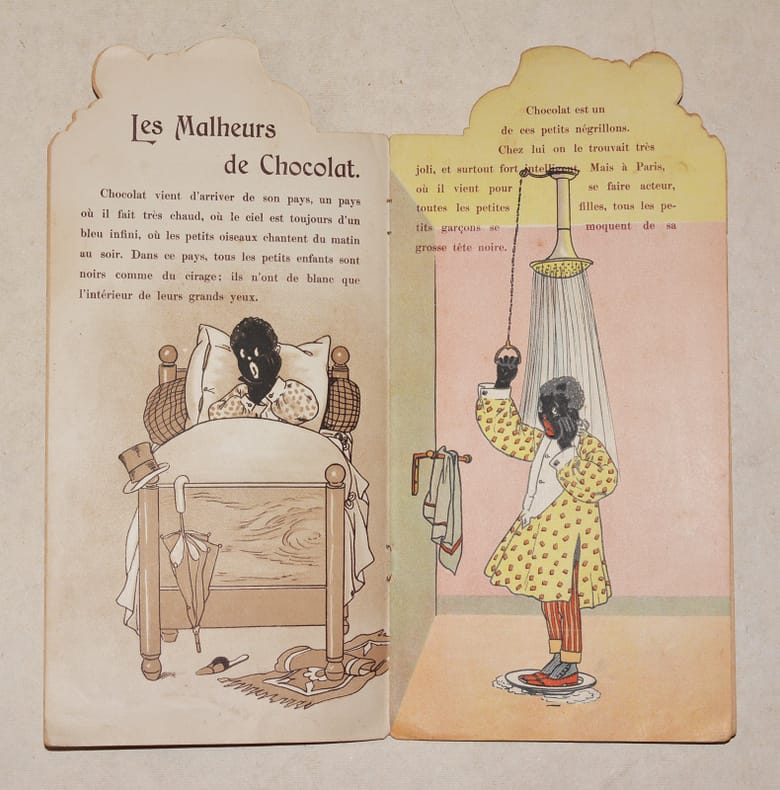
005435Paris, Éditions Nilsson, 8, rue Halévy, sans date [circa 1918-1929]. Petit in-folio étroit (168 X 344 mm) demi-toile bleue de l'éditeur, plats cartonnés à découpes lithographiés en couleurs ; 10 pages. Petits manques de papier aux plats cartonnés, infimes manques de toile à l'emplacement des deux agrafes.
Madrid, Imprenta del Reyno, s.a. (1744). 8vo.; 8 hs., 222 pp. Ejemplar con rastros de polilla en el margen interior blanco de 35 pp. sin afectar al texto. Encuadernación en pergamino. Un texto de notable interés histórico, desarrollado en forma de un gran diálogo dramático-político en la cumbre del Olimpo entre los reyes de Prusia, Inglaterra, Francia, Portugal, España y la República de Holanda, que contiene detalladas relaciones de acciones de guerra en tierras americanas, como las expediciones del Almirante Vernon y los ataques a La Habana, La Guaira, Cartagena de Indias, saqueo de Portobelo, etc., así como sobre el ataque a San Agustín, en Florida, por el General Oglethorpe, gobernador de Carolina. Actualmente se atribuye la obra al médico protestante francés, exilado en Inglaterra y Holanda, J. Gautier de Faget, autor de "L'Argus de l'Europe . Ouvrage historique, politique, critique ; où l'on dévelope les intérêts & les maximes des souverains, depuis la mort de l'empereur Charles VI. jusques à la fin de la guerre que son auguste fille Marie Thérèse reine de Hongrie, grande duchesse de Toscane, soutient avec beaucoup de gloire" (Amsterdam, 1742-1743) y de la refundición de la obra anterior como "L'Oracle de ce siecle, consulté par les souverains de la terre : ouvrage singulier sur les affaires critiques et politiques du temps" (Londres, 1744).
19624785Various locations in Cuba Europe and the United States 1962. Very good. 113 leaves of scrapbook cardstock illustrated with 388 photographs chiefly silver gelatin photographs several colored or in color in mounting corners. Most captioned in Spanish. Square folio. Contemporary brown cloth spring-loaded spine front cover stamped "CUBA." Joints split but holding well moderate rubbing and dust-soiling. Light foxing handful of images lacking some images slightly browned or with mild edge wear. An extensively-annotated vernacular family photograph album centering on the German-Cuban Coyula-Moeller family picturing their lives family members travels and more in Cuba the United States Germany and other locations in Europe mainly during the 1920s and '30s. The album was likely compiled by Gerardo Coyula y Moeller who was born in the early-1920s and attended Aloisiuskolleg in Bad Godesberg in the late-1930s. The album includes numerous pictures of Coyula y Moeller as a toddler young man and teenager traveling with his mother and various family members attending school and more with numerous photographs featuring the family and their environs in Cuba and Germany. The caption to a family photograph indicates that the Coyula family were shareholders in the German Club "Club Aleman" in Havana from 1939 to 1960. Other family members identified through the profuse captions include Aunt Merci Aunt Hortensia Uncle Gustavo Estela grandfather Enrique Moeller grandmother Rosa Gelpi and others.<br /> <br /> The album also contains several photographs relating to the Nazi Party in Germany before the war as well as two photographs with captions poignantly noting one young man who would die in a concentration camp in Germany. One of the latter examples pictures a young man named Gerd Wolf with the Spanish caption translated as "Rabbi Fidellis eating bananas - He was with the Resistance and died in the Dachau concentration camp." The Coyula y Moeller family were apparently shareholders in a German casino in Cuba. Notably an antecedent of the family was apparently friends with a German individual who is documented as later helping usher Hitler into power and the album records two additional Nazi individuals who "visited grandfather's house" and "fled to Brazil" to escape the consequences of their war crimes. Yet another family photograph shows a group of adults posed in a garden with the caption reading: "Nuestro amigo: Resulto ser Himmler" "Our friend: turned out to be Himmler". Indeed the image shows the man third from right is clearly Heinrich Himmler.<br /> <br /> In addition to pictures of the family at home in Cuba the album captures them in various locations in Germany mainly Bonn Hamburg and the aforementioned Bad Godesberg. The family also traveled to New York in the United States and Southampton England among other places with several photographs documenting their travels in each location. The album is also replete with identified photographs of a legion of family friends and acquaintances providing ample opportunity for deeper research into the connections within the family but also to the family's larger community. According to a previous owner the album came out of the noted Weber family in Cuba. An exceptional and well-preserved collection presenting the lives of this noted German-Cuban family. unknown
24064P., Emile-Paul, 1939, in 8° carré broché, 51pp. ; couverture fanée ; frontispice gravé de J.-J. SICRE.
6498Paris, Calmann-Lévy / Jazz, 1997. In-12 carré, broché.
194755153Havana: Cuban Tourist Commission 1947. Paperback. Very good. Paperback. 22 by 28 inches unfolded. Foxed overall with some expected toning at the creases else very good and crisp. <br/><br/> Cuban Tourist Commission paperback
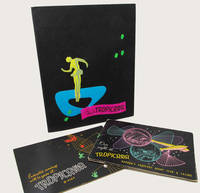
195534840Havana Cuba: The Tropicana circa 1955. 4 volumes. Original Printing. Original velour cover illustrated by hand using the technique of collage in yellow green blue pink and black and illustrated throughout with photographs designs and decorations the three brochures also in colour. Large 4to 28 x 23 cm Original velour with collage decorations to the cover the brochures of paper over board all coloured. 24 pages with numerous illustrations and 2 hand-made excerpts that allow a view of the following page. The large format brochure also includes: 1. 'Our Night at Tropicana. Havana's Fabulous Night Club & Casino' illustrated folder to insert a photograph here without photo. 2. The same with an original photograph of a party hand-dated 'Marzo 1962' and inscribed 'Boda de Cora y Vicente' with the names of the guests. The envelope is rubbed a bit. 3. The same in a different design with a photograph showing a lady in an evening dress. Her companion has been cropped from the photograph. Two additional postcards are provided here one showing the poolo of the Cabana Sun Club the other shows Calle Obispo in Havana in an older photograph. A fine copy of the 'This is Tropicana' cover and contents the brochures with a bit of age or evidence of use. VERY SCARCE. A beautiful collection from one of the most famous nightclubs of the 1950's. In 1950 Martin Fox bought Villa Mina and commissioned architect Max E. Borges to carry out the spectacular renovation with parabolic concrete arches and glass walls to roof the stage. On March 15 1952 the new Arcos de Cristal cabaret building was opened. Artists who performed at the Tropicana included star such as Nat King Cole and Josephine Baker and visitors included Edith Piaf Ernest Hemingway Jimmy Durante and Marlon Brando. Shortly after the revolution in 1959 the Tropicana like other casinos and nightclubs was nationalized. The Tropicana unknown
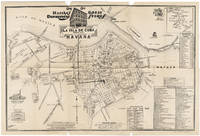
1930560Havana Cuba: American Express Co et al. 1930. Small archive of six items from a trip in the early years of the 1930s all good or better. Items include: One forty page brochure in decorated and printed card stock wrappers "CUBA The Pearl of the Antilles" with 16 itineraries and copious pictorial advertisements; two contemporary color picture postcards unused; small brochure folded to make four pages offering visits to "Algibe" Farm the "most typical Cuban Farm in the vicinity of Havana" where you are invited to see how crops are grown attend "Thrilling Cock-Fights at all hours" and "Royal Palm Climbing Exhibitions." Finally a fan-folded invitation to "Buy where Cubans buy" at La Isla de Cuba with an accompanying map 21 x 14 in. dated 1928 of the entire downtown Havana shopping district folded into twelve 7 x 3.75 in. panels with breaks at folds see photo. All good or better with nicks small closed tears and a few smudges. American Express Co, et al. unknown
200503543Paris, Christian Chalmin éditeur, 1986 ; in-4, 48 pp., cartonnage de l'éditeur.
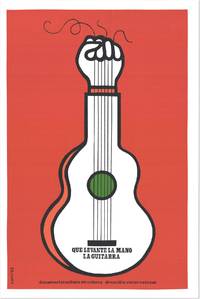
198383069Havana: S.i. 1983. Original illustrated poster with text and pictorial elements silkscreened in four colors on white stock measuring 51cm x 76.25cm 20 1/8" x 30". Mild handling to extremities ele a bright Fine copy unbacked. Striking poster designed by Concepción Robinson Mendoza aka. "Coni" for Victor Cassaus's 1983 documentary Que Levante la Mano la Guitarra centered around Cuban musician and folk singer Silvio Rodríguez Domínguez. 83069. S.i. unknown
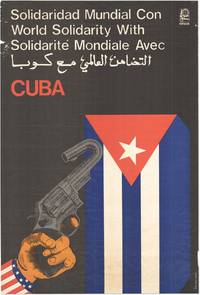
198083250Havana: OSPAAAL 1980. Original lithographed poster with text and images offset printed in colors on white stock measuring 51cm x 75cm 20" x 29.5". Pinholes to corners light wear and several tiny tears and creases to extremities with paper around upper left margin slightly abraded and a few faint marks and stains on verso; Very Good. Attractive poster designed by Cuban artist Rafael Enríquez Vega b.1947 calling for an international day of solidarity with the people of Cuba. The central image features a large Cuban flag and an American hand holding a revolver with the barrel pointed at itself. 83250. OSPAAAL unknown