Caribbean and Cuba; LaborBiblio.com
2 508 résultats
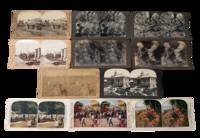
1890231711890. Stereoview archive of the post-emancipation Caribbean showing how the islands were marketed to western viewers through plantation labor export agriculture civic spectacle and catastrophe. As a group these photos function not only as an ethnographic travel archive but as evidence of the visual economy that followed slavery. The British West Indies moved through emancipation in 1834 to 1838 the French Caribbean in 1848 Puerto Rico in 1873 and Cuba in 1886 yet plantation production remained central to regional life well into the early twentieth century. These stereoviews preserve a colonial way of seeing in which Black and Afro-Caribbean labor rural discipline and extractive agriculture remained the background condition of "tropical" beauty and commercial modernity. Cuba's sugar economy in particular expanded through the nineteenth century and slavery was not abolished there until 1886 while Weyler's later reconcentration policy during the Cuban War of Independence violently reorganized rural life. Martinique after 1848 likewise shifted into new labor regimes including imported workers from India and China.<br /> <br /> Archive of 11 stereoview cards late 1890s to early 1900s depicting Cuba Jamaica Martinique Puerto Rico and the Dominican Republic. Most black and white with a few colorized. Each measure 3.5" x 7". All with captions on the margins. "Reconcentrado Farming Scene Province of Havana Cuba" links agricultural production to the brutal displacements of Spain's reconcentration campaign; "Cutting sugar cane Montego Bay Jamaica W.I." records cane labor in a colony where emancipation had not ended plantation dependency; and "Harvesting Coconuts Porto Rico" likewise frames Caribbean land through export work rather than local life. Other views extend that economic framing through cacao and coffee scenes while the paired Havana cards shift into urban leisure and public display including "Beautiful Central Park Havana Cuba" and "Holiday in Havana Cuba" the latter with both Cuban and American flags visible a telling image of the new imperial order after 1898. The disaster views from Martinique and the Lesser Antilles show how stereoview publishers also turned Caribbean destruction into consumable spectacle. the Morne Rouge card is accompanied on the reverse by the grim printed text "Dead bodies which were to be seen in Morne Rouge." while the wider context is the 1902 eruptions of Mount Pelée in Martinique and La Soufrière on Saint Vincent two catastrophes that killed roughly 30000 and 1600 people respectively and devastated local communities and agriculture.<br /> <br /> Some corner wear light toning scattered surface and edge wear. Overall very good condition. This collection gives direct visual representation of Caribbean history Atlantic slavery and emancipation plantation labor and U.S. imperial expansion in the circum-Caribbean preserving the transition from slavery to post-abolition labor. unknown
Primera edición.
trad. di Linda Verna n. 1156 in 16°, bross. edit. ill. con bandelle
Gallimard, Du monde entier, 2004, 784 pp., broché, légères traces d'usage, état correct.
Gallimard, Du monde entier, 1975, 349 p., broché, état général correct.
Ypsilon, 2017, 227 pp., broché, très bon état.
Madrid, Nuestra Cultura, 1979. Coleccio´n Pueblos ibe´ricos ; 1 : Serie Textos Recuperados)Compilado por Julio Rodríguez Puértola. 176 p. 8º. Rústica editorial ilustrada. Levemente rozada. Muy buen ejemplar. 1ª edición. 1st edition.
197415260CBFrankfurt am Main, Suhrkamp Verlag (= Bibliothek Suhrkamp Band 422), 1974. 8°, 119 S., original Pappband (Hardcover) mit original Schutzumschlag, erste Auflage dieser Ausgabe minimal beriebener Schutzumschlag rückwärtig an oberer Kante mit ca. 2cm Anriss (sauber mit Tesafilm hinterlegt), sonst schönes, sauberes Exemplar
Barcelona, Editorial Seix Barral, 1969. Biblioteca Breve de Bolsilo. 145p. 8º menor. Rústica editorial ilustrada. Muy buen ejemplar.
Santiago de Compostela, 2004. 4to. cuadrado; 302 pp., 2 hs. Ilustraciones. Cubiertas originales.
México, EDIAPSA, 1949. 4to.; 198 pp., 3 hs. Primera edición. Cubiertas originales. Pérdida de papel en cabeza y pie de lomera.
Frankfurt, Insel-Verlag, 1964. 4to.; 380 pp. Encuadernación original en tela, con sobrecubiertas.
Barcelona, Lumen, 1972. Dibujos de Marcel Berges. 71p. 4h. 8º. Rústica editorial ilustrada. Muy buen ejemplar. 1ª edición en España. Primera edición. 1st edition.
Barcelona, Lumen, 1972. Col. Palabra Menor 3. Dibujos de Marcel Berges. 72 p. 4 h. 8º. Rústica editorial ilustrada algo rozada. Diseño de Àngel Jové. Buen ejemplar. 1ª edición. First edition
Square small quarto in white wraps with gilt title; 94 p. : ill., ports. ; 23 x 22 cm In Spanish. An homage to the much admired Cuban writer. Several b/ew photos. || Carpentier, Alejo, 1904-1980. Carpentier, Alejo, 1904-1980 -- Critique et interpretation.
21x21. 92p. Ilstr.
24x16. 119p. Ilstr. Enc. cart. Ed.
19x12. 300p. 610p. 2 Vols.
19x12. 96p. Cubierta algo deteriorada.
16,5x11. 136p.
16,5x11. 136p. Col. Bosilibros.
19x13. 365p.
18,5x11,5. 139p. Segunda Edición. Col. Ediciones de Bolsillo. Serie Narrativa.
La Habana, Ediciones Unión de Escritores y Artistas de Cuba, 1963. 4to.; 155 pp., 2 hs. Primera edición cubana. Cubiertas originales.
21x14. 576p.


