[Cuba]. [Trade]Biblio.com
2 507 résultats
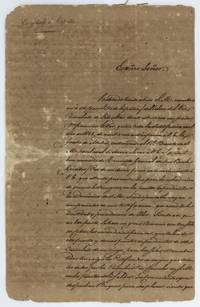
18282401Gibraltar 1828. Good. 3pp. on a bifolium. Previously folded with separations. Tanned somewhat brittle. An interesting example of official communications concerning trade between colonial Cuba and the Spanish mainland. In this manuscript letter date March 14 1828 the new Spanish Vice Consul in Gibraltar writes to the Governor General of Cuba concerning several topics. These include the regulation of shipping to Cuba and by implication the rest of the Caribbean through Gibraltar particularly of French ships leaving Mediterranean ports. Also discussed is keeping track of individuals particularly merchants going to Cuba by means of identification papers and other documents. The consul also reminds the colonial government of the importance of documenting duties and tariffs paid for shipping cargo and goods. unknown
18732024Cuba 1873. About very good. 3 folio leaves. Light wear at edges a couple of small chips at lower left edge of each leaf. Light tanning and foxing. Accomplished in a neat legible script. Scarce manuscript listing of slaves and indentured servants from a Cuban sugar plantation. The present list was made in January 1873 on the Ingenio Tartesio east of Havana near the small village of Las Pozas. On two separate sheets nine Chinese and twenty-eight African or Criollo men are listed as rented to the farm; on a third sheet eighteen slave births for 1873 and 1874 are recorded giving names mothers and dates of birth. The Chinese men are identified simply by first name and owner; the African and other slaves are listed with additional details such as nationality age owner. A section for additional observations notes which slaves have run away and at least one death. A fascinating document of slave hires on an isolated Cuban plantation during the 1870s. unknown books
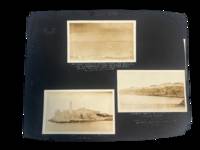
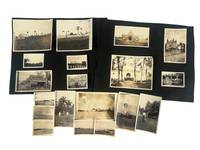
1920227281920. Havana Cuba travel photo album circa 1920s documents an American visitor's encounter with Havana during the interwar years when U.S. tourism commercial presence and Spanish-American War memory shaped how many American travelers interpreted the city. The vernacular photographs record arrival by steamship harbor landmarks civic buildings commercial streets factories boulevards monuments cemeteries and guarded public spaces giving insight into both Havana's urban landscape and the traveler's assumptions about access history and spectacle. The album's references to the USS Maine and Spanish-American War memorials place ordinary sightseeing within a longer history of U.S. intervention in Cuba; the Maine exploded in Havana Harbor on February 15 1898 killing more than 260 sailors and intensifying the crisis that led to war with Spain.<br /> <br /> Approximately 25 sepia-toned silver gelatin photographs each about 3 x 5 inches mounted to black album leaves with detailed handwritten captions in white pencil. The sequence begins aboard the S.S. Kroonland with one caption reading "My first view of Havana from the deck. three miles out at sea in a dark storm" followed by a landing view captioned "where we landed in Havana Cuba." The S.S. Kroonland returned to Panama Pacific Line service in 1923 on a New York to San Francisco route via Havana the Panama Canal and Los Angeles supporting the album's interwar travel context. The photographs then trace Havana's maritime and civic topography: harbor views Morro Castle captioned "Famous during the Spanish-American War" the waterfront in front of the fortress the Court House the President's Palace a "600-year-old church" the Henry Clay Cigar Store Havana's factory district and public boulevards "where all streets have parks in the center." Other images include a cemetery visit captioned "All people in Cuba are laid to rest above the ground" and a restricted-view street or carriage scene captioned "Officer would not let me take picture but when he turned I took it anyway" a revealing note on tourist privilege and unauthorized looking.<br /> <br /> Several images directly record the ways American travelers consumed Havana through imperial memory and Cuban nationalist commemoration. One monument is captioned "This was given by the Cuban people to the American soldiers that fell in the Spanish-American War" while another marks "the spot where the Maine sank at the entrance of the harbor." The album was made after Cuba's formal independence in 1902 and during the long aftermath of the Platt Amendment framework under which the United States retained extensive influence over Cuban affairs and intervened repeatedly in the early twentieth century. Album leaves chipped at edges several with corner losses not affecting images; prints generally sharp with strong contrast and clear annotations very good overall. Socially revealing Havana travel album documenting how a U.S. visitor pictured Cuba through steamship tourism colonial architecture cigar commerce Spanish-American War remembrance and the everyday authority structures of an interwar Caribbean capital. unknown
1996148583Culver City CA: TriStar 1996. Shooting Script for the 1997 film. SIGNED on the title page by director-screenwriter James L. Brooks.<br/><br/>A misanthropic novelist uses sarcasm and animosity to mask his extreme obsessive-compulsive disorder but finds his highly regimented world begins to unravel when he is forced to dog-sit for his neighbor following a violent robbery. Nominated for seven Academy Awards and winning two for Best Actor and Best Actress for Jack Nicholson and Helen Hunt respectively.<br/><br/>Set in New York City and Baltimore shot on location in New York New Jersey and California.<br/><br/>Navy generic Tri-Star Pictures wrappers. Title page present dated 7/29/96 noted as Shooting Script with credits for screenwriters James L. Brooks and Mark Andrus. 164 leaves with last page of text numbered 136. Xerographic duplication with white revision pages throughout dated variously between 9-24-96 and 6-12-97. Pages Near Fine wrapper Near Fine bound internally with two gold brads. TriStar unknown books
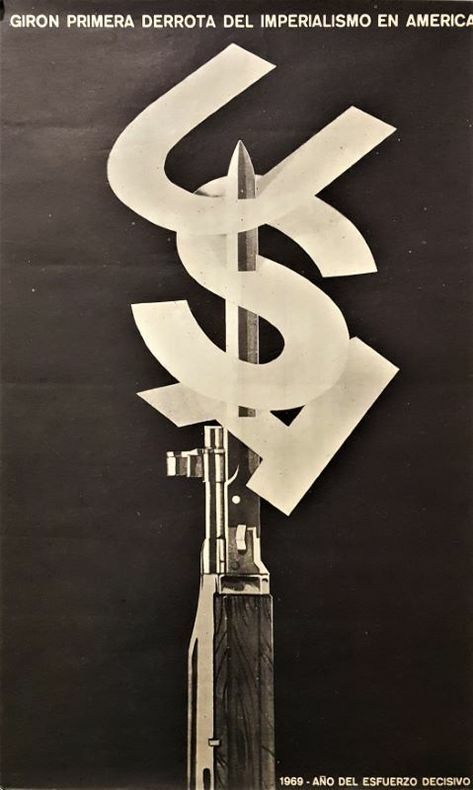
2092Sans mention d'éditeur. 1969. Impression offset.Dim : 52,5 x 32,5 cm
2092Sans mention d'éditeur. 1969. Impression offset.Dim : 52,5 x 32,5 cm
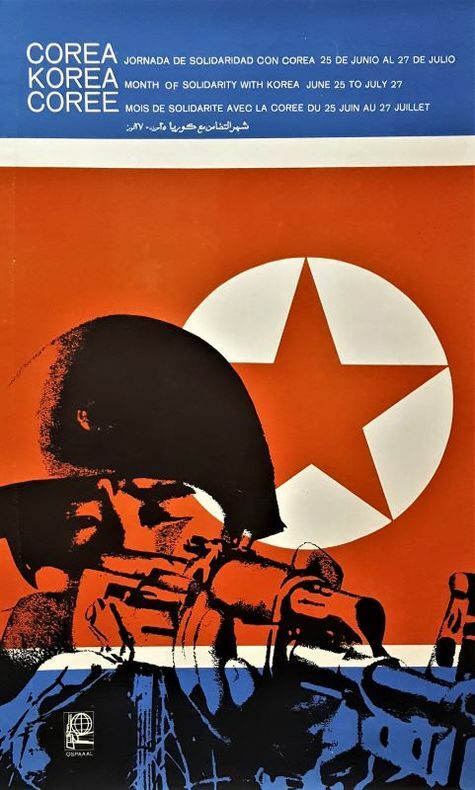
2090Edit. OSPAAAL. 1968. Impression offset. Dim : 53 x 33 cm.
2090Edit. OSPAAAL. 1968. Impression offset. Dim : 53 x 33 cm.
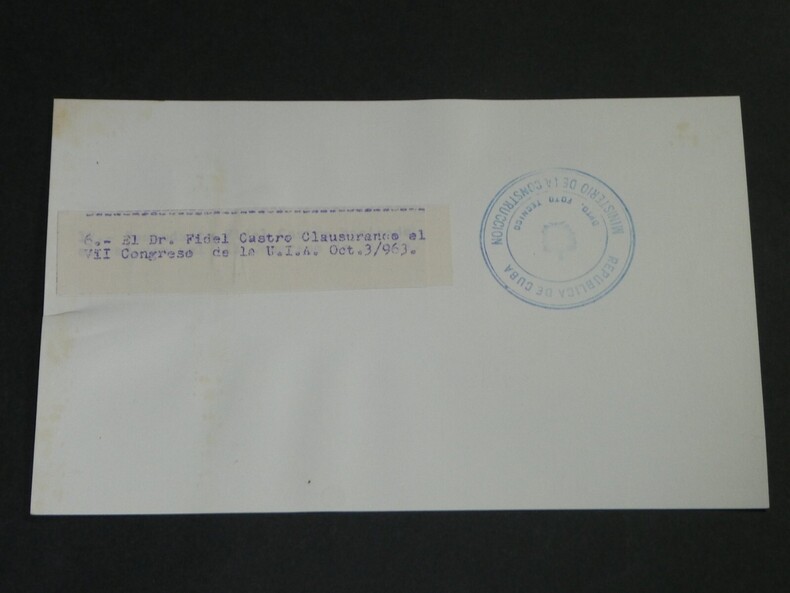
1963boz_003353Fidel Castro Lot de 13 Photos d'époque officielles - VIIème Congrès de l'Union Internationale des Architectes à La Havane, 1963, avec comme problématique "L'architecture dans les pays en voie de développement", Tampon du "Ministère des relations extérieures" et du Ministère de la construction Dimensions : Grandes photos : 20,2 x 25,5 cm Petites photos : 12,4 x 19,8 cm État : bon état, certaines ont des traces de frottements.
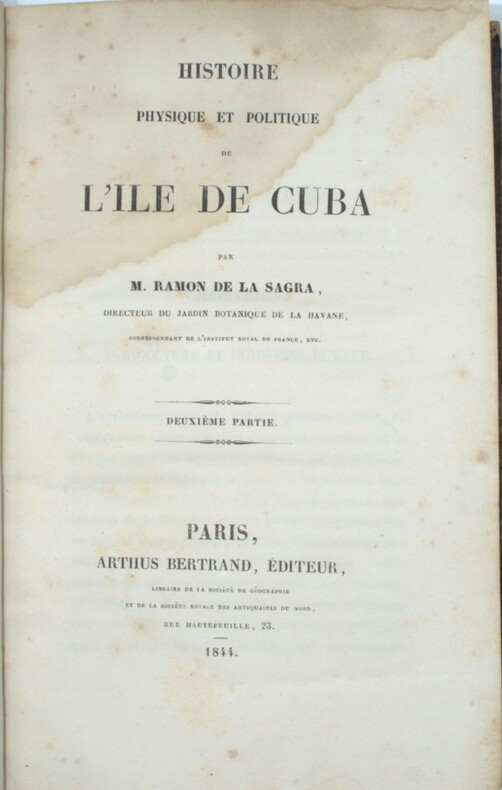
1844PHO-1491Paris, Arthus Bertrand, 1844, in-8, 2 volumes, LXXI-771-[2] pp. en numérotation continue, 20 diagrammes hors texte, demi-chagrin rouge, dos à faux nerfs, monogramme "J.M.C." doré en pied des dos, Rousseurs, quelques auréoles, l'une assez large en tête du second tome.
1906ZB705570Habana: 1906-1931 passim. Tomo I 1906 Tomo III 1906 a 1908 Tomo IV 1909 a 1911 Tomo VIII 1917 a 1919 Tomo 10 1921 a 1923 Tomo XII 1925-1927 Tomo XIII Vol. I 1927 a 1929 Tomo XIII Vol. 2 1929 a 1931 only; first editions; small usually thick quartos; ex library original cloth bindings smudged and worn with one side and a few text leaves detached most hinges cracked or broken text age toned but not fragile reading copies only. - If you are reading this this item is actually physically in our stock and ready for shipment once ordered. We are not bookjackers. Buyer is responsible for any additional duties taxes or fees required by recipient's country. Photos available upon request. Habana: hardcover
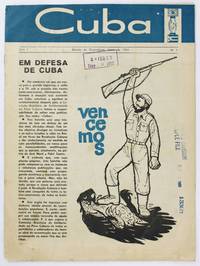
19615832Guanabara 1961. About very good. 111pp. Small folio. Original pictorial self-wrappers stapled. Contemporary and slightly later ink stamps to front wrap. Light edge wear. Some tanning and dust soiling. First issue of this evidently unrecorded periodical published by the "Comissão Brasileira de Solidariedade ao Pavo Cubano" in May 1961. The publication contains numerous positive stories on the progress of the Cuban Revolution and support of the cause from the Brazilian people. Illustrated throughout with photographs and drawings including the beginning of a serial comic on the history of the revolution at the rear. The front wrap depicts Fidel Castro with his foot on the chest of a supine eagle and a rifle raised triumphantly over his head. Interesting support for the Communist cause in Cuba from South America. Not in OCLC. unknown
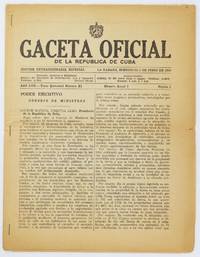
19595470Habana: June 3 1959. Good plus. 11pp. Small folio. Previously folded; stapled along gutter margin. Some edge and corner wear; closed tear to initial leaf from fore-edge along old fold. Toned cheap newsprint. A special edition of the Gaceta Oficial of Communist Cuba devoted to the printing of the First Agrarian Reform Law passed and signed on May 17 1959. The law effected the first major land redistribution under Fidel Castro and the Communist Party. Under its authority all properties were over 420 hectares were confiscated and redistributed to the people and native businesses. Prior to the law over 80% of Cuban land was owned by foreign mostly American companies. The preamble and sixty-seven articles lay out the motivations for the law the parameters for confiscation by the Department of Agriculture the mechanisms for seizure and redistribution and the creation of a new government organization to facilitate the land transfers the Instituto Nacional de Reforma Agraria. Signed in print by Fidel as Prime Minister Manuel Urrutia Lleo as President and a slew of other officials. June 3 unknown
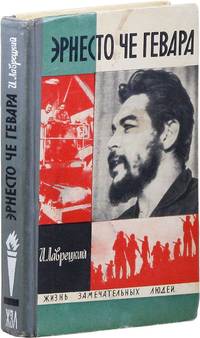
197232549Moscow: ИздательÑтво ЦК ВЛКСМ ÐœÐ¾Ð»Ð¾Ð´Ð°Ñ Ð³Ð²Ð°Ñ€Ð´Ð¸Ñ 1972. First Edition. Octavo. Cloth-backed pictorial paper-covered boards; 348 3pp; portraits plates. Slight external rubbing and shelfwear; corners nudged; still a solid Very Good copy. Apparently the first full-length Soviet biography of the Argentinian revolutionary martyr and hero of the Cuban Revolution well-illustrated with photographic portraits and plates. <br /> <br /> According to Costa Rican investigative journalist Marjorie Ross "Lavretsky" was a pseudonym for Soviet master-spy Iosif Grigulevich who got his start as a hired hit-man against Trotskyist and Anarchist factions in the Spanish Civil War. She pegs him as the never-identied "third man" in the assassination of Leon Trotsky; and during the Cold War posing as an international coffee expert Grigulevich reputedly penetrated the highest levels of government and culture in Costa Rica Chile and Mexico during which time he was also the Kremlin's "handler" for Chilean poet Pablo Neruda and Mexican painter José Siqueiros see Marjorie Ross El secreto encanto de la KGB/ The Secret Charm of the KGB: Las cinco vidas de Iosif Grigulievich/ The Five Lives of Iosif Grigulevich. San José: 2006. <br /> <br /> Apparently an uncommon work at least in Western institutions; OCLC locates just one copy British Library; KVK and European Library Meta Catalog find three more Nat. Lib. Lithuania; BNF; Staatsbibliothek Berlin. ИздательÑтво ЦК ВЛКСМ ÐœÐ¾Ð»Ð¾Ð´Ð°Ñ Ð³Ð²Ð°Ñ€Ð´Ð¸Ñ unknown
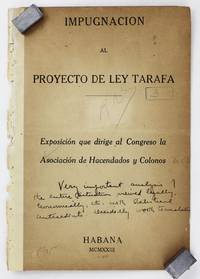
19235672Havana 1923. Fair. 14pp. Original wrappers rear cover lacking. Contemporary ink notation to front cover reinforced at spine with later paper tanned. Text guillotined; leaves silked some chipping and wear at edges. A rare work arguing against railroad consolidation in Cuba and a victim of the New York Public Library's microfilming project. The subtitle reads "Exposicion que dirige al Congreso la Asociacion de Hacendados y Colonos." We locate only the microfilm copy at NYPL in OCLC no physical copies. unknown
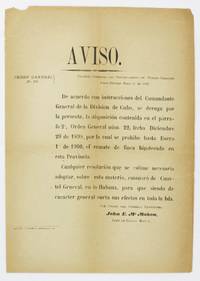
18995378Puerto-Principe Cuba: Imp. el Progreso-Soledad January 11 1899. Good. Broadside 11.75 x 8.25 inches. Old folds minor chip at top left corner uniformly tanned and somewhat tender. An unrecorded general order issued in Spanish by the American "Jefe de Estado Mayor" Chief of Staff John E. McMahon during the military occupation of Cuba in the Spanish-American War. The order stipulates that a paragraph in a previous order prohibiting the auction of mortgaged property in the province of Puerto-Principe until January 1 1900 is hereby repealed and any further instructions on this matter will come from the Army's General Headquarters in Havana. McMahon issued several general orders during the American Army's occupation of Cuba and all appear to be rare. An interesting artifact from America's expansionist period with no other copies in OCLC auction history or the trade. Imp. el Progreso-Soledad, January 11 unknown
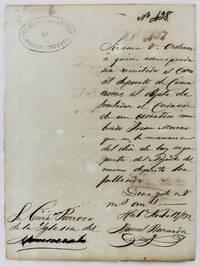
18723066Havana 1872. Very good. Manuscript form approximately 8.5 x 6.25 inches. Minor wear at edges; a few small worm holes. Contemporary ink stamp. Light tanning and offsetting. This 1872 manuscript form from a Havana jail the Celaduria de la Punta notes the death there of an "Asiatico" a Chinese indentured servant with the given name of Juan Macao and orders the transfer of the body to the mortuary for cremation. Indentured servants found themselves jailed for several reasons including suspicion of theft and other crimes recapture following runaway or mere suspicion of abandoning a contract. unknown
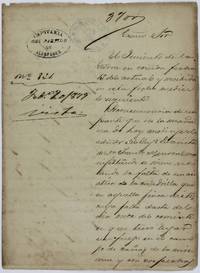
18792090Cuba 1879. About very good. 3pp. on a small bifolium. Contemporary ink stamps; accomplished in a fairly legible hand. Minor wear. A few small wormholes. Light tanning and dust soiling. Brief but very interesting manuscript report on the case of a missing Chinese indentured servant in the district of Alagranes near Matanzas. On February 18 1879 the owner of the plantation Juanita reports the missing person stating that there was a fire in his sugar cane field and it is thought that the laborer might have been burned. It seems that the present document serves to register the case with regional authorities in Matanzas and is a good record of the bureaucracy controlling indentured servitude in Cuba at this time. unknown
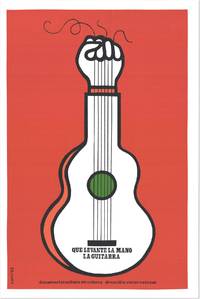
198383069Havana: S.i. 1983. Original illustrated poster with text and pictorial elements silkscreened in four colors on white stock measuring 51cm x 76.25cm 20 1/8" x 30". Mild handling to extremities ele a bright Fine copy unbacked. Striking poster designed by Concepción Robinson Mendoza aka. "Coni" for Victor Cassaus's 1983 documentary Que Levante la Mano la Guitarra centered around Cuban musician and folk singer Silvio Rodríguez Domínguez. 83069. S.i. unknown
197232549Moscow 1972. First Edition. Octavo. Cloth-backed pictorial paper-covered boards; 348 3pp; portraits plates. Slight external rubbing and shelfwear; corners nudged; still a solid Very Good copy. Apparently the first full-length Soviet biography of the Argentinian revolutionary martyr and hero of the Cuban Revolution well-illustrated with photographic portraits and plates. <br/><br/>According to Costa Rican investigative journalist Marjorie Ross "Lavretsky" was a pseudonym for Soviet master-spy Iosif Grigulevich who got his start as a hired hit-man against Trotskyist and Anarchist factions in the Spanish Civil War. She pegs him as the never-identied "third man" in the assassination of Leon Trotsky; and during the Cold War posing as an international coffee expert Grigulevich reputedly penetrated the highest levels of government and culture in Costa Rica Chile and Mexico during which time he was also the Kremlin's "handler" for Chilean poet Pablo Neruda and Mexican painter José Siqueiros see Marjorie Ross El secreto encanto de la KGB/ The Secret Charm of the KGB: Las cinco vidas de Iosif Grigulievich/ The Five Lives of Iosif Grigulevich. San José: 2006. <br/><br/>Apparently an uncommon work at least in Western institutions; OCLC locates just one copy British Library; KVK and European Library Meta Catalog find three more Nat. Lib. Lithuania; BNF; Staatsbibliothek Berlin. unknown books
1860234291860. Spanish colonial administration in Havana used port health regulation as a mechanism of commercial and maritime control with the Captaincy General directing military customs and sanitary officials through centralized orders. This December 6 1860 manuscript concerns the "Junta local de Sanidad" "víveres averiados" and Dr. Rafael Cortés placing damaged provisions public health authority and port enforcement within the same bureaucratic chain. The phrase "usando de las facultades que me competen" invokes the vested powers of the colonial government confirming that the matter was handled through Spanish imperial authority rather than local civic discretion.<br /> <br /> Gobierno y Capitanía General de la Isla de Cuba. Secretaría de Gobierno sección de Gobierno. Manuscript order. Havana Cuba: December 6 1860. Single folded manuscript document with printed colonial seal and heading docketed "Habana y Dic. 6 de 1860" and addressed to maritime or port authorities. The text instructs compliance with a petition or order involving the local Board of Health damaged provisions or foodstuffs and Dr. Rafael Cortés with official endorsements and large administrative signatures below. The verso bears docketing and filing marks consistent with bureaucratic circulation.<br /> <br /> The document belongs directly to Spanish colonial governance in Cuba where the Governor and Captain General exercised civil military and administrative power over the island until the end of Spanish rule in 1898. Its contents connect colonial rule to the management of ports food safety and public health all crucial areas in Havana's nineteenth-century Atlantic economy. Folded as issued with toning scattered foxing edge wear and original folds; seal heading date and principal manuscript text remain legible. Overall good condition. unknown
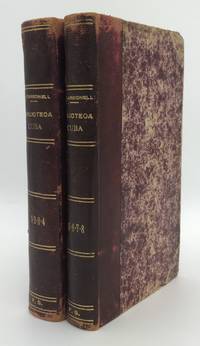
19161505Havana 1916. Good plus. Eight parts in two volumes. Original half calf and marbled boards spine gilt. Calf scuffed at spine ends; light wear to corners and edges; boards rubbed. Rear board with a dime-sized chip at lower fore-edge. Slightly later pencil ownership inscriptions to initial title pages of each volume. Small chip at fore-edge of first title page. Light tanning. The first eight issues of this scarce Cuban literary periodical which published twice monthly during 1916. The editor of the series Nestor Carbonell y Rivera grew up in the United States before returning to Cuba and obtaining his doctorate from the University of Havana; he was active in several prominent intellectual and literary society of Cuba and later served as ambassador to Argentina and Peru. Each issue of the periodical comprises one previously unpublished work by Cuban author including José Martà Manuel Sanguily and Máximo Gómez. We locate runs of the series at seven institutions as well as scattered holdings of individual issues. This set clearly bound by a contemporary Cuban subscriber one F. Gamboa. unknown books
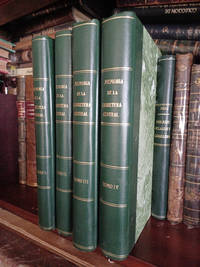
19302416<p>Memoria administrativa y descriptiva de las obras de la carretera nacional de cuba 4 vols primera edicion habana cuba 1930 nueva encuadernacion 4 tomos con algunas paginas restauradas y algo gastadas publicado por la Republica de cuba secretaria de obras publicas negociado de caminos y puentes bajo la administracion del honorable presidente de la republica de cuba general gerardo machado y morales siendo secretario de obras publicas el dr carlos miguel de cespedes.</p><p>La <strong>Carretera Central de Cuba</strong> es la principal vía de transporte automotor de la isla. Fue construida entre 1927 y 1931 bajo el gobierno del presidente Gerardo Machado. Con una longitud total de 1139 km en 1931 la carretera está dividida en dos ramas a partir de La Habana: una hacia oriente y otra a occidente. El kilómetro 0 se encuentra en el Capitolio de La Habana. En el momento de su construcción enlazaba las 6 capitales provinciales: >Pinar del Río La Habana Matanzas Santa Clara >Camagüey y Santiago de Cuba actualmente enlaza 14 de las 15 provincias del país con la sola excepción de Cienfuegos.</p><p><strong>Gerardo Machado y Morales</strong> Camajuaní Las Villas 28 de septiembre de 1869-Miami Beach Florida 29 de marzo de 1939 fue un militar y >político cubano que fungió como general a favor de su país en la guerra de independencia contra España y fue el quinto presidente de la >República de Cuba 1925-1933.</p><p>Machado ingresó a la presidencia con una amplia popularidad y apoyo de los principales partidos políticos. Cabe destacar que durante su administración se realizaron obras que perduran hasta el día de hoy: el Capitolio de La Habana y la Carretera Central. Aquellas obras públicas y otras "menores" caracterizaron su gestión dado que puso énfasis en la impulsión de ellas para absorber el desempleo que entonces azotaba a la isla tras el hundimiento de los precios del azúcar en 1921. Sin embargo su apoyo disminuyó con el tiempo puesto que reformó la Constitución de 1901 para perpetuarse en el poder. A medida que las protestas y rebeliones se volvían más estridentes debido al impacto del crac del 29 en Cuba su administración redujo la libertad de expresión y recrudeció la represión cosa que significó por parte de su mandato la lenta transición a una dictadura. Finalmente en 1933 fue obligado a dimitir a favor de un Gobierno provisional encabezado por Carlos Manuel de Céspedes y Quesada hijo de su homónimo padre a quien se considera padre de la patria y mediado por el embajador estadounidense Sumner Welles</p> secretaria de obras publicas hardcover
1836231491836. Diario Constitucional de Santiago de Cuba No. 57 November 1836 just months after the restoration of Spain's liberal Constitution of 1812. This newspaper records the transmission of Spanish constitutional government into eastern Cuba in late 1836 through decrees ministerial correspondence and public political dispute printed for circulation in Santiago de Cuba. Issued weeks after the political upheavals that restored constitutional rule in Spain this number shows how the language of the regency government the suppression and reorganization of state bodies and local declarations of loyalty to Isabel II reached colonial readers through the newspaper press. In a Cuban setting where metropolitan policy was filtered through governors ministries and municipal elites an issue such as this preserves the working connection between imperial administration and provincial print.<br /> <br /> Diario Constitucional de Santiago de Cuba. No. 57. Santiago de Cuba 27 November 1836. 4 pages. Folio newspaper issue. The masthead reads "DIARIO CONSTITUCIONAL / DE SANTIAGO DE CUBA" with the date line "DOMINGO 27 DE NOVIEMBRE DE 1836." Page 1 opens with "MINISTERIO DE LA GOBERNACION DEL REINO" followed by a circular and a substantial "EXPOSICION A LA REINA GOBERNADORA" leading into a "REAL DECRETO" concerning the suppression of the Consejo Real de España e Indias. Interior pages continue the decree and carry translatedly legible sections including "MISCELANEA" notices on "Las islas turcas libres" and "Noticias sobre Tejas" and a long exchange under "REMITIDOS" dated "Cuba 25 de Noviembre de 1836" addressing militia service volunteers of Isabel II and the political insult attributed to an earlier subscriber. The issue survives as a complete four page folio with dense double column text throughout and no wrappers as issued.<br /> <br /> Printed in Santiago the issue shows constitutional and monarchist language being adapted for a colonial audience that was expected to follow ministry decrees military loyalty and debates over public honor in the same sheet. Folded as issued with minor edge chipping small losses at corners and margins some toning and closed tears and pinholes; complete and legible. Overall good condition. The juxtaposition of metropolitan government text Caribbean and Atlantic news and the local controversy printed in "Remitidos" gives the number a documentary range broader than a routine official gazette placing state policy beside the contested language of provincial political life. unknown
1915224781915. Polk George Washington Jr. Havana and rural Cuba photo archive 1915 documents Cuba through the viewpoint of an American military traveler during the Platt Amendment era when U.S. power shaped Cuban sovereignty port security naval access and commercial movement. The photographs record ships in Havana Harbor coastal fortifications rural dwellings Cuban farmers agricultural landscapes and colonial plazas providing insight into how U.S. military personnel visually encountered Cuba just before American entry into World War I. The Platt Amendment gave the United States broad authority to intervene in Cuban affairs and required Cuba to lease land for naval stations remaining central to U.S.-Cuba relations until its repeal in 1934; this archive therefore places vernacular travel photography within a larger framework of military oversight and commercial access. <br /> <br /> Polk George Washington Jr. Havana Cuba vernacular photo collection. Havana Cuba: unpublished December 1915. Twenty-eight silver gelatin photographs pasted to album pages with some loose or partially detached ranging from approximately 2 x 2½ inches to 4½ x 3½ inches many with handwritten ink annotations dated December 22 to 29 1915. The images include vessels anchored in Havana Harbor harbor views from on board ship Morro Castle and other coastal fortification views colonial civic plazas local laborers and civilians thatched rural huts or bohíos sugarcane fields and agricultural scenes captioned "Orange Trees & Coconut Palms Near Havana." One photograph is captioned "Cuban Farmer & Son Near Havana Dec 22 1915" giving the archive direct documentary value for rural family life and American observation of Cuban agricultural communities. Other captions identify boats as "U.S.C. 5th Protectors off Havana" and refer to the United Fruit Company steamer Abangarez on the Havana-Colon route; the Abangarez was a United Fruit Company passenger and cargo vessel completed in 1909 and later brought under United States registry during World War I.<br /> <br /> The photographs combine military commercial and rural subjects in a compact record of U.S.-Cuban contact. Polk's annotations and the repeated Potchernick-Birdsong Co. Kodak Place San Antonio Texas stamps on versos indicate that the images were developed in the United States after the trip or sent home for processing preserving the path by which overseas military travel became a personal photographic record. Polk's later military service is supported by burial and veterans' records identifying George Washington Polk Jr. as born May 13 1889 died July 27 1976 and buried at Fort Rosecrans National Cemetery; the supplied description identifies him as later a Colonel in the U.S. Army Air Corps and instructor in the early U.S. Air Force. Most photographs lightly pasted along one edge to scrapbook leaves with some detached or partially affixed; a few corner creases otherwise sharp images with strong contrast good to very good overall. Focused 1915 Cuba archive linking Havana Harbor rural Cuban labor vernacular architecture United Fruit maritime movement and American military observation during the U.S. protectorate period. unknown