Sawkins, James Gay (1806 Southampton - 1878 London)Antiquariat.de

109 résultats
1850230131Um 1850. In der Platte bezeichnet. 27 x 39,8 cm (Darstellung) 39 x 49 cm (Papier).
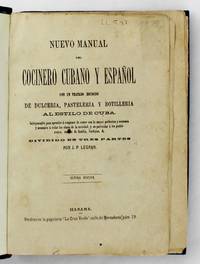
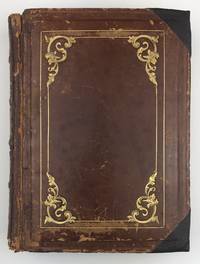
18806249Habana 1880. About very good. 199xxi3pp. Contemporary quarter red leather with modern marbled boards spine gilt. Light wear to binding. Minor soiling and wear to text. "Ultima edicion" originally published in 1857. This charming Cuban production is divided into three parts -- Sopas; Menestras Salsas Legumbres Frituras y Menudencias; and Pasteleria Reposteria y Dulceria. Each section has an index at the end of the text. The work includes local flavors such as Sopa Cubana; Ajiaco de Puerto-Principe; Lengua a la Criolla; Jigote Cubano; Pargo a la Americana; and more. We locate two copies of the 1857 edition of this work. Though we find a listing in OCLC there are no physical locations attached. unknown
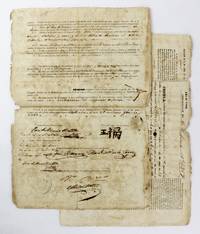
18636222Havana 1863. Good. Two partially printed broadsheets completed in manuscript 13 x 9 inches. Old folds wear at edges; some light worming slightly affecting text. Lightly soiled. A pair of documents recording the indenture of a Chinese national in Havana. The present documents contract the "Asiatico Francisco" as a cook to Don Jose Antonio Battle y Olle; the contract is dated June 28 1861 and is signed by "Francisco" in Chinese characters for a term of two years. At the end it is noted in manuscript that the Asiatico Francisco has completed the two years of his contract. The cedula is dated 1863 and indicates that Francisco is 33 years of age and now indentured for eight years as a "cocinero." An interesting pair of documents showing the continuing servitude of imported Chinese laborers particularly attractive for being signed in Chinese characters. unknown
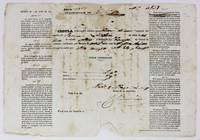
18574502Havana 1857. Good plus. Small broadside form approximately 8.5 x 12.5 inches. Previously folded with some separation and minor loss along vertical fold. Completed in manuscript with additional manuscript docketing on blank verso. Ink burn causing additional minor loss in a few small areas. Light edge wear; some staining and offsetting; light tanning. A 19-century Cuban identification form known as a cedula filled out in manuscript to authorize the travel of an Asian indentured servant between plantations in early May 1857. The document was completed for a twenty-six-year-old Asian fieldhand named Chan who had signed a contract to work for one Gallego Toriceo to be transferred to the premises of "P. Soler y Compañia." Printed at the left and right edges are nine articles from an 1855 decree that outline the regulations for issuing and keeping such documents including the following: <br /> <br /> "Estas cédulas servirán de documentos de seguridad y además de licencias de transito para los colonos que se trasladen de un punto á otro de la Isla. Los patronos respectivos cuidarán de que los colonos no emprendan el viage sin licencia expresa suya que haràn constar al pié de la cedula. Si algun colono fuere hallado sin cédula deberá ser detenido y puesto à disposicion del Gobernador ó Capitan del partido mas inmediato e cual dará conocimiento al patrono dentro de segundo dia."<br /> <br /> On the otherwise blank verso is additional contemporary manuscript docketing concerning the transfer of the cedula and therefore the laborer concerned to the receiver located in Matanzas. A very interesting document of the bureaucracy and control of indentured servitude in Cuba during the mid-19th century. unknown
18841574Habana 1884. Good plus. 2496 i.e. 498pp. Quarto. Contemporary calf gilt a.e.g.; rebacked with original spine laid down. Corners repaired with later black buckram; boards scuffed spine chipped. Hinges cracked repaired with later cloth and renewed endpapers. Minor scattered foxing and toning to text. Accomplished in a neat highly legible hand. A very attractive manuscript translation into Spanish of Pierre Larousse's well-known work on eminent and historical personages Fleurs Historiques des Dames et des Gens du Monde in a contemporary Cuban gilt goatskin binding. The manuscript connects three figures in the upper social echelons of Cuban society. José Fernandez Pellon the scribe of this volume is recorded as the Grand Master of Cuba's freemasons lodge the Gran Logia Unida de Colón y la Isla de Cuba. The translator Aurelio Almeida helped to found the organization in 1875 and at this time served as the Lodge Secretary. The initials E.D. gilt at the foot of the spine and the dedicatory inscription "A Eugenia Desvernine" refer to Eugenia Desvernine y Galdós b. 1865 daughter of the famous Cuban pianist Pablo Desvernine and Carolina Galdós y Echániz. She was also the niece of Benito Pérez Galdós the Spanish realist novelist who some authorities consider only second in stature to Cervantes. A contemporary social register remarks that Eugenia was one of the most beautiful women in Cuba perhaps an inspiration for the painstaking production of this manuscript.<br /> <br /> The original work by Larousse was a loose collection of religious parables classical myths biographies of ancient and modern historical figures. The title of the manuscript advises that is an extract and in the brief introduction Almeida explains his selection process writing that "He suprimido algunos artículos sobre cosas muy sabidas de la historia sagrada; y otros sobre la de Francia que mencionan frases ó personas casi ninca citadas ó citades solamente por las escritores francesas." He also notes several alterations and additions more relevant to Spanish history saying "En Cambio he agregado algunos artículos sobre historia de España que no están en el original y he tomado unos pocos de otra obra del mismo Mr. Larousse y de libros diversos." The result is an original amalgam of biographies historical episodes and religious parables. Interestingly we find no recorded printed editions of Larousse's work in Spanish so that the present manuscript is also an entirely original work of translation. A fascinating product of the cultural interests and mores of Cuban high society near the end of the Spanish colonial period. unknown
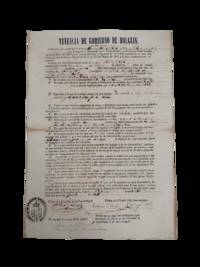
1868231331868. Cuba Chinese Labor Cuban indentured servant contract documenting the state administration of Chinese indenture in eastern Cuba in January 1868 with direct evidence of how colonial authorities private employers and local officials formalized the re-contracting of Chinese laborers under the legal framework established after the 1860 royal decree regulating Asian colonos on the island. Printed references within the form cite the Reglamento aprobado por Real decreto de 6 de Junio de 1860 and the Circular del Gobierno Superior Civil de 27 de Marzo de 1861 placing the document squarely within the coercive labor regime that Spanish Cuba built after the suppression of the transatlantic slave trade. The named employer Antonio Gonzalez the identification of the worker as a 37 year old Chinese male "Yuet" and the required signatures and government seal make the sheet a concise administrative record of the contract system through which Cuban planters and officials bound Chinese workers to plantation and rural labor in the final decade before the Ten Years' War.<br /> Tenencia de Gobierno de Holguín. January 1868. One page printed and manuscript contract form approximately 8" x 11". Printed in Spanish with extensive manuscript completion in brown ink. The form opens "Contrata que celebran el colono." and records a renewed labor agreement between a Chinese colono identified in the contract and Don Antonio Gonzalez with manuscript entries identifying the laborer as 37 years of age and supplying the individualized terms of service. The printed clauses set out the structure of the contract in eleven numbered articles including the term of service compulsory labor under the employer's orders days and hours of work subjection to discipline under the Reglamento monthly salary of 14 escudos food and clothing provisions medical attendance and hospital care treatment during illness and the requirement at the end of the contract either to renew service or enter the depósito de cimarrones. The sheet is signed by the patron the colono and the Teniente Gobernador and bears the circular official stamp of the Tenencia de Gobierno at lower left with additional show-through and seal impression visible on the verso.<br /> By 1868 Chinese indenture in Cuba had become one of the island's central labor systems supplying workers to a plantation economy still structured by slavery while giving colonial officials a paper mechanism for disciplining reallocating and surveilling labor. Forms such as this show the overlap between private contracting and state enforcement: the worker's obligations are written into a government template disputes are reserved to local authority and illness wages food clothing and renewal are all treated as administrative matters within a coercive labor order. Very good condition with horizontal fold light toning minor scattered staining and foxing and strong printed text manuscript entries seal and signatures. A compact Holguín government document showing the bureaucratic machinery of Chinese indenture in late colonial Cuba. unknown
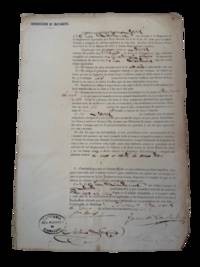
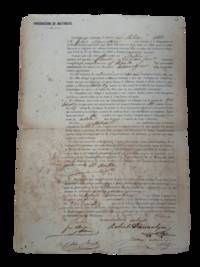
1867231471867. Cuba Chinese Labor Cuban indentured servant contract documenting the state administration of Chinese indenture in western Cuba February 1867 records the municipal enforcement of Cuban contract labor rules for Asian migrants under the post 1860 regulatory system that governed wages discipline illness food and flight. Issued on a printed form headed "Jurisdiccion de Matanzas" the document cites the Real Decreto of 6 July 1860 and the circular of 27 March 1861 governing the "introduccion y régimen de colonos asiáticos" then applies that framework to a specific recontracting arrangement between the laborer David and a patron named Juan. Dated 17 February 1867 it shows the continued operation of this municipal contract system after the additional order of 28 March 1866 which is also cited in clause 6 governing illness and compensation.<br /> David and Juan. 17 February 1867. Single sheet. 1 page. Approximately 8" x 11". Printed and manuscript Spanish contract on a form headed "Jurisdiccion de Matanzas." The parties are entered as the colono "David" and "Juan ." with David identified as a native of a town in Asia of "oficio campo" and described as having completed a prior commitment before agreeing to contract anew. Clause 1 fixes the term at "dos años." Clause 2 authorizes the patron to direct him to whatever labor he may assign in ingenios fincas or talleres with work entered with how many hours a day. Clause 4 sets compensation together with daily maintenance including meat and vegetable rations medical assistance and medicines during illness and annual clothing allotments including trousers shirt and blanket. Clause 8 repeats the employer's obligation to pay David punctually by completed months and to fulfill all conditions set out in the contract which bears multiple signatures and an oval district stamp at lower left.<br /> Contracts of this kind show the process by which Chinese workers in Cuba were transferred from one term of service into another through standardized paperwork that joined wages to labor discipline rationing medical provision and restricted mobility. The references to the 1860 decree the 1861 circular and the 1866 order place the sheet within the evolving legal structure that governed Chinese indenture in Matanzas one of the island's major plantation districts. Toning original folds edge wear scattered creasing and light ink offsetting; text clear and overall very good condition. A strong surviving municipal record of recontracting Chinese labor in the sugar zone of nineteenth century Matanzas. unknown
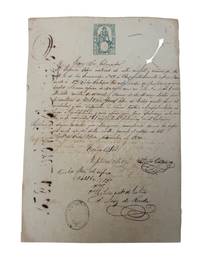
1870231221870. Slavery Cuba Spanish colonial slave sale manuscript recording the transfer of four enslaved individuals in Cuba in 1870. Produced within the official bureaucratic framework of Spanish colonial governance the document reflects the legal normalization of slavery in Cuba even as abolitionist pressures mounted across the Atlantic world. The document records the sale of four enslaved people described as "criollos" and African-born individuals situating the transaction within a labor system that combined locally born and imported enslaved populations. Created at a time when Spain had formally restricted the transatlantic slave trade but continued to permit slavery itself the manuscript demonstrates the persistence of legalized human commodification and the integration of enslaved labor into the island's economic structure sixteen years prior to abolition in 1886.<br /> <br /> Official Cuban slave contract documenting the sale of four enslaved individuals to Don Pedro Catasús by Don Enfemia Ochoa for the sum of 1100 pesos on November 29 1870. Single manuscript leaf written in Spanish cursive in black ink measuring 8.25" x 12". A green "50 cs de escudo" revenue stamp is affixed at the top center with a blind embossed Spanish crest at the upper left and a circular black ink government seal impressed at the lower left. Large vertical docketing appears on the verso. A stylized watermark is visible within the paper. The text organizes the enslaved individuals within a standardized transactional structure while the signatures of Enfemia Ochoa Pedro Catasús and A. Díaz de Rada authenticate the exchange and identify participants within the slaveholding economy.<br /> <br /> By 1870 Cuba remained a central node in the late Atlantic slave system with plantation agriculture especially sugar dependent on enslaved labor despite mounting abolitionist pressure. Although Spain had curtailed official slave imports earlier in the century illegal trafficking persisted into the 1860s and other coerced labor systems including the importation of Chinese indentured workers overlapped with slavery into the 1870s. The presence of both Creole and African individuals in this document reflects the layered composition of the enslaved population during this period. Light toning scattered foxing and edge wear visible. A closed wormhole extends from the upper right margin approximately five inches into the sheet resulting in partial loss of text. Evidence of prior tape reinforcement visible on the verso along with offsetting from previously adjacent material. Overall in very good condition. This document provides named transactional evidence of late-period slavery in Cuba offering concrete material for examining race labor and legal practice within Spanish colonial society. unknown
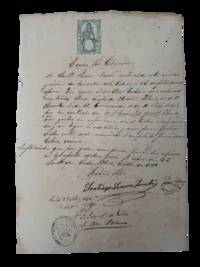
1870231191870. Slavery Cuba Spanish colonial manuscript documenting the late persistence of slavery in Cuba recording the sale of five enslaved Creole individuals including women and children 1870. Produced within the official bureaucratic framework of Spanish colonial governance the document reflects the legal normalization of slavery in Cuba even as abolitionist pressures mounted across the Atlantic world. The presence of multiple children within the transaction underscores the hereditary nature of enslavement and the commodification of family units offering direct material evidence of how slavery functioned socially and economically in its final decades on the island. Although Spain had formally ended the transatlantic slave trade earlier in the century illegal trafficking and internal slave markets persisted and slavery itself would not be abolished in Cuba until 1886 placing this document within a crucial transitional period marked by reform debates gradual emancipation laws and continued exploitation.<br /> <br /> Official Cuban slave contract recording the sale of five enslaved individuals identified as "criollos" including one adult woman and four children from Santiago Simón Fambi to Don Pedro Catasús for the sum of 1200 pesos on November 21 1870. Single page manuscript leaf measuring 8.25" x 12". The manuscript is written in Spanish cursive hand in black ink. The upper left bears a blind embossed crest of Spain while a circular black ink government seal is impressed at the lower left partially overlapping the text. The text enumerates the enslaved individuals with ages and names embedding human lives within the formulaic language of sale and valuation while the bold signatures of both seller Santiago Simón Fambi and buyer Pedro Catasús anchor the transaction in identifiable actors within the colonial economy.<br /> <br /> By 1870 slavery in Spanish Cuba remained central to the island's plantation economy particularly in sugar production which had expanded rapidly in the mid-19th century with industrialized mills and global demand. Enslaved people were primarily forced into agricultural labor under highly regimented and brutal conditions though others were used in urban domestic service skilled trades or as hired laborers generating income for their owners. This document exhibits light toning edge wear and scattered foxing throughout. A closed wormhole extends approximately two inches from the upper right margin inward not affecting legibility of the text. Minor losses and small tears along the edges. Overall in very good condition. Given that this document records a woman and four children the family was likely intended for a combination of field labor and domestic or auxiliary work with the children gradually incorporated into plantation labor as they aged reflecting the system's reliance on both immediate exploitation and the reproduction of enslaved labor over time. unknown
1870231451870. Cuba Chinese Labor Cuban indentured servant contract documenting the state administration of Chinese indenture in western Cuba July 1870 records the municipal enforcement of Cuban contract labor rules for Asian migrants under the post 1860 regulatory system that governed wages discipline illness food and flight. The form cites the Real Decreto of 6 July 1860 and the circular of 27 March 1861 governing the "introduccion y régimen de colonos asiáticos" placing the document within the mature legal framework used to renew and regulate Chinese labor contracts in colonial Cuba. Dated 5 July 1870 it records the continued operation of that system in Matanzas a decade after the initial decree when recontracting rationing medical provision and labor discipline had become standardized through municipal enforcement.<br /> Melchor and Roberto . 5 July 1870. Single sheet. 1 page. Approximately 8" x 11". Printed and manuscript Spanish contract on a form headed "Jurisdiccion de Matanzas." The parties are entered as the colono "Melchor" and "Roberto ." with Melchor identified as a native of a town in China and described as having completed an earlier commitment before agreeing to contract anew with Roberto for "un año." Clause 2 authorizes the patron to assign him to whatever labor his "citado patrono" requires whether in ingenios other fincas or talleres and the wage clause sets compensation at "20 escudos." The maintenance provisions specify daily rations including "12 onzas de carne" and "2 libras de plátanos boniatos ú otras sustancias alimenticias" together with medical attendance medicines during illness and two annual changes of clothing including trousers shirt and blanket. The text concludes with the employer's obligation to pay the twenty-escudo salary by completed months signatures of the parties and witnesses and an official Matanzas stamp.<br /> Contracts of this kind show the process by which Chinese labor in Cuba was renewed after a prior term and folded back into a system that combined wages with coercive control over movement occupation food clothing and bodily maintenance. The references to multiple governing orders the official jurisdictional heading and the stamped validation place the document inside the administrative chain that translated colonial labor law into enforceable local practice. Toning and scattered foxing throughout minor tears to original folds edge wear some minor wormholes and ink offsetting from the manuscript entries; text remains legible and document is in overall very good condition. A strong surviving municipal record of recontracting rationing and wage enforcement within the Chinese indenture system in Matanzas. unknown
18560006868New York: D. Appleton 1856. First edition. Hardcover. fine. 12mo xii 412 pages original light brown embossed cloth. <br/><br/>These observations are related in a series of 61 letters. These were originally composed in Spanish then translated into English by Joseito. "I have thereby been enabled to impart entirely new data and reliable information instead of merely copying from books already known. . I applied myself to natives who besides an intimate knowledge of affairs in general possessed a sound judgment and an investigating disposition. It has beeen indeed a very happy incident to have found them. . That part of my work which treats on judicial matters and the secrets of the management of the tribunals will especially attract the attention of my readers. - Introductory Letter." Sabin 17816; Treiles BIBLIO. CUBANA vo. 4 p.17. D. Appleton hardcover
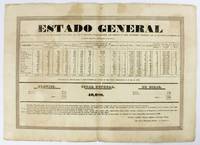
18385957Sancti Spiritus 1838. Good plus. Broadside measuring 12.5 x 17.5 inches. Previously folded. Light wear to edges and along old fold lines with a few small chips at edges. Moderate toning and soiling. An unrecorded broadside that prints statistics relating to agricultural production for the region of Sancti Spiritus in central Cuba during the late 1830s. For each municipality the broadside prints the number of property owners; ranches; land-grant farms; slaves; white employees; animals including mules donkeys cows and sheep; distances to transport and shipping hubs; and several other figures. In the bottom third of the broadside are printed the census figures from 1836 with the population totaling just over 40000 people and split into Black and white groups. Rather pointedly the figures for the white population are divided by gender while the figures for the Black population are divided by status free or slave. A very interesting statistical snapshot of a smaller rural region in colonial Cuba in 1838. Not in OCLC. unknown
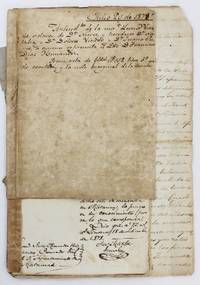
18784011Various places in Cuba 1878. Overall good. 29 leaves varying sizes. In contemporary ad hoc selfwrappers loosely stitched. Rear wrap tattered. Varying degrees of toning and wear. Scattered offsetting throughout. Fascinating gathering of documents and letters that present several cases of Cuban slaves applying for their own freedom in 1878. The gradual abolition of slavery on the island was enacted by Spain in 1880 but prior to this there were several bureaucratic mechanisms by which enslaved people could apply for or purchase their own manumission. The most interesting case amongst the present manuscript documents is the claim of a male slave that states he was born free in Puerto Rico but was somehow included in an inheritance as a young boy transported to Cuba and sold into slavery:<br /> <br /> "Un individuo que hoy se encuentran en la Cárcel del Alacranes y que dice nombrase Juhan ó José Julian Quintana y ser esclavo actualmente de Dn. Serapio Hernandez dueño de los ingenios Escorial ubicado en Colon y Sta. Rosa en Limonar y vecino de esa Ciudad calle del Rio ha solicitado se le restituyan un derechos de libertad por haber nacídolibre en Puerto Rico de donde á la edad de 5 ó 6 años le trajeron à esta Ysla y vencieron como esclavo."<br /> <br /> Interesting for the study of manumission in late-colonial Cuba and certainly worthy of further research. unknown
18095958Havana 1809. Good. 1p. on a bifolium. Printed form completed in manuscript. Previously folded. Small portion of upper left corner torn away and some scattered worming neither affecting text. Upper right of blank conjugate leaf clipped. Some scattered staining and offsetting with even tanning. An early 19th-century bill of sale for four slaves in Havana. The form completed in manuscript approves the sale by Doña Dolores Hernandez of "quatros negros" who had been brought from the coast of Africa on the slave ship Juno captained by Jabez Gibbs 1360 reales. It further states that the enslaved men are "Con la calidad de bozal alma en boca huesos en costal à uso de férias sin asegurar de tachas ni enfermedades mal de corazon gota coral de S. Lazaro ni orta qualesquiera que puede paceder la humana naturaleza porque toas corren por cuenta del comprador." The document is signed by the relevant authorities and dated March 26 1809. A good document of the slave trade in Cuba during the early 1800s. unknown
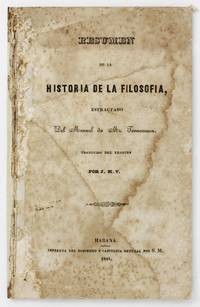
18455307Havana: Imprenta del Gobierno y Capitania General por S.M. 1845. Good. 684pp. Disbound. Some insect damage to gutter of title page ample staining throughout mostly minor foxing. A very rare mid-19th century Cuban imprint translating into Spanish a work by German philosophical historian Wilhelm Gottlieb Tennemann entitled Manual of the History of Philosophy. Tennemann originally published the work in 1812 as a much-abridged history of philosophy after authoring a massive multi-volume work on the subject. According to the translator's note at the beginning of the text the present work was produced in order to provide a text in Spanish for those studying the history of philosophy "at the Royal Academy and in the private schools of the island of Puerto Rico." The translator also notes that the history of philosophy is "one of the subjects.of the general plan of education that must be taught." The work itself is organized as a series of lectures detailing the history of philosophy chronologically from ancient Eastern and Egyptian times through the Greeks Pythagoras Socrates Plato Aristotle and many others concluding with modern thinkers such as Descartes Espinosa Hume Kant Hegel and others. The work ends with an Index and an Errata page.<br /> <br /> "Wilhelm Gottlieb Tennemann 1761–1819 German historian of philosophy was born at Erfurt. Educated at his native town he became lecturer on the history of philosophy at Jena in 1788. Ten years later he became professor at the same university where he remained till 1804. His great work is an eleven-volume history of philosophy which he began at Jena and finished at Marburg where he was professor of philosophy from 1804 till his death. He was one of the numerous German philosophers who accepted the Kantian theory as a revelation. In 1812 he published a shorter history of philosophy which was translated into English in 1852 under the title Manual of the History of Philosophy" - Encyclopedia Britannica. No copies located in the United States. Three copies found in OCLC -- two in Chile and one in Spain. Imprenta del Gobierno y Capitania General por S.M. unknown