CAMIN, Alfonso.MareMagnum

2 507 résultats
20x15. 234p.
Madrid, 1991. 4to.; XXXVI pp., 356 pp. y diez reproducciones fotográficas en láminas aparte. Cubiertas originales.
brossura Punto di svolta della Guerra fredda nonché dell'era nucleare tuttora aperta, la crisi di Cuba è uno degli eventi più studiati dalla storiografia internazionale. Questo libro - il primo italiano sul tema da vent'anni a questa parte - non si limita ad aggiungere particolari a una produzione ampia e variegata, ma attua un ribaltamento di prospettiva, ricostruendo non solo gli eventi, ma anche le sue percezioni internazionali. Il "braccio di ferro" atomico verificatosi nell'ottobre 1962 fu infatti uno shock globale, capace di suscitare reazioni nei contesti più diversi: presso governi, opinioni pubbliche, media, intellettuali, politologi, artisti, scienziati, religiosi. E si tratta di reazioni rivelatrici, come mostrano qui i casi di USA e Italia. Muovendo da una reinterpretazione di Braudel e McLuhan e poggiando su una vasta documentazione inedita reperita in sette anni di ricerche (tra archivi di vari Stati e un'analisi certosina della stampa internazionale di quei giorni), il libro da un lato mostra il carattere della crisi come esperienza globale, dall'altro comincia a indagarne la dimensione socio-culturale, finora trascurata, ma destinata a diventare la prossima frontiera della storiografia su quest'evento.
52228Paris Librairie Arthème Fayard 1960 in 8 (19,5x14,5) 1 volume broché, couverture illustrée, 202 pages [2], avec des illustrations hors texte en noir et blanc. Achevé d'imprimer à la date du 8 janvier 1960. Bel exemplaire ( Photographies sur demande / We can send pictures of this book on simple request )
Mm 170x240 Brossura editoriale di pp. 216. Opera in ottime condizioni. SPEDIZIONE IN 24 ORE DALLA CONFERMA DELL'ORDINE. WORLDWIDE DELIVERY.
Cinque vedute in unico foglio: 1. Trasporto di feriti della Banda Maceo all’ospedale di Cuzco - 2. Josè Antonio Maceo, capo degl’insorti - 3. Isolani che si congiungono agl’insorti dopo essere stati catturati da questi - 4. Maximo Gomez, capo degl’insorti - 5. Posto d’insorti a Santa Clara. Testo al retro
Quattro vedute in unico foglio: 1. Insorti della Banda di Josè Maceo - 2. Cappellano, Portabandiera e ufficiale subalterno spagnuolo - 3. Insorti, che impadronitisi dei treni, sparano contro gli Spagnuoli - 4. Sezione d’artiglieria d’una colonna spagnuola. Testo al retro
QWA-8226La Havane, Si-Mar S.A., 2000, in-8 br., 298 p., 2ème édition (5ème tirage), illustrations in-t., un portrait de José Marti en front., bon état.
pp. xiii, 112. 8vo. Original full cloth binding. Original dust jacket. Ninth volume in the Brown and Haley Lecture Series. Coldwar/Economics 8
0366228641.Ghardcover. Good. Access codes and supplements are not guaranteed with used items. May be an ex-library book. hardcover
0365944262.Gpaperback. Good. Access codes and supplements are not guaranteed with used items. May be an ex-library book. paperback
19855111Wuppertal, Peter Hammer Verlag, 1985. 8°, 386 S., Hammer TB 33 Bräunung des OS, sonst gutes Ex kartoniert/ Taschenbuch
1968MEXIQUE22220815Paris, Calmann-Lévy, "Temps & continents", 1968, 14 x 21, 268 pages cousues sous couverture illustrée. Présentation de jean-Pierre Berthe. Traduit de l'italien.
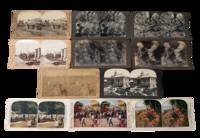
1890231711890. Stereoview archive of the post-emancipation Caribbean showing how the islands were marketed to western viewers through plantation labor export agriculture civic spectacle and catastrophe. As a group these photos function not only as an ethnographic travel archive but as evidence of the visual economy that followed slavery. The British West Indies moved through emancipation in 1834 to 1838 the French Caribbean in 1848 Puerto Rico in 1873 and Cuba in 1886 yet plantation production remained central to regional life well into the early twentieth century. These stereoviews preserve a colonial way of seeing in which Black and Afro-Caribbean labor rural discipline and extractive agriculture remained the background condition of "tropical" beauty and commercial modernity. Cuba's sugar economy in particular expanded through the nineteenth century and slavery was not abolished there until 1886 while Weyler's later reconcentration policy during the Cuban War of Independence violently reorganized rural life. Martinique after 1848 likewise shifted into new labor regimes including imported workers from India and China.<br /> <br /> Archive of 11 stereoview cards late 1890s to early 1900s depicting Cuba Jamaica Martinique Puerto Rico and the Dominican Republic. Most black and white with a few colorized. Each measure 3.5" x 7". All with captions on the margins. "Reconcentrado Farming Scene Province of Havana Cuba" links agricultural production to the brutal displacements of Spain's reconcentration campaign; "Cutting sugar cane Montego Bay Jamaica W.I." records cane labor in a colony where emancipation had not ended plantation dependency; and "Harvesting Coconuts Porto Rico" likewise frames Caribbean land through export work rather than local life. Other views extend that economic framing through cacao and coffee scenes while the paired Havana cards shift into urban leisure and public display including "Beautiful Central Park Havana Cuba" and "Holiday in Havana Cuba" the latter with both Cuban and American flags visible a telling image of the new imperial order after 1898. The disaster views from Martinique and the Lesser Antilles show how stereoview publishers also turned Caribbean destruction into consumable spectacle. the Morne Rouge card is accompanied on the reverse by the grim printed text "Dead bodies which were to be seen in Morne Rouge." while the wider context is the 1902 eruptions of Mount Pelée in Martinique and La Soufrière on Saint Vincent two catastrophes that killed roughly 30000 and 1600 people respectively and devastated local communities and agriculture.<br /> <br /> Some corner wear light toning scattered surface and edge wear. Overall very good condition. This collection gives direct visual representation of Caribbean history Atlantic slavery and emancipation plantation labor and U.S. imperial expansion in the circum-Caribbean preserving the transition from slavery to post-abolition labor. unknown
1992HI315713,8 cm X 21,1 cm, 73 pp, couverture souple. Agrafé.
1979HIS3102C1661979, Madrid, Editorial playor, 21x14, 244 paginas, tapa rustica impresa a 2 tintas, 400 gramos. 244pp. Broché à deux encres, 400g.
Primera edición.
71682P., Gallimard, NRF, 1983, in 12 broché, 203 pages.
71683P., Gallimard, NRF, 1980, in 8° broché, 537 pages.
71681P., Gallimard, NRF, 1979, in 8° broché, 205 pages.
71680P., Gallimard, NRF, 1975, in 8° broché, 353 pages.
16600Collection " Arcades " / Gallimard (2003) - In-12 broché de 366 pages - Traduit de l'espagnol (Cuba) par Serge Mestre - Préface de Carmen Vasquez - Exemplaire en excellent état
trad. di Linda Verna n. 1156 in 16°, bross. edit. ill. con bandelle
Gallimard, Du monde entier, 2004, 784 pp., broché, légères traces d'usage, état correct.