22 résultats
182016495Washington: Gales & Seaton 1820. 8pp folding charts. Disbound. Untrimmed worn edges. Foxed. Good. Gales & Seaton unknown books
1826WRCAM24134Washington 1826. 106pp. Dbd. Scattered foxing. Else quite good. An interesting collection of laws governing British colonial trade in the West Indies including tables of duties on various Caribbean products. AMERICAN IMPRINTS 27406. unknown books
19721018San Francisco: John Howell--Books 1972. First English Language Edition. Hardcover. Near fine/near fine. A near fine first English translation in a near fine dustjacket. Blue cloth boards with bright gilt title stamping on cover and spine. Sunning to endpaper edges otherwise fine. Orange endpapers. Rear pocket map present and pristine. Jacket showing a bit of dust stains otherwise fine. Illustrations in black and white with some in color. xviii 148 pp. Quarto 9 x 12 1/2 inches tall. O'Crouley's description of New Spain in the eighteenth century is a valuable contribution to scholarship mostly unknown until the late twentieth century when it was published. The original manuscript comprises 202 leaves bound in red leather in the Biblioteca Nacional de Madrid Ms. 972.02. It was published in English in 1972 as A Description of the Kingdom of New Spain by Sr. Dn. Pedro Alonso O'Crouley 1774.Once published it was widely reviewed in the scholarly literature. In 1975 it was published in a facsimile edition. For the English edition the translator Galvin rearranged some of the text to produce a more readable work. One scholar criticized this saying "This is a disservice to the text since part of its overall significance as an 'enlightened' compendium resides precisely in its structure as a miscellany." -- Wikipedia The volume is richly illustrated. He drew native plants and flowers cacao vanilla avocado sapote mamey passion flower and pricky pear cactus as well as animals not known in Europe. What has gained most attention are his depictions of race mixture castas which have been published in works on that topic. O'Crouley provides written text for the illustrations which were likely copies of existing casta groupings. He devotes an entire section of text to the condition of the Indians lamenting their current state. Unlike many casta paintings that show scenes of imagined everyday life of the racial types O'Crouley's lack any further context.11 He wrote short descriptions of New Spain's principal cities the capital Mexico City the second largest city Puebla; Valladolid now Morelia; Oaxaca; Guadalajara; Durango; Acapulco; and Veracruz. He travelled north to presidios of Los Adáes in Texas; El Paso del Norte; and the province of Nayarit. His description of New Mexico is considerably longer than the places coming before it. Also lengthy is the chapter on his voyage up the Gulf of California; his description of California itself; and an expedition to Nueva Andalucía Sinaloa and Sonora. John Howell--Books hardcover books
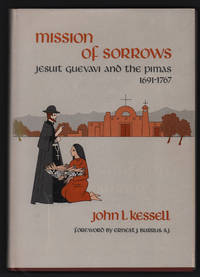
1970689Tucson AZ: University of Arizona Press 1970. First Edition. Hardcover. Near fine/fine. A near fine first edition in a fine unclipped dust jacket. Brown cloth boards front top corner bumped. Gilt title stamping. Mission map end papers. From the private library of Larry Southwick collector's marginalia pencilled at inner edge of half title. xvi 224 pp. including index. Quarto 7 1/4 x 10 1/2 inches tall. The Mission of Guevavi on the Santa Cruz River in what is now southern Arizona served as a focal point of Jesuit missionary endeavor among the Pima Indians on New Spain's far northwestern frontier. For three-quarters of a century from the first visit by the renowned Eusebio Francisco Kino in 1691 until the Jesuit Expulsion in 1767 the difficult process of replacing one culture with anotherthe heart of the Spanish mission systemwent on at Guevavi. Yet all but the initial years presided over by Father Kino have been forgotten. Drawing upon archival materials in Mexico Spain and the United Statesincluding accounts by the missionaries themselves and the surviving pages of the Guevavi record booksKessell brings to life those forgotten years and forgotten men who struggled to transform a native ranchería into an ordered mission community. Of the eleven Black Robes who resided at Guevavi between 1701 and 1767 only a few are well known to history. Otherssuch as Joseph Garrucho who presided more years at Guevavi than any other Padre; Alexandro Rapicani son of a favorite of Sweden's Queen Christina; Custodio Zimeno Guevavi's last Jesuithave the details of their roles filled in here for the first time. In this in-depth study of a single missionary center Kessell describes in detail the daily round of the Padres in their activities as missionaries educators governors and intercessors among the often-indifferent and occasionally hostile Pimas. He discusses the Pima uprising of 1751 and the events that led up to it concluding that it actually continued sporadically for some ten years. The growing ferocity of the Apache the disastrous results of certain government policiesespecially the removal of the Sobaípuri Indians from the San Pedro Valleyand the declining native population due to a combination of enforced culture change and epidemics of European diseases are also carefully explored. The story of Guevavi is one of continuing adversity and triumph. It is the story finally of expulsion for the Jesuits and a few short years later the end of Mission Guevavi at the hands of the Apaches. In Mission of Sorrows Kessell has projected meticulous research into a highly readable narrative to produce an important contribution to the history of the Spanish Borderlands." -- From the Publisher University of Arizona Press hardcover books
1727WRCAM20832London: Printed by Sam. Buckley 1727. 48pp. Title vignette. Later plain stiff paper wrappers. Very good. This work includes many references to Spanish plundering of ships in the West Indies specifically involving Admiral Hosier's squadron. Prints the text of letters between the Marquis de la Paz to the Marquis de Pozobueno and the Duke of Newcastle as well as other diplomatic communications regarding naval actions involving especially Spain and England. EUROPEAN AMERICANA 727/146. SABIN 40576. Printed by Sam. Buckley unknown books
1928654Los Angeles: Wetzel Publishing Co. 1928. First English Language Edition. Hardcover. Very good. First English translation of Historia de los descubriementos antiguos de la Nueva Espa a. HOWES O 351 a. Blue cloth boards gilt title stamping on spine is crisp and bright. Corners lightly rubbed. Front hinge starting but text block sound and square. Errata tipped in. From the private library of Larry Southwick collector's marginalia pencilled near front hinge. Very good folding map has offset onto TOC and has a fine crease along part of the edge of map. No DJ. Frontis. xxxvi 351 pp. including index. Octavo 6 x 9 inches tall textblock. Baltasar Obregón born 1534 was a 16th-century Spanish explorer and historian. He is most notable for publishing the Historia de los descubrimientos de Nueva Espana an account of his travels in the New World. Obregón was born the son of an encomendera in the Spanish colony of New Spain. At the age of 19 Obregón joined up with a Spanish expedition to California from which he returned with travel experience. In 1554 at the age of 20 he joined the expedition of Francisco de Ibarra to explore the frontiers of Spanish territory and to secure mineral resources. The expedition was a success founding several settlements and allowing the Spanish to colonize Zacatecas. Later in life Obregón published an account of his travels the Historia de los descubrimientos de Nueva Espana in which he described the landscape of northern Mexico. After cataloging his own life he continued to publish the accounts of other Spanish expeditions such as that of Antonio de Espejo --- wikipedia Wetzel Publishing Co. hardcover books
1820WRCAM31346Paris 1820. 7pp. Quarto. Self-wrappers. Light dust soiling. Very good. The text of a new French law relating to the import and export of goods from Martinique Guadeloupe Saint Lucie and Tobago. Rare. Not on OCLC. unknown books
1791WRCAM31348Grenoble: M. Cuchet 1791. 10pp. Quarto. Modern marbled boards red gilt morocco label. Internally clean. Very good. A French law relating to the armaments permitted on merchant vessels trading with French possessions in the West Indies. Rare. Not on OCLC. M. Cuchet hardcover books
250556New York: Carlton & Lanahan nd. Reminiscences of the West India Islands Second Series.-No. II. Frontis. 159 pp. 12mo. Contemp cloth. Very Good. Reminiscences of the West India Islands Second Series.-No. II. Frontis. 159 pp. 12mo. Carlton & Lanahan unknown books
1937203Baltimore: The Maya Society 1937. Second Edition. Hardcover. Very good. Friar Diego De Landa. A good edition HAND D83 with solid sturdy binding and cover. Original blue cloth boards with gilt stamping and Maya Society crest in gilt. The blue cloth is showing heavy spotting on the spine and front cover and the top front corner is bumped. Pages toned top edge darkened. Former owner's bookplate. From the private library of Larry Southwick. Laid in with a staplebound pamphlet for "Publications in the Field of Archaeology Anthropology etc. issued by the Carnegie Institute of Washington. May 1937." Heavily illustrated includes maps and related documents. 142 pp. Octavo 6 x 10 inches tall. An important primary source scarce in this edition "Modern scholars regard Landa with a mixture of frustration and admiration. At the same time he wrote his comprehensive work on Mayan culture his orders to destroy all icons and hieroglyphics obliterated the Mayan language . helping to undermine and destroy the civilization he so vividly described. Yet his book which was not printed until 1864 provided a phonetic alphabet that made it possible to decipher about one-third of the Mayan hieroglyphs and many of the remainder have since been deciphered." - Britannica The Maya Society hardcover books
1786WRCAM34282Stockholm: Tryckeriet 1786. 4pp. Vignette on titlepage. Self-wrappers. Bright and clean. Near fine untrimmed. "Because of meager resources of the island of St. Barthelemy in the West Indies efforts should be made to discourage Swedes from settling there" - Bell. Signed in type by Gustavus III. Rare. OCLC locates only one copy at the University of Minnesota. BELL S994. OCLC 29084888. Tryckeriet unknown books
182521618London 1825. Folio. 310pp. Bound in modern blue wrappers with copy of title on front wrapper. Fine. <br/><br/> A wonderfully detailed report on the structure of the legal system in these colonies with explanations of the courts forms of action and remedies crimes punishments police forces slave codes manumission reform measures fees tables of cases tables with names and races of parties to legal proceedings. <br/>OCLC records eight locations under several accession numbers as of September 2018. unknown books
1791WRCAM34281Stockholm: Tryckeriet 1791. 7pp. Self-wrappers. Minute toning to edges. Contemporary library markings in lower margin and upper outer corner of titlepage. Bright and clean. Near fine. Untrimmed. Recent trade laws concerning the Swedish colony on St. Barthelemy. Signed in type by Gustavus III. Rare. OCLC locates only one copy at the University of Minnesota. BELL S998. OCLC 29100654. Tryckeriet unknown books
1786WRCAM34280Stockholm: Tryckeriet 1786. 8pp. Self-wrappers. Contemporary manuscript page numbers in upper outer corners. Bright and clean. Near fine. Untrimmed. "Nine provisions concerning the government and commerce of the Swedish colony on St. Barthelemy" - Bell. Signed in type by Gustavus III. Rare. OCLC locates only two copies at the University of Delaware and the University of Minnesota. BELL S993. OCLC 14283661 29084873. Tryckeriet unknown books
17971022408vo modern calf 407 pp. Lacks half title ex-library stamps on both sides of title front endpaper chipped on top expert repair to last page a little soiling normal aging and foxing; otherwise very good in a very nice modern binding. Before James Monroe 1758-1831 became president of the United States his political apprenticeship included serving as Minister to France. He was appointed by George Washington in 1794 to this post which proved disastrous from a political standpoint. He was recalled in 1796 and while he was an enthusiastic supporter of the French Revolution he was openly critical of the Jay Treaty with Britain which antagonized Washington's pro -British cabinet. This work was Monroe's attempt to justify his position. New Book of Knowledge. Evans 32491. Sabin 50020. Howes M727. Benj. Franklin Bache, books
17971022418vo contemporary calf spine and tips rebacked with original spine label laid down new endpapers includes half title 407 pp. Signature on front endpaper and title ink and pencil numbers on back of title extremity wear to binding corner mended dampstaining to the bottom third of book some soiling foxing and aging; otherwise in very good condition overall. Before James Monroe 1758-1831 became president of the United States his political apprenticeship included serving as Minister to France. He was appointed by George Washington in 1794 to this post which proved disastrous from a political standpoint. He was recalled in 1796 and while he was an enthusiastic supporter of the French Revolution he was openly critical of the Jay Treaty with Britain which antagonized Washington's pro-British cabinet. This work was Monroe's attempt to justify his position. New Book of Knowledge. Evans 32491. Sabin 50020. Howes M727. Benj. Franklin Bache, books
1703WRCAM1650London: Printed for John Gellibrand; and are to be sold by A. Baldwin 1703. Title-leaf 10pp. Folio. Modern half morocco and marbled boards. Text lightly age-toned. Very good. Kirkby and the other naval officers were court-martialed at Port Royal in Jamaica for their disgraceful behavior in Benbow's encounter with the French in August 1702. The whole action is detailed especially regarding the officers who refused to fight deserted the line of battle etc. A well- known mutiny cited as a precedent in other British naval cases. SABIN 37982. EUROPEAN AMERICANA 703/84. CUNDALL 94. JCB 1III:29. DNB XI pp.207-8. Printed for John Gellibrand; and are to be sold by A. Baldwin hardcover books
17781001488vo period calf rebacked with modern calf and new endpapers 3 202pp. Wear to covers; ink name to top of title page and some foxing and darkening within. Otherwise very good. The contents provide coverage of the important proceedings before the Declaration of Independence on July 4th 1776.This commentary reflects the efforts of the Second Continental Congress which was headed by John Hancock. A good portion of the contents focus on correspondence between Washington who had taken command of the Continental Army in May 1775 and Congress election of delegates form each of the Colonies and funding the war with Great Britain. Some remarks actually give insight into the pay that soldiers received privates got $5 per month. Also some information on printing of paper money and what denominations would be used. While the title page indicated this was a reprinted work Sabin only lists the London edition. Reprinted For J. Almon books
1782CA0094lii315 pages. Octavo 8" x 5 3/4" bound in full leather with gilt lettering to spine. Translated with notes by Pedro Varela y Ulloa. Palau 196692. First Spanish edition.<br /><br />A text that engaged the well-studied debates about the natural history of the Americas and Spain's colonial history. In 1780 in Venice Juan Nuix published Riflessioni imparziali supra l'umanita degli spagnuoli nell' Indie contro i pretersi filosofi e politici. Nuix a Catalan living in Italy since the expulsion of the Jesuits wrote the book to defend Spanish colonialism and historiography against the attacks of Robertson and Raynal. It sailed by the censors in the Council of the Indies and two separate translations appeared in succession one in 1782 edited by a member of the Royal Council Pedro Varela y Ulloa and another in 1783 by Joseph Nuix Juan's brother. The Spanish edition sponsored by the crown opened with an essay by Varela y Ulloa in which he first offered a searing Critique of traditional forms of colonialism not unlike that put forth by Raynal. After describing military campaigns in foreign lands from Alexander the Great to Genghis Kahn as butcheries Varela y Ulloa went on to claim that the Spanish colonialism was unique. The crimes attributed to Spain in the Indies had been committed by private individuals who did not represent the nation as a whole and who had acted as they did while surrounded by hungry cannibals. Moreover compared with the atrocities committed by other European colonial powers the actions of the Spaniards looked like misdemeanors. Varela y Ulloa's effort to portray Spanish colonialism as unique benign captured the essence of Nuix's thesis well. Nuix's defense of the record of Spanish colonialism opened with passages that sought to bolster his credibility by stressing that he was a Catalan and that Catalans had not really participated in the Spanish colonization of the Indies so that he could not be accused of being partisan. He then articulated a five-pronged defense of Castilian colonial behavior in America seeking to demonstrate the unreliability of the sources used by Robertson and Raynal and of their interpretations. Nuix First set out to prove that charges of Spanish cruelty to Amerindians were exaggerations originally put into circulation by writers such as Las Casas whose reports on the destruction of the Indies were at the root of most foreign criticisms of Spain. According to Nuix Las Casas was of Flemish origin which explained why he had sought to undermine Spain. Las Casas also often contradicted himself Nuix argued no impartial jury could trust such "an inept" witness. Foreign historians who had echoed Las Casas's allegations were not credible either not Robertson whose moderation had prompted him to dismiss Las Casas. Robertson had selected and reinterpreted the testimony of Spanish witnesses when recounting various colonial massacres. Instead of quoting them moreover Robertson had manipulated the testimony of witnesses to depict the Amerindians as passive victims of Spanish cruelty. History was not a matter of interpretation however but of faithfully presenting the testimony of witnesses and in that respect Robertson lacked credibility. In order to prove that Spaniards in America had not behaved like greedy barbarians Nuix argued that the alleged depopulation caused by the Conquest was the product of factors outside human control. The infantile susceptibility of the natives to disease for example was why epidemics had wiped them out. The barrenness of the Americas and the idleness of the originally small number of natives had moved the conquerors to create economies based on mining and large estates. Such economies along with the foreign monopoly on colonial trade not Spanish cruelty and greed Nuix contended were responsible for having slowed both markets and population growth.<br /><br />Condition:<br /><br />Provenance: Book plate of Alberto Parreño formerly president of the Cuban Chamber of Commerce in New York to front paste down. Spine head chipped rubbing to edges and corners very crisp internally else about a very good copy. Joachin Ibarra hardcover books
1707WRCAM17560London 1707. 8pp. Modern half morocco and marbled boards. Tanned. Very good. The author sets out the five most important advantages which he associates with trading with the Spanish West Indies and then proceeds to respond to the potential objections of others. He concludes by listing the conditions set out by the Spanish which he considers very reasonable as "This Trade is a Jewel." EUROPEAN AMERICANA 707/95. hardcover books
182335353London 1823. Four works in one volume 8vo. Collations as below. Contemporary half calf and marbled paper covered boards flat spine tooled in gilt and blind<br/> <br/>Sammelband of pamphlets relating to the West Indian sugar trade.<br/> <br/>Comprising the following: 1 Larpent Sir George. On Protection to West-India Sugar . Second Edition Corrected and Enlarged. London: Printed for J.M. Richardson 1823. 159 1pp. Sabin 39068. 2 Macaulay Zachariah East and West India Sugar or a Refutation of the Claims of the West India Colonists to a Protecting Duty on East India Sugar. London: Printed for Lupton Relfe 1823. 2 viii 128pp. Sabin 42951. 3 Macaulay Zachariah A Letter to William W. Whitmore Pointing out some of the Erroneous Statements contained in a Pamphlet by Joseph Marryat entitled "A Reply to the Arguments contained in Various Publications Recommending an Equalisation of the Duties on East and West India Sugars." London: for Lupton Relfe 1823. 2 38pp. Sabin 42953. 4 Marryat Joseph. A Reply to the Arguments recommending an Equalization of the Duties on East & West Indian Sugar . second edition. London: for J.M. Richardson 1823. 111 1pp. Sabin 44708. A nice group of pamphlets focusing on the equalisation debate; i.e. an abolition argument that sugar growers in the East Indies were at a disadvantage to their counterparts in the West Indies due to the latter's use of slavery. unknown books
1861100126<p>Group of three daily diaries for 1861 1863 1865 and two others for 1866 and 1867. Together five diaries. Various places: 1861-1867. Each 12mo morocco wallet style bindings four black one red. Diaries for 1861 and 1863 in pencil others combination of pencil and ink. All bindings are worn 1863 is more so and a couple have some tears along edges and hinges. The 1866 diary has more significant wearm and some cracks along the edges. Group of 10 pages are loose in 1863. Condition of writing varies but generally fairly legible. Overall the group is in very good condition.Herrick was from Syracuse New York and served in Company D of the 110th Regiment of the New York Volunteers. However information from the National Park Service archive suggest he served with the 12 Regiment out of New York. He appears to have served during the siege at Port Hudson and did garrison duty at the infamous Union prison Fort Jefferson in Florida. The first diary covers his enlistment in April 1861 to the end of that year. The diary describes training and the trip to Washington where the regiment was reviewed by President Lincoln. It appears that in July 1861 he was discharged for medical reasons but for some reason he re-inlisted in August 1862. The diary for 1863 covers the entire year and includes descriptions of the siege and assault on Port Hudson. Herrick seems to have been ill during this period and stayed in camp a lot. In February 1864 Herrick and the 110th began garrison duty at Fort Jefferson the much reviled Union prison located on Garden Key Island in the Gulf of Mexico. While Herrick’s descriptions often seem somewhat monotonous the weather his health which ships came in his impressions of various drills this diary is one of very few first hand accounts inside the prison. There are some interesting entries including a prison detail discovering coffins while digging a foundation for a new building an officer arrested for selling whiskey to prisoners and a prisoner being "strung up" for stealing. Perhaps the most significant content of this diary is related to Lincoln’s assassination. In an entry on April 22nd a ship brings news to the prison "they had three prisoners slung up for rejoicing over it" Then in an entry dated July 24th the naval transport Florida brought three of the Lincoln assassination conspirators Samuel Arnold Michael O’Laughlin and Dr. Samuel Mudd to the prison. This prison wasn’t known for kindly treatment of prisoners the weather usually very hot and humid and the place was infested with bugs and misquotes. The food was what you would expect and Samuel Arnold was reported to have said the meat was so rotten "dogs ran from it." nps.gov/civilwar/soldiers</p> books