TARDIEU (Ambroise).Livre Rare Book
346 résultats
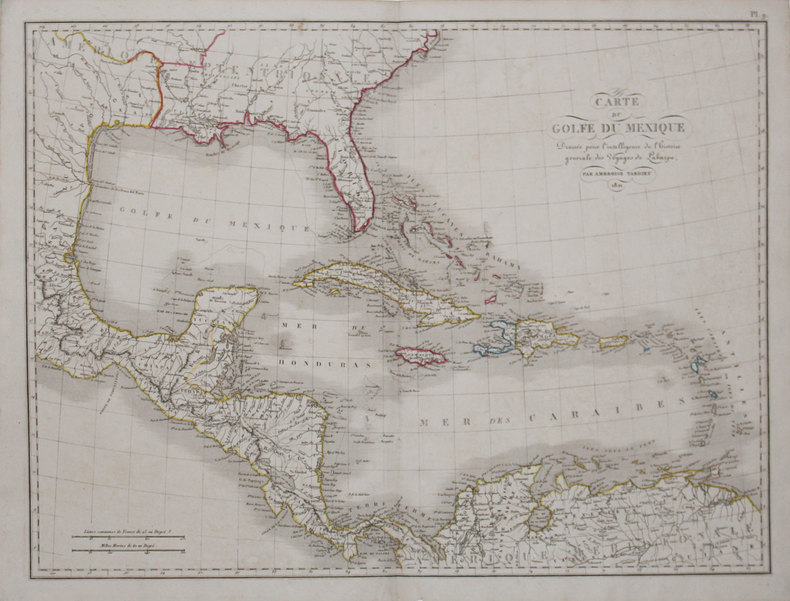
1825LBW-32271821 [1825]. 406 x 542 mm.
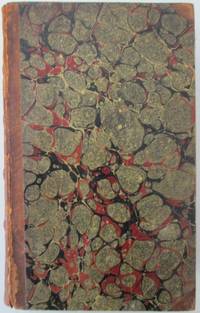
1822011473Boston: Cummings and Hilliard 1822. Quarter Leather. Good. Stated second edition. Quarter calf leather with marbled boards. Xii 480;2481-818 plus errata. Fold out color map at the front with five fold out plates at the rear. An early work studying the mineralogy and geology of the United States by Parker Cleaveland a geologist and professor who drew on his own collection of minerals to compile this work. With general discussion of the properties of minerals as well as sections studying specific minerals in the US. GOOD condition. Leather cracked flaking and darkened along the spine being rather brittle. Some darkening along the extremities of the boards. Minor scuffing and bumping to the edges. Scattered minor foxing throughout heavier to the first few pages and to a few pages scattered throughout. Misfolding present to the plates in the rear. Map with several wrinkles and some toning. Owner's signature present with front endpaper torn along the upper hinge. Sabin 13611 for first edition and this. Cummings and Hilliard unknown
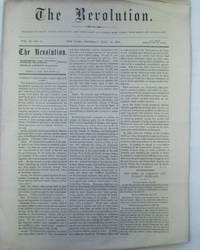
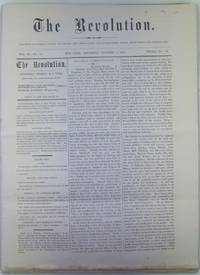
1868020098New York: Susan B. Anthony Proprietor; R.J. Johnson Publisher 1868. Wraps. Good. Side sewn journal. Approximately 12 ¼ by 9 inches. 16 pp. Early issue of the Revolution a groundbreaking and influential newspaper produced by Elizabeth Cady Stanton Susan B. Anthony and Parker Pillsbury. The paper was established to provide a voice to activists and suffragists such as Stanton and Anthony whose voices were marginalized by the mainstream press as well as many abolitionist publications with whom they had been previously allied. Anthony and Stanton advocated for an amendment giving suffrage to women along with the amendment sponsored by abolitionists that would give Black men the right to vote. Many abolitionists actively discouraged Stanton and Anthony from pursuing their amendment until the amendment enfranchising Black men passed creating a rift in the abolitionist movement as well as the women's suffrage movement. Feeling betrayed by abolitionists and Republicans who initially supported them they established the Revolution with financial help from George Francis Train a Democrat who supported women's rights but was openly racist. As the name indicates The Revolution adopted a combative radical tone with Stanton and others unafraid to take on critics. The paper openly discussed sexual and physical abuse in marriage and advocated better divorce laws that would offer women a way to escape abusive marriages. In 1869 the paper broke with Train who had supplied very little of the funding he initially offered. It published until 1872 struggling to make expenses along the way. This issue with several articles written by Elizabeth Cady Stanton including a lambasting of the Democratic Party with another piece not treating Republicans kindly either. She also discusses the Peoples Party etc. A short piece by Susan B. Anthony present addressing the beginning of volume 2 of the Revolution. GOOD condition. Several fold creases present with other general wrinkling. Minor toning and scattered soiling in the interior. Front and rear leaf separating from the rest of the piece but still intact. Susan B. Anthony, Proprietor; R.J. Johnson, Publisher unknown
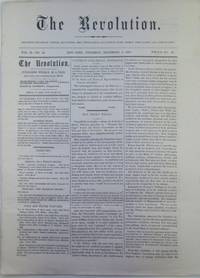
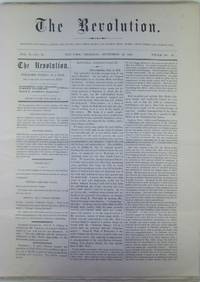
1868020395New York: Susan B. Anthony Proprietor; R.J. Johnson Publisher 1868. Wraps. Good. Side sewn journal. Approximately 12 ¼ by 9 inches. 16 pp. Early issue of the Revolution a groundbreaking and influential newspaper produced by Elizabeth Cady Stanton Susan B. Anthony and Parker Pillsbury. The paper was established to provide a voice to activists and suffragists such as Stanton and Anthony whose voices were marginalized by the mainstream press as well as many abolitionist publications with whom they had been previously allied. Anthony and Stanton advocated for an amendment giving suffrage to women along with the amendment sponsored by abolitionists that would give Black men the right to vote. Many abolitionists actively discouraged Stanton and Anthony from pursuing their amendment until the amendment enfranchising Black men passed creating a rift in the abolitionist movement as well as the women's suffrage movement. Feeling betrayed by abolitionists and Republicans who initially supported them they established the Revolution with financial help from George Francis Train a Democrat who supported women's rights but was openly racist. As the name indicates The Revolution adopted a combative radical tone with Stanton and others unafraid to take on critics. The paper openly discussed sexual and physical abuse in marriage and advocated better divorce laws that would offer women a way to escape abusive marriages. In 1869 the paper broke with Train who had supplied very little of the funding he initially offered. It published until 1872 struggling to make expenses along the way. This issue with a continuation of a lengthy profile of Anna Elizabeth Dickinson written by Elizabeth Cady Stanton as well as five shorter pieces by her: "The Old Year Gone" "Roll up the Petitions" "Henry Ward Beecher" "Henry James on Woman" and "Hearth and Home." A short column by Susan B. Anthony is present thanking their helpers. Also of note is a report on the Working Women's Association by Sarah Norton in which she reports in detail on the work of rag pickers in New York City. GOOD condition. Rear leaf very tenuously attached with the binding a bit fragile. Rear leaf also rather toned. Several fold creases present with other general wrinkling. Minor toning and scattered soiling in the interior. Susan B. Anthony, Proprietor; R.J. Johnson, Publisher unknown
184954750Madrid La Imprenta Nacional 1849. Small 4to. Contemp. hcloth. Gilt lettering on spine. Stamp on title-page. 2468 pp. 1 folded table. Internally clean and fine. <br/><br/><em>This edition not in Sabin. Sabin 19679 for other editions. </em> hardcover
184954750Madrid, La Imprenta Nacional, 1849. Small 4to. Contemp. hcloth. Gilt lettering on spine. Stamp on title-page. (2),468 pp., 1 folded table. Internally clean and fine.
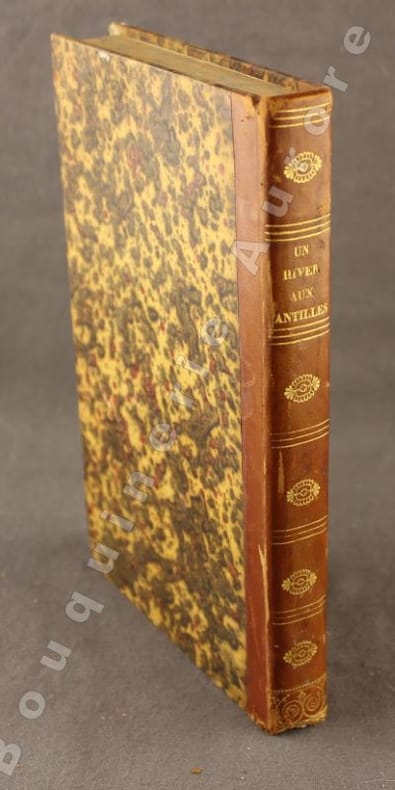
1842142561842 P., Firmin-Didot frères, 1842, 1 vol. in-8° (212 x 135 mm) relié 1/2 veau marron, dos lisse, auteur, titre, filets et fleurons dorés, plats de papier marbré, tranches marbrées, de XI pp. (faux-titre, titre, table, avertissement du traducteur) - 358 pp.mors frottés, coiffe inférieure accidentée, quelques taches marginales en début et fin d'ouvrage, bon exemplaire par ailleurs.
1808P2-2DParis, Maradan, 1808. 8 volumes in-8° (210x130mm) reliés plein basane époque, dos lisses richement décorés, pièces de titre maroquin rouge et de tomaison verte, lisière or sur les plats, frontispice, chaque volume comprend entre 400 et 500pp., coins émoussés, coiffes usés, mouillure sur 30 pages en fin de 2 volumes, bel ensemble.
1832004862Concord New Hampshire: No Publisher 1832. Disbound. Fair. Proclamation Regarding Nullification December 10 1832. Published in the New Hampshire Statesman and State Journal Saturday December 22 1832. Concord New Hampshire: 1832. Vol. II-No.32. Single sheet Page 1 and 2 ONLY of this newspaper printing on the front page almost the entire proclamation by Andrew Jackson lacking the last 1 and ½ paragraphs which would have appeared on the last page of this paper now LACKING. An early printing of this important speech by Jackson declaring that one any one state did not have the authority to annul any federal law of the United States and declaring that South Carolina "stood on the brink of insurrection and treason." Jackson asserted in the speech that no state had the right to secede. This conflict arose from South Carolina's efforts to nullify federal tariffs that it considered were hurting its economy. Both the state and federal government prepared for possible military action to enforce their cause with a compromise eventually reached in 1833. In FAIR condition lacking the aforementioned last paragraphs. Upper left of the sheet torn with LOSS of text along the left margin of the first few paragraphs. Small area torn from the lower left margin not affecting text. General wrinkling and creasing to the paper with a horizontal fold crease present. Minor foxing staining and soiling. Some creasing and minor tearing along the upper edge. Small hole in the center of the paper at the title. No Publisher unknown
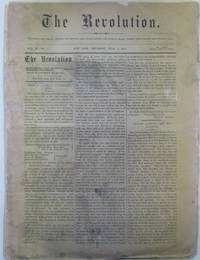
1868020147New York: Susan B. Anthony Proprietor; R.J. Johnson Publisher 1868. Wraps. Good. Side sewn journal. Approximately 12 ¼ by 9 inches. 16 pp. Early issue of the Revolution a groundbreaking and influential newspaper produced by Elizabeth Cady Stanton Susan B. Anthony and Parker Pillsbury. The paper was established to provide a voice to activists and suffragists such as Stanton and Anthony whose voices were marginalized by the mainstream press as well as many abolitionist publications with whom they had been previously allied. Anthony and Stanton advocated for an amendment giving suffrage to women along with the amendment sponsored by abolitionists that would give Black men the right to vote. Many abolitionists actively discouraged Stanton and Anthony from pursuing their amendment until the amendment enfranchising Black men passed creating a rift in the abolitionist movement as well as the women's suffrage movement. Feeling betrayed by abolitionists and Republicans who initially supported them they established the Revolution with financial help from George Francis Train a Democrat who supported women's rights but was openly racist. As the name indicates The Revolution adopted a combative radical tone with Stanton and others unafraid to take on critics. The paper openly discussed sexual and physical abuse in marriage and advocated better divorce laws that would offer women a way to escape abusive marriages. In 1869 the paper broke with Train who had supplied very little of the funding he initially offered. It published until 1872 struggling to make expenses along the way. This issue with a lengthy column editorial correspondence written by Elizabeth Cady Stanton on her travels in the US spanning almost two pages. Other pieces by Stanton discuss "National Labor Congress;" "Frank Blair on Woman's Suffrage;" and "Adah Isaacs Menken." Two lengthy pieces print quotes speaking from two meetings of the Workingwoman's Workingwomen's Association printing the discussion between Susan B. Anthony and others. GOOD condition. Several fold creases present with other general wrinkling. Minor toning and scattered soiling in the interior. Susan B. Anthony, Proprietor; R.J. Johnson, Publisher unknown
1868020317New York: Susan B. Anthony Proprietor; R.J. Johnson Publisher 1868. Wraps. Good. Side sewn journal. Approximately 12 ¼ by 9 inches. 16 pp. Early issue of the Revolution a groundbreaking and influential newspaper produced by Elizabeth Cady Stanton Susan B. Anthony and Parker Pillsbury. The paper was established to provide a voice to activists and suffragists such as Stanton and Anthony whose voices were marginalized by the mainstream press as well as many abolitionist publications with whom they had been previously allied. Anthony and Stanton advocated for an amendment giving suffrage to women along with the amendment sponsored by abolitionists that would give Black men the right to vote. Many abolitionists actively discouraged Stanton and Anthony from pursuing their amendment until the amendment enfranchising Black men passed creating a rift in the abolitionist movement as well as the women's suffrage movement. Feeling betrayed by abolitionists and Republicans who initially supported them they established the Revolution with financial help from George Francis Train a Democrat who supported women's rights but was openly racist. As the name indicates The Revolution adopted a combative radical tone with Stanton and others unafraid to take on critics. The paper openly discussed sexual and physical abuse in marriage and advocated better divorce laws that would offer women a way to escape abusive marriages. In 1869 the paper broke with Train who had supplied very little of the funding he initially offered. It published until 1872 struggling to make expenses along the way. This issue with a lengthy column editorial correspondence written by Elizabeth Cady Stanton on her travels in the US spanning almost two pages. Another piece by Stanton discusses on "Miss Becker and the Difference of the Sexes." A lengthy piece prints a meeting/public event by the Women's Council in Mount Vernon New York that brought together women taxpayers. This prints the discussion between Susan B. Anthony and others. GOOD condition. Small piece torn from the upper edge of one leaf and another from the bottom corner of the last leaf. Several fold creases present with other general wrinkling. Minor toning and scattered soiling in the interior. Susan B. Anthony, Proprietor; R.J. Johnson, Publisher unknown
1868020504New York: Susan B. Anthony Proprietor; R.J. Johnson Publisher 1868. Wraps. Poor. Side sewn journal. Approximately 12 ¼ by 9 inches. 16 pp. Early issue of the Revolution a groundbreaking and influential newspaper produced by Elizabeth Cady Stanton Susan B. Anthony and Parker Pillsbury. The paper was established to provide a voice to activists and suffragists such as Stanton and Anthony whose voices were marginalized by the mainstream press as well as many abolitionist publications with whom they had been previously allied. Anthony and Stanton advocated for an amendment giving suffrage to women along with the amendment sponsored by abolitionists that would give Black men the right to vote. Many abolitionists actively discouraged Stanton and Anthony from pursuing their amendment until the amendment enfranchising Black men passed creating a rift in the abolitionist movement as well as the women's suffrage movement. Feeling betrayed by abolitionists and Republicans who initially supported them they established the Revolution with financial help from George Francis Train a Democrat who supported women's rights but was openly racist. As the name indicates The Revolution adopted a combative radical tone with Stanton and others unafraid to take on critics. The paper openly discussed sexual and physical abuse in marriage and advocated better divorce laws that would offer women a way to escape abusive marriages. In 1869 the paper broke with Train who had supplied very little of the funding he initially offered. It published until 1872 struggling to make expenses along the way. This issue publishes an address by Susan B. Anthony at Tammany Hall; several articles by Elizabeth Cady Stanton including one on the Workingmen's Convention; a response to a letter from a subscriber complaining about the cost per issue where the paper points out the flaw in the writer's mathematics etc. POOR/FAIR condition. Front and rear page DETACHED from the rest. Heavy toning moderate soiling and some staining to the front page. Several fold creases present with other general wrinkling. Minor toning and scattered soiling in the interior. Susan B. Anthony, Proprietor; R.J. Johnson, Publisher unknown
1818001142Paris: F. Béchet 1818. First Edition. Paperback. Very Good . 6 267 1 p.; 22 cm. Original pink paper wrappers with printed paper spine label. Untrimmed. Verso of half title page contains list of booksellers in other cities selling books printed by Imprimerie de Poulet. Verso of table of contents contains list of other works by Pradt. First edition. This volume discusses independence movements in South America in particular developments in the second half of 1817 as well as the reactions of European powers. Pages 177-258 contain translations of documents concerning Haiti and other areas. In 1789 Pradt 1759-1837 was elected to the États Généraux; he fled to Germany after the beginning of the French Revolution. After he returned to France in 1800 Pradt supported Napoleon and became bishop of Poitiers 1805 and archbishop of Malines 1808. In Very Good Condition: much of paper spine label lacking; lower corner of front and back wrapper lacking; tear from lower edge of first leaf half title not touching text; occasional light foxing; otherwise a clean and bright copy in the original wrappers. F. Béchet paperback
188326762Paris Octave Doin 1883 in-8 broché
1834LBW-7492S.l., 1834. In-8 de 32 pp.; toile noire, pièce de titre bordeaux (reliure moderne).
1862LBW-2534Orléans, Georges Jacob, 1862. In-8 paginé de 387 à 399; broché, couverture beige imprimée.
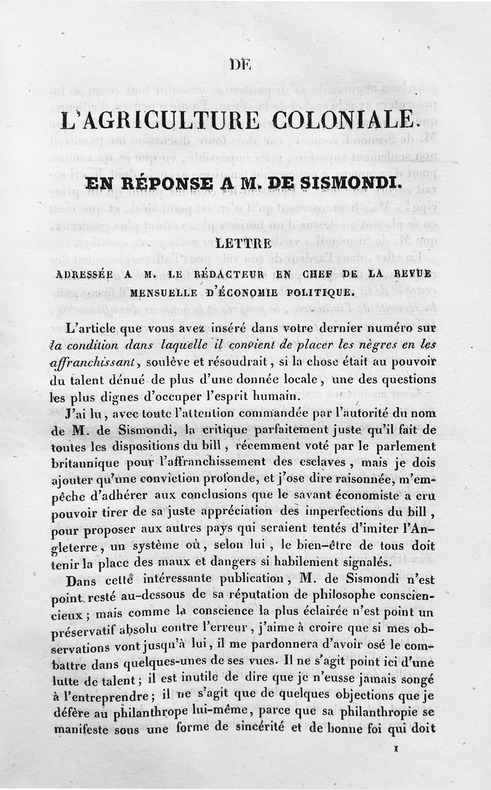
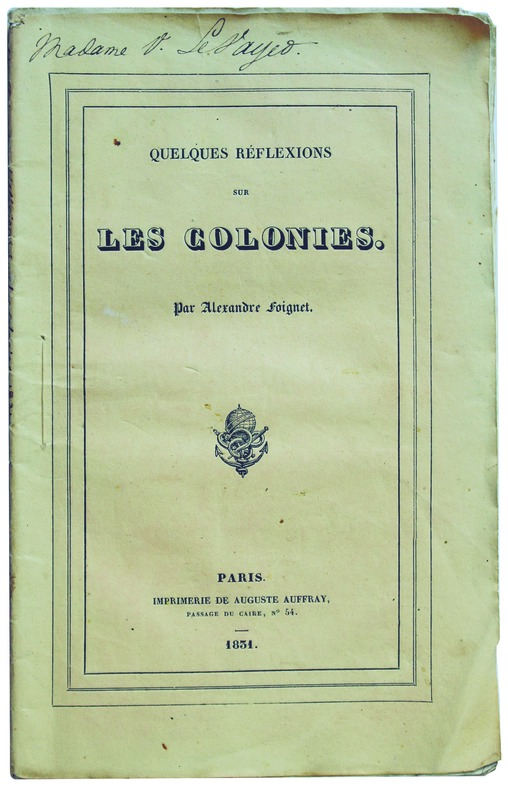
1831LBW-5111Paris, Auguste Auffray, 1831. In-8 de 40 pp.; broché, couverture imprimée.
1833022230Dover: J.T. Gibbs Publisher 1833. Cloth. Good. Folio. Quarter cloth with paper covered boards. Large folio. Bound volume of the Dover New Hampshire newspaper the Dover Gazette and Strafford Advertiser comprising of every weekly issue spanning from December 4 1832 to November 28 1833. Of particular note is a printing of Andrew Jackson's proclamation on Nullification asserting that states could not override or disregard federal law. This was issued in response to South Carolina's refusal to enforce tariffs. Also present is an article written by George Catlin on the Mandan tribe recalling customs ceremonies and dress among other subjects. The tribe had been decimated by small pox with an estimated 125 remaining by 1838. Also present is an article on the Native American leader Black Hawk written a little after his capture. A small paragraph describes a former Mormon displeasure with the faith. GOOD condition. Ex-library with exterior spine labels interior pastedowns and minor markings. First leaf DETACHED. Minor scuffing fading soiling to the covers. Years written on masking tape taped to the spine with some other tape repairs on the spine. Paper a bit browned and brittle. J.T. Gibbs, Publisher unknown
1853004531New York: P.T. Barnum and H.D. Beach Publishers 1853. Half-Leather. Fair/No Jacket. Marbled boards with leather binding.416 pages. A bound volume of this journal/newspaper founded and first published by P.T. Barnum. This work contains news and articles on items of interest from around the world and the United States. Of note is a four part reprint of Edgar Allan Poe's work on autography and the meanings behind signatures abridged and rearranged and a short poem by Horatio Alger Welcome to May. A map of Mecilla Valley a disputed territory around the area of New Mexico and of which the Gadsden Purchase centered around is present. This is accompanied by a short article relating details of the dispute p. 357. Also of interest are articles with illustrations on various ship and train wrecks Ericsson's caloric engine for use in ships articles on California gold the second Grinnell expedition in the Arctic the Baltimore and Ohio railway and Pettibone's tunnel the Naval Academy in Maryland Japan shad fishing clipper ships and Vanderbilt steam yacht Scuba divesr and apparatus p. 236 Arthur Spring the Philadelphia murderer Baltimore shot works p. 241 an African church in Cincinnati Parisian mantilla fashions as well as other Parisian fashions p. 308 and others The New York hippodrome p. 313 a railway calamity in Norwalk CT p. 333 Paterson railroad accident Parisian electric clock p. 341 Sicard's scuba apparatus p. 365 custom house in Charleston SC p. 373 a map of Central Park in New York p. 409. In FAIR condition. Binding very worn along the spines with the covers mostly detached and the leather backstrip torn and lifting away in several places. Moderate to heavy scuffing to the covers and extremities. Minor soiling and uneven fading. First two pages of the book very creased and wrinkled. Pages 173/4 269/70 and 401/2 are MISSING with pages 259/60 LOOSE and laid in. Pages 395-98 have a large horizontal tear at the center of the page. Large pencil scribbles on the first blank endpaper with a scribble to an illustration in the book. Text block solid but weakened with a few minor tears minor scattered dampstains and scattered minor soiling. P.T. Barnum and H.D. Beach, Publishers unknown
1829BB1450London: Henry Colburn and Richard Bentley New Burlington-Street 1829. First Edition. Half-Calf. Fine. Scarce First Printing complete in three volumes of the "first anti-miscegenation novel in our literature Fiedler. 12mo: xiv2991; 23111; 2316pp. Contemporary pink half calf over marbled boards by Harrison of Belfast their ticket to front paste-down of vol. I; black morocco lettering pieces gilt; spines decorated in blind; marbled endpapers and edges. A truly excellent set occasional light foxing mostly marginal; spines rubbed and faded to tan. Spiller & Blackburn 11. BAL 3843. Sabin 16416. Fiedler quoted in Wallace James D. “Race and Captivity in Cooper's the Wept of Wish-ton-wish†American Literary History 7.2 1995: 189–209. True First Edition of this historical novel published in London September and later in November in Philadelphia under the title The Wept of Wish-Ton-Wish: A Tale both from the same sheets printed in Florence by Molini. Written in Paris when Cooper was as the center of the small American expatriate community and set in the seventeenth century on frontier land later part of Connecticut. N. B. With few exceptions always identified we only stock books in exceptional condition carefully preserved in archival removable mylar sleeves. All orders are packaged with care and posted promptly. Satisfaction guaranteed. Fine Editions Ltd is a member of the Independent Online Booksellers Association and we subscribe to its codes of ethics. Henry Colburn and Richard Bentley, New Burlington-Street unknown
182521618London 1825. Folio. 310pp. Bound in modern blue wrappers with copy of title on front wrapper. Fine. <br /> <br /> A wonderfully detailed report on the structure of the legal system in these colonies with explanations of the courts forms of action and remedies crimes punishments police forces slave codes manumission reform measures fees tables of cases tables with names and races of parties to legal proceedings. <br /> OCLC records nine locations under several accession numbers as of September 2024. unknown
182936507Paris Imprimerie royale juin 1829 in-4 broché sous couverture d'attente de papier bleu
188513661Makaire Aix-en-Provence 1885 1 vol. In-8 de 2 ff.n.ch. XIX 2 ff.n.ch. 134 pp., demi-chagrin de l'époque, dos à nerfs fileté.
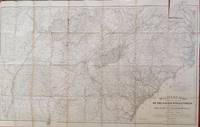
1865021368New York: Ferdinand Mayer Lithographer 1865. Unbound. Good. 47 by 30 inches. Black and white only. A large map apparently issued in 1865 that depicted the marches General William Tecumseh Sherman undertook during the Civil War. The map depicts railroads terrain etc. demonstrating the extraordinary lengths Sherman went to in order to dismantle the Confederacy's ability to resupply and fight. This edition was issued by Ferdinand Mayer with two other editions of this map published by two other firms. GOOD condition. Many fold creases present as issued. Large L shaped tear along one of the upper folds affecting the map in that area. Many other tiny tears along the folds fold edges or intersections present along with evidence of repair on the reverse to some of the tears. Map browned along the fold creases. Ferdinand Mayer, Lithographer unknown
1879005674Oneida NY: The American Socialist Publisher 1879. Wraps. Good. 104 issues spanning the years 1878 and 1879 being two complete years. Edited by John Humphrey Noyes the founder of a utopian community in Oneida and an advocate of communal style living including the controversial advocacy of men and women marrying multiple partners. Included are several articles on the short-lived Transcendentalist Utopian community Brook Farm including several articles containing excerpts from Charles Fourier's Harbinger as well as other topics related to the philosophy of Charles Fourier. Other topics include socialism in England the Workingmen's party Spiritualism and the necessity of Spiritualism Communism Communism in America Industrialization Krupp's Great Gun Factory-its cooperative phase 'The Father Land' by James Russell Lowell an illustration of the Shaker Village at Mount Lebanon Malthusian facts articles on the work studying population growth by Malthus The Marpingen miracles three views on the Origin of the Species Cook's marriage philosophy Utopian schemes labor and strikes Spirit rapping the Mennonites Paris under electric lights the Red Cross American Socialism the Atlantic Cable etc. Condition ranges from GOOD to VERY GOOD with most having light toning minor soiling creasing and edgewear. A few with minor chips and tears along the extremities. Vol IV. No. 52 with with moderate tearing along the extremities. A 4 inch triangular piece missing from the lower rear cover. Same sort of tearing to Vol III No. 52 with this number bearing heavy browning and staining to the rear cover affecting the last pages of this number. Vol. III no. 1 with moderate offsetting and soiling along the extremities. The American Socialist, Publisher unknown