No Author GivenBiblio.com
130 résultats
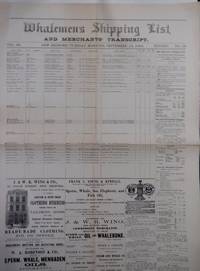
1908017904New Bedford MA: George R. Phillips Publisher 1908. Tabloid. Good. Large tabloid format single sheet. 2 pp. Single issue of this weekly paper devoted to the whaling industry. It was founded in 1843 and published until 1914. This issue with a list of names masters sailing date and destination along with the latest report of approximately 32 whaling ships departing from New Bedford San Francisco and elsewhere. Reverse has a few articles including one describing the fad of oxygen parties in London. GOOD condition. Horizontal and vertical fold crease present with a few minor tears along the folds. Minor toning and foxing. George R. Phillips, Publisher unknown
1991009436Bowie MD: Heritage Books 1991. Wraps. Near Fine. Glossy pale yellow wraps. Quarto. 615 total pages between the two books plus an index of beneficiaries and executors at the end of volume 2. An abstract list of 15126 wills from Hamilton County Ohio from 1791-1900 providing testator location of will in the UC collection residence of the testator date filed executioner and beneficiaries. Perhaps useful for the genealogist or genealogy. NEAR FINE condition. Light bumping and edgewear. Owner's name and perhaps purchase date on the inside of each volume. Heritage Books unknown
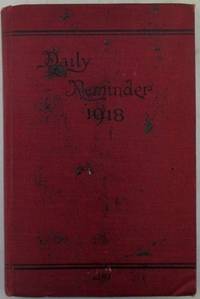
1918021403No Place: No publisher 1918. Cloth. Good. World War I Hospital/Medical Worker Diary. 1918 France. In a Daily Reminder Calendar for 1918. Red cloth. 365 pp. one for each day of the year. No name/author given. Some entries rather faded and most written in pencil. Handwriting is sometimes illegible. We speculate the author may have been an officer in the AEF as many of their entries refer to daily inspections and they reference an officer training drill in one entry. Many entries also refer to lieutenants majors and other officers although very rarely giving names instead using a single initial. It appears they were part of the AEF's hospital unit with mention of being at a frontline ambulance medical facility run by French forces and called Ambulance de Bois Roger see Feb. 12. First entry for January 1st indicates the author was in Langres France with the AEF American Expeditionary Force and mentions that school is out and he took a walk. They describe waiting for orders eventually being moved to Liffol-le-grand and Camp Hospital 18 for the month of January. By Early February entries are from Field Hospital 101. A hand drawn map/plan of Ambulance de Bois Roger appears on February 12. They describe setting up a triage with plan. On February 17 "considerable artillery to the east" is mentioned and the author as well as their going to an abandoned trench on the ridge. German biplanes are referred to using the French term avion boche. Boche was a derogatory term for Germans and the word appears off and on in entries going forward including March 8th where it states "Some boche in the air." They also mention that two were killed. By April the author is back at Camp Hospital 18 another map/plan of the facility appears and Field Hospital 101. Entries pretty much cease by April 23 with a few scattered entries short a few long" through the rest of the book. In general the diarist discusses basic day to day operations at the various medical facilities as well as planning interactions with others basic orders etc. GOOD condition. Residue/staining on the front cover. General fading. Minor soiling and edgewear. Some bumping. No publisher unknown
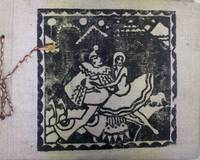
1926022001No Place: No publisher 1926. Cloth. Good. Clothbound scrapbook measuring 13 by 10 inches. String tied. Large ink block print of a man and woman dancing on the front cover with ink block print initials on the rear cover. Artwork presumably done by the owner. Thin paper stock in the interior. Approximately 57 photographs of various sizes including a few 8 by 10 inch photographs 5 by 7s and smaller as well as a few thumbnails. Many of the pages are empty. Other items in the interior include a program of camp exercises a few camp songs a homemade gypsy camp pennant two pages of notes from other campers to the owner a postcard of Gypsy Camp wrappers and labels etc. Photos consist of group photos or photos of individuals some depicting young women in Romani costumes some swimming horseback riding as well as photos of the Tree Top Inn main cabin etc. The owner and creator of this scrapbook was Dorothy Henderson who had an artistic touch in assembling this scrapbook as well as the art within. It appears she attended Gypsy Camp in 1926. Gypsy Camp originating in the early 1900s as an artist colony. The site 65 acres of land with some frontage along the Illinois River and located in Benton County Arkansas was purchased by Weesie and J.H. McAllister in 1921. Weesie McAllister envisioned turning the land into a summer camp for girls. The first building erected on the site was a three story structure that served as camp office residence for the McAllister family and dorm for the girls. Other structures were built in the late 1920s and eventually the camp could hold around 120 young women. The camp operated until 1978. It eventually fell into disrepair before being added to the National Register Historic District in 1988. Even so it was still empty until 2017. This scrapbook documents the early stages of Gypsy Camp as experienced by a young woman. GOOD condition. The scrapbook is generally solid. Some pages are loose and laid in with chipped and torn edges. Paper is rather brittle. No publisher unknown
1937203Baltimore: The Maya Society 1937. Second Edition. Hardcover. Very good. Friar Diego De Landa. A good edition HAND D83 with solid sturdy binding and cover. Original blue cloth boards with gilt stamping and Maya Society crest in gilt. The blue cloth is showing heavy spotting on the spine and front cover and the top front corner is bumped. Pages toned top edge darkened. Former owner's bookplate. From the private library of Larry Southwick. Laid in with a staplebound pamphlet for "Publications in the Field of Archaeology Anthropology etc. issued by the Carnegie Institute of Washington. May 1937." Heavily illustrated includes maps and related documents. 142 pp. Octavo 6 x 10 inches tall. An important primary source scarce in this edition "Modern scholars regard Landa with a mixture of frustration and admiration. At the same time he wrote his comprehensive work on Mayan culture his orders to destroy all icons and hieroglyphics obliterated the Mayan language . helping to undermine and destroy the civilization he so vividly described. Yet his book which was not printed until 1864 provided a phonetic alphabet that made it possible to decipher about one-third of the Mayan hieroglyphs and many of the remainder have since been deciphered." - Britannica The Maya Society hardcover books