Various AuthorsBiblio.com
213 résultats
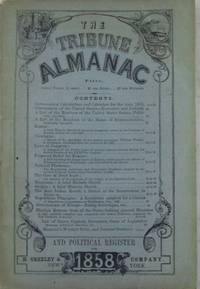
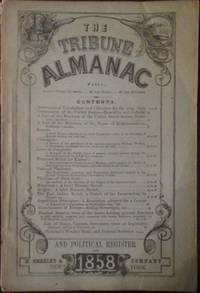
1858020712New York: H. Greeley and Company 1858. Wraps. Good. no date circa 1858. Light blue printed wraps. 68 pp. An almanac published by Horace Greeley that besides the usual monthly almanac information focuses on political subjects. This includes a look at the executive and judicial parts of the US government lists of the Senate and House of Representatives etc. Of note is a seven page look at the Case of Dred Scott mostly abstracts of court opinions; along with brief historic sketches of Minnesota and Oregon etc. GOOD condition. General toning and minor soiling to the covers. Minor curling and creasing at the corners. Paper toned in the interior. Small stain on the lower fore edge. H. Greeley and Company unknown
1858021511New York: H. Greeley and Company 1858. Wraps. Good. no date circa 1858. Light blue printed wraps. 68 pp. An almanac published by Horace Greeley that besides the usual monthly almanac information focuses on political subjects. This includes a look at the executive and judicial parts of the US government lists of the Senate and House of Representatives etc. Of note is a seven page look at the Case of Dred Scott mostly abstracts of court opinions; along with brief historic sketches of Minnesota and Oregon etc. GOOD condition. General toning and minor soiling to the covers. Minor curling and creasing at the corners. Paper toned in the interior. Small stain on the lower fore edge. H. Greeley and Company unknown
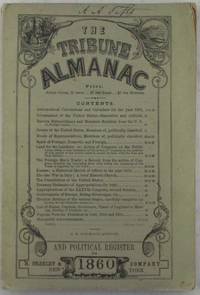
1860021982New York: H. Greeley and Company 1860. Wraps. Good. Light blue printed wraps. 80 pp. including ads. An almanac published by Horace Greeley that besides the usual monthly almanac information focuses on political subjects. This includes a look at the executive and judicial parts of the US government lists of the Senate and House of Representatives etc. Includes an essay on the attempts of Southern politicians to revive the foreign slave trade essentially making the practice legal again. GOOD condition. General toning and minor soiling to the covers. Minor curling and creasing at the corners. Paper toned in the interior. Owner's name on the upper front cover. H. Greeley and Company unknown
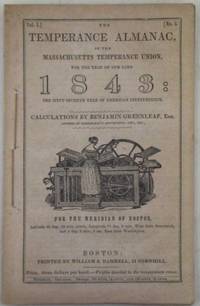
1843021405Boston: William S. Damrell Publisher 1843. Wraps. Good. no date circa 1843. Illustrated wraps side sewn. An almanac for the year 1843 issued by the Massachusetts Temperance Union containing the usual almanac information. Of note is the inclusion of a short story by Nathaniel Hawthorne "A Rill from the Town Pump." Several cartoons of drinkers a Dutch rum merchant etc. throughout as well as essays on the ills of drinking alcohol the ills of cider mills etc. GOOD condition. General toning some soiling and minor staining to the covers. A few minor wrinkles and creases. William S. Damrell, Publisher unknown
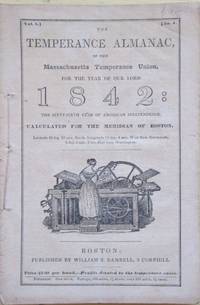
1842021824Boston: William S. Damrell Publisher 1842. Wraps. Good. no date circa 1842. Illustrated wraps side sewn. An almanac for the year 1842 issued by the Massachusetts Temperance Union containing the usual almanac information along with essays on the ills of alcohol consumption a speech of the leader of the Temperance Union small illustrations at the head of each month some illustrations drunk men etc. GOOD condition. General toning some soiling and minor staining to the covers. A few minor wrinkles and creases. William S. Damrell, Publisher unknown
1896SY-4SWM-RAHD1896. Hardcover. Very Good. First edition 1896. Moderate external wear a little fraying at bottom of spine some foxing to textblock edges gilt and decorations remain bright. Pages somewhat yellowed with an occasional bit of foxing or minor blemish. Binding reasonably firm. hardcover
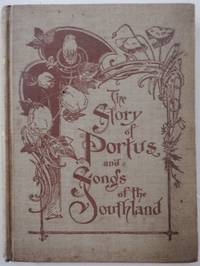
1894017944Buffalo: Charles Wells Moulton 1894. Cloth. Good. Illustrated beige cloth. 107 pp. A work that begins with the long poem "The Story of Portus" a work recalling the life of an enslaved man Portus. While the work reflects on the cruelty of enslaving people transporting them. and selling them it adopts a tone that the enslavers themselves were benevolent and that African-Americans would prefer to remain enslaved as there was nothing for them if they were free. The African-American protagonist Portus lives through the Civil War only to be murdered by the Ku Klux Klan. This work is accompanied by other shorter poetry most reflecting on life and the people of the US South. The poetry is rather conflicted with some celebrating Jefferson Davis while others reflecting on the lives of African-Americans in the South assuming the benefits of spirituality or Christianity in their lives. Overall it would seem much of the poetry whitewashes and glorifies the South while downplaying negative aspects of the region and the legacy of slavery. GOOD condition. Covers foxed and spotted with some soiling toning and minor staining. Text block toned. Owner's inscription on the first endpaper. Charles Wells Moulton unknown
1888030359Sam T. Clover: 1888. The revised edition 251 pages illustrated. Author's experiences in the Civil War. The author was a Late Colonel 3d U.S. Vol. Cav. "In the appendix to this revised edition there is sufficient additional matter and evidence so that the reader will have considerable proof besides the word of the author that the Smoked Yank as originally written was a description of actual occurrences and experience and as nearly correct as it was possible to describe them from memory." VERY GOOD- HARDCOVER Light wear to red cloth covers. Internally ine. Hard Cover. Very Good-/No Dust Jacket Present. 8vo - over 7¾" - 9¾" tall. Sam T. Clover: Hardcover
1865022123Richmond VA: Walker and Lewellen Publisher 1865. Tabloid. Good. Large format tabloid newspaper. Single sheet 4 pp. Single issue of this short lived newspaper from Richmond Virginia published from 1865 to 1866. The Gilder Lehrman Institute of American History speculates that this was an occupation newspaper which may be true given that the town was burned by Confederate soldiers prior to surrender. The paper's byline reads "No North No South No East No West-Our Whole Country." This issue with the usual sort of local national and international news reporting on crime shipping food etc. Of note is a column on the upcoming trial of Jefferson Davis and another column that reports on the trial of a Spiritualist in New York that also reports on the practice of Spiritualism. GOOD condition. Horizontal and vertical fold creases present. Minor creasing toning and soiling. A few ink spots along with an ink bracket around one passage. Walker and Lewellen, Publisher unknown
1848004771Washington: J. & G.S. Gideon Printers 1848. Original Wraps. Good. Printed wraps. 26 pp. Pertaining to the Dorr Rebellion of 1841 and 1842 in which disenfranchised voters in Rhode Island established a new constitution granting broader voting rights in contrast to the original Rhode Island charter. In Luther v. Borden it was argued that Borden had no authority to search the home of Luther a Dorr supporter as the Rhode Island charter was unconstitutional and thus did not grant Borden legitimate rights. In GOOD condition. Vertical crease present to the pamphlet with moderate uneven darkening minor soiling and a faint ownership signature in pencil at the upper front cover. Some creasing to the wraps with light scuffing and creasing along the extremities. Interior clean and solid. J. & G.S. Gideon, Printers unknown
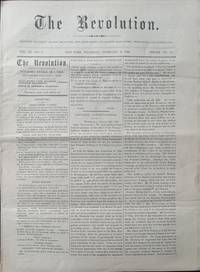
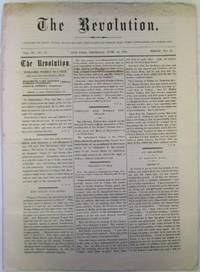
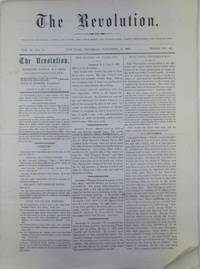
1869020893New York: Susan B. Anthony Proprietor; R.J. Johnson Publisher 1869. Wraps. Good. Side sewn journal. Approximately 12 ¼ by 9 inches. 16 pp. Early issue of the Revolution a groundbreaking and influential newspaper produced by Elizabeth Cady Stanton Susan B. Anthony and Parker Pillsbury. The paper was established to provide a voice to activists and suffragists such as Stanton and Anthony whose voices were marginalized by the mainstream press as well as many abolitionist publications with whom they had been previously allied. Anthony and Stanton advocated for an amendment giving suffrage to women along with the amendment sponsored by abolitionists that would give Black men the right to vote. Many abolitionists actively discouraged Stanton and Anthony from pursuing their amendment until the amendment enfranchising Black men passed creating a rift in the abolitionist movement as well as the women's suffrage movement. Feeling betrayed by abolitionists and Republicans who initially supported them they established the Revolution with financial help from George Francis Train a Democrat who supported women's rights but was openly racist. As the name indicates The Revolution adopted a combative radical tone with Stanton and others unafraid to take on critics. The paper openly discussed sexual and physical abuse in marriage and advocated better divorce laws that would offer women a way to escape abusive marriages. In 1869 the paper broke with Train who had supplied very little of the funding he initially offered. It published until 1872 struggling to make expenses along the way. This issue with editorial correspondence written by Elizabeth Cady Stanton as well as a letter by Susan B. Anthony addressing concerns from readers regarding George Train's contributions to the journal etc. GOOD condition. Several fold creases present with other general wrinkling. Minor toning and scattered soiling in the interior. Susan B. Anthony, Proprietor; R.J. Johnson, Publisher unknown
1869020934New York: Susan B. Anthony Proprietor; R.J. Johnson Publisher 1869. Wraps. Good. Side sewn journal. Approximately 12 ¼ by 9 inches. 16 pp. Early issue of the Revolution a groundbreaking and influential newspaper produced by Elizabeth Cady Stanton Susan B. Anthony and Parker Pillsbury. The paper was established to provide a voice to activists and suffragists such as Stanton and Anthony whose voices were marginalized by the mainstream press as well as many abolitionist publications with whom they had been previously allied. Anthony and Stanton advocated for an amendment giving suffrage to women along with the amendment sponsored by abolitionists that would give Black men the right to vote. Many abolitionists actively discouraged Stanton and Anthony from pursuing their amendment until the amendment enfranchising Black men passed creating a rift in the abolitionist movement as well as the women's suffrage movement. Feeling betrayed by abolitionists and Republicans who initially supported them they established the Revolution with financial help from George Francis Train a Democrat who supported women's rights but was openly racist. As the name indicates The Revolution adopted a combative radical tone with Stanton and others unafraid to take on critics. The paper openly discussed sexual and physical abuse in marriage and advocated better divorce laws that would offer women a way to escape abusive marriages. In 1869 the paper broke with Train who had supplied very little of the funding he initially offered. It published until 1872 struggling to make expenses along the way. This issue with "Who Killed Cock Robin" by Susan B. Anthony; four pieces by Elizabeth Cady Stanton a review of a book on Women's Suffrage "Impunity in Crime" "President Woolsey" "Women's Education" Also present is news on the American Equal Rights Association etc. GOOD condition. Front cover torn along the upper hinge. Several fold creases present with other general wrinkling. Minor toning and scattered soiling in the interior. Some foxing and offsetting along the top edge. Susan B. Anthony, Proprietor; R.J. Johnson, Publisher unknown
1869020935New York: Susan B. Anthony Proprietor; R.J. Johnson Publisher 1869. Wraps. Good. Side sewn journal. Approximately 12 ¼ by 9 inches. 16 pp. Early issue of the Revolution a groundbreaking and influential newspaper produced by Elizabeth Cady Stanton Susan B. Anthony and Parker Pillsbury. The paper was established to provide a voice to activists and suffragists such as Stanton and Anthony whose voices were marginalized by the mainstream press as well as many abolitionist publications with whom they had been previously allied. Anthony and Stanton advocated for an amendment giving suffrage to women along with the amendment sponsored by abolitionists that would give Black men the right to vote. Many abolitionists actively discouraged Stanton and Anthony from pursuing their amendment until the amendment enfranchising Black men passed creating a rift in the abolitionist movement as well as the women's suffrage movement. Feeling betrayed by abolitionists and Republicans who initially supported them they established the Revolution with financial help from George Francis Train a Democrat who supported women's rights but was openly racist. As the name indicates The Revolution adopted a combative radical tone with Stanton and others unafraid to take on critics. The paper openly discussed sexual and physical abuse in marriage and advocated better divorce laws that would offer women a way to escape abusive marriages. In 1869 the paper broke with Train who had supplied very little of the funding he initially offered. It published until 1872 struggling to make expenses along the way. This issue with a letter on taxes owed by Susan B. Anthony; two pieces by Elizabeth Cady Stanton "Women's privilege in Edinburgh" and a continuation of a piece on Reverend Henry Edgar. Also present is news on the American Equal Rights Association an essay on hygiene vs. fashion etc. GOOD condition. Several fold creases present with other general wrinkling. Minor toning and scattered soiling in the interior. Susan B. Anthony, Proprietor; R.J. Johnson, Publisher unknown
1870022308New York: Susan B. Anthony Proprietor; R.J. Johnson Publisher 1870. Wraps. Good. Side sewn journal. Approximately 12 ¼ by 9 inches. 16 pp. Early issue of the Revolution a groundbreaking and influential newspaper produced by Elizabeth Cady Stanton Susan B. Anthony and Parker Pillsbury. The paper was established to provide a voice to activists and suffragists such as Stanton and Anthony whose voices were marginalized by the mainstream press as well as many abolitionist publications with whom they had been previously allied. Anthony and Stanton advocated for an amendment giving suffrage to women along with the amendment sponsored by abolitionists that would give Black men the right to vote. Many abolitionists actively discouraged Stanton and Anthony from pursuing their amendment until the amendment enfranchising Black men passed creating a rift in the abolitionist movement as well as the women's suffrage movement. Feeling betrayed by abolitionists and Republicans who initially supported them they established the Revolution with financial help from George Francis Train a Democrat who supported women's rights but was openly racist. As the name indicates The Revolution adopted a combative radical tone with Stanton and others unafraid to take on critics. The paper openly discussed sexual and physical abuse in marriage and advocated better divorce laws that would offer women a way to escape abusive marriages. In 1869 the paper broke with Train who had supplied very little of the funding he initially offered. It published until 1872 struggling to make expenses along the way. This issue with a printing of an interview conducted by Susan B. Anthony in which she interviews "Jennie" Claflin Tennie Claflin sister of Victoria Woodhull about her part in the brokerage firm started by Woodhull and herself. They discuss a variety of subjects relating to brokerage and the skills needed to run a business. Tennie C. Claflin partnered with her activist and suffragist sister Victoria Woodhull to open this firm in 1870. Backed by Cornelius Vanderbilt the firm became quite successful tapping into the needs of women who wanted to invest. Shortly after opening the firm Woodhull and Claflin started to publish a newspaper that was considered radical at the time advocating for equal rights free love and other social movements. GOOD condition. Several faint fold creases present with other general wrinkling and creasing. Chipping and tearing along the edges. Minor toning and scattered foxing and soiling. Several pages unopened along the top edge. Susan B. Anthony, Proprietor; R.J. Johnson, Publisher unknown
1871020733New York: Susan B. Anthony Proprietor; R.J. Johnson Publisher 1871. Wraps. Good. Side sewn journal. Approximately 12 ¼ by 9 inches. 16 pp. Early issue of the Revolution a groundbreaking and influential newspaper produced by Elizabeth Cady Stanton Susan B. Anthony and Parker Pillsbury. The paper was established to provide a voice to activists and suffragists such as Stanton and Anthony whose voices were marginalized by the mainstream press as well as many abolitionist publications with whom they had been previously allied. Anthony and Stanton advocated for an amendment giving suffrage to women along with the amendment sponsored by abolitionists that would give Black men the right to vote. Many abolitionists actively discouraged Stanton and Anthony from pursuing their amendment until the amendment enfranchising Black men passed creating a rift in the abolitionist movement as well as the women's suffrage movement. Feeling betrayed by abolitionists and Republicans who initially supported them they established the Revolution with financial help from George Francis Train a Democrat who supported women's rights but was openly racist. As the name indicates The Revolution adopted a combative radical tone with Stanton and others unafraid to take on critics. The paper openly discussed sexual and physical abuse in marriage and advocated better divorce laws that would offer women a way to escape abusive marriages. In 1869 the paper broke with Train who had supplied very little of the funding he initially offered. It published until 1872 struggling to make expenses along the way. This issue with articles/essays on marriage news on various women a few pages of ads in the rear etc. GOOD condition. Several fold creases present with other general wrinkling. Minor toning and scattered soiling in the interior. Susan B. Anthony, Proprietor; R.J. Johnson, Publisher unknown
1868020098New York: Susan B. Anthony Proprietor; R.J. Johnson Publisher 1868. Wraps. Good. Side sewn journal. Approximately 12 ¼ by 9 inches. 16 pp. Early issue of the Revolution a groundbreaking and influential newspaper produced by Elizabeth Cady Stanton Susan B. Anthony and Parker Pillsbury. The paper was established to provide a voice to activists and suffragists such as Stanton and Anthony whose voices were marginalized by the mainstream press as well as many abolitionist publications with whom they had been previously allied. Anthony and Stanton advocated for an amendment giving suffrage to women along with the amendment sponsored by abolitionists that would give Black men the right to vote. Many abolitionists actively discouraged Stanton and Anthony from pursuing their amendment until the amendment enfranchising Black men passed creating a rift in the abolitionist movement as well as the women's suffrage movement. Feeling betrayed by abolitionists and Republicans who initially supported them they established the Revolution with financial help from George Francis Train a Democrat who supported women's rights but was openly racist. As the name indicates The Revolution adopted a combative radical tone with Stanton and others unafraid to take on critics. The paper openly discussed sexual and physical abuse in marriage and advocated better divorce laws that would offer women a way to escape abusive marriages. In 1869 the paper broke with Train who had supplied very little of the funding he initially offered. It published until 1872 struggling to make expenses along the way. This issue with several articles written by Elizabeth Cady Stanton including a lambasting of the Democratic Party with another piece not treating Republicans kindly either. She also discusses the Peoples Party etc. A short piece by Susan B. Anthony present addressing the beginning of volume 2 of the Revolution. GOOD condition. Several fold creases present with other general wrinkling. Minor toning and scattered soiling in the interior. Front and rear leaf separating from the rest of the piece but still intact. Susan B. Anthony, Proprietor; R.J. Johnson, Publisher unknown
1868020102New York: Susan B. Anthony Proprietor; R.J. Johnson Publisher 1868. Wraps. Good. Side sewn journal. Approximately 12 ¼ by 9 inches. 16 pp. Single issue of the Revolution a groundbreaking and influential newspaper produced by Elizabeth Cady Stanton Susan B. Anthony and Parker Pillsbury. The paper was established to provide a voice to activists and suffragists such as Stanton and Anthony whose voices were marginalized by the mainstream press as well as many abolitionist publications with whom they had been previously allied. Anthony and Stanton advocated for an amendment giving suffrage to women along with the amendment sponsored by abolitionists that would give Black men the right to vote. Many abolitionists actively discouraged Stanton and Anthony from pursuing their amendment until the amendment enfranchising Black men passed creating a rift in the abolitionist movement as well as the women's suffrage movement. Feeling betrayed by abolitionists and Republicans who initially supported them they established the Revolution with financial help from George Francis Train a Democrat who supported women's rights but was openly racist. As the name indicates The Revolution adopted a combative radical tone with Stanton and others unafraid to take on critics. The paper openly discussed sexual and physical abuse in marriage and advocated better divorce laws that would offer women a way to escape abusive marriages. In 1869 the paper broke with Train who had supplied very little of the funding he initially offered. It published until 1872 struggling to make expenses along the way. This issue with a lengthy column written by Elizabeth Cady Stanton on her travels in the US spanning almost two pages. Very small paragraph by Susan B. Anthony present soliciting 6 to 8 women for potential employment. A few pieces discuss voting rights for Black men. GOOD condition. Several fold creases present with other general wrinkling. Minor toning and scattered soiling in the interior. Small hole in the upper front page. Susan B. Anthony, Proprietor; R.J. Johnson, Publisher unknown
1868020147New York: Susan B. Anthony Proprietor; R.J. Johnson Publisher 1868. Wraps. Good. Side sewn journal. Approximately 12 ¼ by 9 inches. 16 pp. Early issue of the Revolution a groundbreaking and influential newspaper produced by Elizabeth Cady Stanton Susan B. Anthony and Parker Pillsbury. The paper was established to provide a voice to activists and suffragists such as Stanton and Anthony whose voices were marginalized by the mainstream press as well as many abolitionist publications with whom they had been previously allied. Anthony and Stanton advocated for an amendment giving suffrage to women along with the amendment sponsored by abolitionists that would give Black men the right to vote. Many abolitionists actively discouraged Stanton and Anthony from pursuing their amendment until the amendment enfranchising Black men passed creating a rift in the abolitionist movement as well as the women's suffrage movement. Feeling betrayed by abolitionists and Republicans who initially supported them they established the Revolution with financial help from George Francis Train a Democrat who supported women's rights but was openly racist. As the name indicates The Revolution adopted a combative radical tone with Stanton and others unafraid to take on critics. The paper openly discussed sexual and physical abuse in marriage and advocated better divorce laws that would offer women a way to escape abusive marriages. In 1869 the paper broke with Train who had supplied very little of the funding he initially offered. It published until 1872 struggling to make expenses along the way. This issue with a lengthy column editorial correspondence written by Elizabeth Cady Stanton on her travels in the US spanning almost two pages. Other pieces by Stanton discuss "National Labor Congress;" "Frank Blair on Woman's Suffrage;" and "Adah Isaacs Menken." Two lengthy pieces print quotes speaking from two meetings of the Workingwoman's Workingwomen's Association printing the discussion between Susan B. Anthony and others. GOOD condition. Several fold creases present with other general wrinkling. Minor toning and scattered soiling in the interior. Susan B. Anthony, Proprietor; R.J. Johnson, Publisher unknown
1868020196New York: Susan B. Anthony Proprietor; R.J. Johnson Publisher 1868. Wraps. Good. Side sewn journal. Approximately 12 ¼ by 9 inches. 16 pp. Early issue of the Revolution a groundbreaking and influential newspaper produced by Elizabeth Cady Stanton Susan B. Anthony and Parker Pillsbury. The paper was established to provide a voice to activists and suffragists such as Stanton and Anthony whose voices were marginalized by the mainstream press as well as many abolitionist publications with whom they had been previously allied. Anthony and Stanton advocated for an amendment giving suffrage to women along with the amendment sponsored by abolitionists that would give Black men the right to vote. Many abolitionists actively discouraged Stanton and Anthony from pursuing their amendment until the amendment enfranchising Black men passed creating a rift in the abolitionist movement as well as the women's suffrage movement. Feeling betrayed by abolitionists and Republicans who initially supported them they established the Revolution with financial help from George Francis Train a Democrat who supported women's rights but was openly racist. As the name indicates The Revolution adopted a combative radical tone with Stanton and others unafraid to take on critics. The paper openly discussed sexual and physical abuse in marriage and advocated better divorce laws that would offer women a way to escape abusive marriages. In 1869 the paper broke with Train who had supplied very little of the funding he initially offered. It published until 1872 struggling to make expenses along the way. This issue with a lengthy column written by Elizabeth Cady Stanton on her travels in the US spanning almost two pages. Another piece by Stanton discusses the upcoming presidential election and the potential affiliation of the Revolution with the Democrats. Three small paragraphs by Susan B. Anthony one on the National Unitarian Convention the National Workingmen's Congress and one soliciting more subscribers. A few pieces discuss voting rights for Black men. GOOD condition. Small piece torn from the upper edge of one leaf and another from the bottom corner of the last leaf. Several fold creases present with other general wrinkling. Minor toning and scattered soiling in the interior. Susan B. Anthony, Proprietor; R.J. Johnson, Publisher unknown
1868020221New York: Susan B. Anthony Proprietor; R.J. Johnson Publisher 1868. Wraps. Good. Side sewn journal. Approximately 12 ¼ by 9 inches. 16 pp. This issue with a front page "Appeal for Equal Suffrage" undersigned by Elizabeth Cady Stanton Abby Hopper Gibbons Mrs. Horace Greeley Susan B. Anthony and Elizabeth Smith Miller. With two pieces "Hester Vaughan" and "Our Children at School" both written by Elizabeth Cady Stanton. GOOD condition. Front page separating from the spine somewhat tenuously attached. Several fold creases present with other general wrinkling. Minor toning and scattered soiling in the interior. Minor staining to the front cover. Susan B. Anthony, Proprietor; R.J. Johnson, Publisher unknown
1868020242New York: Susan B. Anthony Proprietor; R.J. Johnson Publisher 1868. Wraps. Good. Side sewn journal. Approximately 12 ¼ by 9 inches. 16 pp. Early issue of the Revolution a groundbreaking and influential newspaper produced by Elizabeth Cady Stanton Susan B. Anthony and Parker Pillsbury. The paper was established to provide a voice to activists and suffragists such as Stanton and Anthony whose voices were marginalized by the mainstream press as well as many abolitionist publications with whom they had been previously allied. Anthony and Stanton advocated for an amendment giving suffrage to women along with the amendment sponsored by abolitionists that would give Black men the right to vote. Many abolitionists actively discouraged Stanton and Anthony from pursuing their amendment until the amendment enfranchising Black men passed creating a rift in the abolitionist movement as well as the women's suffrage movement. Feeling betrayed by abolitionists and Republicans who initially supported them they established the Revolution with financial help from George Francis Train a Democrat who supported women's rights but was openly racist. As the name indicates The Revolution adopted a combative radical tone with Stanton and others unafraid to take on critics. The paper openly discussed sexual and physical abuse in marriage and advocated better divorce laws that would offer women a way to escape abusive marriages. In 1869 the paper broke with Train who had supplied very little of the funding he initially offered. It published until 1872 struggling to make expenses along the way. This issue with a lengthy article written by Elizabeth Cady Stanton on US prisons and prison reform. Many shorter anonymous articles on suffrage labor and other topics present as well as a brilliant and scathing retort against the Warrick Indiana Herald which while reviewing the Revolution calls "women's suffrage an absurdity and an evil." GOOD condition. Several fold creases present with other general wrinkling. Minor toning and scattered soiling in the interior. Susan B. Anthony, Proprietor; R.J. Johnson, Publisher unknown
1868020291New York: Susan B. Anthony Proprietor; R.J. Johnson Publisher 1868. Wraps. Good. Side sewn journal. Approximately 12 ¼ by 9 inches. 16 pp. arly issue of the Revolution a groundbreaking and influential newspaper produced by Elizabeth Cady Stanton Susan B. Anthony and Parker Pillsbury. The paper was established to provide a voice to activists and suffragists such as Stanton and Anthony whose voices were marginalized by the mainstream press as well as many abolitionist publications with whom they had been previously allied. Anthony and Stanton advocated for an amendment giving suffrage to women along with the amendment sponsored by abolitionists that would give Black men the right to vote. Many abolitionists actively discouraged Stanton and Anthony from pursuing their amendment until the amendment enfranchising Black men passed creating a rift in the abolitionist movement as well as the women's suffrage movement. Feeling betrayed by abolitionists and Republicans who initially supported them they established the Revolution with financial help from George Francis Train a Democrat who supported women's rights but was openly racist. As the name indicates The Revolution adopted a combative radical tone with Stanton and others unafraid to take on critics. The paper openly discussed sexual and physical abuse in marriage and advocated better divorce laws that would offer women a way to escape abusive marriages. In 1869 the paper broke with Train who had supplied very little of the funding he initially offered. It published until 1872 struggling to make expenses along the way. This issue with a lengthy profile of Anna Elizabeth Dickinson written by Elizabeth Cady Stanton as well as an essay on marriage and mistresses that questions legal rulings favoring men in marriage over women. Also present is an essay by actor and writer Olive Logan titled "U.S". GOOD condition. Several fold creases present with other general wrinkling. Minor toning and scattered soiling in the interior. Small tear affecting the title at the top of the first page appearing to have happened during the printing. Susan B. Anthony, Proprietor; R.J. Johnson, Publisher unknown
1868020317New York: Susan B. Anthony Proprietor; R.J. Johnson Publisher 1868. Wraps. Good. Side sewn journal. Approximately 12 ¼ by 9 inches. 16 pp. Early issue of the Revolution a groundbreaking and influential newspaper produced by Elizabeth Cady Stanton Susan B. Anthony and Parker Pillsbury. The paper was established to provide a voice to activists and suffragists such as Stanton and Anthony whose voices were marginalized by the mainstream press as well as many abolitionist publications with whom they had been previously allied. Anthony and Stanton advocated for an amendment giving suffrage to women along with the amendment sponsored by abolitionists that would give Black men the right to vote. Many abolitionists actively discouraged Stanton and Anthony from pursuing their amendment until the amendment enfranchising Black men passed creating a rift in the abolitionist movement as well as the women's suffrage movement. Feeling betrayed by abolitionists and Republicans who initially supported them they established the Revolution with financial help from George Francis Train a Democrat who supported women's rights but was openly racist. As the name indicates The Revolution adopted a combative radical tone with Stanton and others unafraid to take on critics. The paper openly discussed sexual and physical abuse in marriage and advocated better divorce laws that would offer women a way to escape abusive marriages. In 1869 the paper broke with Train who had supplied very little of the funding he initially offered. It published until 1872 struggling to make expenses along the way. This issue with a lengthy column editorial correspondence written by Elizabeth Cady Stanton on her travels in the US spanning almost two pages. Another piece by Stanton discusses on "Miss Becker and the Difference of the Sexes." A lengthy piece prints a meeting/public event by the Women's Council in Mount Vernon New York that brought together women taxpayers. This prints the discussion between Susan B. Anthony and others. GOOD condition. Small piece torn from the upper edge of one leaf and another from the bottom corner of the last leaf. Several fold creases present with other general wrinkling. Minor toning and scattered soiling in the interior. Susan B. Anthony, Proprietor; R.J. Johnson, Publisher unknown
1868020339New York: Susan B. Anthony Proprietor; R.J. Johnson Publisher 1868. Wraps. Fair. Side sewn journal. Approximately 12 ¼ by 9 inches. 16 pp. Early issue of the Revolution a groundbreaking and influential newspaper produced by Elizabeth Cady Stanton Susan B. Anthony and Parker Pillsbury. The paper was established to provide a voice to activists and suffragists such as Stanton and Anthony whose voices were marginalized by the mainstream press as well as many abolitionist publications with whom they had been previously allied. Anthony and Stanton advocated for an amendment giving suffrage to women along with the amendment sponsored by abolitionists that would give Black men the right to vote. Many abolitionists actively discouraged Stanton and Anthony from pursuing their amendment until the amendment enfranchising Black men passed creating a rift in the abolitionist movement as well as the women's suffrage movement. Feeling betrayed by abolitionists and Republicans who initially supported them they established the Revolution with financial help from George Francis Train a Democrat who supported women's rights but was openly racist. As the name indicates The Revolution adopted a combative radical tone with Stanton and others unafraid to take on critics. The paper openly discussed sexual and physical abuse in marriage and advocated better divorce laws that would offer women a way to escape abusive marriages. In 1869 the paper broke with Train who had supplied very little of the funding he initially offered. It published until 1872 struggling to make expenses along the way. This issue with a lengthy column editorial correspondence written by Elizabeth Cady Stanton wherein she discusses her time in Philadelphia and Pennsylvania as well as the case of Hester Vaughn. There are two other lengthy articles on Hester Vaughn one written by Elizabeth Cady Stanton. Vaughan was tried and convicted of murdering her newborn baby to which she gave birth alone. The circumstances around the birth and death the child were murky and she was sentenced to death by an all male jury. The Revolution took up her case seeking her pardon and inferred she was raped. Stanton and Anthony attracted a lot of publicity to the case. Vaughn was eventually pardoned by the governor of Pennsylvania and sent back to England. The cause proved a bit divisive for Stanton and Anthony and the Revolution with modern historians asserting it helped to set back their work for women's suffrage. FAIR condition. Front leaf DETACHED with the binding a bit fragile. Several fold creases present with other general wrinkling. Minor toning and scattered soiling in the interior. Susan B. Anthony, Proprietor; R.J. Johnson, Publisher unknown
1868020366New York: Susan B. Anthony Proprietor; R.J. Johnson Publisher 1868. Wraps. Good. Side sewn journal. Approximately 12 ¼ by 9 inches. 16 pp. Early issue of the Revolution a groundbreaking and influential newspaper produced by Elizabeth Cady Stanton Susan B. Anthony and Parker Pillsbury. The paper was established to provide a voice to activists and suffragists such as Stanton and Anthony whose voices were marginalized by the mainstream press as well as many abolitionist publications with whom they had been previously allied. Anthony and Stanton advocated for an amendment giving suffrage to women along with the amendment sponsored by abolitionists that would give Black men the right to vote. Many abolitionists actively discouraged Stanton and Anthony from pursuing their amendment until the amendment enfranchising Black men passed creating a rift in the abolitionist movement as well as the women's suffrage movement. Feeling betrayed by abolitionists and Republicans who initially supported them they established the Revolution with financial help from George Francis Train a Democrat who supported women's rights but was openly racist. As the name indicates The Revolution adopted a combative radical tone with Stanton and others unafraid to take on critics. The paper openly discussed sexual and physical abuse in marriage and advocated better divorce laws that would offer women a way to escape abusive marriages. In 1869 the paper broke with Train who had supplied very little of the funding he initially offered. It published until 1872 struggling to make expenses along the way. This issue with a piece "The Dignity of the Ballot" and an account of the Boston Woman's Suffrage Convention both written by Elizabeth Cady Stanton. GOOD condition. Several fold creases present with other general wrinkling. Minor toning and scattered soiling in the interior. Small crease to the lower front page corner. Susan B. Anthony, Proprietor; R.J. Johnson, Publisher unknown