SENDAK (Maurice)Biblio.com
30 137 résultats
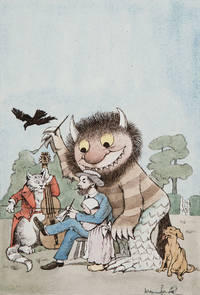
19851838<p><em><strong>SENDAK and CALDECOTT</strong></em></p><p><em>A watercolor in homage of his muse</em></p><p>Original ink and watercolor drawing depicting Moishe "Wild Thing" Sendak's avatar mimicking the artist Randolph Caldecott's self-caricature drawing from his period of sketching in Brittany 1870s now given a garden backdrop and including "The Cat and the Fiddle" Caldecott's dog and a blackbird aloft – with a Wild Thing to bring home the sentiment.</p><p>The design was commissioned by The Horn Book Magazine a Boston based publication which since inception in 1924 used the "Three Jovial Huntsmen" Caldecott image 1880 on horseback blowing their horns until in 1985 when the publication decided to invite a different illustrator to design new covers for a year – Maurice Sendak was their first choice and Maurice continued their honoring Caldecott by his "Moishe and Randolph" interpretation.</p><p>The ink and watercolor drawing measures 9 x 6-1/4 inches on larger paper Signed in full at bottom right the initials "R.C." and "M.S." are on Caldecott's sketchbook pages.</p><p>Aside from the image being used as the magazine cover a poster limited to 300 signed and numbered copies was also produced.</p><p>Maurice Sendak was a Brooklyn-born artist best remembered for his iconic book</p><p>"Where the Wild Things Are" published in 1963 and winner of The 1964 Randolph Caldecott Medal for the "most distinguished American picture book for children" given annually by the American Library Association's Children Services division. Sendak has written and illustrated numerous children's books created designs for posters prints book covers advertising campaigns and also many costume and set designs for opera and ballet.</p><p>This particular design honors Randolph Caldecott one of the major illustrators of his day and one of the many major influences in Maurice's canon of work.</p>
19712820DIOGENES 1971. 1. hardcover. Arsène Lupin Sirmkovrilo! KLASSISCHE ABENTEUER DIOGENES hardcover
1907579131907. Fine. ca.1907-2003 30 x 32 cm Maurice BLANCHOT Extraordinary collection of Maurice Blanchot's original photographs taken in the family setting the only printings C. 1907-2003 272 photographs various format Blanchot challenged photographers and caricaturists of the literary press for a long-time. His 'portraits' over so many years are minimalist and rare: in 1962 in L'Express a hand holds up a book at the bottom of the page; in 1979 in Libération a blank square is in the middle of the page with only Maurice Blanchot's name and a quote from the Entretien infini as a caption: an empty universe: nothing that was visible nothing that was invisible' C. Bident Maurice Blanchot. In 1986 at the time of an exhibition of writers' portraits he requested that his photo be replaced by a text showing his desire to appear as little as possible not to glorify his books but to avoid the presence of an author who was entitled to an independent existence. A photo taken without him knowing by a paparazzi in a supermarket carpark was used as the writer's portrait for a long time before his friend Emmanuel Levinas revealed a few rare photographs of their youth. The fact that Maurice Blanchot did not oppose this release and the fact that this was his closest friend's deed could be explained by what Bident calls the spacing of worry as the revealed portraits were not up-to-date similar to the postponed publications of his books L'Idylle Le Dernier Mot L'Arrêt de mort. Only a few photographs gathered on the central pages of the Cahiers de l'Herne issue dedicated to Maurice Blanchot and published in 2014 supplement these unique shots of the 20th-century's most secret writer. In his chapter The indisposition of the secret Christophe Bident devotes several pages to the almost total absence of images of this invisible partner questioning the intellectual and psychological motivation of the writer who was aware of the inevitable future revelation of his appearance: Everything must become public. The secret must be told. The darkness must emerge. That which cannot be said must however be heard. Quidquid latet apparebit all that is hidden is that which must appear. Maurice Blanchot L'Espace littéraire In general Maurice Blanchot refused to be photographed even in private life as confirmed by the family of his sister-in-law Anna who revealed in a letter to her nephew that she had not taken any photographs of the writer thus respecting his wishes. However the photographs taken with his close family show us a perfectly willing Blanchot and one even playing very elegantly with the image of himself that he projects to the photographer generally his brother. As such we discover an elegant man posing proudly on a boat pontoon or on the banks of the Seine or more mysteriously playing with lighting effects in the corner of an empty room. Here we see a real photographic staging and a symbolic reappropriation of image particularly in a surprising seated portrait of the writer holding the Inconnue de la Seine death mask in his arms the well-known plaster head of a young woman supposedly drowned who adorned artists' studios after 1900. A true romantic legend this sculpture with a mysterious post-mortem smile is at the heart of Aragon's novel Aurélien and haunts the work of artists at the beginning of the century including Rainer Maria Rilke Vladimir Nabokov Claire Goll Jules Supervielle Louis-Ferdinand Céline Giacometti and Man Ray who produced a worrying photographic portrait of the mask at Aragon's request. Maurice Blanchot described the unknown woman as an adolescent girl with her eyes closed but full of life with a smile so slender so rich . that we could believe that she was drowned in a moment of extreme happiness. This photograph of an impervious Blanchot cradling the white mask of the Mona Lisa of suicide asserts itself as a true deconstruction of representation. It becomes an ill unknown
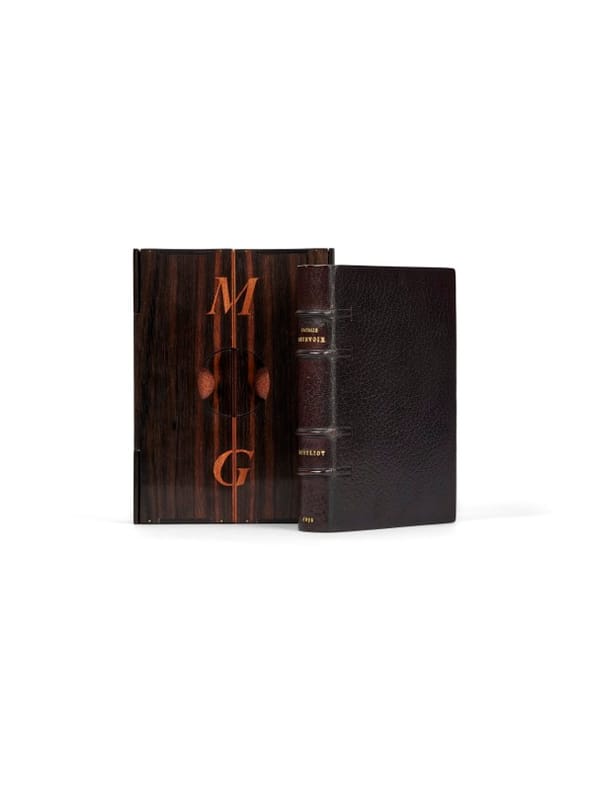
192531436L'historique exemplaire du prix Goncourt Paris, Bernard Grasset, (29 septembre) 1925. 1 vol. (115 x 180 mm) de 349 p. et [1] f. Maroquin brun, dos à nerfs, faux nerfs à froid sur les plats, titre doré, date en pied, contreplats à encadrement ornés de filets et pointillés dorés, doubles gardes de soie moirée et papier marbré, double filet doré sur les coupes, tranches dorées sur témoins, couvertures et dos conservés (reliure signée de G. Lévitsky) - conservé dans un écrin signé de Renaud Vernier : bois d'ébène, lettre mosaïquée en bois de rose, buffle assorti sur les deux rabats intérieurs avec titre doré, chemise et étui bordés. Édition originale. Un des 13 exemplaires sur japon, celui-ci hors-commerce (n° III). Exceptionnel exemplaire de l'auteur qui l'a fait relier avec : - la lettre autographe collective des membres de l'Académie Goncourt, signée par chacun d'eux et datée du 16 décembre 1925 (1 p. en 1 f. à en-tête de l'Académie + l'enveloppe à en-tête), remise place Gaillon et qui lui annonce qu'il est couronné du prix ; - Les 5 dessins originaux d'André Deslignères, du croquis à la maquette finale, qui ont servi au bois gravé pour l'illustration de la couverture (5 f., mine de plomb, encre et crayon de couleurs rouge). Une seconde couverture, illustrée d'un bois de Gérard Cochet et qui fait partie intégrante de l'édition, est bien présente dans l'exemplaire.
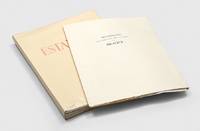
1950154025Paris & New York: L'Image Littéraire & R. Finelli-Feugère 1950. With an additional suite of Braque colour separations First edition first printing number 29 of 150 copies signed by all the artists and authors with each print numbered and signed by the respective artist and Robert Rey. This copy with an additional suite of 46 sheets with colour separations of Braque's print housed in separate wrappers lettered in black. The print titles included are: Braque "Nature morte au huitres"; Brianchon La neige a auteuil; Chagall La sirène; Desnoyer Liseuses au bord de mer; Dufy Le casino de la jetée a Nice; Laurencin Portrait de femme en rouge; Matisse Nature morte au magnolia; Picasso La cassarole Émaillée; Utrillo Le jardin de Montmagny; Van Dongen Tête de femme; Vlaminck Les blés dans la perche; and Waroquier Dolori sacrum. Folio. 12 colour woodcuts after each of the artists printed on Van Gelder Zonen wove paper with one edge untrimmed. Sheet sizes: 46.5 x 36 cm. Unbound sheets printed on Van Gelder Zonen wove paper in white wrappers titles to front cover in red. With glassine dust jacket. Housed in the publisher's blue morocco clamshell box titles to front cover and spine gilt. All contained in the original card packing box. Closed tear to front wrapper and glassine hinge of clamshell box split minor foxing in places otherwise a bright unfaded set. unknown
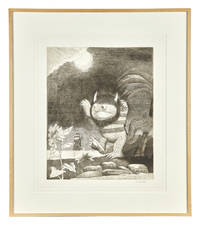
19791112104<p>An etching of an original image of a wild thing created and signed by Maurice Sendak on arches paper. Though there is no limitation number on the etching there were three separate pressing of three copies each done of this etching and signed by Sendak. The image itself measures 20 3/4" by 16 3/4". </p>
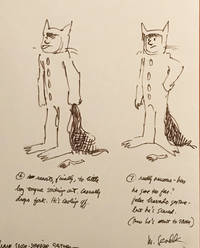
1973BB011SENDAK MAurice<br />MAX - Where The Wild Things Are Animation 1973<br />A series of seven character sketches of the protagonist Max dressed in his wolf suit intending to show the animators how the figure should move throughout the animated film.<br />Weston Woods Studio under the leadership of Morton Schindel introduced film strips in 1968 and eventually translated popular children's picture books into animated films for American schools. In 1973 he developed a rendition of Sendak's WILD THINGS created under the direction of Gene Deitch in Prague which proved a great success. Sendak put together this study sheet showing a variety of hand and foot gestures head motions &c with both front and partial profile views. Each of the seven sketches he has annotated below then writing a full line of extended text across the bottom: <i>"Note: all of this should be more agitated - more stacato ! - all sharp pointing stabbing gestures - Hitler moves : harsh sharp goose-stepping gestures"</i> with his signature at far right "M Sendak". <br />The drawings are first sketched in pencil and then further developed in ink using a pentel felt tip pen on smooth matte paper. A few copies were photographically reproduced to send to Czechoslovakia for animators to follow but this sheet is the actual artwork. books
1955135433New York: Harper & Brothers 1955. First edition first issue of the first book in Crockett Johnson’s charming Harold series first issue with "30-60" and "No. 5671A" to the front flap of the dust jacket. 12 mo original cloth illustrated. Association copy inscribed by the author on the front free endpaper to fellow children's book author and illustrator Maurice Sendak "To Maury with fond regards Crockett Johnson." The recipient Maurice Sendak is best known for his immensely popular illustrated children's book Where the Wild Things Are which was awarded the Caldecott Medal in 1964 and gained him international fame. Sendak Johnson and Johnson's wife Ruth Krauss were introduced by Harper & Row publisher and editor-in-chief of juvenile books Ursula Nordstrom in 1952. Nordstrom facilitated the partnership of Krauss and Sendak as author and illustrator of Krauss' A Hole Is to Dig 1952 which launched Sendak's career and was published 3 years before Harold and the Purple Crayon. Sendak would go on to illustrate seven additional Krauss titles and their collaborations became something of a cultural phenomenon spawning a host of imitators of their "unruly" and "rebellious" child protagonists. These "good books for bad children" became Nordstrom's trademark who disliked the genteel sentimental tone of earlier American children's literature and sought to change its purpose to appeal to children's imaginations and emotions rather than serve as adult-approved morality tales. In addition to Harold and the Purple Crayon 1955 and Where the Wild Things Are 1963 Nordstrom edited and published numerous milestones of children's literature including E. B. White's Stuart Little 1945 and Charlotte's Web 1952 Margaret Wise Brown's Goodnight Moon 1947 Louise Fitzhugh's Harriet the Spy 1964 and Shel Silverstein's The Giving Tree 1964. Near fine in a near fine dust jacket. Housed in a custom half morocco clamshell box by the Harcourt Bindery. An exceptional association. Crockett Johnson— the pen name for David Johnson Liesk—was “a cartoonist whose simplest sparest and boldest outlines produced unforgettable gently humorous and always endearing caricatures… His natural gift for drawing and writing from a young child’s viewpoint enabled him to craft more than 20 juvenile books†including this his most popular one. “With the fewest of lines Johnson depicts Harold as a toddler clad in sleepers his chubby hand gripping a fat plum-colored crayon. From page to page the thick firm purple mark delineates Harold’s actions against the stark white background so effectively and ingeniously that the crayon is as much a character as Harold. The same economy that informs Johnson’s art permeates his text; he writes so concisely of Harold’s moonlight stroll that his style perfectly echoes the clarity of his boldly outlined cartoon illustrations†Silvey 355. Harper & Brothers hardcover
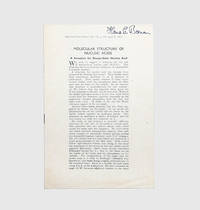
1953176047St Albans: Fisher Knight & Co. Ltd 1953. The founding document of modern biology owned by a prominent biologist First edition the three-paper offprint issue of the primary record of the co-discovery of the molecular structure of DNA. This copy is from the library of Professor Hans Gustav Boman 1924-2008 the leading molecular biologist in Sweden; his signature is in ink on the first page. Three research groups independently investigated the structure of DNA in England in the early 1950s: Francis Crick and James Watson at the Cavendish Laboratory in Cambridge and two teams at King's College London comprising Maurice Wilkins Rosalind Franklin Raymond Gosling Alec Stokes and Herbert Wilson. To acknowledge the simultaneity of the discovery the directors of the respective institutions agreed that the three resulting papers would be published under the general title Molecular Structure of Nucleic Acids in the British scientific weekly Nature. Crick and Watson's paper "A Structure for Deoxyribose Nucleic Acid" is illustrated with a schematic drawing by Odile Crick of the twisted-ladder structure of DNA now famously known as the double helix. Wilkins Stokes and Wilson co-wrote "Molecular Structure of Deoxypentose Nucleic Acids" the second paper. Franklin and her research student Gosling submitted "Molecular Configuration in Sodium Thymonucleate" which features a half-tone illustration of Gosling's iconic X-ray "Photograph 51" of crystallized DNA. Franklin died four years before the Nobel Prize in Physiology or Medicine was awarded to Crick Watson and Wilkins in 1962 for their work on DNA but without question her "contributions and indeed her actual X-ray data were crucial to the total achievement" ODNB. "Two offprints exist of Watson and Crick's paper: a single sheet containing the Watson and Crick article only and a fourteen-page pamphlet containing the papers of all three research groups. The pamphlet pages are smaller in size than the single leaf which has the same dimensions as the leaves of the journal and the layout is different the single-leaf offprint being printed in two columns like the journal the pamphlet in single-column pages. The page breaks are different in each of the two offprints and the journal as is the placement of the illustrations relative to the text. Despite these differences all three versions appear to have been printed from the same setting of type except that in the two offprints one paragraph of text has been reset to accommodate the placement of the diagram of the DNA molecule" Grolier p. 363. Haskell F. Norman discusses the difficulty in establishing priority between the two formats in his introduction to One Hundred Books Famous in Medicine and closes by stating that "it is now our tentative conclusion that the three-paper offprint is the first issue" p. xxi. Boman "was one of the pioneers in the field of molecular biology in Sweden" Norrby p. 11. After teaching at Uppsala University he transferred to Umeå University to establish their microbiology department; under his leadership it became an international hub of research excellence. "Halfway through his career Boman moved on to Stockholm University and initiated a completely new line of research. It pioneered the development of insights into the emerging field of natural immunity. He developed this work in collaboration with Swedish colleagues and coined the term cecropines for this new kind of peptide antibiotics. This was a Nobel-class discovery" but - like Franklin - Boman died before he could see his research recognized as such Norrby p. 11. In 2011 his work formed the basis of a discovery by Jules Hoffman and Bruce Beutler for which they received the Nobel Prize in Physiology or Medicine. Octavo pp. 14. With 4 illustrations. Printed pamphlet wire-stitched as issued. A few neat red pencil marks to first three pages lower outer corners creased: a near-fine copy. Garrison-Morton 256.3 Crick and Watson's paper; Grolier One Hundred Books Famous in Medicine 99; Heirs of Hippocrates 2342. Erling Norrby Nobel Prizes: Cancer Vision and the Genetic Code 2019. unknown
196896790New York: Atheneum 1968. First edition of Watson's ground breaking work regarding the discovery of DNA for which the author Francis Crick and Maurice Wilkins were awarded the Nobel Prize in Medicine in 1962. Signed by all three laureates on the title page James D. Watson Francis Crick and Maurice Wilkins. Octavo original blue cloth with numerous diagrams and photographic illustrations. Near fine in a near fine dust jacket. Jacket design by Jeanyee Wong. Foreword by Sir Lawrence Bragg. Housed in a custom half morocco clamshell box. We have never seen another example signed by all three contributors; exceptionally rare. "Science seldom proceeds in the straightforward logical manner imagined by outsiders" writes James Watson in The Double Helix his account of his codiscovery along with Francis Crick of the structure of DNA. Watson and Crick won Nobel Prizes for their work and their names are memorized by biology students around the world. But as in all of history the real story behind the deceptively simple outcome was messy intense and sometimes truly hilarious. To preserve the "real" story for the world James Watson attempted to record his first impressions as soon after the events of 1951-1953 as possible with all their unpleasant realities and "spirit of adventure" intact. Atheneum hardcover books
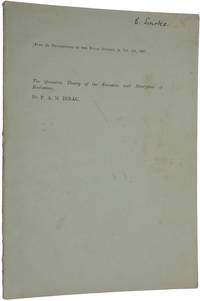
19275979London: Harrison & Sons for the Royal Society 1927. First edition. <p>First edition extremely rare offprint of Dirac's quantum theory of the electromagnetic field which for the first time reconciled the wave and particle nature of light. "This paper marks the birth of quantum electrodynamics" Schweber QED and the Men Who Made It. "Dirac's approach to the radiation problem . came as a revelation" Gregor Wentzel.</p>. THE BIRTH OF QUANTUM ELECTRODYNAMICS. <p>First edition extremely rare offprint of Dirac's quantum theory of the electromagnetic field which for the first time reconciled the wave and particle nature of light. "This paper marks the birth of quantum electrodynamics. In his 'Introduction and Summary' Dirac noted that the new quantum theory based on non-commuting dynamical variables was by then sufficiently developed to form a 'fairly complete theory of any 'dynamical system' composed of a number of particles with instantaneous forces acting between them provided it is describable by a Hamiltonian function.' But hardly anything had been done 'up to the present on quantum electrodynamics.' 'The questions of the correct treatment of a system in which the forces are propagated with the velocity of light instead of instantaneously of the production of an electromagnetic field by a moving electron and of the reaction of this field on the electron have not yet been touched. In addition there is a serious difficulty in making the theory satisfy all the requirements or the restricted principle of relativity' . Gregor Wentzel who contributed significantly to the development of quantum electrodynamics during the 1920s commented in 1959: 'Today the novelty and boldness of Dirac's approach to the radiation problem may be hard to appreciate . there had been no possibility within the correspondence principle framework to understand the process of spontaneous emission or the disappearance of a photon. Dirac's explanation . came as a revelation' . In his paper Dirac dealt with the problem of an atom interacting with the radiation field in two distinct ways that can be characterized as the 'corpuscular' and the 'wave' approaches. In the corpuscular approach the light quanta are described as an assembly of 'non-interactive particles moving with the speed of light and satisfying the Einstein-Bose statistics' . In the last brief section of his paper Dirac turned to the interaction of an atom with the electromagnetic field as described from the wave point of view . In a lecture on the origin of quantum field theory in 1982 Dirac characterized the two approaches as follows: 'Instead of working with a picture of the photons as particles one can use instead the components of the electromagnetic field. One thus gets a complete harmonizing of the wave and corpuscular theories of light. One can treat light as composed of electromagnetic waves each wave to be treated like an oscillator; alternatively one can treat light as composed of photons the photons being bosons and each photon state corresponding to one of the oscillators of the electromagnetic field. One then has the reconciliation of the wave and corpuscular theories of light. They are just two mathematical descriptions of the same physical reality" Schweber pp. 23-31. "Dirac's approach was instantly welcomed as the first consistent quantum theory of radiation and accepted as the paradigm in a whole series of subsequent studies" Kojevnikov p. 232. "Salam and Wigner in their preface to the Festschrift that honored Dirac on his seventieth birthday and commemorated his contributions to quantum mechanics succinctly assessed the man. 'Dirac is one of the chief creators of quantum mechanics . Posterity will rate Dirac as one of the greatest physicists of all time . He is a legend in his own lifetime and rightly so'" ibid. pp. 11-12. Not on OCLC no copies in auction records.</p> <br /> <p>Provenance: Bertha Swirles 1903-99 signature on front wrapper marginal pencil annotations including an equation in the lower margin of p. 261. As an undergraduate at Cambridge Swirles attended lectures by J. J. Thomson and Rutherford. She remained at Cambridge in 1925 to undertake research in mathematical astronomy under the supervision of Ralph Fowler; another of Fowler's research students a couple of years ahead of Swirles was Paul Dirac. After periods at Bristol Imperial College London and Manchester Swirles took up a lectureship in mathematics at Girton College Cambridge in 1938 where she remained for the rest of her career.</p> <br /> <p>Before Dirac's work the understanding of the emission and absorption of radiation was founded on that set out by Einstein in 1917. Einstein admitted the existence of three kinds of processes involving the interaction of radiation with matter: spontaneous emission absorption and stimulated emission. Einstein denoted the probability per unit time of these processes A ÏB and ÏB' where Ï is the intensity of the incident radiation in the cases of absorption and stimulated emission. Einstein showed that in order to satisfy Planck's radiation law one must have B = B' so that the processes were determined by two coefficients A and B. The new process of stimulated emission in which an atom is 'persuaded' to undergo a quantum jump between two quantum states when radiation of the correct frequency is incident upon it is the process involved in the operation of the laser.</p> <br /> <p>Dirac's first study of radiation theory was the subject of the last section of the important paper 'On the Theory of Quantum Mechanics'. The first part of this paper is best known for establishing the connection between Bose-Einstein statistics and symmetric wave functions on the one hand and what became known as Fermi-Dirac statistics and anti-symmetric wave functions on the other. In the second part of this paper "Dirac considered a system of atoms subjected to an external perturbation that could vary arbitrarily with the time. Of course the particular perturbation he had in mind was an incident electromagnetic field but characteristically he stated the problem in the most general way possible . Dirac obtained results 'in agreement with the ordinary Einstein theory' that is with the quantum mechanical derivation of the B coefficients that occurred in Einstein's theory of 1917. Since he made use of a classical description of the electromagnetic field Dirac was not at the time able to proceed further and he noted 'One cannot take spontaneous emission i.e. the A coefficients into account without a more elaborate theory.' This more elaborate theory was ready less than half a year later" Kragh pp. 120-121.</p> <br /> <p>"The introduction to the 'Quantum Theory of Radiation' appears to have been written after reflection on the already completed body of the paper. It presented the construction of a quantum theory 'of the emission of radiation and of the reaction of the radiation field on the emitting system' as the main object of the paper. This must be accomplished by taking the Hamiltonian for an atom interacting with an electromagnetic field and converting the classical field quantities into quantum-mechanical operators. If the Hamiltonians were then written in terms of a closed system that is with terms representing the energies of the atom the field and the interaction a calculation of the coefficient of spontaneous emission as well as of induced emission and absorption would be possible and thus the problem that had been left open would be solved. Dirac also reported that he had discovered a way to write the Hamiltonian for matter and radiation in terms of the interaction of the atom with an assembly of light quanta. This gave him two equivalent expressions whose starting points were respectively waves and quanta. This equivalence on the one hand and the translation of the classical field variables into quantum operators on the other provided the formal basis for an understanding of the constitution of light" Bromberg p. 151.</p> <br /> <p>"According to Dirac's recollections the fundamental idea of his 1927 radiation theory was obtained unsystematically and unexpectedly. It was 'one of those ideas out of the blue' from which so much of his science originated. The work was the result of 'playing about with the Schrodinger equation . . . and seeing what happens when you make the wave functions into a set of non-commuting variables.' This idea out of the blue led to what was later called 'second quantization.' Instead of treating the energies and phases of radiation as c-numbers i.e. commuting quantities as he had done in his 1926 paper Dirac treated them as q-numbers non-commuting quantities generalizing the matrices of Heisenberg's quantum mechanics. In general second quantization involves considering the wave function as an operator instead of just a number .</p> <br /> <p>"In order to calculate the probabilities of absorption and emission of a photon he constructed a Hamiltonian that described the interaction between a photon and an atom. The Hamiltonian had to incorporate the fact that photons are not conserved but may be spontaneously created or destroyed. Dirac included this feature in his Hamiltonian by introducing unobservable or spurious photons that is photons with zero energy and momentum:</p> <br /> <p>'When a light-quantum is absorbed it can be considered to jump into this zero state and when one is emitted it can be considered to jump from the zero state to one in which it is physically in evidence so that it appears to have been created. Since there is no limit to the number of light-quanta that may be created in this way we must suppose that there are an infinite number of light-quanta in the zero-state.'</p> <br /> <p>"Dirac introduced the idea of zero-state photons because he believed such entities were necessitated by formal reasons. From the point of view of methodology it should be noted that unobservable zero-state photons were dubious entities according to the positivist Heisenberg-inspired view of physical theory that Dirac by and large accepted. This only illustrates that Dirac's positivism was not strict. Also worth noticing is that in 1930 when introducing the hole theory of electrons Dirac proceeded in a way that was conceptually similar to the way he followed in formulating his radiation theory .</p> <br /> <p>"In the last section of his paper Dirac turned to consider the interaction between an atom and radiation from the wave point of view. He again calculated the Einstein coefficients getting the same result he had obtained when using the photon point of view. He concluded that</p> <br /> <p>'. the Hamiltonian which describes the interaction of the atom and the electromagnetic waves can be made identical with the Hamiltonian for the problem of the interaction of the atom with an assembly of particles moving with the velocity of light and satisfying the Einstein-Bose statistics by a suitable choice of the interaction energy for the particles . There is thus a complete harmony between the wave and light-quantum descriptions of the interaction'" Kragh pp. 121-124</p> <br /> <p>"The quantization of the electromagnetic field as carried out in the construction of the second Hamiltonian for atoms and waves by itself brought with it introduction of light quanta. 'The assumption that the variables are q-numbers satisfying the standard quantum conditions immediately gives light-quantum properties to the radiation'" Bromberg p. 153.</p> <br /> <p>"As an indirect consequence of his theory Dirac arrived at a completely new picture for the vacuum. After Einstein had abolished the concept of the ether the matter-free and field-free vacuum was considered as an entirely empty space. But in quantum mechanics because of Heisenberg's uncertainty principle the electromagnetic field oscillators cannot be strictly at rest. As a consequence even in the ground state with the lowest possible energy there still exist the so-called zero-point oscillations of quantum oscillators. Hence the oscillatory nature of the electromagnetic field of radiation leads to the zero-point oscillations of this field in the vacuum state the state of lowest possible energy. The physical vacuum is not an empty space but is 'populated' with zero point oscillations which are the cause of the spontaneous emission of radiation from atoms. Thus Dirac's theory provided the explanation for all results regarding the emission and absorption of radiation by atoms" Mehra & Milton p. 180.</p> <br /> <p>"Everybody was impressed by the new radiation theory. Heisenberg and Pauli soon decided to construct their own quantum electrodynamics on the same basis. Bohr liked it too because it fit well with his philosophy of complementarity. 'The renunciation of intuition in space and time that characterizes this treatment of the radiation problem gives and impressive indication of the essentially complementary nature of description in the theory of quanta'" Darrigol p. 226. "On the other hand since the early 1930s Dirac was an active critic of the theory and tried to develop alternative schemes. He did not become satisfied with the later method of renormalization and regarded it as a mathematical trick rather than a fundamental solution and died unreconciled with what to a large extent was his own brainchild" Kojevnikov p. 229.</p> <br /> <p>"Although not well known to the general public Paul Adrian Maurice Dirac hardly needs to be introduced to physicists and historians of science. Born in Bristol in 1902 as a Swiss citizen - his father was Swiss and Paul only acquired British nationality in 1919 - he became one of the most important theoretical physicists ever. His impact on modern physics may even have been greater than that of Einstein. Young Dirac made his first breakthrough in the fall of 1925 when he developed his own version of quantum mechanics known as q-number algebra and over the next few years he established himself as a leading expert in the new quantum physics. In 1927-28 he made pioneering contributions to quantum statistics Fermi-Dirac statistics quantum electrodynamics and relativistic quantum theory. The linear and relativistically-invariant wave equation for the electron that he published in early 1928 not only explained the electron's spin and magnetic moment but also three years later led to the prediction of antielectrons positrons and antiparticles more generally.</p> <br /> <p>"Dirac's genius was recognized early on. For example he was part of the exclusive company of physicists invited to the famous Solvay conference in 1927. In 1930 at the unusually young age of 27 he was elected a fellow of the prestigious Royal Society and the same year he published his monumental Principles of Quantum Mechanics. Two years later he was appointed Lucasian Professor of mathematics at Cambridge University the chair once held by Isaac Newton and later by Stephen Hawking. Another high point of Dirac's career came in 1933 when he was awarded the Nobel Prize in physics sharing it with Erwin Schrödinger. Although Dirac's scientific fame is closely linked to his fundamental contributions to quantum theory and especially to those of the period 1925-34 he also dealt with other subjects including cosmology classical electron theory and the general theory of relativity. Moreover the influence of his ideas extended beyond physics especially to mathematics e.g. the Dirac δ-function Dirac matrices and Dirac operators. Paul Dirac remained Lucasian Professor until his retirement in 1969 when he joined the physics department of Florida State University in Tallahassee. He died in 1984 and in 1995 a commemorative stone carrying his name and equation was unveiled at a ceremony in Westminster Abbey.</p> <br /> <p>Bromberg 'Dirac's Quantum Electrodynamics and the Wave-Particle Equivalence' pp. 147-157 in: History of Twentieth Century Physics. Proceedings of the International School of Physics 'Enrico Fermi' Course LVII Weiner ed. 1977. Darrigol 'The Origin of Quantized Matter Waves' pp. 197-253 in: Historical Studies in the Physical and Biological Sciences 16 1986. Kojevnikov 'Dirac's quantum electrodynamics' pp. 229-259 in: Einstein Studies in Russia. Einstein Studies Vol. 10 2002. Kragh Dirac. A Scientific Biography 1990. Mehra & Milton Climbing the Mountain. The Scientific Biography of Julian Schwinger 2003. Schweber QED and the Men Who Made It 1994.</p> <br/> <br/> 8vo 254 x 179 mm pp. 243 244-265 1 blank Original printed wrappers. Harrison & Sons for the Royal Society unknown
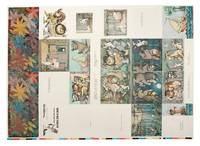
1963395571New York: Harper & Row 1963. Unbound. Near Fine. Measuring 56†x 42â€. Some light wear at edges and a few light scattered creases near fine. A production page proof for Maurice Sendak's classic children's book Where the Wild Things Are. The proof is printed on both sides and retains its original bright and vibrant colors. It comes from the personal archives of a distinguished children's book author and editor who worked closely with both Sendak and the book's editor Ursula Nordstrom. While there is no jacket present to verify the issue points as typical for a first edition of the book the title page is conspicuously missing its Library of Congress identification number suggesting it was printed prior to securing one as required for publication. Further we have only been able to locate one other known copy of page proof for Where the Wild Things Are in the Maurice Sendak Collection at the Rosenbach Museum and it too lacks the LOC number on the title page. An amazing artifact from what is one of the most popular and influential children's book of the 20th Century. Harper & Row unknown
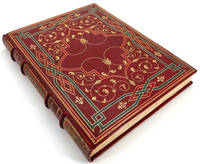
1926577Paris: Société Nouvelle des Éditions d'Art Devambez 1926. Limited Edition. Fine. Edgar Chahine. 4to 13 x 10 3/4 inches 330 x 250 mm; 112 pp. Copy number XXIV of 30 HC copies on papier japon ancien with 26 plates frontispiece title vignette 5 in-text and 19 full-page. Each plate appears in 3 states: first state final state with remarques final state. This is one of 30 copies with roman numerals reserved for the artist and his friends "Imprimé pour l'artiste et ses amis" from an edition limited to 230 special copies; our copy also includes 4 additional plates also in 3 states an original drawing in reddish-orange crayon signed by Edgar Chahine and a signed copper etching plate for one of the illustrations. Superb red morocco binding by H. Blanchetière signed at foot of front turn-in. Covers with inlaid strapwork border of scarlet and turquoise morocco and elaborately tooled in gilt with scrolls and hatched decoration; spine titled in gilt with 3 strapwork compartments and 4 raised bands doublures of turquoise morocco within border of red morocco all tooled in gilt with the original copper plate for an etched portrait inset into front doublure gilt decorations on back doublure red silk moiré flyleaves marbled endpapers t.e.g. Original wrappers and spine bound in very slight rubbing to joints some light foxing; marbled board slipcase a little rubbed. <br /> <br /> Carteret IV 60; BNF34834086. A sumptuous edition of Maurice Barrès 1862 - 1923 travel impressions of Venice which he wrote in 1903 while living in Italy. Barrès was closely associated with the French Symbolists and the Italian Decadents like Gabriele d'Annunzio. He wrote a trilogy The Cult of the Self in 1888 and shortly thereafter was elected to the Chamber of Deputies and remained very involved in nationalist politics for the rest of his life. <br /> This superb 1926 edition is masterfully illustrated by Edgar Chahine 1874 - 1947 an artist of Armenian descent who studied in Venice for several years before moving to Paris. In his etchings he captures the mood and character of the city and its inhabitants. This super-illustrated edition includes the copper plate of the portrait of Chateaubriand p. 52 inset into the front doublure with the following inscription etched at the top of the plate after printing: "Achevé d'imprimer. 1926" followed by Chahine's signature. The book incorporates beautiful typography and a unique colophon set in the shape of the bow-iron that characterises the prow of all Venetian gondolas. Société Nouvelle des Éditions d'Art Devambez unknown
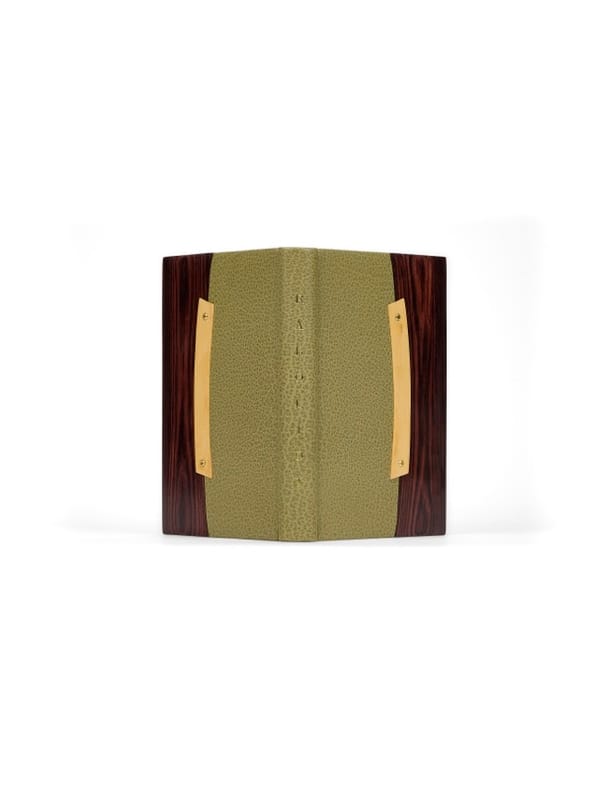
192530971n° 1 sur papier de Chine, pour Genevoix.Reliure de Renaud Vernier Paris, Bernard Grasset, (29 septembre) 1925. 1 vol. (115 180 mm) de 349 p et [1] f. Buffle vert olive à décor de bois de violette et de buis, dos lisse, titre doré, tranches dorées sur témoins, doublures et gardes de chèvre velours violet, couvertures et dos conservés, chemise, étui (reliure signée de Renaud Vernier, Maître d'art, ED. Claude Ribal, dorure sur tranches de Jean-Luc Bongrain, 2025). Édition originale. Un des 7 premiers exemplaires sur chine (n° I).
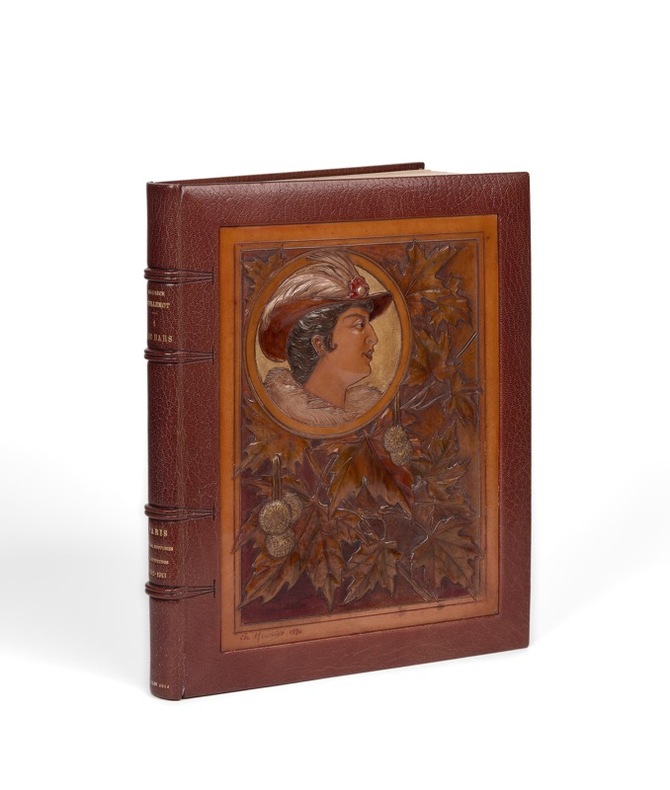
191229062Précieux exemplaire dans une importante reliure de Charles Meunier Paris, La Maison du Livre, imprimé pour Charles Meunier, 1914. 1 vol. (300 x 375 mm). Exemplaire entièrement monté sur onglets. Maroquin havane, dos à nerfs soulignés sur les mors, plats biseautés avec, sur le premier, un important motif en cuir modelé et incisé, en relief peint et doré, représentant un visage d'élégante chapeautée dans un médaillon sur un fond de feuilles de platane, double filet doré sur les coupes, large encadrement intérieur orné de filets dorés et à froid avec motifs d'angle doré, tranches dorées sur brochure, couverture muette et couverture imprimée, chemise et étui (reliure signée de Charles Meunier). Édition de luxe tirée à 30 exemplaires seulement, sur Japon impérial (n° 6). Premier tirage de cette illustration, la plus réussie et la plus forte de cet artiste, comportant vingt eaux-fortes originales dont dix en couleurs, hors-texte.
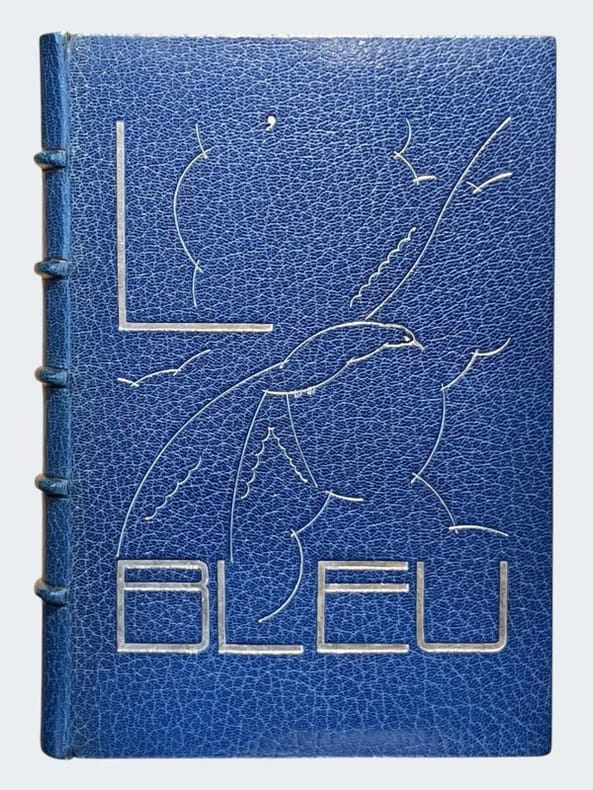
19246351924 Paris, « Le Livre » [Émile Chamontin], 1924-1925 et 1927 ; 2 vol. in-8, maroquin bleu roi, titre et décor au palladium ornant le premier plat, dos à nerfs muets, large cadre intérieur décoré de deux filets au palladium, doublures et gardes de moire bleue, tranches dorées, couvertures illustrées en couleurs, chemises à rabats et étuis (Canape R. D. 1927).
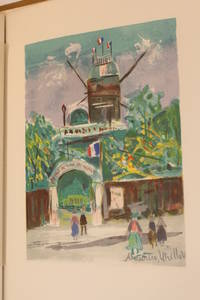
194774125Paris: Editions Pétridès 1947. Fine. Editions Pétridès Paris 1947 28 x 38 cm relié First edition one of 240 numbered copies on vélin d'Arches with 22 color lithographs after gouaches including 12 full-page plates by Maurice Utrillo printed in the ateliers of Fernand Mourlot and Lucien Détruit. White aniline calf with gilt titanium joints ink-painted boards in green and grey decoration continuing edge-to-edge on the liners loose endpapers on papier japon dyed with Kakishibu by the binder title lengthwise on the spine decorated chemise titled on the spine and matching custom slipcase. Original wrappers and spine preserved. Binding signed by Julie Auzillon gilt title by Geneviève Quarré de Boiry and gilt top edge by Jean-Luc Bongrain 2022. This book presenting every style of the famed artist from Montmartre was published on the occasion of his exhibition in 1947 at the Paul Pétridès gallery. This book presenting every aesthetic period of Montmartre artist Maurice Utrillo was published for his 1947 exhibition at the Paul Pétridès gallery. Mounted at the front of the book an autograph sonnet entitled ""L'Art pictural"" signed by Maurice Utrillo and addressed to Francisque Poulbot; two quatrains and two tercets written in black ink on lined paper. Before the poem Utrillo specified: ""Sonnet par Maurice Utrillo V < dédié à son ami et confrère < Georges Kars."" Sonnet by Maurice Utrillo V < dedicated to his friend and colleague < Georges Kars Signed and inscribed by Utrillo a second time at the top of the sheet: ""Amicalement à Francisque Poulbot"". A few stains to the margins not affecting reading. The sonnet was published in ART vol. 2 October 1934-July 1935 p. 9. This beautiful poem a true poetic manifest of pictorial independence twice signed by Utrillo is dedicated to cartoonist Francisque Poulbot a key figure in Montmartre society. It brings together iconic figures of the Butte famous for their bohemian life and eternal drunkenness: Utrillo Poulbot and Georges Kars a Cubist artist of Czech origin living in Montmartre whose paintings are celebrated by Utrillo in the sonnet. Utrillo wrote this manuscript in 1928 to Francisque Poulbot former classmate of the Lycée Rollin who had become a renowned draughtsman goguettier and founder of the République de Montmartre. Poulbot sketched the painter many times in his beloved Montmartre streets brush in one hand and bottle in the other the silhouette of the Sacré-Coeur church looming in the distance. Utrillo and Poulbot both stayed at some point in their lives at 12 rue Cortot where the Musée de Montmartre is now located. The year he wrote this poem Utrillo painted a superb gouache of Poulbot's house on avenue Junot. Although known for his paintings Utrillo also found in poetry a form of redemption for his bouts of alcohol-induced hysteria. Considered by his friends as a ""builder of sonnets or dithyrambic quatrains"" his verses were praised by famed critic Félix Fénéon. Utrillo also used poetry to celebrate his Montmartre artist neighbors. He wrote this poem in honor of Czech painter Georges Kars thanking him for a striking portrait of him exhibited at the Berthe Weill gallery: « Qu'il me soit donc ici permis en compagnon Sincère et noble et pur en non troubleur en rond Sur cet Art pictural d'émettre un trait austère Georges Kars en ce lieu de digne réunion Rue Laffitte chez Weill de l'art porte-fanion S'affirme en ses tableaux inventif et sincère. » Kars had settled in Montmartre in 1908 and spent many summers in Cadaquès with his wife Utrillo and his mother Suzanne Valadon. In these verses dedicated to the lines of ""his friend and colleague"" Kars Utrillo celebrates the independence and aesthetic personality emancipated from any artistic movement which also characterized Utrillo's own style. Utrillo being a self-taught painter he states his difference from academism and even the avant-gardes of yesteryear citing the Impressionist revolution embodied by the Cormon s Editions Pétridès hardcover
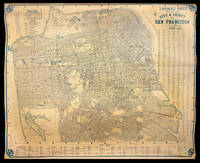
192614395San Francisco Oakland and Los Angeles: Compiled & Published by Thomas Bros. Map Publishers & General Draftsmen 1926. 1676 by 2083mm. 66 by 82 inches; 5.5 by 7 feet. Lithographed wall map printed in blue over-printed in red blue and green wash in outline to coastline and the park areas respectively laid down on linen as issued A monumental map of San Francisco at the height of its post-fire pre-depression era development the vision of the chief engineer Michael Maurice O'Shaughnessy 1864-1934 who modernised the infrastructure of San Francisco and who is revered as one of the most important civil engineers in American history. After the devastating earthquake and fire of 1906 San Francisco underwent an intense period of reconstruction and development which culminated in the city as the Thomas Brothers' map shows it. A year later in 1927 construction began on San Francisco airport on Mills Fields 13 miles south in San Mateo County making it a truly international city. The city is limited by its natural boundaries with the Pacific Ocean and San Francisco Bay on three sides and the border with San Mateo County to the south. Included on the map are a 'Street index' 'Tract Index' 'Legend' 'San Francisco Street Car Lines' including all stops for the 'Market Street Railway' 'California St. Cable RY.' 'Municipal Railway' and a list of the 'New Streets' in the newly developed southwest portion of the City adjacent to California and San Francisco Golf Clubs at Laguna de la Merced. In 1912 the then mayor of San Francisco James Rolph persuaded O'Shaughnessy to take the post of chief engineer for the city a position which he held for the next twenty years. "The tasks he faced were challenging the more so as he could have made much more money in the private sector. O'Shaughnessy whose long-term view of the city's infrastructure included much more than its water supply which had been his previous concern felt that San Francisco's public transportation network should be a single system providing uniform service at a reasonable price throughout the city. The transportation system could be used to encourage growth in given areas through construction of new lines ahead of residential development. Careful design of the system would produce cost-effectiveness. O'Shaughnessy thus supervised the expansion of the city's streetcar system by building new lines into areas with no previous service using funds derived from operating income and by assessing properties along the right-of-way. Between 1915 and 1927 O'Shaughnessy created the municipal streetcar system that formed the basis of San Francisco's future public transportation network. In addition to modernizing the railway system O'Shaughnessy supervised a new fire system sewers streets highways bridges and tunnels. Much of this construction was done over the areas destroyed by the 1906 earthquake and fire. Under his leadership the city built a main sewer line under Golden Gate Park to the Pacific Ocean. All of these accomplishments however paled before the challenge of the construction of the city's water-supply system from the Hetch Hetchy Valley" Abraham Hoffman for ANB. The Thomas Bros. publishing firm was founded by cartographer George Coupland Thomas and his two brothers in Oakland California in 1915. They published the popular 'Thomas Guide' which was not only useful for tourists but indispensable to the government and emergency services who would refer to the 'Thomas Guide' page number and map grid in dispatches. They published many other maps and atlases until 1999 when they were acquired by Rand McNally. Rare: not in Rumsey; while OCLC records other maps with this title published by the Thomas Bros. company from 1922 to 1946 all are much smaller folding maps. List of 'New Streets': Aerial Way Agnon Ave. Aloho Ave. Benton Ave. Brentwood Ave. Cascade Way Colonial Way Cecilia Ave Cragmount Way Delmote St. El Verano Way Fanning Way Genebern Av. sic Grant Way Harding Blvd. Justin Dr. Lurline St. Lomita Av. Loyola Terrace Mandaly Lane Manor Drive Mantucket Ave. Miroloma Drive Mount Lane Mt. Davidson Way Murray Av. North Gave Dr. Oriole Way Ortega Way Pilgrim Ave. Pinehurst Way Radio Terrace Rock Ridge Drive Roosevelt Way Rudden Av San Andres Way San Jacinto Way St. Elmo Ave. Southern Heights Av. Upland Drive Westgate Drive Wilson fmly Bismark. Compiled & Published by Thomas Bros. Map Publishers & General Draftsmen, unknown
1946003794Floury 1946. 1st Edition 1st Printing. Soft cover. Very Good. About the book: Softcover. First Printing. Signed by Delavier on half title page. Half title page is uncut at the top. Still attach to title page. 60 loose plates with one fold out table of contents. All are in very good condition. Cover is also in very good condition. Onion skin protecting the cover. Not sure if this was part of the production or added on afterwards. Published by hand in a print run of 500 copies. Extremely rare. Additional photos available upon request. Additional shipping charges may apply. <br/> <br/> Floury paperback
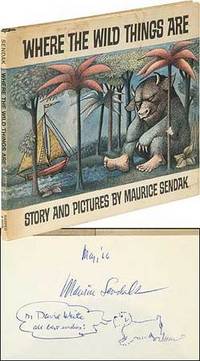
1963325185New York: Harper & Row 1963. Hardcover. Near Fine/Very Good. First edition with the publisher's price and the correct first issue code on the front flap. Cloth and papercovered illustrated boards. A bit of foxing to the boards near fine in a modestly toned very good dust jacket with a couple of faint splash marks. Nicely Inscribed by Sendak in 1966 with a small drawing of a dog. Harper & Row hardcover
194774125Editions Pétridès | Paris 1947 | 28 x 38 cm | relié
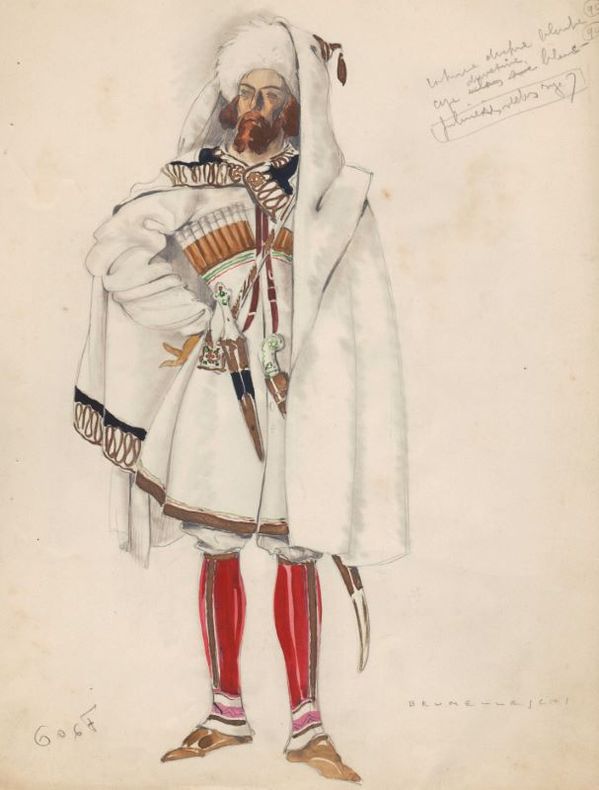
1938193831938 22 aquarelles pour le spectacle-opérette de Mogador, sur papier cartonné beige, 21 signées en bas à droite, 4 datées (1938), rehauts d'or et de blanc, mine de plomb, feuilles de 32 x 25 environ, dessins de 30 x 15 cm. environ.
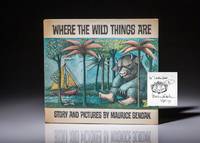
1963874New York: Harper & Row Publishers 1963. First Edition. Hardcover. Near fine/near fine. First edition of Where The Wild Things Are signed by Maurice Sendak in first state dust jacket. Oblong quarto 38pp. Illustrated boards olive green cloth spine. Light shelf wear to edges of boards. Housed in custom cloth clamshell title on spine on red morocco label. On title page contains Library of Congress number 63-21253. Pictorial endpapers bright boards and clean illustrated text. In a first issue dust jacket near fine with $3.50 price on front flap code "40-80 / 1163" on bottom of front flap three paragraph blurb on front flap and no mention of the Caldecott Award. Light wear to dust jacket on spine with 1 mm chip at top corner of spine. Signed by author and illustrator Maurice Sendak on half title with illustration of "Wild Thing" drawn in his hand dated September 1971. Hanrahan A58 An exceptional signed copy. Harper & Row, Publishers hardcover books
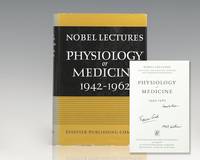
196495688Amsterdam: Elsevier Publishing Company 1964. First edition of this collection of Nobel Lectures in physiology or medicine from the years 1942-1962. Thick Octavo original yellow cloth. Signed by all three Nobel Prize-winning scientists Francis Crick James D. Watson and Maurice Wilkins on the title page. They were awarded the Nobel Prize in Medicine in 1962 "for their discoveries concerning the molecular structure of nucleic acids and its significance for information transfer in living material."Fine in a very good dust jacket with some closed tears and toning to the spine. An exceptional piece signed by these Nobel Prize-winning scientists. In the early 1950s the race to discover DNA was on. At Cambridge University graduate student Francis Crick and research fellow James Watson had become interested impressed especially by Pauling's work. Meanwhile at King's College in London Maurice Wilkins b. 1916 and Rosalind Franklin were also studying DNA. The Cambridge team's approach was to make physical models to narrow down the possibilities and eventually create an accurate picture of the molecule. The King's team took an experimental approach looking particularly at x-ray diffraction images of DNA. Watson and Crick took a crucial conceptual step suggesting the molecule was made of two chains of nucleotides each in a helix as Franklin had found but one going up and the other going down. Crick had just learned of Chargaff's findings about base pairs in the summer of 1952. He added that to the model so that matching base pairs interlocked in the middle of the double helix to keep the distance between the chains constant. Watson and Crick showed that each strand of the DNA molecule was a template for the other. During cell division the two strands separate and on each strand a new "other half" is built just like the one before. This way DNA can reproduce itself without changing its structure -- except for occasional errors or mutations. The structure so perfectly fit the experimental data that it was almost immediately accepted. DNA's discovery has been called the most important biological work of the last 100 years and the field it opened may be the scientific frontier for the next 100. Elsevier Publishing Company hardcover books
196495688Amsterdam: Elsevier Publishing Company 1964. First edition of this collection of Nobel Lectures in physiology or medicine from the years 1942-1962. Thick Octavo original yellow cloth. Signed by all three Nobel Prize-winning scientists Francis Crick James D. Watson and Maurice Wilkins on the title page. They were awarded the Nobel Prize in Medicine in 1962 "for their discoveries concerning the molecular structure of nucleic acids and its significance for information transfer in living material."Fine in a very good dust jacket with some closed tears and toning to the spine. An exceptional piece signed by these Nobel Prize-winning scientists. In the early 1950s the race to discover DNA was on. At Cambridge University graduate student Francis Crick and research fellow James Watson had become interested impressed especially by Pauling's work. Meanwhile at King's College in London Maurice Wilkins b. 1916 and Rosalind Franklin were also studying DNA. The Cambridge team's approach was to make physical models to narrow down the possibilities and eventually create an accurate picture of the molecule. The King's team took an experimental approach looking particularly at x-ray diffraction images of DNA. Watson and Crick took a crucial conceptual step suggesting the molecule was made of two chains of nucleotides each in a helix as Franklin had found but one going up and the other going down. Crick had just learned of Chargaff's findings about base pairs in the summer of 1952. He added that to the model so that matching base pairs interlocked in the middle of the double helix to keep the distance between the chains constant. Watson and Crick showed that each strand of the DNA molecule was a template for the other. During cell division the two strands separate and on each strand a new "other half" is built just like the one before. This way DNA can reproduce itself without changing its structure -- except for occasional errors or mutations. The structure so perfectly fit the experimental data that it was almost immediately accepted. DNA's discovery has been called the most important biological work of the last 100 years and the field it opened may be the scientific frontier for the next 100. Elsevier Publishing Company hardcover