Johannes Mauritius (1660-1720).Biblio.com
61 résultats
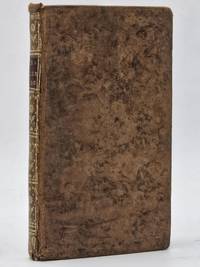
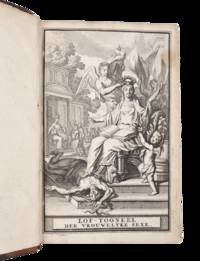
17042202<p>48 378 12 pp. With an engraved frontispiece.</p><p>Contemporary mottled calf with ribbed and gold-tooled spine sprinkled edges.</p><p>Rare first and only edition of a peculiar and polemical work which uses a female abecedarium to attack Catholic invective against women. Arranged alphabetically—from <em>Avidum animal</em> to <em>Zelus Zelotipus</em>—the author ironically surveys women's wit eloquence moral qualities and physical appearance combining satire polemic and learned rhetoric. The book also offers insight into early-eighteenth-century Protestant debates on marriage gender and Catholic religious culture.<br />The author was an Amsterdam merchant and former Catholic priest who converted to Calvinism and became known for his vehemently anti-Catholic writings often directed against monastic life and clerical celibacy. <em>Zeege-pralende lof-tooneel der vrouwelyke sexe</em> must be read within this broader religious and ideological agenda: Johannes Mauritius presents Catholic denunciations of women as a deliberate strategy employed by "the Papists" to justify the prohibition of marriage and to lure men into the cloister. He was the father of the prodigy poet jurist and later Suriname governor Joan Jacob Mauricius 1692–1768 whose early intellectual development was shaped by his father's militant anti-Catholicism and literary ambitions.</p><p><strong>Condition: </strong>corners slightly bumped front joint splitting. Small faint stain on the first few pages see pictures. Otherwise in very good condition.</p><p><strong>Reference: </strong>Muller 482; De Vries 190; Scheepers I 452.</p> Johannes Strander
1753293074La Haye.: Aux Depens de la Compagnie. 1753. Contemporary full brown leather gilt spine decorations marbled edges marbled endpapers. Good plus front hinge beginning to split bookplate removal to paste down minor marginal damage to the lower corner of the plates. 12mo. 14x8 cm. French text. weight: 0.3 lb. 3 folding tables. Aux Depens de la Compagnie. hardcover
1800v0545London: John Dean for J. Wright 1800. Important first-person account of the Spanish conquest of the Aztec empire written some 50 years after the events described based in part on discussions with others involved at the time. Diaz counters de las Casas' depiction of the Spaniards as needlessly cruel and emphasizes the role of the common soldier objecting to accounts he felt gave too much credit to Cortes. First edition in English. Hardcover as pictured - original or early leather covers effectively if not attractively rebacked in cloth with reinforced hinges some time ago. General wear chipping scuffing & rubbing; ink & pencil names & note inside front cover; pages tanned with minor stains here and there offsetting/tanning from ink minor foxing; ink name & marks on pages 1 & 2. Text otherwise clean; viii 514 pages errata page; frontispiece map. . First Edition in English. Hard Cover. Good. Quarto. John Dean for J. Wright Hardcover
180054439London:: Printed For J. Wright Piccadilly By John Dean 1800. 1800. First edition in English. 4to. Translated from the original Spanish by Maurice Keatinge. Leather and boards viii 514 1 pp. frontispiece map preface. One of the most important firsthand accounts of the Spanish conquest of Mexico. Written by Bernardo Diaz del Castillo a foot soldier who served under Hernan Cortes during the expedition that led to the fall of the Aztec Empire. The book covers the expedition from Cuba to Mexico in 1519; first encounters with Indigenous peoples along the Gulf Coast; the alliance with the Tlaxcalans; the march to Tenochtitlan; meetings between Cortes and Moctezuma II; the uprising in Tenochtitlan and the retreat known as the La Noche Triste; the siege and fall of Tenochtitlan in 1521; etc. The book provides detailed descriptions of Indigenous cities markets and customs; military operations and logistics; relationships among Spanish commanders; daily life of common soldiers; the cultural shock experienced by Europeans encountering Mesoamerican civilization; etc. Encyclopedia Britannica: "Bernal Diaz del Castillo 1495 – 1584 was a Spanish soldier and author who took part in the conquest of the Aztec nation. Diaz's account is written in an unassuming colloquial style and has both historical and artistic value." A.S.W. Rosenstock 19 #193: "All the later histories of America have acknowledged their debt to Bernal Diaz and his work has been acclaimed one of the most valuable source books of the period." The author was an original member of Cortez’s expedition to conquer the Aztec nation. He was involved in the initial planning stages all the way to its culmination. One of the most important sources on the conquest of the Aztec Empire and Mexico. The original leather spine label is missing but a new leather label approximating the original has been placed inside this copy. Retains the original leather boards which exhibit perimeter wear. Internally there are repairs to the hinges with some toning of the text but remarkably free of foxing. In all a very good copy. Printed For J. Wright, Piccadilly, By John Dean, 1800. hardcover
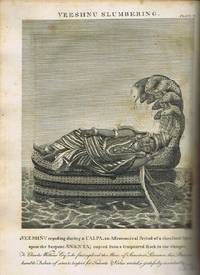
179526710London: W. Bulmer. Good with No dust jacket as issued. 1795. 1st Edition. First Printing. Leather. Publisher's full contemporary leather spine in six compartments separated by raised bands gilt lettering in three compartments gilt tooling in remainder gilt floral borders on covers gilt dentelles marbled endpapers all edges marbled. Illustrated with 19 spectactular full-page engravings some fold-out. "Printed by W. Bulmer and Co. Cleveland Row St. James's for the Author; and Sold by R. Faulder New Bond Street. M.DCC.XCV." Thomas Maurice 17541824 was a British oriental scholar and historian. The son of a schoolmaster Maurice was educated at the Wesleyan seminary at Bristol before entering University College Oxford in 1774 aged 19 B.A. 1778 M.A. 1808 he was chaplain to the 87th regiment about 1784 Vicar of Wormleighton Warwickshire 17981824 and Cudham Kent 180424. Maurice was a noted oriental scholar and historian and assistant-keeper of MSS at the British Museum 179824. Maurice published numerous works on the religion and history of India. After completing his seven volume Indian Antiquities Maurice traced Indian history back to its classical origins. His History of Hindostan the three volumes of which in quarto were published in 1795 1798 1799 and a second edition appeared in 1821 were resounding sucesses. Volume I of his history of Hindostan is almost exclusively devoted to the astronomical systems of the Greeks Indians Chaldeans Egyptians etc. Upper board detached but present some small old dampstains small corner of ffep torn text block tight and square some foxing throughout. GOOD. The History of Hindostan Series. Vol. 1. Engravings and Maps. 4to 11" - 13" tall. 40 577 pp . W. Bulmer hardcover
171847265London: various publishers 1917-18. 1st editions. Near Fine. octavo. 1/2 leather 51 35 20 40 20 14 52 24 15 23pp. frontis. b/w pls. maps 10 WWI pamphlets bound together usually retaining original wrappers various publishers hardcover
1759007542London: at the Buck in Pater-nostere Row; and at the Wheatsheaf in Cheapside: J. at the Buckland; and T. Field 1759. 3rd Edition . Hardcover. Very Good. 8vo - over 7¾ - 9¾" tall. An account of the arrival of Christianity in Roman London. Uncommon! In worn full calf corners bumped & worn. Faded spine raised bands gilt tooling gilt title to maroon calf label edges bumped with loss cracked along joints. Internally 2 iii-viii 1 2-552 pp woodcut to tp numerous printers devices contemp. ink name to epd Williams front board has been very well re-hinged some offsetting evidence of book plate removal to fpd the front free EP's are lacking otherwise a nice tight clean example. 201118 mm. ESTC T97260. The word "Caerludd" is used to refer to London throughout. While this is the 3rd edition the earlier editions are practically impossible. ESTC Locating 1 copy of the second edition of 1740 lacking all but the title leaf two OK copies and 1 copy of the first and one copy of the another volume called a second edition but with a printing date of 1750. Our third edition is in fact the first reasonable edition. ESTC locating 18 copies world wide. There is an etched landscape vignette on the title page with a sun rising with a face on it and a group of people facing us on our right. The dialogues include several Welshmen with welsh names who also say what town or place they come from with the Welsh name given. There are ten sections each beginning with a decorative capitol and a type ornament vignette. <br/> <br/> J. at the Buckland; and T. Field hardcover
1757177255London: J. Nourse 1757. wrote by the Count to the late King of Poland and M. de Folard which were never before made publick; Together with His reflections upon the propagation of the human species. Translated from the French. Illustrated with Copper-plates. Pp. x196last advertisement 40 plates all but one folding some with multiple images head & tailpiece decorations decorative initials; cr. 4to; later half calf spine lettered in gilt and decorated in gilt & black around raised bands marbled papered boards; later endpapers bookplate of David Levine Sydney on upper pastedown the title page cropped with piece torn from the bottom fore-corner causing minor loss of imprint mounted on a later sheet long 10 cm. closed tear from fore-edge into centre of pages 7/8 affecting a couple of words of text on page 7 closed tears to one fold of plate 16 and two folds of plate 20 long piece torn from fore-edge of plate 19 with some loss of image tiny hole in top margin pages 183/4 a few small marginal damp stains a little light foxing and occasional slight soiling; J. Nourse London 1757. First edition in English. J. Nourse unknown
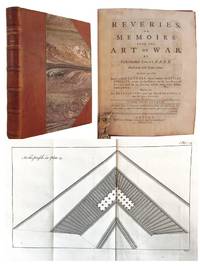
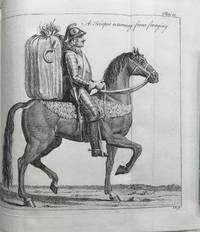
175757281CELEBRATED GENERAL ON THE ART OF WAR<br />first edition in English 4to. 2 title iii-x 2 dedication 195 1 advts.pp. 40 numbered engraved images on 34 folding plates attractive and sympathetic modern contemporary-style tan half calf by Brockman spine panelled by raised bands highlighted by double gilt fillets large blind tool at panel centres black morocco title label brown marbled sides hand-made paper endpapers title leaf a little dusty and with minor and almost invisible archival tissue reinforcement on verso at fore edge a few slight fox spots on fore-edge of plates else a nice fresh copy. A handsome copy.<br /><br />ESTC t97717 <br />Maurice Comte de Saxe 1696-1750 one of the most notable and successful military commanders of the eighteenth century was an illegitimate son of Augustus II King of Poland and Elector of Saxony. He was engaged in and immersed in military engagements and soldiering from his early youth and served successively in the armies of the Holy Roman Empire the Austrian army and France with the title of Marshal General of French being specially revived for him in the last of these. Characteristic of his military methods were the use of surprise and of mobile warfare by harassing a superior force without head-on conflict until he was in a position to engage it in a decisive battle. The most celebrated of his victories the brilliant and decisive defeat of the English at the Battle of Fontenoy in 1745 was an exemplar of his methods. His book on the art of war <i>Mes Rêverie</i>s was first postumously published in 1757.In the book Saxe subjected military affairs to reasoned criticism with a view to creating military doctrines based on universal principles. "Written following Prussian expansion during the War of the Austrian Succession Saxe in the book rejected their rigid discipline; arguing the French character was fundamentally different and their tactics should reflect that he advocated the use of a deep order or ordre profond rather than relying on firearms. However <i>Mes Rêveries</i> also challenged French military orthodoxy in arguing for a greater focus on mobile warfare rather than fortifications; this was partly a legacy of the French military engineer Vauban 1633-1707 who had revolutionised this field but adherence to his principles meant French engineers became ultra-conservative. As early as 1701 John Churchill 1st Duke of Marlborough argued winning one battle was more beneficial than taking 12 fortresses; Saxe followed this line but his argument was later given increased weight by French losses in the 1756-1763 Seven Years' War" wikipedia.<br />The Battle of Fontenoy on 11 May 1745 during the War of the Austrian Succession pitted the Pragmatic Allies - principally the Dutch British and Hanoverians - against the French which pitched two armies of about 50000 men against each other was notable for several reasons: both the British and French kings were present on the field of battle; it enabled further French victories; and in so doing it greatly reinforced the position of the French Ancien Régime. The battle was for a time closely fought but was swayed in French favour by the deployment of the Irish Brigades in the French army which in a celebrated counter attack swept a flank of English infantry from the field with great loss of life on both sides. They captured the English colours and 15 cannon and reputedly charged with the war-cry in Irish "Cuimhnigidh ar Luimnech agus feall na Sassonach!" that is "Remember Limerick and Saxon Perfidy". The casualty figures were appalling with at least 7000 killed or wounded on the French side including 500 Irish and between 10000 and 12000 on the allied side. Printed by J. Nourse hardcover
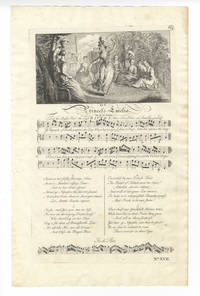
174036782London 1740. Unbound. Very Good. 1 leaf with a large elaborate vignette to head illustrating the song with music and text below set for voice and figured bass with a separate part for flute. Ca 326 x 200 mm. 12.75" x 7.85" plate mark.<br /> <br /> Slightly worn; minor browning to edges; minor soiling and dampstaining; slightly creased. From the second edition of Bickham's monumental work first published in 1737-1739. BUC p. 107. RISM BII p. 245. <br /> <br /> Green was an English composer and organist. "Though remembered chiefly for his church music he was also an important composer of keyboard music songs and extended vocal works." H. Diack Johnstone in Grove Music Online.<br /> <br /> "Bickham 1706-1771 was principally famous in music circles for his two illustrated folio volumes The Musical Entertainer first issued in fortnightly parts each containing four plates from January 1737 to December 1739. The 200 plates are songs headed and surrounded with pictorial embellishments illustrative of the song . and engraved in the style of and even copied directly from Gravelot and Watteau. This work was the first of its kind to be published in England and quickly produced imitators such as Lampe's British Melody engraved by Benjamin Cole." Frank Kidson et al. in Grove Music Online. <br /> <br /> A charming engraving.<br /> <br /> The Musical Entertainer is considered one of the finest 18th century illustrated books. Complete copies of this monumental work are exceptionally rare. unknown
1796284291796. Small quarto. 4pp. Single folded sheet. Contemporary manuscript notations. Light soiling and wear. Early and unrecorded imprint from the colonial press at the French colony of Mauritius also known as the Ile de France. The text contains the deliberations and acts of the colonial assembly of the island at a time when it was operating virtually independent from France. The acts all concern measures to be taken for the defense of the island at a time when British invasion was feared. The Dutch were the first Europeans to become interested in the island taking possession in 1598. After exploiting the island's dense forests for a century and introducing the cultivation of sugar cane and cotton the Dutch abandoned the colony in 1710. The French soon claimed it as "Ile de France" and the island remained under the control of the French East India Company until 1767. During the long war between France and England at the beginning of the 19th century Mauritius proved to be an important strategic naval base and as a result the British took charge of the island in 1810 and the Treaty of Paris confirmed official British possession in 1814. It remained an important sugar producing colony and in the 20th century agricultural production was expanded to include tea rice and other produce. Printing began on Mauritius in 1768. During the French period until 1810 only about 400 imprints were produced mostly in the form of official documents and newspapers though there are also almanacs and a few other items. All are quite rare. No copies located in OCLC and not recorded by Toussaint in his bibliography of Mauritius imprints. unknown
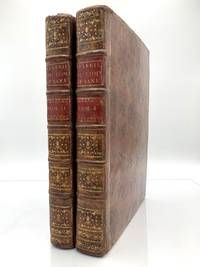
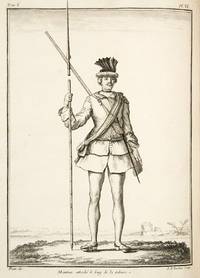
175775650A Amsterdam & à Leipzig: Chez Arkstée et Merkus 1757. Fine. Finest edition of this work Chez Arkstée et Merkus A Amsterdam & à Leipzig 1757 21.50 x 29 cm In-4 2 volumes reliés The finest edition of this work the original having appeared in 1756. It comprises 84 plates 61 of which are folding compared to only 40 in the original engraved in intaglio by Moitte Patte and Tardieu depicting military costumes plans and profiles and troop formations. Published by Abbé Perau this edition is augmented with a biography 134pp. and several pieces letters. it is better organized and superbly printed in large type. Contemporary full marbled and glazed calf binding. Decorated raised spine head and tail rolls. Red morocco title label and volume label. Double gilt fillet frame on boards. One tear at tail. One lower corner cut on volume 1. Small lack at head of volume II. One corner bumped on volume II. One scratch on upper board of volume II. One plate protruding in volume I and 2 in volume II caused by improper folding. Despite some minor defects a very handsome copy. A unique work in its field the book shines with the author's animating spirit. The Count of Saxe reviews all the factors all the elements necessary for successful conduct of battles from uniforms to food to strategy to spies in a simple clear and intelligible style. This is followed by the chapter on the propagation of the human species intended to counterbalance the art of destroying populations; the author shares his thoughts on demographic proliferation and the means of increasing it. The term ""rêveries"" refers not to the modern sense of ramblings but to that of realized hopes and secret thoughts. Marshal de Saxe was one of the most illustrious military men of his century; he develops in his work the quasi-utopian vision of a military art proposing new solutions both tactical and practical a new uniform for running more quickly. Chez Arkstée et Merkus hardcover
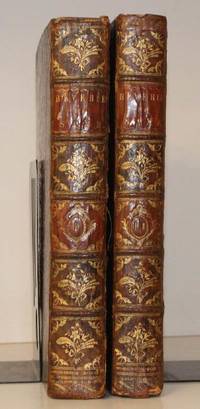
175737954Amsterdam and Leipzig Arkstrée et Merkus; Paris Desaint and Saillant Durand 1757. First edition thus the Macclesfield copy of this influential 18th-century treatise on war by a renowned commander remembered above all for his decisive victory at Fontenoy in the War of the Austrian Succession after earlier service in the Imperial and French armies. Mes Rêveries was published after his death. "He puts forward his ideal military model his 'legion' and taking issue with the views and practices of his age he advances many original ideas. However rather than discussing his military doctrines the aim of this book is to elucidate the intellectual premises that dominated his mind: he saw a need to subject military affairs to reasoned criticism and intellectual treatment and the ensuing military doctrines were perceived as forming a definitive system" Gat The Origins of Military Thought p. 33. Carlyle called it a "strange military farrago dictated as I should think under opium" - a judgment not entirely unfair since a note on the Dresden manuscript reads: "I composed this work in Thirteen nights: I was ill therefore it may perhaps bear marks of the fever which I had. This ought to excuse the regularity of the arrangement as also the elegance of style. I wrote in a military manner and to kill time." Odd as its style may be the Rêveries proved successful reprinted three times in 1757 and again in 1761 and 1763 with German editions in 1757 and 1767 and English ones in 1757 1759 and 1776. 2 vols quarto 280 x 210 mm. 84 plates 37 of them folding 4 of them coloured wood-engraved head- and tailpieces. Contemporary sprinkled calf raised bands spine gilt in compartments with floral and foliate tools red morocco title piece green stained and gilt "numbering piece" gilt barred edge-roll green silk page-markers edges sprinkled in red. The Macclesfield copy with the Shirburn Castle blind stamp to the early leaves the copy of Lieutenant-General George Lane Parker younger son of the second earl who served for over 20 years in the 1st Foot Guards. In 1773 at rank of major-general he was appointed Colonel of the 20th Foot and saw service in the War of Independence. One of his contributions to the Shirburn Castle Library was a remarkable collection of books detailing the professional interests of a soldier in the latter part of the 18th century. Some light browning one plate slightly misfolded and standing proud at fore edge some light shelf-wear corners a little soft headcaps scuffed but overall a very good set. Jähns II 1502; Brunet V 174. hardcover
1757H40472Amsterdam Leipzig Paris: Arkstee et Merkus / Desaint et Saillant Durand 1757. First Printing. Hardcover. Fair. Vol. ONE only. Quarto 11 x 9 inches contemporary brown calf of the period fair copy with edgewear to boards spine leather mainly gone previous owner did some touching up of the spine with brown paint or dye to make it look a little more attractive contents very good light toning and waviness to pages. 10 cxxxiv 159 58 plates almost all hand colored many of which are folding plates some of artillery and battle formations but many of military men and uniforms and of chevaliers and their horses. the plates are mainly good to very good showing foxing and only a handful of the plates showing tide marks and tan stains from damp staining. Light waviness to most of the plates demonstrating its time in damp circumstances. But all the plates are pleasing with contemporary hand coloring and this is a a rare book. Old owner probably 19th C. has also stamped his namestamp at least a dozen times throughout Ex-Libris Rene Fauvelle including on the borders of some plates. The stamp is fading in most cases. Maurice Comte de Saxe was a notable soldier officer and a famed military commander of the 18th century. The illegitimate son of Augustus II the Strong King of Poland and Elector of Saxony Maurice Count of Saxony d. 1750 initially served in the Army of the Holy Roman Empire then the Imperial Army before finally entering French service. De Saxe became a Marshal and even Marshal General of France. He is best known for his deeds in the War of the Austrian Succession and especially for his decisive victory at the Battle of Fontenoy. Arkstee et Merkus / Desaint et Saillant, Durand hardcover
175751567Arkstee et Merkus Amsterdam and Liepzig 1757. 2 vols. roy. 8vo. First Edition Large Paper text in French on laid paper with 84 fine engraved plates 52 large and folding ALL BUT TWO FINELY COLOURED BY HAND and numerous fine engraved head- and tail-pieces title and first Avertissement leaf of first volume creased; contemporary full tree calf sides framed in gilt backs with raised bands second and fourth compartments with red leather labels framed lettered and numbered in gilt all other compartments richly framed and tooled in gilt with floral sprays red sprinkled edges boards mildly age-marked upper joint of first volume cracked but sound all other joints mildly rubbed but bindings wholly sound A REMARKABLY BRIGHT FRESH CLEAN CRISP COPY WITH BROAD MARGINS IN WHOLLY UNRESTORED PERIOD BINDING. With the eighteenth century personal bookplate of Steuart of the Isle of Man overlaid by the nineteenth-century armorial bookplate of Sir John Ogilvy of Inverquharity on front paste-downs. From the broad margins this may well be a Large Paper or similar superior issue. The later bookplate is that of Sir John Ogilvy 9th Baronet 1803-1890 sometime MP for Dundee and Convener of Forfarshire. De Saxe 1696-1750 was a distinguished soldier of the first half of the eighteenth century serving first the Holy Roman Empire and then the Imperial Army before French service as Marshal General of France. He is remembered for his victories during the Austrian Succession most notably at Fontenoy in 1745 and for this most influential military treatise published shortly after his death. A SPLENDID COPY WITH NOTABLE PROVENANCE. Jähns II 1502; Brunet V 174. Arkstee et Merkus, Amsterdam and Liepzig, hardcover
175756261Dresden Walther 1757. Uncut in contemp. boards. Some wear to covers. Stamp on foot of title-page. 44914 pp. 13 large folded engraved plates. Internally clean on good paper. hardcover
175356810La Haye Aus Depens de la Compagnie 1753. Uncut in contemp. stiff blank wrappers. Stamp on title-page. Title-page in red/black. 96 pp. 3 folded tables. Faint scattered brownspots. <br/><br/><em>First edition. </em> unknown
175357619La Haye Antoine Gibert 1753. A fine contemp. full calf. raised bands. Richly gilt spine. Titlelabel with gilt lettering. Gilt borders on covers.The monogram of king Christian 7 on red background on upper cover. A paperlabel pasted on lower part of spine. Stamp on title-page.Title-page in red/black. 96 pp. 3 folded tables. hardcover
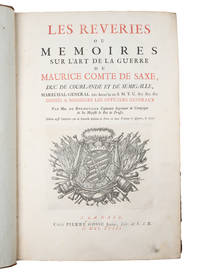
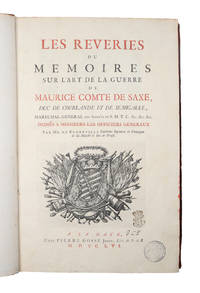
175863209à La Haye The Hague: Chez Pierre Gosse Junior 1758. Fine. Chez Pierre Gosse Junior à La Haye The Hague 1758 24 x 35 cm In-folio relié Second edition a reprint of the first folio edition published in 1756 by the same publisher. A rare edition illustrated with 40 plates including 4 folding and 16 double-page arms costumes plans manoeuvres. Large vignette with coat of arms on the title-page and 41 ornaments headpieces tailpieces. Title-page printed in red and black. At the end Supplement aux Reveries with its own title-page; this short addition spanning only a few pages contains the corrections made to the original. A two-volume quarto edition appeared in Paris in 1757. Bound in later full marbled brown calf; a skilful early 20th-century pastiche signed Saingy at foot. Spine with raised bands richly decorated gilt rolls at head and tail. Red morocco lettering-piece black morocco date-piece gilt. Rubbing to head- and tailcaps edges corners and lower board. Plate XXXIV has been refolded having been badly folded. An exceptionally fresh copy the paper only slightly toned. One leaf misbound among the preliminary pages. A handsome copy. A unique work in its field animated throughout by the spirit of its author one of the greatest generals of the eighteenth century. The Comte de Saxe reviews all the factors and elements required for the successful conduct of battle from uniforms and provisions to strategy in a style that is simple clear and intelligible. This is followed by a chapter on the propagation of the human race intended to counterbalance the art of destroying populations; here the author offers his reflections on demographic growth and the means of fostering it. The term ""rêveries"" refers not in the modern sense of idle fancies but in that of fulfilled hopes and secret thoughts. Chez Pierre Gosse Junior hardcover
1756161734A La Haye : chez Pierre Gosse Junior 1756. In-4 gr. mm. 361x228 piena pelle coeva spacchi alle cerniere esterne; lievi mancanze alle cuffie e abrasioni tagli rossi pp. XII2284 con 40 belle tavole incise in rame fuori testo a doppia pagina o più volte ripiegate che raffigurano schieramenti di truppe schemi strategici profili di fortificazioni apparati bellici e cavalieri etc.Al frontespizio con titoli in rosso e nero un grande stemma e decine di testate e finalini tutto inciso su rame raffiguranti vedute trofei militari etc. Edizione postuma di questi scritti importanti per la storia dell'arte militare nel XVIII secolo sintesi della lunga esperienza di Maurice comte de Saxe Dresda 1696 - Chambord 1750 figlio naturale del re di Polonia.Dopo la sua sfortunata avventura in Curlandia si dedicò dal dicembre 1732 alla stesura delle sue "Rêveries". L'autore era un filosofo ma soprattutto uno psicologo per il quale "la conoscenza del cuore umano è il principio dell'arte militare" Léonard L'Armée et ses problèmes au XVIIIe siècle p. 123. Nella prima parte il maresciallo de Saxe braccio armato del regno di Luigi XV passa in rassegna tutti i "dettagli" e gli aspetti necessari per padroneggiare la scienza militare dal reclutamento alla disciplina dalle uniformi al cibo in uno stile chiaro e comprensibile. L'opera si conclude con "le qualità che deve avere un generale dell'esercito" e con alcune curiose riflessioni sulla propagazione della specie umana volte a controbilanciare l'arte di distruggere le popolazioni.ùEsemplare ben conservato. chez Pierre Gosse Junior, unknown
17567435<b><i>Les Reveries ou Memoires Sur L'Art de la Guerre de Maurice Comte de Saxe Duc de Courlande et de Semigalle Marechal-General des Armées de S.M.T.C. &c. &c. &c. Dediés a Messieurs les Officiers Generaux.</i></b><i> Par Mr. de Bonneville Capitaine Ingenieur de Campagne de Sa Maheste le Roi de Prusse.</i><br /><i><br /></i>Illustrated with 40 full-page and folding plates and 42 engraved vignettes. Folio. Bound in full mid-18th century English paneled calf expertly rebacked with raised bands and morocco spine label. A La Haye Chez Pierre Gosse Junior . . . 1756. First Edition.<p>Maurice Comte de Saxe was the greatest French military general of the 18th century. Having been born as the illegitimate son of Augustus II King of Poland he eventually rose to become Marshall of France. His greatest exploits came during the War of the Austrian Succession where he seized Prague by surprise in a daring invasion captured the fortress of Eger Cheb and gained his famous victory at Fontenoy. The latter made possible the 1745 Jacobite rising and was credited by Napoleon with preserving the <i>Ancien Regime</i> in France for a further 30 years.</p><p>Saxe's <i>Reveries</i> is one of the great classics of 18th century military strategy and theory. "He puts forward his ideal military model his 'legion' and taking issue with the views and practices of his age he advances many original ideas. However rather than discussing his military doctrines the aim of this book is to elucidate the intellectual premises that dominated his mind: he saw a need to subject military affairs to reasoned criticism and intellectual treatment and the ensuing military doctrines were perceived as forming a definitive system." Gat <i>Origins of Military Thought</i>.</p>With the bookplate of the United Service Institution presented by Major General Samuel Lambert. Samuel Lambert served with distinction in the campaign under Sir John Moore in 1808-09 and in the expedition to Walcheren in the later year. He was engaged in the defense of Cadiz in 1810 - 1811 and served throughout the peninsular campaigns of 1812 1813 and 1814. He died in 1848 while serving as Commander of Her Majesty's Forces in Jamaica. Minor wear to binding at edges and corners; o/w a fine wide-margined copy.
175856274A la Haye Pierre Gosse 1758. Folio. Contemp. hcalf. Raised bands. Richly gilt compartments. Light wear to foot of spine.Titlelabel with gilt lettering. Title-page in red/black. Large engraved title-vignette. XII2284 pp. 16 pp. Supplement. With 61 mostly folded engraved plates. Profusely illustrated with head- and tailpieces. A large and wide-margined copy clean and printed on good paper. <br/><br/><em>This profusely illustrated second edition has 21 more plates than the first from 1756. - Klaus Jordan 2617. </em> hardcover
175656814La Haye Pierre Gosse 1756-57. Bound in 2 later hcalf. and 1 contemp. hcalf with raised bands. Gilt spines. Gilt lettering. A paperlabel pasted on spines. Stamps on titles and at ends. 232;223 pp. and 11 large folded engraved plates - Supplement: 8172 pp. Some faint scattered brownspots in the first 2 volumes. hardcover
175756818Manheim Jean Drieux 1757. 4to. Contemp. full calf. Raised bands. Richly gilt spine. Titlelabels with gilt lettering. A nich to top of spine. lower compartment a bit worn. Covers blindtooled and with gilt borders. Stamp on title-page. Engraved titlevignette. 4XV180;686 pp. 5 engraved vignettes 40 engraved plates many folding. Printed on good paper a few brownspots. hardcover
175629302A la Haye Pierre Gosse 1756. Folio. Cont. hcalf. 6 raised bands. Titlelabel in leather with gilt lettering. Lower compartment lightly worn and with faint remains of a tape-strip. Corners a bit bumped. Large engraved titlevignette 39 engraved and in wood-cut head-and tailpieces. VIII42282 pp. and 40 engraved maps and plans many double-page and folded. Printed on fine thick paper. Internally clean. Stamps on titlepage. One crowned stamp with "C.F." = King Christian VIII of Denmark and with his initials in ink "F.C.F. <br/><br/><em>First edition. - Klaus Jordan No. 2618. </em> hardcover