THE STORY OF BURNT NJAL or Life in Iceland at the End of the Tenth Century. From the Icelandic of the Njals Saga
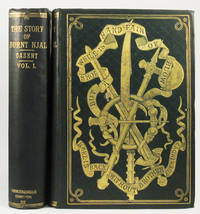
186132889Edinburgh: Edmonton and Douglas 1861. 2 volumes. First Edition. Illustrated in both volumes with engraved maps and plans a number double-page and a number large and multi-folding collated complete. 8vo publisher's original forest-green cloth the spines lettered and ruled in gilt the upper cover of each volume with elaborate giltwork in an all-over designs showing crossed swords axes and other weapons surrounded by two of the most famous of the wise Viking sayings which were passed down from family elders oral tradition and later the sagas: "Bare is Back Without Brother Behind It" and "But Short While is Hand Fain Of Blow" xxx cciv 256; xiii 507 pp. An essentially fine copy bright and clean with very little wear the green cloth remains in very pleasing condition without fading the giltwork is strong and very well preserved the text-blocks and hinges are sound and tight a very pleasing set with only slight evidence of age or shelving at the extremities. FIRST EDITION. A VERY HANDSOME COPY OF THIS ICONIC SCANDINAVIAN TREASURE. With a long and scholarly Introduction which explains in great detail the Iceland of the period in which the saga was written. Further to the Introduction is a complete Index allowing for study of many elements presented both in the scholarship and in the saga. Njáls saga like the other sagas of Icelanders is anonymous. There are however several hypotheses about the saga's authorship. The oldest idea attested in the early 17th century is that Sćmundr fróđi wrote the work. Other suggested authors include Sćmundr's sons Jón Loftsson Snorri Sturluson Einarr Gilsson Brandr Jónsson and Ţorvarđr Ţórarinsson.<br> The saga is now believed to have been composed in the period from 1270 to 1290. Among written sources which the author likely used are Laxdćla saga Eyrbyggja saga and Ljósvetninga saga as well as the lost sagas Brjáns saga and Gauks saga Trandilssonar. however the author probably derived the bulk of the material in the saga from oral tradition which he manipulated for his own artistic purposes. Opinions on the historicity of the saga have varied greatly ranging from pure fiction to nearly verbatim truth to any number of nuanced views. It can be regarded as certain that Njáll and Gunnarr were real historical people and their fateful deaths are referred to in other sources. Gabriel Turville-Petre said "It was not the author's purpose to write a work of history but rather to use a historical subject for an epic in prose".<br> Njáls saga explores the consequences of vengeance as a defence of family honor by dealing with a blood feud spanning some 50 years. The saga shows how even worthy people can destroy themselves by disputes and demonstrates the tensions in the Icelandic Commonwealth which eventually led to its destruction. Any insult to one's honor had to be revenged: sometimes this includes slights which seem trivial to modern readers. <br> From THE SLAYING OF THORD FREEDMANSON in Njal's Saga: Thrain said "We have won an ill work and Njal's sons will take this slaying ill when they hear of it."<br> They ride home and tell Hallgerda. She was glad to hear of the slaying but Rannveig Gunnar's mother said "It is said 'but a short while is hand fain of blow' and so it will be here; but still Gunnar will set thee free from this matter. But if Hallgerda makes thee take another fly in thy mouth then that will be thy bane."<br> Hallgerda sent a man to Bergthorsknoll to tell the slaying and another man to the Thing to tell it to Gunnar. Bergthora said she would not fight against Hallgerda with ill words about such a matter; "That" quoth she "would be no revenge for so great a quarrel." WIKI. Burnt Njal<br><br> Edmonton and Douglas hardcover
Buddenbrooks, Inc. · États-Unis825,00 $US≈ 698,03 €